
Matrix and adaptive driving beam (ADB) headlights are legal in the United States following a 2022 federal rule change, but availability is still narrow. Confirmed U.S. models with enabled functionality include the Rivian R1S and R1T, the refreshed 2025 Tesla Model Y, and Audi's Q7 and Q9, which arrive with enabled Digital Matrix technology in 2026 and 2027. Hardware capable of matrix lighting is spreading fast across the U.S. lineup, but strict American glare rules mean most systems run more conservatively than their European counterparts.
TL;DR:
- U.S. regulations now permit matrix headlights, but most systems operate more conservatively due to strict glare rules, limiting features like road projections and aggressive curve shaping.
- Confirming a vehicle's enabled matrix headlights requires asking the seller, checking the build sheet, and testing the system in night driving conditions before purchase.
- The 2022 regulatory change was the start, but many manufacturers still delay full U.S. implementation due to certification costs and hardware re-engineering needs.
- Genuine U.S. enabled matrix systems are only found on specific models like the Rivian R1S and R1T, the 2025 Tesla Model Y, and upcoming Audi Q7 and Q9, with verification crucial to avoid misleading aftermarket kits.
Table of Contents
- What Matrix and Adaptive Driving Beam Headlights Actually Do
- Are Matrix Headlights Legal in the U.S.? The FMVSS No. 108 Rule
- Which U.S. Cars Have Enabled Matrix Headlights Right Now
- How U.S.-Spec Systems Differ From European Versions
- How to Confirm ADB Functionality Before You Buy
- The Safety Case for Matrix Headlights
- Matrix Headlights vs. Other Advanced Lighting Tech on U.S. Roads
- What Comes Next for U.S. Matrix Headlight Rules
- Aftermarket Matrix Headlights: Tempting, but Legally Risky
- How Matrix Headlights Change What Night Driving Feels Like
- Sourcing a Matrix-Equipped Used Luxury Car
- Perspective: What the Matrix Headlight Rollout Really Tells You
- Get Help Finding a Car With Matrix Headlights
- Sources
- FAQ
What Matrix and Adaptive Driving Beam Headlights Actually Do
A matrix headlight is not one bulb behind a lens. It is a grid of individually controlled LEDs, sometimes called pixels, that a computer switches on and off dozens of times per second based on what a forward-facing camera sees. Instead of choosing between high beams and low beams, the system keeps high beams on almost constantly and simply blacks out the specific LEDs aimed at an oncoming car or a driver ahead. Everyone else on the road still gets full brightness.
The industry uses several overlapping names for this: matrix LED, Digital Matrix LED, and adaptive driving beam (ADB). Treat them as variations on the same idea rather than competing technologies. Core capabilities tend to include:
- Automatic dimming of only the LED segments pointed at other vehicles
- Extended high-beam range for everything outside that dimmed zone
- Cornering and lane lighting that shifts brightness toward curves
- In some higher-resolution systems, road markings or projected symbols, though this feature is market-dependent and often limited in U.S.-spec cars
A typical system reads the camera feed roughly 30 to 100 times per second, tracks the position of oncoming headlights or taillights, and recalculates which LED groups need to dim. The driver just sees a smoothly lit road with a moving dark patch that follows other traffic.
Are Matrix Headlights Legal in the U.S.? The FMVSS No. 108 Rule
Yes, and the change is more recent than most drivers realize. The NHTSA final rule amending FMVSS No. 108 took effect in 2022, replacing a decades-old standard that had effectively forced automakers to choose between simple high beams and low beams with no in-between. Reuters reported that the process traced back to a petition Toyota filed years earlier, and NHTSA took roughly a decade to finalize the change.
The rule doesn't just legalize matrix headlights, it defines exactly how bright each LED segment can be, how fast the system must react, and how a vehicle proves it meets those limits before it ever reaches a dealer lot.
That last part matters more than most buyers assume. NHTSA requires both component-level photometry testing and full vehicle-level track tests using stimulus fixtures that simulate oncoming traffic, a testing structure informed by the SAE J3069 recommended practice used internationally. Areas the system dims must still meet minimum lower-beam photometry so the road ahead never goes dark.
The U.S. also runs on a self-certification model rather than the type-approval process common in Europe. Manufacturers test their own vehicles against NHTSA's published limits and certify compliance themselves, with the agency conducting spot enforcement rather than pre-approving every design. That distinction pushed several automakers to re-engineer lens geometry, optical plastics, and module vertical positioning rather than simply flipping a software switch. Legal does not mean identical to the European version. It means the system met a specific, narrower glare standard.
Which U.S. Cars Have Enabled Matrix Headlights Right Now
The list of vehicles shipping with the feature turned on is short but growing. As of 2026, the confirmed lineup includes:
- Rivian R1S and R1T, both offering enabled adaptive driving beam functionality
- Tesla's refreshed 2025 Model Y, which enabled pixel-level beam control after earlier model years shipped with the hardware present but the feature disabled
- Audi Q7 and Q9, with Audi confirming Digital Matrix LED will be enabled on U.S.-market models arriving in 2026 and 2027, with the Q9's headlight architecture built around 25,600 micro-LEDs per unit
That Tesla example is worth pausing on. Several manufacturers, Tesla included, shipped vehicles with matrix-capable hardware for years before U.S. regulators finalized ADB rules, meaning the parts sat in the headlight housing doing nothing until a software update or new model year switched the feature on. If you're shopping a used vehicle from those earlier model years, don't assume the hardware equals the feature.
Trim level and model year matter enormously here. A base trim of an otherwise ADB-capable model may skip the feature package entirely, and regional variations sometimes affect which software build a specific VIN received. Always confirm the exact configuration rather than assuming a nameplate guarantees the technology.
How U.S.-Spec Systems Differ From European Versions
Anyone who has watched a European car magazine demo a matrix system, then driven the U.S. version of the same car, tends to notice the American implementation feels a step more cautious. That is by design, not oversight.
Features commonly restricted or toned down on U.S.-spec vehicles include:
- Road-surface projections and pedestrian warning symbols, which remain more common in European and Asian markets
- Some cornering animations and welcome-light sequences tied to unlocking
- More aggressive beam-shaping around curves, since U.S. photometry tables mandate a wider minimum "tunnel" of unlit space around other vehicles
The Ars Technica reporting on ADB adoption explains why: manufacturers frequently ship the same physical hardware worldwide, then gate features in software depending on which market's photometry rules the vehicle needs to satisfy. A car that dazzles in Germany may run a scaled-back beam pattern in Ohio, even with identical LED arrays under the lens.
Pro Tip: Don't judge a matrix system by a European YouTube review. Ask the dealer specifically what the U.S.-certified software allows, since the marketing material and the U.S. legal reality are often two different documents.
How to Confirm ADB Functionality Before You Buy
Verifying a matrix headlight system takes ten minutes and saves you from a costly assumption. Work through this before signing anything:
- Confirm U.S.-spec enablement by asking the seller directly whether the feature is active in this specific configuration, not just present in the model line.
- Request the window sticker or OEM build sheet, which should list the lighting package by name rather than a vague "premium lighting" bullet.
- Drive it at night in automatic high-beam mode and watch how the system reacts as oncoming cars approach.
- Watch the beam pattern through a curve to see whether cornering lighting shifts brightness toward the turn.
- Ask about over-the-air update history and whether the headlamp module carries its own warranty separate from the vehicle's general electrical coverage.
Photograph the VIN and the build sheet before you leave the lot to anticipate potential headlamp repair and maintenance costs; you can learn how to save on these expenses with three checks from Mistree Blog. That paper trail protects you if a seller later disputes what was actually enabled on that exact vehicle. Treat vague verbal claims, inconsistent behavior during your night test, or a surprisingly high repair quote for the headlamp module as reasons to ask more questions before you commit.
The Safety Case for Matrix Headlights
The entire rationale behind NHTSA's rule change comes down to one idea: increase how far a driver can see at night without increasing glare for anyone else on the road. Traditional high beams extend visibility but blind oncoming drivers, which is why most people barely use them. Matrix systems remove that tradeoff by keeping the high-beam pattern active almost everywhere except the small zone around another vehicle.
IIHS research on headlight performance has long identified inadequate headlight reach and poor glare control as factors tied to nighttime crash risk, since a driver moving at highway speed with insufficient forward lighting has less time to react to a pedestrian, an animal, or stopped traffic. ADB directly targets that gap by extending usable beam range for the majority of a nighttime drive rather than forcing constant manual switching between high and low beams.
IIHS also draws a useful distinction between ADB and simpler auto high-beam assist. Auto high-beam systems, common in many vehicles for years, just toggle between full high beam and full low beam based on traffic detection. Matrix and ADB systems create dynamic shadowing instead, dimming only the exact pixels aimed at another vehicle while everything else stays bright. That's a meaningfully more sophisticated response than the on/off switching most drivers are used to.
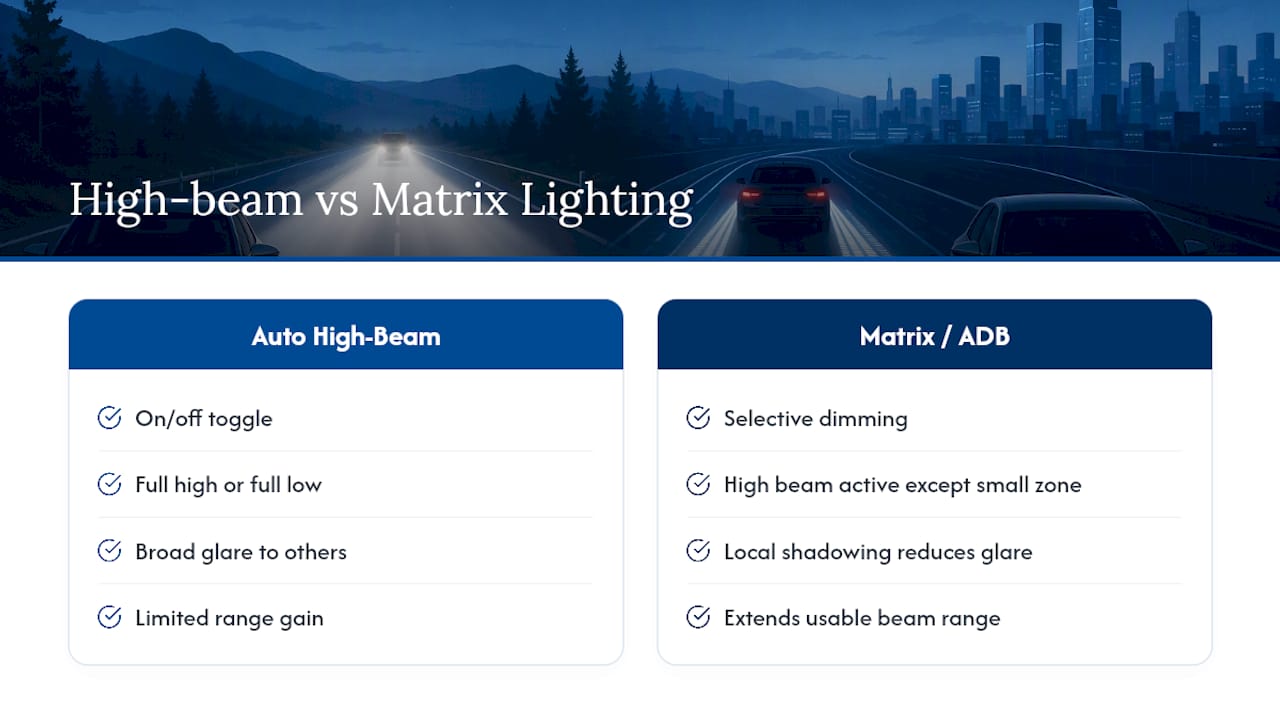
Nighttime crashes remain disproportionately severe relative to daytime crashes given lower visibility and higher rates of impaired or fatigued driving during those hours. A technology that meaningfully extends safe forward visibility without adding glare risk addresses a real gap in a way that incremental brightness increases alone never could.
Matrix Headlights vs. Other Advanced Lighting Tech on U.S. Roads
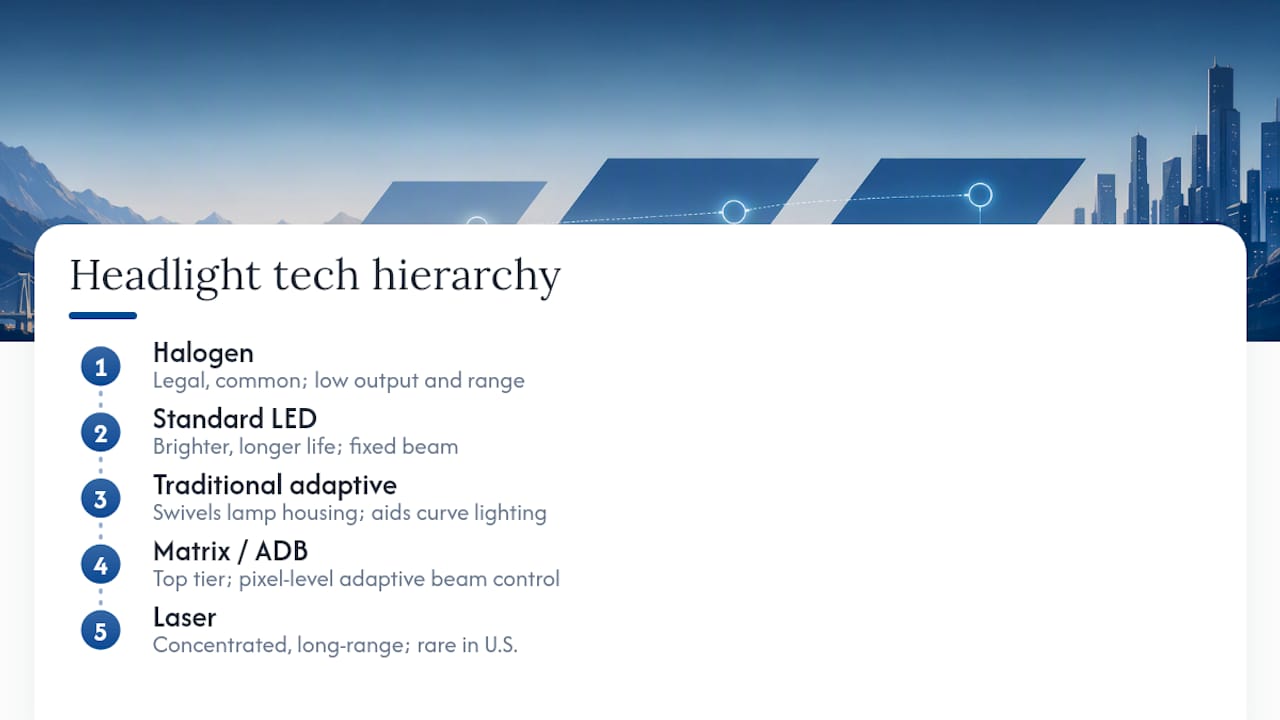
Matrix and ADB sit at the top of a lighting hierarchy that most American car shoppers have never had fully explained to them. Basic halogen headlights remain legal and common on economy trims, but they produce less light output and shorter range than LED alternatives. Standard LED headlights, now standard on most mid-range and above vehicles, improve brightness and bulb life over halogen without adding any adaptive behavior. The beam pattern is fixed; it doesn't respond to traffic.
Traditional adaptive headlights, a technology that predates matrix systems by well over a decade, swivel the entire headlamp housing left or right based on steering input, illuminating curves better than a fixed beam. That's genuinely useful but mechanically simple compared to matrix lighting, since it moves the whole light source rather than selectively controlling dozens or hundreds of individual LED segments.
Laser headlights represent a different branch of the technology tree entirely. Laser diodes generate a more concentrated, longer-range beam than LEDs, and a handful of ultra-premium vehicles have offered them, though regulatory and cost hurdles have kept them rarer in the U.S. market than in Europe. Laser systems can sometimes be paired with matrix-style pixel control for the best of both worlds, but that combination remains largely limited to flagship trims.
For most American buyers in 2026, the realistic hierarchy runs halogen, then standard LED, then traditional swiveling adaptive headlights, then matrix or ADB systems at the top. Each step up adds cost and complexity, and matrix technology is the only one on that list that actively reshapes the beam pattern dozens of times per second in response to other traffic.
What Comes Next for U.S. Matrix Headlight Rules
NHTSA's 2022 rule opened the door, but the framework is still young by regulatory standards, and manufacturers are actively working within it rather than against a settled final version. Expect incremental clarifications rather than a single dramatic overhaul. The Federal Register's amended FMVSS No. 108 documentation already reflects ongoing refinement of the photometry tables that govern how much light reduction is required around detected vehicles.
The practical implication for developers has been significant: achieving U.S. compliance sometimes means changing optical plastics, lens geometry, or the vertical arrangement of LED modules rather than only adjusting software. That kind of hardware-level rework is expensive and slow, which is part of why adoption has lagged Europe by years even after the legal barrier disappeared.
Watch for two trends over the next two to three model years. First, more automakers will likely follow Audi's path of announcing enabled U.S. Digital Matrix or equivalent systems on flagship models before trickling the feature down to mainstream trims. Second, expect continued pressure from safety researchers to expand ADB's approved feature set, potentially including road-projection elements that remain restricted under current U.S. photometry limits. Nothing suggests road-surface projections or pedestrian-warning symbols will gain approval imminently, but the regulatory direction has consistently moved toward permitting more of what European and Asian markets already allow.
Aftermarket Matrix Headlights: Tempting, but Legally Risky
A quick search turns up aftermarket kits marketed as "matrix" or "adaptive" headlight upgrades for popular models, and almost none of them meet FMVSS No. 108's actual certification requirements. Genuine ADB compliance requires the vehicle-level track testing and photometry documentation described earlier, testing that aftermarket parts manufacturers essentially never perform or publish.
Installing an uncertified lighting system can create real legal exposure. Federal law prohibits manufacturers, distributors, and dealers from selling equipment that takes a certified vehicle out of compliance with federal safety standards, and several states separately regulate headlight modifications through their own vehicle inspection and equipment codes. An aftermarket "matrix" kit that simply retrofits programmable LEDs without the underlying camera integration, glare-limiting software, and certified photometry isn't a true ADB system. It's a cosmetic upgrade wearing the name.
If you want genuine matrix functionality, the only reliable path today is buying a vehicle that shipped with the feature factory-enabled and certified. That reality is exactly why checking VIN-specific configuration before purchase matters more than chasing a retrofit promise.
How Matrix Headlights Change What Night Driving Feels Like
Drivers who spend real time behind a working ADB system tend to describe the same shift: less squinting, less manual high-beam toggling, and noticeably more confidence reading dark rural roads or unlit residential streets. Because the system keeps extended-range lighting active almost continuously, you get the forward visibility of high beams during the majority of a nighttime drive, something that simply isn't possible with traditional headlights without constantly blinding other drivers.
The dimming itself is subtle enough that most passengers never notice it happening in real time. You see a moving dark patch trailing an oncoming car's position, but the overall scene stays evenly lit rather than plunging into the jarring bright-to-dim transition of manual high-beam switching. On winding roads, cornering-light behavior adds a further layer, shifting extra brightness toward the turn a fraction of a second before the driver's eyes would naturally need it there.
The tradeoff, as covered above, is that current U.S. systems run more conservatively than their European counterparts, so the experience, while a clear upgrade over standard LED or halogen lighting, may fall short of what enthusiast forums describe from Euro-spec demos. Still, for anyone who drives rural highways or unlit suburban streets after dark regularly, the difference between a fixed low beam and a working matrix system is immediately noticeable the first night you own one.
Sourcing a Matrix-Equipped Used Luxury Car
Finding a used vehicle with genuinely enabled matrix or ADB lighting takes more than a keyword search on a listing site, since trim packages and model-year cutoffs vary so much. Auto Vendors Inc curates a premium selection of vehicles with a focus on craftsmanship and detail, and that same attention applies to verifying which lighting packages and technology features actually shipped on a given VIN before it reaches our lot.
Our Car Finder service lets buyers specify the exact trim, model year, and feature set they're after, including advanced lighting packages, rather than settling for whatever happens to be sitting on a general inventory page. If you already know you want a Q7-generation Audi or a Model Y with pixel-beam control, that's the kind of specific request our personalized vehicle-finding assistance is built to handle, and we verify feature documentation against the vehicle's own build sheet before it changes hands.
Perspective: What the Matrix Headlight Rollout Really Tells You
The common narrative around matrix headlights in the U.S. treats the 2022 rule change as the finish line. It wasn't. It was the starting gun, and most of the coverage since has undersold how much engineering work sat between "legally permitted" and "actually available in your driveway."
Here's the part that gets glossed over: the U.S. self-certification model, often framed as the lighter-touch, faster-to-market approach compared with European type approval, actually slowed matrix headlight rollout in some respects. Because manufacturers certify their own compliance against NHTSA's specific photometry tables rather than following a single harmonized European standard, several automakers found it cheaper to simply disable features already sitting in the hardware than to run the full U.S. certification and re-engineering process on a rushed timeline. That's why a Tesla could ship matrix-capable LED arrays years before the feature actually activated for American drivers.
The lesson for buyers isn't that U.S. matrix headlights are inferior. It's that the badge on the hood and the trim name on the window sticker tell you far less than actually asking the dealer to show you the feature working, at night, in automatic mode. Regulatory approval created the opportunity. It didn't create uniform execution, and won't for several more model years as more automakers work through their own certification timelines.
— Allen
Get Help Finding a Car With Matrix Headlights
Some dealerships offer services that help customers find matrix-equipped luxury vehicles more reliably than browsing generic listings alone. Verifying lighting packages and technology features against the vehicle's VIN and build sheet can help avoid guesswork when shopping for cars advertised with advanced lighting.
Start with our Car Finder if you have a specific model or trim in mind, and our team will track down vehicles matching your feature requirements, including ADB-equipped Audi, Rivian, and Tesla models as they become available. Prefer to browse first? Our current inventory of cars for sale lets you filter by body style, and our SUV listings are a strong starting point given how many matrix-equipped models on the market today are SUVs. Reach out and tell us what you're after. We'll do the legwork of confirming the feature is real before you ever schedule a test drive.
Sources
- NHTSA final rule: Adaptive driving beam (ADB) headlamps — FMVSS No. 108
- IIHS — Headlights research area
- Ars Technica — These clever active beam headlights are finally coming to America
FAQ
Are Matrix Headlights Legal in the U.S.?
Yes. NHTSA's 2022 amendment to FMVSS No. 108 legalized adaptive driving beam and matrix headlight technology nationwide, replacing the older rule that only allowed simple high and low beams.
What Cars in the U.S. Have Matrix Headlights?
Confirmed models with enabled functionality include the Rivian R1S and R1T, the refreshed 2025 Tesla Model Y, and Audi's Q7 and Q9, with Audi's Digital Matrix system arriving on U.S. models in 2026 and 2027. Always confirm the specific trim and model year, since not every configuration includes it.
Where Can I Buy a Car With LED Matrix Headlights?
Dealerships that verify feature documentation against a vehicle's VIN and build sheet are the most reliable source, since general listing sites often don't distinguish between hardware present and feature enabled. Autovendorsfl's Car Finder can search specifically for matrix-equipped trims across available inventory.
Are Adaptive Headlights Available in the USA?
Yes, both traditional swiveling adaptive headlights and the newer matrix-style adaptive driving beam systems are legal and available on select U.S. models. Matrix/ADB adoption remains limited compared to Europe because of stricter U.S. photometry and glare requirements that require additional hardware re-engineering.
How Do Matrix Headlights Work?
A matrix headlight uses a grid of individually controlled LEDs paired with a forward-facing camera that tracks oncoming vehicles. The system dims only the specific LED segments aimed at another driver, keeping the rest of the beam at high-beam brightness for extended visibility without glare.