
A pre-owned luxury car inspection checklist is a structured, multi-step evaluation that protects buyers by uncovering mechanical defects, electronic faults, safety hazards, cosmetic damage, and documentation inconsistencies before any money changes hands. Unlike a standard used car check, this process demands platform-specific tools, marque-aware diagnostics, and a trained eye for the complex systems found in vehicles like Mercedes-Benz, Porsche, and Lexus. Skipping even one category on this checklist can mean inheriting a repair bill that rivals the car's purchase price. The industry term for the formal version of this process is a pre-purchase inspection, or PPI, and it is the single most effective tool a luxury buyer has before signing.
1. Key mechanical components to inspect on a pre-owned luxury car
The engine bay tells the story of how a car was maintained, and on a luxury vehicle, that story carries significant financial weight. Look for oil leaks around the valve covers, oil pan, and rear main seal. Check the condition of belts and hoses for cracking or glazing, and pull the dipstick to assess oil color and consistency. Milky or frothy oil is a strong indicator of a compromised head gasket, which is a repair that can exceed $3,000 on a European luxury engine.
Transmission behavior is equally telling. A healthy automatic transmission shifts smoothly and without hesitation across all gear ranges. Shuddering during upshifts, delayed engagement from park to drive, or a burnt smell from the transmission fluid all signal internal wear. On dual-clutch transmissions found in vehicles like the Porsche Panamera or Audi A8, hesitation at low speeds is a known fault pattern worth flagging.
The cooling system and exhaust deserve close attention as well. Inspect radiator hoses for softness or swelling, and check the coolant reservoir for discoloration or oil contamination. On the exhaust side, look for soot deposits around joints or the catalytic converter housing, which can indicate exhaust leaks or converter failure.
- Engine: oil leaks, belt condition, fluid quality, head gasket signs
- Transmission: shift smoothness, fluid color, engagement behavior
- Cooling system: hose integrity, coolant condition, radiator leaks
- Exhaust: soot deposits, catalytic converter condition, joint integrity
Pro Tip: Look for signs of recent repairs, such as fresh paint on bolts, new hose clamps on otherwise aged components, or mismatched fluid colors. These can indicate a seller masking an underlying issue rather than resolving it.
2. Electronic systems and diagnostics that must be included
Luxury vehicles carry dozens of electronic control modules governing everything from adaptive suspension to night vision cameras, and a surface-level scan misses most of them. A proper used luxury car inspection requires a full OBD-II scan across all modules, not just the powertrain. Superficial OBD-II scans can miss critical faults hidden in deeper dealer-level module reads, and sellers sometimes clear codes to conceal persistent issues.
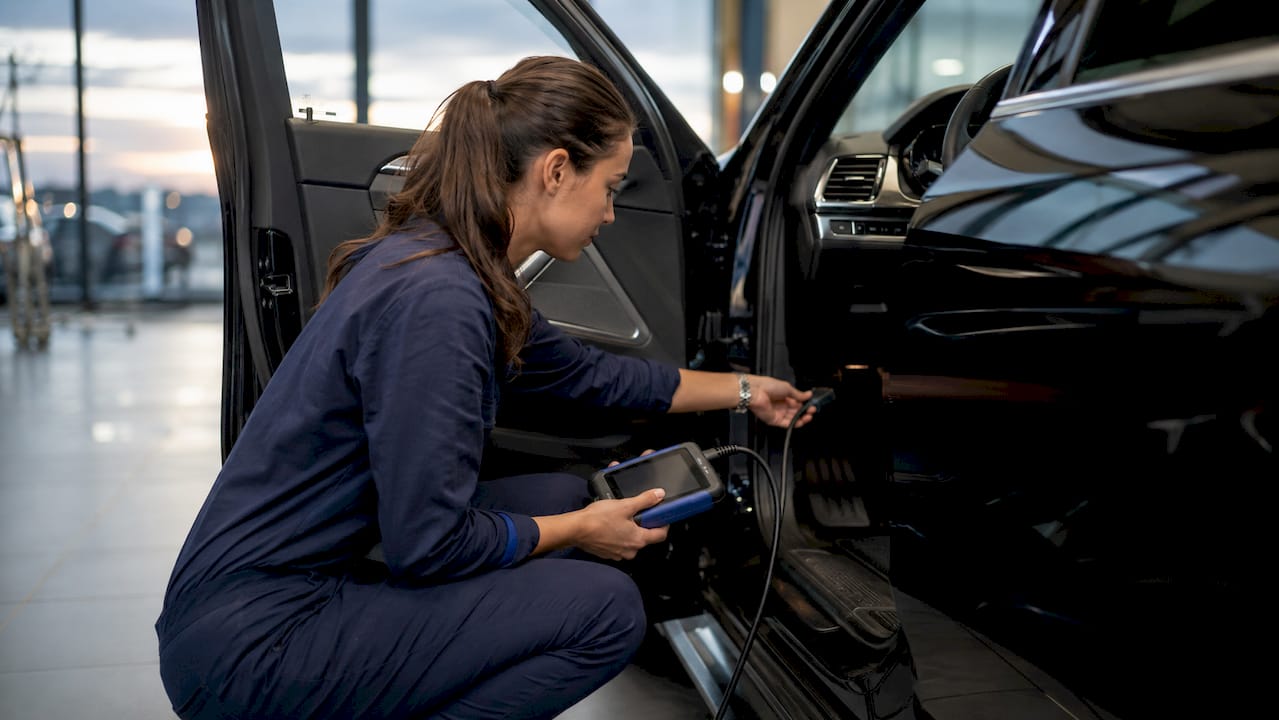
For European luxury brands specifically, generic scan tools fall short. Platform-aware diagnostics are necessary to correctly identify electronic faults that generic shops might miss. Tools like PIWIS for Porsche, ISTA for BMW, and XENTRY for Mercedes-Benz read fault trees and module histories that a standard code reader simply cannot access.
Pay particular attention to the HVAC system, infotainment screen, power accessories, and driver assistance features. A malfunctioning air suspension module on a Range Rover or a failed MMI controller on an Audi can cost well over $2,000 to repair. These faults rarely trigger a dashboard warning light until they reach full failure.
- Full multi-module OBD-II scan, not just engine codes
- Marque-specific software: PIWIS (Porsche), ISTA (BMW), XENTRY (Mercedes-Benz)
- HVAC, infotainment, and power accessory function tests
- Driver assistance system checks: lane keep, adaptive cruise, parking sensors
Pro Tip: Confirm your inspector accesses stored, pending, and historical fault codes. Stored codes reveal current faults; pending codes show issues developing; historical codes expose problems that were cleared but recurred.
3. Safety systems and body inspection criteria
The brake system on a luxury vehicle is both a safety concern and a significant expense. Measure pad thickness and inspect rotors for scoring, warping, or heat cracks. Calipers should show no signs of fluid seepage, and the brake fluid itself should be clear, not dark brown. Contaminated brake fluid absorbs moisture over time, reducing stopping performance and corroding internal components.
Suspension and steering components wear differently on luxury vehicles because of their added weight and complex multi-link geometries. Check for play in tie rod ends, ball joints, and control arm bushings by rocking the wheel at the 9 and 3 o'clock positions. On air suspension systems, listen for compressor cycling during the test drive, which can indicate a slow leak in the air bags or lines.
Tire condition reveals driving habits and alignment history. Uneven wear across the tread face points to alignment or suspension issues. Cupping or scalloping on the tread surface suggests worn shock absorbers. Check sidewalls for bulges or cracking, particularly on vehicles that have sat for extended periods.
- Measure brake pad thickness and inspect rotors for scoring or warping
- Check suspension components for play: tie rods, ball joints, control arm bushings
- Inspect tires for tread depth, wear patterns, and sidewall integrity
- Use a paint thickness gauge to detect undisclosed body repairs or repaints
- Inspect frame rails and undercarriage for rust, weld repairs, or impact damage
- Verify all glass, seals, lights, and weather stripping for leaks or cracks
A paint thickness gauge is one of the most underused tools in a luxury car evaluation. Readings above 200 microns on a panel typically indicate filler or a repaint, which can signal an undisclosed accident. Panel alignment gaps that are inconsistent across the body are another reliable indicator of prior collision damage.
4. How to verify documentation and history to prevent fraud
Vehicle documentation is where fraud most often hides, and a thorough inspection guide for used cars must treat paperwork with the same rigor as mechanical checks. Checking open safety recalls via the vehicle's 17-character VIN on the NHTSA database is a non-negotiable step. Open recall repairs are free at authorized dealers, and unresolved recalls can present genuine safety risks even when the car appears to run normally.
Vehicle history reports reveal major red flags including salvage titles, flood damage, accident history, and odometer fraud, and these factors can reduce resale value by 20% to 40%. That range matters because a luxury car with a clean appearance but a salvage title may be worth tens of thousands less than market price. Cross-referencing multiple reports from providers like Carfax and AutoCheck helps catch gaps or discrepancies that a single report might miss.
VIN consistency across the dashboard, door jamb, and title is a foundational fraud check. Mismatched VINs are a strong indicator of title washing or a stolen vehicle, and either scenario is an immediate reason to walk away. Check the VIN plate on the dashboard for signs of tampering, such as scratches around the rivets or a plate that appears re-adhered.
| Red flag | What it means |
|---|---|
| Salvage or rebuilt title | Vehicle was declared a total loss; structural integrity may be compromised |
| Odometer discrepancy | Possible rollback fraud; actual mileage and wear may be far higher |
| Mismatched VIN | Potential title washing or stolen vehicle; walk away immediately |
| Missing service records | No maintenance history; unknown condition of wear items and fluids |
| Open safety recalls | Unresolved defects that may present safety risks and require dealer repair |
Pro Tip: Use the vehicle resale history alongside a VIN report to cross-check ownership timelines and spot gaps that suggest unreported damage or fleet use.
5. Why a professional pre-purchase inspection is worth the cost
A pre-purchase inspection is an independent mechanical and safety evaluation performed before purchase, typically lasting one to two hours and resulting in a detailed written report. The independence of the inspector is the key variable. An unbiased inspector with no stake in the sale will report findings that a dealer-recommended shop might minimize or omit.
Specialty PPIs for European luxury brands typically cost between $300 and $600, compared to $150 to $300 for mainstream vehicles. That premium reflects the need for marque-specific diagnostic software and platform expertise. A well-structured PPI report categorizes findings into deal-killers, negotiable items, and deferred maintenance, giving buyers a clear framework for their next move.
A complete PPI includes a road test, a full multi-module diagnostic scan, and a lift inspection of the undercarriage. Photo-only remote inspections lack the value needed for luxury vehicles, where faults often require load testing and thermal cycling to surface. A cold start and extended road test covering highway speeds, hard braking, and varied surfaces is the standard for detecting intermittent faults.
A PPI report listing both open recalls and stored diagnostic trouble codes empowers buyers to negotiate repairs, request price reductions, or walk away before a costly mistake is made.
Early warning signs detected in electronics or transmission before outright failure, such as module trends or air-suspension issues, may not trigger dashboard lights but will impact reliability and repair costs soon after purchase. These findings are negotiation leverage, not just warning signs.
Key takeaways
A thorough pre-owned luxury car inspection covers mechanical condition, full multi-module diagnostics, safety systems, body integrity, and documentation verification to protect the buyer's investment and negotiating position.
| Point | Details |
|---|---|
| Mechanical inspection first | Check engine, transmission, cooling, and exhaust for leaks, wear, and red flags before anything else. |
| Full module diagnostic scan | Use marque-specific tools like PIWIS or XENTRY to access stored, pending, and historical fault codes. |
| Document and VIN verification | Cross-check VIN on dashboard, door jamb, and title; run NHTSA recall lookup and vehicle history reports. |
| Independent PPI is non-negotiable | Hire an inspector with no sales incentive; specialist PPIs for European brands cost $300 to $600. |
| Use findings to negotiate | A detailed PPI report gives buyers leverage to reduce price, request repairs, or walk away confidently. |
What I've learned from watching buyers skip the hard steps
After years of working alongside buyers at Autovendorsfl and watching transactions unfold, the pattern is consistent. Buyers who skip the electronic module scan or treat the paperwork check as a formality are the ones who call back three months later with a repair bill they did not see coming. The mechanical inspection gets attention because it feels tangible. The diagnostic scan and documentation review feel bureaucratic, so buyers rush them.
The single most expensive mistake I see is trusting a basic OBD-II scan on a European luxury vehicle. A BMW 7 Series or Mercedes-Benz S-Class can carry dozens of stored fault codes across suspension, transmission, and comfort modules that a standard scanner never touches. Those codes do not always mean the car is broken today. They mean it is trending toward a failure that will cost you.
Timing and environment matter more than most buyers realize. Inspect the car in daylight, on a dry day, and always request a cold start. A warm engine hides oil leaks and masks cold-start behavior that reveals a lot about engine health. The test drive should include a highway stretch and a hard stop from 50 mph. If the seller resists either condition, that resistance is itself a data point.
The buyers who negotiate the best outcomes are the ones who arrive with a full PPI report in hand. Findings that categorize deal-killers separately from negotiable items give you a clear, unemotional framework for the conversation. I have seen buyers save $4,000 to $8,000 on a single transaction because an inspector caught an air suspension fault or a transmission trending code before the sale closed.
— Allen
Find your next luxury vehicle with confidence at Autovendorsfl
Autovendorsfl makes the pre-owned luxury car buying process straightforward for buyers who want quality without the guesswork. The inventory at Auto Vendors Inc in Fort Lauderdale is curated with craftsmanship and condition in mind, and the team provides transparent vehicle information alongside personalized guidance for every buyer.
Whether you are considering a Mercedes-Benz S-Class or exploring the full Lexus inventory, Autovendorsfl connects buyers with vehicles that meet high standards before they ever reach the lot. The dealership's hands-on approach includes helping buyers understand inspection findings and navigate the purchase process with clarity. Browse the full Mercedes-Benz selection and reach out to the team for personalized support on your next luxury purchase.
FAQ
What does a pre-owned luxury car inspection checklist cover?
A pre-owned luxury car inspection checklist covers mechanical systems, full multi-module electronics, safety components, body and paint condition, and documentation verification including VIN checks and vehicle history reports. The goal is to identify hidden defects and negotiation points before purchase.
How much does a luxury car pre-purchase inspection cost?
Specialty PPIs for European luxury brands typically cost between $300 and $600, reflecting the need for platform-specific diagnostic tools and marque expertise. Mainstream vehicle PPIs generally run $150 to $300.
Why is a standard OBD-II scan not enough for luxury vehicles?
A standard OBD-II scan only reads powertrain codes and misses faults stored in suspension, comfort, transmission, and driver assistance modules. Marque-specific tools like PIWIS for Porsche or XENTRY for Mercedes-Benz are required to access the full fault history.
What documents should I check when buying a pre-owned luxury car?
Check the title for salvage, flood, or rebuilt designations, verify VIN consistency across the dashboard, door jamb, and title, run an NHTSA recall lookup, and review at least one vehicle history report from providers like Carfax or AutoCheck.
Can inspection findings be used to negotiate the price?
A detailed PPI report categorizing deal-killers and negotiable items gives buyers direct leverage to request price reductions or repairs. Vehicle history reports showing prior accidents can also reduce resale value by 20% to 40%, supporting a lower offer.