
The remote vehicle purchase process is the series of steps that allow consumers to buy cars online without visiting a dealership in person. What was once a niche approach has become a recognized path to car ownership, driven by wider inventory access, competitive pricing, and the convenience of digital car buying. In early 2026, about 13.1% of luxury car buyers purchased out of state, up from 10.4% five years ago. That shift signals a clear change in how buyers think about geography when shopping for a vehicle. This guide walks you through every stage of the online auto purchase process, from research and financing to virtual inspections, paperwork, and delivery.
What steps are involved in the remote vehicle purchase process?
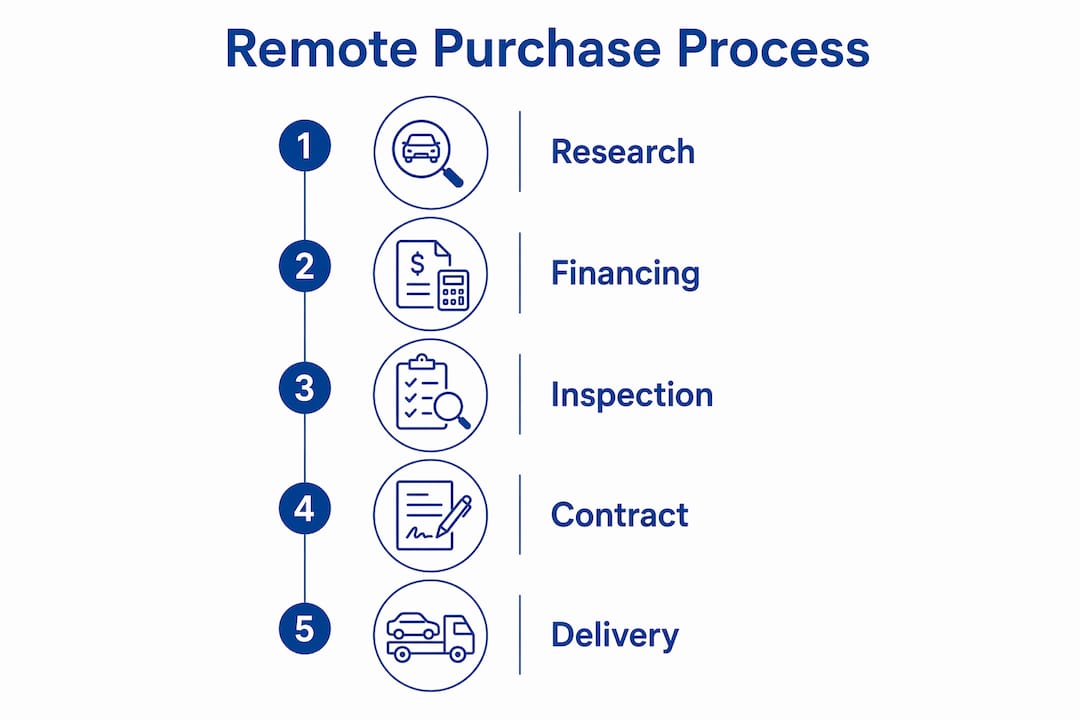
The remote vehicle purchase process follows a clear sequence. Skipping any step increases the risk of delays, unexpected costs, or legal complications. Here is how the process works from start to finish.
-
Research and select vehicles online. Use dealer websites, digital showrooms, and listing platforms to narrow your choices. Filter by make, model, mileage, and price. Save vehicle identification numbers (VINs) for any car you want to investigate further.
-
Get pre-approved for financing. Contact your bank, credit union, or an online lender before you reach out to any dealer. Pre-approval financing is critical to avoid dealer steering into less favorable loan terms. It also gives you a firm budget ceiling before negotiations begin.
-
Schedule a virtual inspection or request a detailed video. Ask the dealer for a live video walkthrough, a third-party inspection report, or both. This step is non-negotiable for remote buyers. A vehicle history report from a service like Carfax or AutoCheck adds another layer of verification.
-
Negotiate price and terms in writing. Conduct all price discussions via email or a dealer messaging platform. Written records protect you if terms change later. Confirm the out-the-door price, which includes taxes, fees, and any add-ons, before signing anything.
-
Complete the paperwork. Most states require a physical signature to finalize a vehicle sale contract. This typically means a mobile notary visits you, or you sign documents at a local office. Digital contracts handle some steps, but legal signature requirements vary by state.
-
Arrange delivery or pickup. Confirm delivery fees, estimated transit time, and the condition guarantee before the vehicle ships. Once the car arrives, inspect it thoroughly before accepting the handoff.
Pro Tip: Keep a dedicated email folder for every message, quote, and document exchanged with the dealer. That paper trail is your best protection if a dispute arises after delivery.
How do virtual inspections and vehicle evaluations work in remote car buying?

Virtual inspections are the closest substitute for a physical walkthrough, and they work best when you know exactly what to request. Remote buyers rely heavily on vehicle history reports, detailed online communication, and third-party inspection services to verify condition. Live stream video is the most reliable tool for final confirmation.
The most common evaluation methods include:
- Live video walkthroughs. Ask the dealer to walk the car on a video call. Request specific angles: door jambs, tire tread depth, under the hood, and the undercarriage if possible.
- Dealer-produced videos. These are useful for a first impression but are not a substitute for a live session. Dealers control the lighting, angle, and pace.
- Third-party inspection reports. Independent inspection services send a certified mechanic to the dealer's lot. The mechanic produces a written report with photos. This is the gold standard for remote buyers.
- Vehicle history reports. A Carfax or AutoCheck report reveals accident history, title status, odometer readings, and service records. Always pull one before making an offer.
- Manufacturer certified pre-owned documentation. If the car carries a certified pre-owned designation, request the inspection checklist that the certification required.
Virtual inspections have real limitations. A video cannot replicate the feel of a suspension, the smell of a cabin, or the sound of an engine under load. A third-party inspector addresses most of those gaps, but even a thorough inspection report can miss intermittent mechanical issues.
Pro Tip: Schedule your live video walkthrough during daylight hours and ask the dealer to film outside. Interior lighting in a showroom can hide paint imperfections and upholstery wear that natural light reveals immediately.
What financing and paperwork considerations are unique to remote vehicle purchases?
Financing a remote purchase requires more preparation than a standard dealership visit. When you walk into a showroom, a finance manager guides you through the process. When you buy online, that structure disappears, and the responsibility shifts to you.
Getting your financing in order
Financial experts recommend keeping all vehicle-related expenses, including monthly payments, insurance, and fuel, below 15% to 20% of take-home pay for long-term financial stability. That benchmark gives you a clear ceiling before you start shopping. Secure a pre-approval letter from your lender before contacting any dealer. That letter tells you your rate, loan term, and maximum amount, and it prevents a dealer from presenting financing as the only option.
Documents you will typically need to provide:
- Government-issued photo ID
- Proof of income (recent pay stubs or tax returns)
- Proof of residence (utility bill or bank statement)
- Insurance binder or proof of current coverage
- Pre-approval letter from your lender
Handling contracts and signatures remotely
Vehicle purchase contracts often require signed in-person or mobile notary signatures due to state laws. A fully digital purchase usually still involves at least one physical signature step. Most states do not accept purely electronic signatures for the title transfer or the retail installment contract. Plan for a mobile notary appointment or a visit to a local signing office as part of your timeline.
Digital contracts handle pre-sale documents well. Dealer disclosures, credit applications, and trade-in agreements can often be completed through e-signature platforms. The final sale contract is where state law typically draws the line.
Pro Tip: Before signing anything, request an itemized breakdown of the out-the-door price in writing. Compare it line by line against the agreed price. Fees can appear between the verbal quote and the final contract.
Registration and insurance logistics add another layer. Your insurance must be active before the vehicle leaves the dealer's lot. Contact your insurer with the VIN as soon as you finalize the deal so coverage is in place for the delivery date.
How do vehicle delivery and post-purchase procedures work for remote buyers?
Delivery is the final operational step, and it carries more complexity than most buyers expect. Fully online vehicle purchases with home delivery accounted for approximately 14% of new vehicle transactions in 2025. That number has held steady since 2021, which suggests delivery logistics remain a friction point for broader adoption.
Common delivery models include:
- Dealer-to-door transport. The dealer arranges a transport carrier to ship the vehicle directly to your address. Delivery fees vary widely based on distance and carrier type.
- Regional delivery centers. Some dealers use regional hubs where you pick up the vehicle from a secure lot closer to your location. This reduces shipping costs and gives you a chance to inspect the car before driving it home.
- Secure lot pickups. For buyers within driving distance, a scheduled lot pickup combines the convenience of remote negotiation with an in-person handoff.
When the vehicle arrives, inspect it before signing the delivery acceptance form. Check for transport damage, confirm the mileage matches the sale documents, and verify that all agreed accessories or documentation are present. Photograph everything before the transport driver leaves.
Post-delivery, registration timing depends on your state. Most states give buyers a window of 30 to 90 days to complete registration. Insurance should already be active from the financing step. If the vehicle does not meet your expectations, review the dealer's return policy before delivery. Post-delivery buyers must coordinate registration and insurance activation promptly and be prepared for vehicle return policies if the vehicle does not meet expectations.
Pro Tip: Log every communication with the transport carrier separately from your dealer correspondence. Damage claims require proof of the vehicle's condition at the time of pickup, not just at delivery.
Key takeaways
The remote vehicle purchase process succeeds when buyers prepare financing early, verify vehicle condition through third-party inspections, and account for the legal signature requirements that most states still mandate.
| Point | Details |
|---|---|
| Pre-approval comes first | Secure financing before contacting any dealer to avoid unfavorable loan terms. |
| Virtual inspections have limits | Always pair dealer videos with a third-party inspector for an accurate condition report. |
| Paperwork requires a physical step | Most states mandate in-person or mobile notary signatures to finalize the sale contract. |
| Delivery needs active insurance | Your coverage must be in place before the vehicle leaves the dealer's lot. |
| Written records protect you | Keep every quote, message, and document in one place throughout the entire process. |
What buying a car remotely taught me about preparation
Remote car buying rewards the prepared buyer and punishes the impatient one. I have seen buyers skip the third-party inspection because the dealer's video looked thorough, only to discover undisclosed paint repairs after delivery. That mistake costs far more than the $150 to $300 a certified inspector charges.
The paperwork step surprises most first-time remote buyers. People assume that buying online means everything happens digitally. The reality is that automotive transactions sit at the intersection of consumer finance law and state motor vehicle regulations, and those two systems were not built for speed. Budget an extra week into your timeline for the notary step alone.
Financing preparation is where buyers gain the most leverage. A pre-approval letter changes the entire dynamic of a remote negotiation. The dealer knows you have a committed rate, which removes one of the most common pressure tactics in automotive sales. Pair that with a time-saving buying strategy and you enter the process with real control.
The buyers who struggle are the ones who treat remote purchasing as a shortcut rather than a different path. The steps are the same as an in-person purchase. The tools are different, the timeline is slightly longer, and the documentation burden falls on you rather than a finance manager. Respect that difference, and the process works well.
— Allen
Autovendorsfl and the remote buying experience
Autovendorsfl works with buyers across the country who want access to premium and luxury vehicles without limiting themselves to local inventory.
Autovendorsfl's team provides personalized vehicle finding assistance, detailed vehicle information, and direct communication throughout every stage of your purchase. Whether you need help identifying the right model, understanding financing options, or coordinating nationwide vehicle delivery, the team at Autovendorsfl brings dealership-level expertise to a fully remote experience. Buyers looking for a premium selection with hands-on guidance can visit Autovendorsfl to start the conversation with a team that treats every purchase as a long-term relationship.
FAQ
What is the remote vehicle purchase process?
The remote vehicle purchase process is the series of steps a buyer follows to purchase a car online without visiting a dealership in person. It includes research, financing, virtual inspection, contract signing, and vehicle delivery.
Is it safe to buy a car online without seeing it in person?
Buying a car online is safe when you use a vehicle history report, schedule a third-party inspection, and conduct a live video walkthrough before committing. These steps reduce the risk of undisclosed damage or misrepresented condition.
Do I still need to sign paperwork in person for a remote car purchase?
Most states require at least one physical signature to finalize a vehicle sale contract. This typically involves a mobile notary or a local signing appointment, even when the rest of the process is completed online.
How does financing work when buying a car remotely?
Securing a pre-approval from your bank or credit union before contacting a dealer is the most effective approach. Pre-approval gives you a fixed rate and loan amount, which prevents dealer steering and strengthens your negotiating position.
How long does remote vehicle delivery take?
Delivery timelines vary based on distance and the transport carrier used. Most dealer-to-door shipments take between 5 and 14 days. Confirm the estimated delivery window and damage policy with the dealer before the vehicle ships.