
An automotive personal shopper is a professional buyer's advocate who handles vehicle research, price negotiation, and purchase paperwork entirely on the buyer's behalf. Unlike dealership sales staff, this role exists solely to serve the buyer's interests. Typical fees range from $650 to $1,000, with some professionals charging a percentage of the savings they secure. Buyers who are time-constrained, unfamiliar with dealer tactics, or purchasing a luxury vehicle for the first time are the most common clients. The service is also called a car buying consultant or concierge car buyer in industry practice.
What is an automotive personal shopper and what do they actually do?
An automotive personal shopper acts independently for the buyer, operating completely outside the dealership's payroll and incentive structure. That independence is the defining feature. Every recommendation they make is filtered through one question: what is best for the buyer?
The typical buying process managed by a personal shopper follows a clear sequence:
- Initial consultation — The shopper interviews the buyer to document must-have features, budget ceiling, preferred brands, and deal-breakers.
- Market research and vehicle scouting — Using pricing databases and dealer networks, the shopper identifies vehicles that match the criteria and flags any with inflated markups.
- Test drive coordination — The shopper arranges appointments, often attending alongside the buyer to prevent high-pressure upselling during the visit.
- Price negotiation — Armed with real market data, the shopper negotiates directly with the dealer, targeting invoice price rather than sticker price.
- Contract and paperwork review — Consultants review purchase documents for red flags, hidden fees, and unnecessary add-ons before the buyer signs anything.
- Delivery and post-sale support — Many services provide 90 to 180 days of post-sale support to address title issues, warranty questions, or service concerns.
Service tiers vary. A full concierge service handles every step above. A consulting-only arrangement gives buyers negotiation scripts and document reviews without full representation. The consulting model suits buyers who want guidance but prefer to stay hands-on.
Pro Tip: Before engaging any personal shopper, write down your three non-negotiable features and your absolute price ceiling. Shoppers work most effectively when buyer criteria are specific and documented from day one.

How personal shoppers differ from dealership advisors and brokers
The confusion between an automotive personal shopper and an automotive service advisor is common and costly. A service advisor is a dealership employee whose job centers on repair and maintenance revenue after the sale. They are not involved in the purchase negotiation and their loyalty runs to the dealership, not the buyer. Treating them as a buying ally leads to poor purchase outcomes.
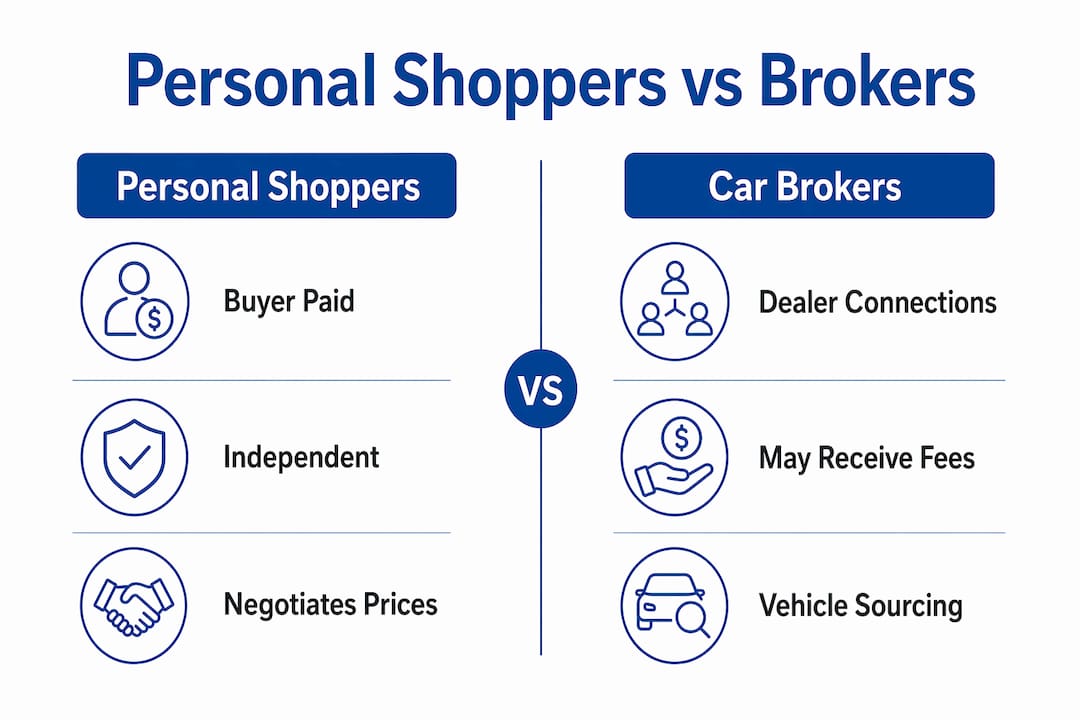
Car brokers occupy a different position. Brokers source vehicles and sometimes negotiate on behalf of buyers, but many accept referral fees or volume bonuses from specific dealerships. That financial relationship creates a conflict of interest that can quietly steer buyers toward vehicles that benefit the broker rather than the buyer.
True independence means the personal shopper is paid solely by the buyer and accepts no compensation from any dealer. That structure removes bias entirely.
| Role | Who they work for | How they're paid | Conflict of interest risk |
|---|---|---|---|
| Automotive personal shopper | The buyer | Flat fee or % of savings paid by buyer | Low, if no dealer ties |
| Automotive service advisor | The dealership | Dealership salary and commissions | High for purchase decisions |
| Car broker | Varies | Dealer referral fees or buyer fee | Medium to high |
| Dealership salesperson | The dealership | Commission on sale price | High |
Pro Tip: Ask any personal shopper or broker directly: "Do you receive any compensation from dealerships?" A legitimate buyer's advocate will answer no without hesitation. If there is any hedging, walk away.
What advantages do AI-powered personal shopper services offer buyers?
Digital-first car buying in 2026 has expanded personal shopper services well beyond the ultra-wealthy. Middle-market buyers now access the same pricing intelligence and negotiation leverage that once required expensive private consultants. Technology is the reason.
Modern personal shoppers who combine AI-driven market analytics with human negotiation expose weak dealer offers and hidden fees that buyers would never catch on their own. Here is what that looks like in practice:
- Real-time pricing analysis — AI tools pull live transaction data from regional markets, showing what buyers in the same zip code actually paid for the same vehicle in the past 30 days.
- Personalized vehicle matching — Algorithms cross-reference buyer criteria against available inventory across multiple dealerships simultaneously, cutting research time from weeks to hours.
- Markup detection — Software flags dealer-installed accessories, documentation fees, and financing rate inflation that inflate the final price without adding real value.
- Remote signing and digital delivery coordination — Buyers can review and sign contracts electronically, with the shopper verifying every line item before submission.
- Quota-period timing — The most effective shoppers leverage dealer quota periods at month-end or quarter-end when dealers are motivated to close deals and more willing to accept lower margins.
The financial results are measurable. Personal shoppers deliver time savings up to 70% and average savings of $2,000 to $4,000 after fees on midsize vehicle purchases. That figure represents the gap between what an uninformed buyer would pay and what a prepared advocate secures. For a luxury vehicle purchase in the $80,000 to $120,000 range, the savings potential scales considerably higher.
You can explore how digital car buying tools are reshaping the entire purchase experience in 2026, from initial research through final delivery.
How to maximize value when working with a personal shopper
Getting the most from a vehicle shopping assistant requires active participation, not passive delegation. The shopper handles execution, but the buyer must supply clear direction.
- Define your criteria before the first call. List your preferred makes, models, trim levels, color preferences, and maximum monthly payment. Vague briefs produce vague results.
- Verify fee transparency upfront. Ask for a written breakdown of all charges before signing any service agreement. Legitimate services disclose fees clearly and do not bury costs in fine print.
- Confirm independence from dealerships. Request written confirmation that the shopper accepts no referral fees, volume bonuses, or dealer incentives of any kind.
- Check credentials and track record. Ask for references from past clients, particularly those who purchased vehicles in a similar price range. Reviews on Google and automotive forums provide additional context.
- Stay involved throughout the process. Clients who maintain communication throughout the process maximize the value of personal shopper services. Respond promptly to requests for decisions or approvals so the shopper can act when timing matters.
- Set realistic price expectations. Shoppers cannot force prices below true market value. Their advantage lies in knowing what fair market value actually is and holding the dealer to it.
Common pitfalls include buyers who go silent after the initial consultation, buyers who set unrealistic price targets based on outdated online estimates, and buyers who skip the credential verification step entirely. Each of these mistakes reduces the shopper's ability to deliver results.
Pro Tip: Review used car negotiation strategies before your consultation so you understand the tactics your shopper will use. Informed buyers ask better questions and set more realistic benchmarks.
Personal shoppers eliminate the information asymmetry that dealers rely on to maximize profit. That asymmetry is the single biggest reason buyers overpay. Removing it is the core value of the service.
Key takeaways
An automotive personal shopper delivers measurable financial savings and significant time reduction by acting as an independent buyer's advocate with no dealer ties.
| Point | Details |
|---|---|
| Independent buyer advocacy | Personal shoppers are paid by the buyer only, eliminating dealer bias from every recommendation. |
| Defined service scope | Services range from full concierge representation to consulting-only document review and negotiation scripts. |
| AI-powered pricing advantage | Real-time market data and quota-period timing expose inflated offers and hidden fees buyers miss alone. |
| Average financial benefit | Buyers save $2,000 to $4,000 after fees on midsize purchases, with higher potential on luxury vehicles. |
| Buyer participation matters | Clear criteria, prompt communication, and realistic price expectations determine how much value the shopper can deliver. |
Why I think personal shoppers are no longer a luxury-buyer-only tool
I have watched the personal shopper market shift dramatically over the past few years, and the most significant change is not the technology. It is the buyer profile. When I first started paying close attention to this space, the clients were almost exclusively high-net-worth individuals buying their third or fourth luxury vehicle. They used personal shoppers the way they used personal assistants: to reclaim time they valued more than money.
That is no longer the full picture. The democratization of concierge car buying means that a first-time luxury buyer in Fort Lauderdale purchasing a $65,000 vehicle can access the same negotiation leverage as someone spending $200,000. The fee is the same. The savings potential is proportional. The stress reduction is identical.
What I find underappreciated in most discussions of this service is the psychological value. Personal shoppers transform dealership negotiations from high-pressure confrontations into straightforward administrative tasks. That shift matters enormously for buyers who dread the process, and it is not captured in the $2,000 to $4,000 savings figure.
My honest advice: if you are spending more than $50,000 on a vehicle and you have not used a personal shopper before, the fee is almost certainly worth it. Not just for the money you save, but for the confidence that comes from knowing someone with no stake in the dealer's outcome reviewed every line of your contract. That peace of mind has real value, and most buyers only recognize it after they have experienced the alternative.
— Allen
Find your next luxury vehicle with Autovendorsfl's personal shopping expertise
Autovendorsfl at Auto Vendors Inc in Fort Lauderdale pairs expert personal shopping assistance with one of South Florida's most carefully curated luxury vehicle inventories. Whether you are searching for a Mercedes-Benz S-Class or exploring the full range of Lexus models available in Fort Lauderdale, the team at Autovendorsfl brings the same buyer-first approach described throughout this article. Every client receives tailored vehicle recommendations, transparent pricing guidance, and after-sale support that extends well beyond the handshake. Explore the current Mercedes-Benz inventory or connect with the Autovendorsfl team directly to start your personalized vehicle search today.
FAQ
What does an automotive personal shopper charge?
Fees typically range from $650 to $1,000 for flat-rate services, with some professionals charging a percentage of the savings they negotiate. The fee structure should always be disclosed in writing before any service agreement is signed.
How is a personal shopper different from a car broker?
A personal shopper is paid exclusively by the buyer and accepts no dealer compensation, while many brokers receive referral fees or volume bonuses from specific dealerships. That distinction determines whose interests the advisor actually serves.
Can a personal shopper help with luxury vehicle purchases specifically?
Personal shoppers are particularly effective for luxury purchases because the higher transaction values amplify both the savings potential and the complexity of financing and contract terms. Buyers spending $60,000 or more benefit most from independent representation.
How much time does a personal shopper save during the buying process?
Personal shoppers deliver time savings of up to 70% compared to buyers who research and negotiate independently. That reduction comes from pre-qualified vehicle scouting, direct dealer relationships, and digital tools that compress the research phase from weeks to days.
What should I ask before hiring a personal car shopper?
Ask whether they accept any compensation from dealerships, request a written fee breakdown, and ask for references from clients who purchased vehicles in a similar price range. Verifying independence and track record upfront prevents conflicts of interest later.