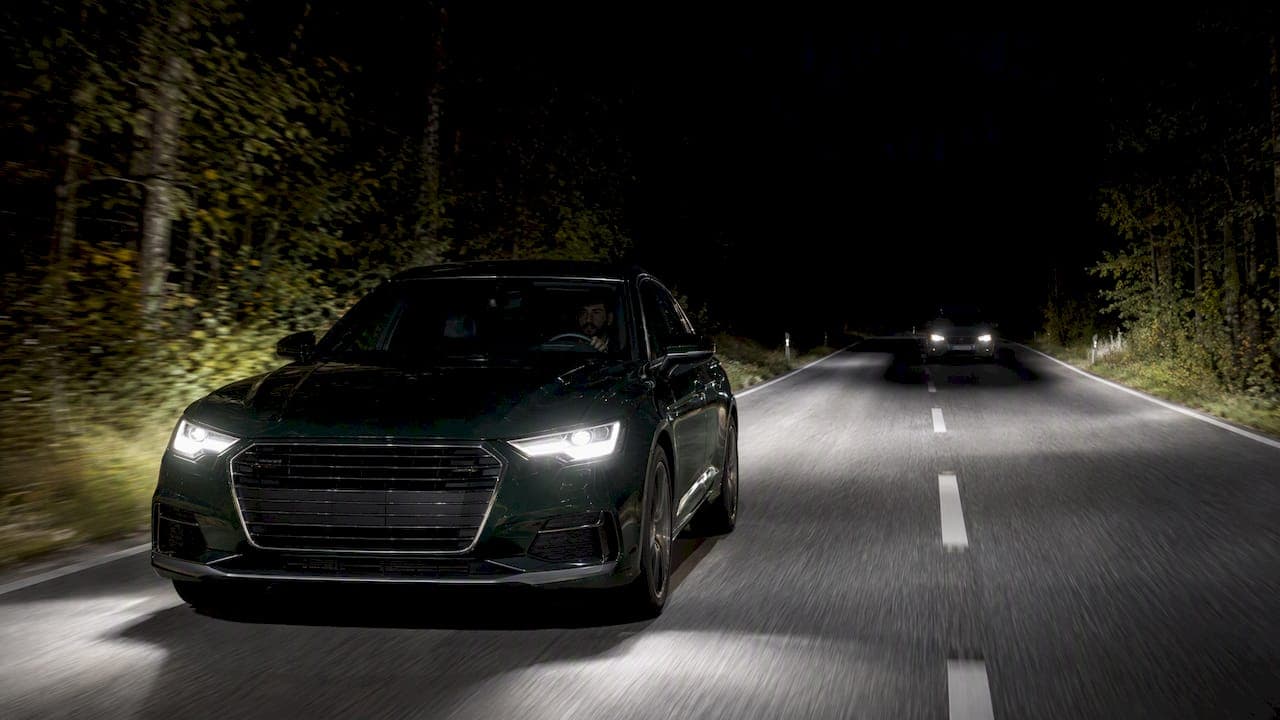
Adaptive headlights are a broad family of systems that reshape or aim your light as driving conditions change. Matrix headlights are one advanced member of that family. They use a grid of individually controlled LEDs to carve shadows around other vehicles while keeping the rest of the road lit. Every matrix system is adaptive, but most adaptive systems are not matrix. That one distinction clears up most of the confusion, and it matters when you shop for a used luxury car, where the badge on the trunk rarely tells you which lighting you actually have.
TL;DR
- "Adaptive" is the category. It covers swiveling projectors, auto-leveling and cornering lights, plus matrix LED arrays at the top end.
- Matrix headlights use many small, separately controlled LED segments to dim only the part of the beam that would reach other drivers.
- Laser headlights are a different technology: they add long range, but they are rare and mostly found on luxury models. They are not a replacement for matrix control.
- Federal rules in the US permitted adaptive driving beam headlamps on new vehicles starting with a 2022 NHTSA final rule, so full matrix behavior is newer here than in Europe.
- On a used car, check the window sticker, the build sheet, the settings menu and the hardware itself rather than trusting a trim name.
Table of Contents
- What "adaptive headlights" actually means
- How matrix headlights work
- Adaptive vs matrix side by side
- Where laser headlights fit
- Are matrix headlights legal in the US?
- Which US cars have matrix headlights?
- How to tell whether a car has matrix headlights
- Do you actually need matrix?
- Our perspective
- Find a car with the lighting you want
- FAQ
- Sources
What "adaptive headlights" actually means
Adaptive lighting is an umbrella term. According to one overview of adaptive and matrix systems, these systems can use steering angle, vehicle speed, camera input and vehicle pitch to adjust how light is distributed. What they do with those inputs varies a great deal:
- Swiveling projectors. The low beam pivots left or right as you steer, so a curve is lit before the car is pointed down it.
- Cornering lights. A separate lamp switches on when you turn the wheel or signal at low speed, lighting the side of the road.
- Auto-leveling. The beam is tilted up or down to compensate for a loaded trunk, hard acceleration or braking.
- Adaptive high beam and matrix. The headlamp changes the shape of the beam itself, not just its aim.
A lot of buyers assume the first three are the same as the last one. They are not, and the gap shows up on a dark two-lane road.
Is auto-leveling the same as adaptive?
No. Clemson University's vehicular electronics lab describes adaptive front lighting as a broader set of technologies, with leveling as one possible piece. Leveling only corrects the vertical angle of the beam. It never steers light into a bend or masks another car. If a listing says "auto-leveling headlights," you have a useful safety feature, but you do not have matrix.
How matrix headlights work
A conventional LED headlight is one light source with a fixed beam shape. A matrix headlight splits the high beam into many small LED elements, and a camera behind the windshield tells a control unit which ones to switch off or dim. Reporting on Audi's digital matrix LED lighting explains that the system can dim an area around other cars while the rest of the road stays lit.
The practical result is that you drive with something close to a permanent high beam. The car cuts a dark pocket around an oncoming driver or the taillights ahead of you, and the road edges, signs and shoulders stay bright. You do not flick a stalk, and the other driver is not blinded.

There is also a durability argument. An engineering write-up on matrix adaptive beam lighting from a chip maker, Lumissil Microsystems, says the absence of moving parts in matrix systems contributes to their reliability. That is the maker's own view, so treat it as a design argument rather than a guarantee, but it is logical: a swiveling projector has a motor that can wear, while a matrix array changes the beam electronically.
Adaptive vs matrix side by side
| Feature | Typical adaptive (swivel, leveling, cornering) | Matrix LED (adaptive driving beam) |
|---|---|---|
| What it changes | Direction or height of the beam | The shape of the beam, segment by segment |
| Reacts to | Steering angle, speed, vehicle pitch | Camera view of other vehicles, plus the same vehicle inputs |
| Other drivers | Still need you to dip the high beams | Shadow carved around their car while high beam stays on elsewhere |
| Moving parts | Often motors or actuators | Mostly electronic control of LED segments |
| Where you see it | Many mainstream and older premium cars | Newer luxury, EV and some premium models |
| Effect on a used purchase | Common, easy to find | Needs verification trim by trim |
The takeaway: if your driving is mostly city streets, standard adaptive features cover the basics. If you regularly drive dark rural roads, matrix is the version that changes what you can see.
Where laser headlights fit
Searchers often type the other comparison too: laser vs matrix. They answer different questions. Laser headlights fire a blue beam into a phosphor converter, which produces yellow light; the blue and yellow combine into white, as Capital One's car-shopping guide explains. The same guide notes they are typically more expensive and complex than LED systems, which is why they are mostly confined to luxury models.
Laser is about the light source and reach. Matrix is about beam control. A car can pair the two, but a laser lamp does not automatically shape its beam around other drivers.
Does laser look brighter in practice? One Australian professional test, from CarExpert, found a matrix LED Skoda Superb Scout brighter than a BMW with laser lights, and the lasers made little apparent difference in intensity when switched on. That is one test of two cars, not a verdict on the technology, but it is a useful reminder that a premium-sounding spec is not the same as better night vision. For a used buyer, matrix control is usually the more meaningful feature, and it is far easier to find.

Are matrix headlights legal in the US?
This is the question that makes the US different from Europe. In February 2022, NHTSA issued a final rule amending FMVSS No. 108 to permit adaptive driving beam headlamps on new vehicles. The standard defines these lamps as ones that dynamically provide less illumination to occupied areas of the road and more to unoccupied areas, which is exactly what matrix does.
Before that rule, many matrix cars sold here carried hardware that was limited or inactive. An IIHS researcher has said that U.S. standards are more restrictive, keeping many existing adaptive-beam systems from being deployed in the United States. So the same model name can behave differently on either side of the Atlantic.
Two more points help when you read a spec sheet:
- NHTSA does not formally approve equipment. Under its published interpretation, manufacturers self-certify that vehicles and equipment meet FMVSS No. 108.
- A European-market car imported privately may carry lighting that does not match U.S. rules. Buying from a dealer that sells U.S.-specification vehicles avoids that question.
Which US cars have matrix headlights?
The list is still short, and it moves as new model years arrive. Rivian was the first manufacturer to deploy compliant adaptive driving beam headlamps on new U.S. vehicles, in 2024, starting with the refreshed R1T pickup and R1S SUV, according to reporting on Rivian's headlights. The same report points to newer Tesla vehicles with matrix LED hardware. Car and Driver reported that the updated 2025 Tesla Model Y is sold in the U.S. with matrix LED technology capable of adaptive beam functionality.
For a deeper rundown of the law, the models and the verification steps, our companion guide on matrix headlights in the USA goes through each in more detail.
If you shop used, remember the timeline. A car from before the 2022 rule is very unlikely to have a fully active matrix function in the US, even if it is a luxury model with excellent standard LED lights. What you will often find are the earlier adaptive features: swiveling or cornering lamps, leveling and automatic high beams. They are real improvements over basic headlights, so judge them for what they are.
How to tell whether a car has matrix headlights
Spec names are inconsistent, so rely on several checks rather than one. A shop's guide to telling whether you have adaptive headlights lists the main ones, and they apply equally to a car you are considering:
- Window sticker or build sheet. Look for terms such as Matrix LED, Adaptive Driving Beam, Adaptive Front-lighting System or Dynamic Bending Light.
- Settings menu. Open the lighting section of the infotainment or instrument cluster. Entries for adaptive or matrix high beam, or automatic leveling, tell you what is fitted.
- Startup check. In a dark garage, some adaptive systems briefly sweep the beam up, down or sideways at start. Watch the wall.
- Look at the lamp. A segmented array of small LED squares suggests matrix. A projector with visible motor housings points to swivel-type adaptive lighting.
- Read the dashboard icon. A headlamp symbol with an "A" generally means automatic high beam, which is not matrix. Do not treat it as proof.
- Drive it at night. On a dark road with traffic, matrix should leave the high beam on while shading oncoming cars. Ask for a test drive after sunset if the feature matters to you.
If the car comes with a vehicle identification number, ask the seller to confirm the original equipment against the manufacturer's build data. That is the surest route when labels disagree.
Do you actually need matrix?
It depends on where and when you drive.
- Dark rural roads and highways at night: matrix is the biggest upgrade, because you keep high-beam range without flashing other drivers.
- Suburban and city driving: well-lit streets give matrix little room to show its strengths. Good standard LED lights with leveling do most of the work.
- Families with long road-trip habits: better illumination at the edges of the road helps you see deer, cyclists and signs earlier. Pair it with a well-maintained set of tires and brakes and you have a safer night car.
- Budget-conscious first-time luxury buyers: do not pay a large premium for a lighting package you will rarely use. A clean, well-serviced premium car with standard adaptive features often serves better than a stretch purchase for the newest option list.
If you are still weighing what separates a premium car from a luxury one, our guide on luxury vs premium cars helps you decide where extras like these are worth paying for.
Our perspective
We spend our days matching buyers with used luxury and premium vehicles, and headlights come up more than people expect, usually after a night test drive. Our view is simple. Treat lighting like any other option: verify what is on the car, not what the brochure says for the model.
We also think buyers should resist the pull of the newest label. Matrix is genuinely impressive, and the technology is arriving in the US fast, but a used car that is carefully chosen, well maintained and fitted with good standard LED or adaptive lights will serve most drivers well. The real risk is assuming a feature is present because a sibling model had it, or because a European review praised it.
That is why our personalized vehicle-finding service starts with a conversation about how and where you drive. If you do a lot of night driving on dark roads, we will tell you to prioritize lighting. If you do not, we would rather you spend on condition, service history and the features you will use every day.
— Allen
Find a car with the lighting you want
If you want a specific kind of headlight system, tell us. Our Car Finder service is built for exactly this kind of request: you describe the vehicle, we search for it and confirm the equipment before you commit.

You can also browse by body style, such as SUVs or sedans, or look through our full used inventory in Fort Lauderdale. Our Tesla listings are a good place to start if advanced electronics matter to you. Trade-in valuation and financing are available at the dealership, so you can handle the whole purchase in one visit.
FAQ
Are adaptive headlights and matrix headlights the same thing?
No. Adaptive headlights are a broad category that includes swiveling projectors, cornering lights and auto-leveling. Matrix is a specific, more advanced adaptive type that uses a grid of individually controlled LEDs. All matrix systems are adaptive, but not every adaptive system is matrix.
Are matrix headlights legal in the US?
Yes, for new vehicles. NHTSA's February 2022 final rule amended FMVSS No. 108 to permit adaptive driving beam headlamps. Manufacturers self-certify that their equipment meets the standard, so availability depends on each automaker's choices and model year.
Is laser better than matrix?
They do different jobs. Laser lights focus on long-range output from a phosphor-converted source, while matrix shapes the beam around other road users. Laser is rare and mostly limited to luxury models. In one professional test, matrix LED lights outshone a laser-equipped car.
How do I know if I have matrix headlights?
Check the window sticker or build sheet for terms like Matrix LED or Adaptive Driving Beam, then look in the lighting menu. You can also inspect the lamp for a segmented LED array and watch how the beam behaves on a dark road with traffic. A headlamp icon with an "A" usually means automatic high beam only.
Is auto-leveling the same as adaptive headlights?
No. Auto-leveling only adjusts the vertical angle of the beam for load, acceleration or braking. Adaptive systems can include leveling, but they may also steer or reshape the beam to help visibility in curves and traffic.
Sources
- Adaptive vs Matrix Headlights: Are They the Same?
- Clemson Vehicular Electronics Laboratory: Adaptive Front Lighting
- You Can Leave the 2027 Audi Q9's High-Beams On, and No One Gets Blinded
- Matrix Adaptive Beam Lighting: Enhancing Nighttime Driving Safety
- What Are Laser Headlights? | Capital One Auto Navigator
- Halogen v LED v matrix LED v laser: Headlights compared and tested
- Federal Register: FMVSS lamps, reflective devices and associated equipment, adaptive driving beam
- NHTSA interpretation: Hyodo.B-3
- Rivian's smart headlights outshine in the U.S.
- 2025 Tesla Model Y's Special Headlights Won't Blind Other Drivers
- How do I tell if my car has adaptive headlights?