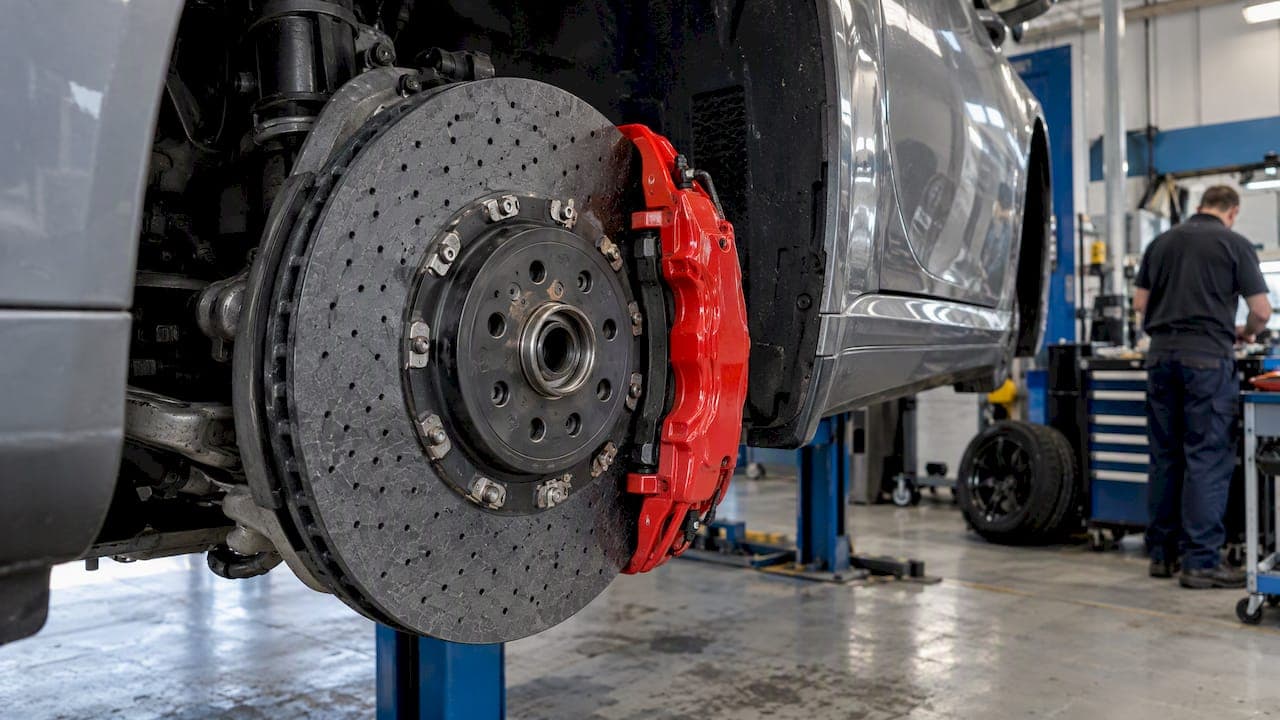
Carbon ceramic brakes usually add roughly $8,500 to $10,400 to a new performance car as a factory option, and a full replacement later can run $15,000 to $25,000 on a performance car and far more on a supercar. A standard steel brake job costs a few hundred dollars per axle. That gap is the whole story, and it matters most when you buy a used car that already has the ceramic package.
Below you will find the real numbers, what drives them, how long the rotors last, and how to decide whether the upgrade makes sense for the way you drive.
TL;DR
- Factory carbon ceramic packages cost about $8,500 on a BMW M4 Competition and $10,370 on a 2026 Porsche 911 GT3, per Motor1.
- Full dealer replacement commonly lands between $15,000 and $25,000 for performance cars and can reach $60,000 for supercars.
- With normal street driving the rotors can last a very long time, but a single chip can end a rotor's service life.
- For most street-driven cars, steel brakes are the better value. Ceramics pay off for track days and for owners who hate brake dust.
- On a used car, ask which brakes it has and what condition the rotors are in before you talk price.
Table of Contents
- What carbon ceramic brakes cost new
- What replacement really costs
- How much four regular brakes cost
- Why carbon ceramic costs so much
- How long carbon ceramic brakes last
- Steel vs. carbon ceramic brakes in daily use
- Are carbon ceramic brakes worth it?
- Buying a used car with carbon ceramic brakes
- Our perspective
- Let us help you find the right car
- FAQ
- Sources
What carbon ceramic brakes cost new
The cheapest moment to own carbon ceramic brakes is the day you order the car. Manufacturers sell them as an option package, and the price depends on the model:
| Vehicle | Carbon ceramic option price |
|---|---|
| BMW M4 Competition | $8,500 |
| 2026 Porsche 911 GT3 | $10,370 |
Both figures come from Motor1's breakdown of carbon ceramic brakes. Other guides put typical factory options at about $8,500 to $9,000 on mainstream performance cars, and one price guide notes that a dealer replacement later can cost two to four times the original option. Higher-end exotics sit well above these numbers.
The option price also hides something. A new-car buyer pays it once, folded into the financing. A second or third owner inherits the brakes, and the bill that comes with them.
What replacement really costs
This is the number most readers are actually searching for, and it is large.
- Performance cars: full OEM replacement, rotors and pads, commonly runs $15,000 to $25,000 at a dealership.
- Supercars: the same source puts the range at $25,000 to $60,000.
- Pads only: specialized pads for carbon ceramic systems typically cost $800 to $1,200 per set, according to Kelley Blue Book. They must be vehicle-specific, because standard semi-metallic pads can damage ceramic surfaces right away.
Owner forums show the same pattern in individual quotes. Posts describe dealers quoting five figures for a full set on a Corvette or a Mercedes-AMG GT, and a single rotor can run $5,000 or more. Treat forum numbers as anecdotes, not price lists. They do show how wide the spread is.
Why two quotes can differ by thousands
The final bill depends on a handful of variables:
- The car. Rotor diameter and complexity vary widely between a sports sedan and a supercar.
- Scope. Rotors only, rotors and pads, or the full hardware kit.
- Sales channel. Dealer parts and labor cost more than independent specialists, and the price guide cited above notes that vehicle, rotor size, hardware scope and channel all move the total.
- Calibration. On BMW M3 and M4 models of the G80 and G82 generation, replacement may require software calibration or a bedding procedure with BMW-specific diagnostic tools.
Always ask for the quote to be itemized: parts per axle, labor, and any calibration or bedding charge.
How much four regular brakes cost
To see the gap clearly, compare it with ordinary steel brakes. One recent shop price guide puts pads and rotors at about $330 to $580 per axle on a mainstream car at an independent shop, with pads alone cheaper. Doing all four wheels therefore lands somewhere around $660 to $1,160 for a typical car, before calipers or a fluid flush. Premium and performance steel setups cost more, but you are still talking hundreds or low thousands.
If you want to see how a shop itemizes rotor work, this walkthrough of brake rotor replacement cost checks is a good primer. For pad timing and pricing on standard cars, see when to replace brake pads and what it costs.
Put side by side, a full ceramic replacement can cost 15 to 40 times what a steel brake job does. That is a big reason the used-car question matters.

Why carbon ceramic costs so much
Cast-iron rotors are cast and machined in volume. Carbon ceramic rotors are a different manufacturing story. They use expensive materials, long high-temperature processing, tight process control and deep inspection, as explained by a brake retrofit maker. Motor1 relays an estimate from the YouTube channel Engineering Explained that a single carbon ceramic rotor takes about three weeks to make, against roughly 90 minutes for cast iron.
Low volume plus slow production means a high price that never really falls.
How long carbon ceramic brakes last
The honest answer is that it depends on how you drive. Manufacturers claim the rotors may never need replacement under normal driving, and trade coverage of servicing carbon-ceramic brakes notes that cracked discs have mostly been reported from weekend racers pushing them hard. On the street, many owners report very long rotor life, though the pads still wear and cost real money.
The bigger risk on a street car is not wear but damage. Service advisors point out that ceramic discs are brittle compared with cast iron. A chip on the edge or surface, often from improper wheel installation or a dropped tool, can make a rotor unsafe and force an expensive replacement. A routine tire change becomes a risk point. If you own or buy a car with ceramics, use a shop that knows them, and tell the tire technician before they touch the wheels.

Steel vs. carbon ceramic brakes in daily use
Cost is only half the comparison. Here is how the two stack up.
| Factor | Cast-iron (steel) | Carbon ceramic |
|---|---|---|
| Purchase price | Standard on most cars | Roughly $8,500 to $10,400 as an option on the cars above |
| Replacement | Hundreds per axle | Often $15,000 or more for a full set |
| Weight | Heavier | About half the weight of equivalent iron rotors |
| Heat resistance | Can fade under repeated hard stops | Resists extreme heat |
| Brake dust | More | Substantially less |
| Cold or wet feel | Predictable | Can perform worse when cold or in heavy rain |
The weight and heat points come from Motor1, which also stresses that carbon ceramic brakes do not inherently stop shorter. They resist fade lap after lap, which is a different thing. Owners of ceramic systems also praise cleaner wheels and no flash-rust film in daily driving.
There is also a middle path on some models. Porsche's tungsten-carbide surface coated brakes put a hard coating on iron rotors for less dust and better performance than plain iron, at a much lower option price than full ceramics when they launched.
Are carbon ceramic brakes worth it?
For most street-driven cars, no. Motor1's conclusion is that the performance benefits are rarely used outside a racing environment. The brakes can still be a sensible choice in two cases:
- Frequent track days. Fade resistance and low weight earn their keep when you brake hard repeatedly.
- Dust and looks. If clean wheels and the signature calipers matter to you and you accept the replacement risk, the premium can feel justified.
If you mostly commute, run errands and take the occasional spirited drive, steel brakes are cheaper to buy and far cheaper to fix.
Buying a used car with carbon ceramic brakes
A used car is where the ceramic question gets most financial. The original owner paid the option price, and you may inherit rotors at any point in their life. Before you commit:
- Confirm what is on the car. Ceramic setups are often paired with large, brightly painted calipers, but the build sheet or VIN-based options list is the proof.
- Ask for rotor inspection records. Look for chips, cracks and surface damage, and ask when the brakes were last serviced.
- Get a pre-purchase inspection from a specialist who knows the model, and ask for a written replacement quote.
- Price the risk. If the rotors are near the end of their life, a five-figure bill belongs in your offer.
- Budget for upkeep. Our guide on what Porsche owners should budget for maintenance shows how running costs add up on performance cars even before ceramics.
Our perspective
We see this question from the buyer's side of the desk. People who walk in looking at luxury and performance cars rarely ask about brakes first, yet the rotor package can change what a car really costs over five years. Our view is simple: a ceramic package is a feature worth understanding, not a trophy to pay extra for. If a car is mostly going to see commutes and weekend drives, steel brakes in good condition are the smarter ownership story. If you love track days or want the dust-free wheels, a ceramic-equipped car can be a great fit, as long as you go in knowing the replacement numbers. We would rather you ask the uncomfortable question now than get surprised by a quote later.
— Allen
Let us help you find the right car
If you want a luxury or performance car without guessing about hidden costs, tell us what you drive, how you drive and what you want to spend. Our Car Finder service helps track down the model you have in mind, and you can browse the current used inventory in Fort Lauderdale by make, model, body style and price. If you are weighing German performance sedans, start with our BMW selection.
FAQ
How much do carbon ceramic brakes cost?
As a factory option they cost about $8,500 on a BMW M4 Competition and $10,370 on a 2026 Porsche 911 GT3. A full dealer replacement later commonly costs $15,000 to $25,000 on performance cars. Supercars can reach $60,000.
How long do carbon ceramic brakes last?
Manufacturers say the rotors may never need replacing under normal driving, and many street owners report very long life. Hard track use and physical damage, such as chips from careless wheel installation, are what end them early. Pads wear on their own schedule and cost roughly $800 to $1,200 per set.
Are carbon ceramic brakes worth it?
For most street-driven cars, they are not worth the added cost. They make sense for frequent track days or for owners who value low dust and accept the replacement bills. If neither fits, steel brakes cost far less to own.
Can I buy a used car with carbon ceramic brakes?
Yes, but inspect the rotors and get a specialist's opinion first. Ask for service records and a written replacement quote. If the rotors are close to the end of their life, use that cost when negotiating.
Sources
- Do You Need Carbon Ceramic Brakes? (Motor1)
- Carbon Ceramic Brakes Price & Cost Guide (2026)
- Carbon Ceramic vs Cast Iron Brakes: Pros, Cons, Costs
- Brake Repair Prices & Cost Estimates (Kelley Blue Book)
- Understanding the Replacement Cost for Carbon Ceramic Brakes on a BMW M3 or M4
- Servicing Carbon-Ceramic Brakes (Brake & Front End)
- Carbon-Ceramic vs. Steel Brakes: A Service Advisor's Guide
- In Depth with the 2019 Porsche Cayenne's Tungsten-Carbide Coated Brakes (Car and Driver)
- Brake Job Cost 2026 (Fixxr)