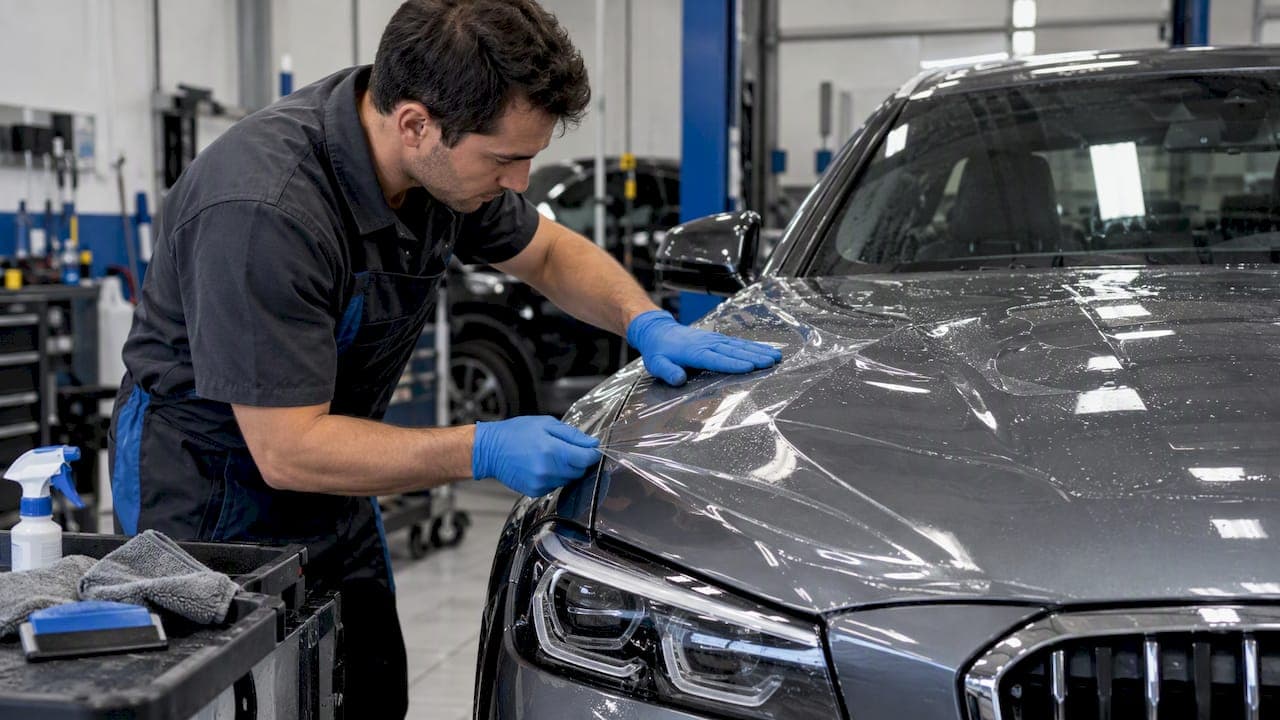
Paint protection film (PPF) is a physical shield that stops rock chips and scratches before they reach your clear coat, while ceramic coating is a surface treatment that improves gloss, hydrophobicity, and resistance to UV fading. If you can only choose one and your priority is chip protection, PPF wins. If your priority is easier washing and lasting shine, ceramic coating wins. Most detailers recommend both: PPF on vulnerable panels, ceramic coating over the film and the rest of the car.
TL;DR:
- Highway drivers and leased car owners should prioritize PPF on the hood, front bumper, mirrors, and headlights, where roughly 80% of stone impacts land.
- Ceramic coatings last about one year for basic consumer kits and nine or more years for professional grades, so compare warranties and reapplication costs.
- Paint correction should precede either treatment because PPF and ceramic coating seal existing swirl marks and scratches rather than conceal or remove them.
- Choose film rated for matte paint or confirm coating compatibility with vinyl wraps; standard glossy products can change matte finishes or fail to bond properly.
Table of Contents
- What is paint protection film and what does it protect?
- What is ceramic coating and what does it protect?
- PPF vs ceramic coating: a side-by-side look at what matters
- Costs, lifespan, and what installation actually involves
- Which should you choose: PPF, ceramic, or both?
- How to maintain PPF and ceramic-coated paint
- How a premium dealership thinks about paint protection
- Why local weather changes the protection equation
- Common myths about ceramic coating and PPF
- Does paint type affect how well these treatments work?
- A straight answer on which protection actually makes sense
- Protecting your next vehicle starts with the right purchase
- FAQ
- Sources
What is paint protection film and what does it protect?
Paint protection film is a clear, flexible layer of polyurethane applied directly over factory paint. Premium versions, such as the 3M™ Paint Protection Film Pro Series, use an ultra-transparent film roughly 0.203 millimeters thick with a self-healing topcoat that smooths out light scratches and swirl marks when exposed to warmth, often from sunlight or warm water.
3M's Pro Series PPF is built as a 203-micron self-healing polyurethane film engineered specifically for chip and scratch resistance, which explains why installers treat it as the first line of defense rather than a cosmetic add-on.
PPF works by absorbing kinetic energy. When a pebble kicked up by a highway truck hits your hood at speed, the film flexes and spreads that impact across its surface instead of letting it chip straight into the clear coat. Chemical Guys frame this distinction clearly: PPF is engineered to absorb impact, while ceramic coatings are too thin, measured in microns rather than mils, to stop anything with real force behind it.
PPF addresses a specific, narrow set of threats well:
- Stone chips and rock impacts from highway driving or gravel roads
- Light abrasion from brush, debris, or improper washing tools
- Minor scratches that self-heal under heat rather than becoming permanent
It does not prevent deep gouges from keys, deliberate vandalism, or major body damage, and it will not improve the paint's gloss or make the car easier to clean on its own.
Coverage choices matter here. A front-end package, typically the hood, front bumper, mirrors, and headlights, covers the panels that take the vast majority of road debris impact, since these are the surfaces that face oncoming traffic and kicked-up gravel directly. A full-vehicle wrap extends that same protection to doors, rear quarter panels, and the trunk, which matters more for cars that see frequent parking lot exposure or long-term ownership.
SunTek Paint Protection Film is another widely installed option alongside 3M's Pro Series, and both brands back their film with manufacturer warranties that typically guarantee against yellowing, cracking, and bubbling for several years, a signal worth checking before committing to an installer. Warranty terms vary by product line, so confirming exact coverage with your installer before paying is worth the extra five minutes.
What is ceramic coating and what does it protect?
Ceramic coating is a liquid polymer, usually silica-based, that chemically bonds to your car's clear coat rather than sitting on top of it like wax. Once cured, it forms a thin, hard layer that changes how the paint surface behaves: water beads and rolls off instead of sheeting, dirt and road grime have less to grip onto, and UV rays that would otherwise fade and oxidize paint over time are partially blocked.
Chemical Guys describes this bonding process as the key difference from traditional wax: ceramic coatings create a semi-permanent chemical bond, while wax sits as a sacrificial topical layer that washes away within weeks.
The core benefits of a quality ceramic coating include:
- Strong hydrophobicity, which makes water and mud slide off rather than cling
- Enhanced gloss and depth that makes paint color look richer
- Resistance to chemical stains from bird droppings, tree sap, and bug splatter
- Added UV protection that slows fading and oxidation over years of sun exposure
What ceramic coating does not do is act as a physical barrier. It measures in microns, far thinner than PPF's mil-thickness film, so a rock chip or a deep scratch will cut straight through it to the paint underneath. Chemical Guys is direct about this limitation: ceramic coatings alter surface chemistry, they don't absorb kinetic energy the way film does.
Ceramic coating longevity ranges widely depending on product grade, from about one year for entry-level consumer kits to nine or more years for professional-grade coatings backed by installer warranties. That spread is significant enough that it should shape your budget conversation with any installer.
Prep work determines how well any coating performs. Professional installers typically require a paint correction pass, polishing out swirl marks and light oxidation, before applying ceramic coating, since the coating will seal in whatever imperfections already exist on the surface rather than hiding them.

PPF vs ceramic coating: a side-by-side look at what matters
Car owners comparing these two treatments usually care about the same handful of factors: what stops physical damage, what keeps the car looking sharp, and what fits the budget. Here is how they stack up.
| Factor | PPF | Ceramic coating |
|---|---|---|
| Stone chip protection | Strong, absorbs impact | None, too thin to resist impact |
| Scratch resistance | Strong, self-healing topcoat | Light surface scuffs only |
| Gloss enhancement | Minimal on its own | Significant, deepens color and shine |
| Hydrophobicity | Limited unless coated | Strong, water beads and sheets off |
| Reversibility | Removable, leaves paint underneath | Wears off gradually, not peeled off |
| Repairability | Damaged sections can be replaced | Can be reapplied once worn |
| Finish compatibility | Available in gloss and matte | Gloss-focused, matte versions exist but are less common |
Cost and time follow a predictable pattern. A partial PPF package covering the front end generally takes a single day to install, while full-vehicle coverage can stretch across several days because of the material and precise trimming involved. Ceramic coating, by contrast, usually wraps up in one to two days for a full application, a gap installer guides attribute to the labor intensity of cutting and wrapping film versus spraying and curing a liquid coating.
Paint imperfections interact with both treatments in the same frustrating way: neither product fixes what's already wrong with the paint. Swirl marks, light scratches, or oxidation visible before installation will still be visible underneath PPF or ceramic coating, which is why paint correction before either treatment isn't optional if you want a clean final result.
Costs, lifespan, and what installation actually involves
Budgeting for either treatment means understanding what drives the price up or down: panel coverage, product grade, and the condition of your paint going in.
Typical cost patterns look like this:
- Partial PPF (front bumper, hood, mirrors) sits at the lower end of the price range, while full-vehicle coverage runs considerably higher due to material and labor
- Entry-level ceramic coatings cost less upfront but need reapplication within a year or two
- Professional-grade ceramic coatings with multi-year warranties cost more initially but spread that cost over a much longer service life
Consumer Reports has cautioned that dealership-sold protective extras are sometimes marked up well beyond what independent detailers charge for comparable work, and that modern factory clear coats already hold up reasonably well without add-on protection in many cases. That said, the same source notes a real consideration for buyers planning to trade in or return a leased vehicle: PPF can help preserve factory paint condition, which matters for resale and lease-end inspections.
Installation timelines depend on scope. A front-end PPF kit might only take your car out of commission for a few hours, while a full wrap can mean leaving the vehicle with an installer for two to four days. Ceramic coating application, including the curing time between coats, typically keeps a car off the road for one to two days.
Warranty structures differ by product. PPF often carries a manufacturer warranty against yellowing, cracking, or lifting, while ceramic coating warranties are usually tied to the installer and depend on the product grade applied. When you annualize the cost against how many years of protection you actually get, premium ceramic coatings and quality PPF often work out cheaper per year than repeatedly buying budget products that need yearly reapplication.
Which should you choose: PPF, ceramic, or both?
The right answer depends less on the product and more on how and where you drive.
- Frequent highway drivers face the highest stone chip risk, so PPF on the front end is the priority, with ceramic coating added for easier bug and tar removal after long trips.
- Garage-kept cars that see limited road exposure benefit most from ceramic coating alone, since UV protection and gloss retention matter more than chip resistance in this scenario.
- Leased vehicles are strong candidates for PPF on high-impact panels, since preserving factory paint condition directly affects lease-end inspection outcomes.
- Urban drivers dealing with tight parking and curb scrapes should prioritize door edges and bumpers alongside the standard front-end package.
- Collectors and long-term owners typically invest in full-vehicle PPF with ceramic coating over the top, treating the combination as long-term paint insurance rather than a one-time purchase.
Installer practice consistently points to the same priority panels: hood, front bumper, mirrors, and headlights, since roughly 80% of stone chip impacts concentrate on these surfaces during normal highway driving.
Pro Tip: If your budget only covers partial PPF, put every dollar into the hood and front bumper first. Those two panels absorb more road debris than every other body panel combined.
When funds are tight, a front-end PPF kit paired with a mid-grade ceramic coating across the rest of the car covers the most common risks without requiring the full-vehicle price tag.
How to maintain PPF and ceramic-coated paint
Both treatments reward simple, consistent care and punish neglect.
- Wash using the two-bucket method, one bucket for soap and one for rinsing your mitt, paired with a pH-neutral car soap to avoid stripping the ceramic layer or clouding the film
- Detail every two to four weeks for daily drivers, less often for garage-kept cars
- Avoid automatic car washes with abrasive brushes, which cause swirl marks on both bare and coated paint
- Check film edges periodically for lifting, especially near wheel wells and door jambs where debris collects
PPF edges are the most common failure point. If you notice lifting or yellowing at a seam, address it quickly since moisture trapped underneath can cause bubbling that spreads if ignored.
Applying ceramic coating over PPF changes maintenance in a practical way: the coating's hydrophobic surface makes washing faster and reduces how often dirt and grime sit against the film, which in turn helps the film's topcoat stay cleaner and last longer. Pairing ceramic coating with PPF is one of the more common combination treatments among installers, though results depend on using a coating rated for film and proper surface prep beforehand.
Pro Tip: Skip waxing over PPF unless the product specifically says it's compatible. Some topcoats interact poorly with traditional carnauba waxes, which is why ceramic coating is the more common pairing.
How a premium dealership thinks about paint protection
What defines premium automotive grade matters here: higher-value vehicles carry more at stake when paint damage affects resale. We work with buyers across sedans, SUVs, and specialty models where finish quality is part of what makes a car worth buying in the first place.
Before committing to any installer, we encourage buyers to ask a few direct questions: Is paint correction included before application? Which panels does the quoted package actually cover? What does the manufacturer warranty cover, and for how long? These questions separate a thorough installer from a rushed one.
If you're shopping for a vehicle where protection decisions will matter from day one, our team can point you toward panels worth prioritizing and installers we trust locally.
Why local weather changes the protection equation
Intense UV exposure and high humidity are near-constant conditions in some regions, and both stress paint differently than they would in a drier, cooler climate. Ceramic coating's UV-blocking properties become more relevant here, since prolonged sun exposure accelerates clear coat fading and oxidation faster than in milder climates.
Salt air near coastal areas also means chemical exposure is a bigger factor than in landlocked regions, which plays to ceramic coating's strength in resisting chemical stains and etching from environmental contaminants. Frequent rain showers add another variable: hydrophobic surfaces shed water and reduce water spotting, a visible benefit in climates where cars get rained on regularly during wet seasons.
PPF's physical protection matters just as much in this environment, since local roads and highway debris don't change with the climate. The practical takeaway is that both treatments address real local stressors from different angles, reinforcing why installers in humid, sun-heavy regions often lean toward recommending the combination rather than picking one over the other.
Common myths about ceramic coating and PPF
A few misconceptions tend to follow car owners into the protection conversation.
"Ceramic coating makes paint scratch-proof." It doesn't. Ceramic coating resists light surface scuffs and chemical etching, but it sits in microns, not mils, so it offers no meaningful defense against rock chips or deep scratches.
"PPF yellows and looks bad after a year or two." Quality films from established manufacturers include UV-stable topcoats specifically engineered against yellowing, and manufacturer warranties typically back that claim for several years. Yellowing issues usually trace back to cheaper film or poor installation rather than the technology itself.
"You don't need paint correction if you're getting PPF or ceramic coating anyway." Both treatments seal in whatever is already on the paint. Skipping correction means locking in swirl marks and light scratches permanently under a layer that's far more difficult to remove than the imperfections themselves.
"Once you have PPF, you don't need to wash your car as carefully." Film still needs gentle care. Abrasive brushes and harsh chemicals can degrade the topcoat just as they would bare paint, undermining the self-healing properties you paid for.
Does paint type affect how well these treatments work?
Most modern factory clear coats, whether on metallic, pearl, or solid paint, accept both PPF and ceramic coating without special modification, since both products are designed to bond to or sit over standard automotive clear coat rather than the base color layer underneath.
Matte finishes require more care. Standard PPF and ceramic coatings are glossy by default and will add shine to a matte surface, which defeats the purpose for owners who specifically chose a matte finish. Matte-specific PPF and matte ceramic coatings exist for this reason, and using the wrong product here is one of the more common installer mistakes.
Wrapped vehicles, those with a vinyl wrap instead of factory paint, generally require different compatibility checks, since not every ceramic coating bonds the same way to vinyl as it does to clear coat. A reputable installer will confirm compatibility with your specific finish before quoting a job rather than assuming a one-size-fits-all approach.
For most daily drivers with standard factory paint, this is one of the simpler decisions in the entire process: compatibility concerns mostly apply to specialty finishes rather than the glossy or satin factory paint most cars roll off the lot with.
A straight answer on which protection actually makes sense
If I had to bet, most owners overthink the choice between PPF and ceramic coating when the real answer is that they solve different problems and were never meant to compete with each other. PPF stops the physical damage that actually lowers resale value and makes a car look neglected. Ceramic coating keeps paint looking sharp and makes weekly maintenance less of a chore. Skip the either-or framing: shortlist your highest-risk panels, get quotes for front-end PPF plus a full ceramic application, and confirm paint correction is part of the package before you sign anything.
— Allen
Protecting your next vehicle starts with the right purchase
Choosing a car worth protecting is the first step, and that's where our team comes in. We specialize in sourcing premium sedans, SUVs, and specialty vehicles for buyers who care about long-term condition, not just the drive off the lot.
Whether you're eyeing a Mercedes-Benz S-Class, a well-kept Audi A4, or something from our broader inventory of used vehicles, our team can walk you through what makes a given car worth the investment and point you toward installers we trust for PPF and ceramic coating once you drive it home. Start browsing our inventory or reach out directly, and we'll help you find the right fit.
FAQ
Which is better: PPF or ceramic coating?
Neither is strictly better since they protect against different things: PPF physically blocks rock chips and scratches, while ceramic coating improves gloss, hydrophobicity, and UV resistance. Most detailers recommend combining both for complete protection rather than choosing one over the other.
What costs less, PPF or ceramic coating?
Ceramic coating generally costs less upfront than PPF, especially compared to full-vehicle film coverage, though premium long-life ceramic products narrow that gap. Partial PPF packages covering just the front end sit closer to ceramic coating pricing than a full wrap does.
Is PPF or ceramic coating better for black cars?
Ceramic coating tends to show a more dramatic gloss improvement on black and dark-colored paint, since it enhances depth and shine that's easier to notice on darker finishes. PPF protection matters just as much regardless of color, so black cars often benefit most from the combination rather than ceramic alone.
Do I need ceramic coating if I already have PPF?
You don't strictly need it, but installers commonly recommend adding ceramic coating over PPF because it improves hydrophobicity and makes the film easier to keep clean. Pairing the two also helps extend the practical lifespan of the film's topcoat when paired with proper prep and a coating rated for use over film.
How long does PPF or ceramic coating actually last?
PPF typically carries manufacturer warranties covering several years against yellowing and cracking, while quality installation can last even longer with proper care. Ceramic coating longevity varies widely by product grade, ranging from about a year for entry-level kits to nine or more years for professional-grade coatings.
Sources
- 3M™ Paint Protection Film (PPF) Pro Series brochure
- Chemical Guys: PPF vs Ceramic Coating
- Dainton's: PPF vs ceramic coating
- Consumer Reports: Just Say No to These Car Dealership Extras