
"Premium automotive grade" means two distinct things on any used or luxury vehicle: first, that electronic components meet certifiable engineering standards like AEC-Q qualification and ISO 26262 functional safety; second, that interior and exterior materials meet traceable quality, provenance, and durability benchmarks. Autovendorsfl helps buyers distinguish between the two before signing anything.
The two meanings you must separate:
- Engineering-grade components: Electronic parts (ECUs, sensors, infotainment modules) that have passed AEC-Q stress testing, carry PPAP documentation, and are designed for a long vehicle life.
- Premium materials and finishes: Full-grain Nappa leather, real wood veneers, forged metals, and traceable sustainable textiles that meet luxury-brand sourcing and durability standards.
Pro Tip: Before anything else, ask the dealer for AEC-Q qualification evidence or a PPAP summary for any replaced electronic module, and a provenance or sourcing statement for leather and wood trim. These two documents separate real premium from marketing language.
Table of Contents
- Why "automotive grade" means different things to different buyers
- What technical standards actually define automotive-grade components?
- What "premium materials" actually means in a luxury interior
- Why the distinction matters for safety and total ownership cost
- How to verify premium claims at the dealership
- How long do premium components and materials actually last?
- Your quick inspection checklist for the test drive
- Key Takeaways
- The gap between what "premium" promises and what it actually proves
- Find a truly premium vehicle at Autovendorsfl
- Authoritative sources and standards for further research
Why "automotive grade" means different things to different buyers
The confusion is understandable. Automakers, parts suppliers, and dealers all use "automotive grade" and "premium" interchangeably, even though they describe entirely different attributes evaluated by entirely different methods.
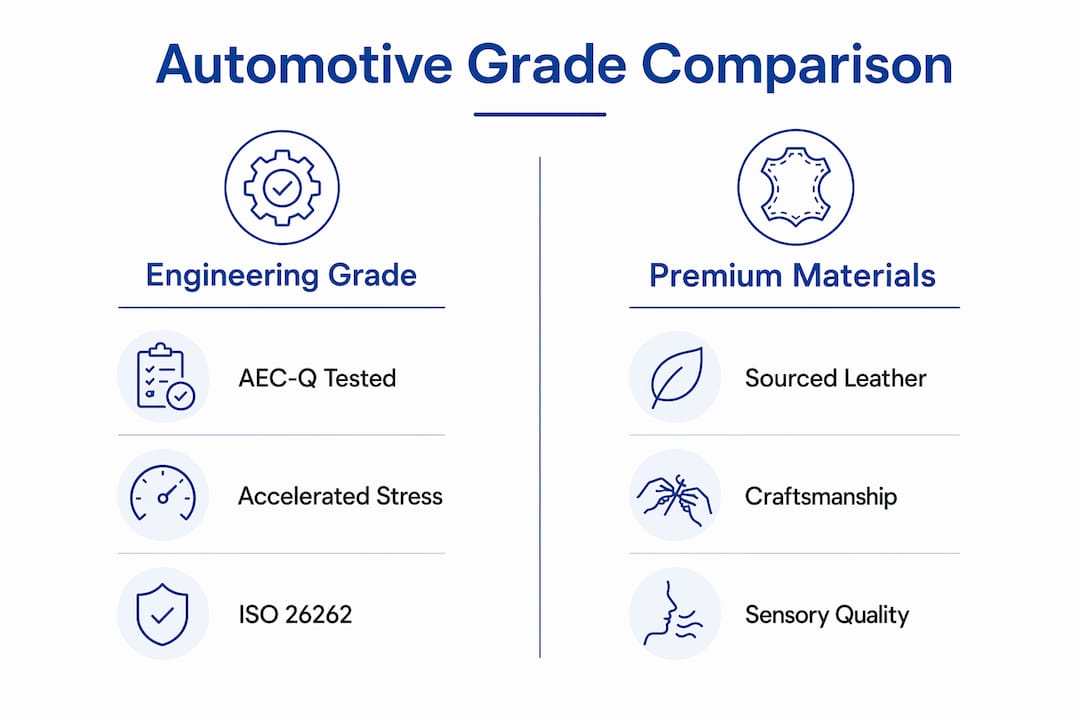
The engineering meaning is formal and testable. A component qualifies as automotive grade when it has survived accelerated stress tests that simulate years of field exposure, carries documented qualification data, and comes with a supplier lifecycle commitment. An infotainment module, for example, either has AEC-Q100 qualification records or it does not. There is no gray area.
The luxury-materials meaning is about sensory quality, craftsmanship, and sourcing integrity. Nappa leather is "premium" because of hide selection, tanning process, and traceability, not because it passed an electrical stress test. These claims are evaluated through provenance documents, third-party certifications, and physical inspection.
| Attribute | Engineering-grade components | Premium materials/finishes |
|---|---|---|
| Evaluated by | AEC-Q test data, PPAP, IATF 16949 audit | Provenance docs, sourcing certs, visual/tactile inspection |
| Documentation | Qualification reports, DFMEA, SPC data | Supplier origin statements, animal welfare certs |
| Buyer impact | Safety, reliability, warranty validity | Aesthetics, durability, resale value |
| Red flag | Missing test records, undocumented replacements | Generic "genuine leather" label, no sourcing info |
Pro Tip: A dealer who uses "automotive grade" to describe both the electronics and the leather in the same breath is almost certainly using it as a marketing term. Ask which meaning they intend, then ask for the corresponding documentation.
What technical standards actually define automotive-grade components?
The core standards buyers should know:
- AEC-Q100 / AEC-Q101 / AEC-Q200: The Automotive Electronics Council qualification standards for integrated circuits, discrete semiconductors, and passive components. A part is AEC-Q qualified only after passing specific stress tests with defined sample sizes and durations.
- IATF 16949: The automotive quality management system standard that governs how parts are manufactured, not just designed. A supplier certified to IATF 16949 operates under statistical process controls and mandatory change-notification requirements.
- ISO 26262: The functional safety standard for road vehicles. It assigns Automotive Safety Integrity Levels (ASIL A–D) to safety-critical functions. Components in ASIL-rated systems must meet stricter design and verification requirements.
- IP/Ingress ratings: Relevant for sensors and connectors exposed to moisture or dust; an IP67 or IP69K rating confirms a component can withstand defined water and particulate exposure.
Temperature grades and why they matter
Grade 0 components are rated for −40°C to +150°C, covering under-hood environments where heat extremes are severe. Cabin and body electronics typically use Grade 1 (−40°C to +125°C). Consumer-grade parts often top out at 85°C, which is why substituting them in automotive applications creates reliability risk.
| Test type | Typical requirement | What it validates |
|---|---|---|
| HTOL (High-Temperature Operating Life) | 1,000+ hours | Long-term reliability under sustained heat |
| Thermal shock | Rapid cycling across full temp range | Solder joint and package integrity |
| Humidity bias | 85°C / 85% RH, extended duration | Moisture resistance in cabin electronics |
| Vibration/mechanical shock | Per AEC-Q spec | Durability over road-induced stress |
The 2–5x cost premium for automotive-grade parts covers qualification testing, 100% production screening, PPAP documentation, FMEA analysis, SPC data, and 15-year supply commitments. The silicon itself is often identical to a consumer part; the difference is entirely in testing depth and documentation.
What "premium materials" actually means in a luxury interior
Luxury brands have moved beyond rarity as the sole measure of premium; understanding museum-quality standards helps clarify authenticity in high-end automobile materials. Provenance, animal welfare standards, and sustainable alternatives now define the top tier alongside tactile quality.
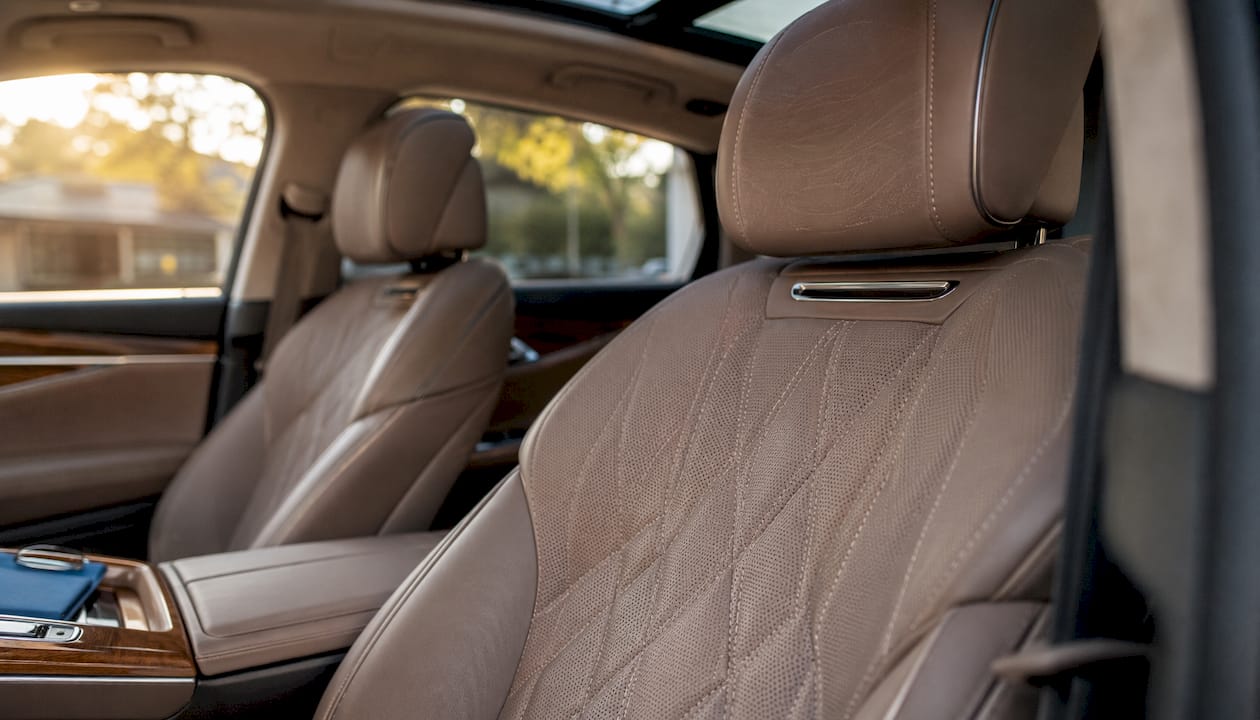
- Full-grain Nappa leather: The highest hide grade, with tight grain and minimal surface correction. Chrome-free tanning and traceable origin (farm or region) are now standard claims at the top of the market.
- Real wood veneers: Sourced from certified forests, bookmatched for grain consistency, and finished with UV-resistant lacquers. Synthetic wood-look panels are common in mid-range vehicles; the difference is visible under direct light.
- Forged and brushed metals: Aluminum, carbon fiber, and open-pore metals used in trim should show consistent machining and no visible seams or color variation between panels.
- Vegan and recycled alternatives: Polestar's interiors, for example, use chrome-free traceable leathers and recycled PET textiles that meet durability requirements while reducing environmental impact. MicroTech, a bio-attributed vinyl with recycled polyester carrier, is one example of a vegan material that performs comparably to leather in wear tests.
Provenance documentation means a specific supplier name, origin region, and ideally a third-party animal welfare or forest certification. "Genuine leather" with no further detail is not a valid provenance claim. For buyers interested in how traceable provenance affects vehicle pricing, the relationship is direct: documented sourcing supports higher resale valuations.
Pro Tip: Ask for the leather supplier's name and whether the hides are chrome-free and traceable. Brands that can answer this question specifically are the ones whose materials claims hold up at resale.
Why the distinction matters for safety and total ownership cost
Non-automotive-grade components in safety-critical systems create real liability exposure. OEMs require AEC-Q qualification and supplier lifecycle commitments for any ASIL-rated function, including braking, steering, and airbag systems. A replacement ECU installed without those credentials can void manufacturer warranty coverage and complicate insurance claims after an incident.
Ownership-cost consequences when components lack lifecycle commitments:
- Parts availability gaps within 5–7 years of production end
- Warranty disputes when a dealer cannot confirm OEM-equivalent qualification for a replaced module
- Higher repair frequency for components that were not designed to the vehicle's original thermal and vibration profile
For premium materials, poor maintenance compounds quickly. Unprotected Nappa leather begins showing stress cracking at high-wear points within two to three years without conditioning. Real wood veneers delaminate when exposed to repeated moisture cycles. These are not cosmetic issues at resale; they directly affect luxury car value retention.
Watch for these red flags when a seller uses "automotive grade" loosely:
- No documentation for replaced electronic modules
- Mismatched trim panels suggesting non-OEM repair
- Vague material descriptions ("premium interior," "leather-appointed")
- Missing service records for the period covering any major system replacement
How to verify premium claims at the dealership
- Request the build sheet and full service history. The build sheet confirms factory-installed specifications. Service records show what was replaced and by whom.
- Run a VIN check. The NHTSA recall database shows open recalls and completed safety campaigns. Cross-reference with the manufacturer's own service history portal.
- Ask specifically about replaced modules. "Was the infotainment module replaced with an OEM AEC-Q part? Can you show the supplier traceability or PPAP documentation?"
- Inspect materials in direct light. Grain consistency in leather, panel-to-panel color match in wood veneers, and machining uniformity in metal trim are all visible under natural or bright showroom light.
- Request provenance documentation for leather and wood. A supplier name and origin statement are the minimum; a third-party certification is better.
- Check for a pre-purchase inspection option. A short independent mobile technician inspection, specifically scoped to ASIL-level systems and material authenticity, is worth the cost on any vehicle above $50,000.
For a complete pre-owned luxury inspection checklist, the step-by-step process covers both electronics and materials in detail.
Pro Tip: A paid pre-purchase inspection by an independent technician familiar with the specific brand costs $150–$300 and can surface undocumented part replacements that a visual walkthrough misses entirely.
How long do premium components and materials actually last?
The engineering design target for automotive-grade components is a long service life. On a used vehicle with 40,000 miles, that means the original electronics should have substantial life remaining, provided no non-OEM replacements were made. The concern is not age alone but whether any replacement parts matched the original qualification level.
For luxury materials, expected lifespan depends heavily on maintenance:
- Full-grain Nappa leather: 10–15 years with conditioning every 3–6 months; high-wear bolsters show fatigue earlier without protection.
- Real wood veneers: Indefinite with UV protection and low humidity; delamination risk rises sharply in vehicles stored in high-humidity environments without climate control.
- Recycled PET and vegan textiles: Generally more resistant to UV and moisture than natural leather; wear patterns at seams are the primary failure point.
Signs of poor maintenance or non-OEM repair worth noting during inspection:
- Uneven patina or color variation across leather panels
- Veneer edges lifting at door cards or center console
- Replaced trim pieces that don't match the original finish grade
- Electronic modules with aftermarket labels or non-OEM connector housings
Maintenance costs for premium materials are real but predictable. Factoring them into total ownership cost, alongside parts availability for the electronics, gives a more accurate picture than purchase price alone. A luxury vehicle trade-in appraisal will reflect both.
Your quick inspection checklist for the test drive
Electronics and documentation:
- Confirm VIN against build sheet and service records.
- Check NHTSA recall status; verify all campaigns are closed.
- Ask for PPAP or AEC-Q documentation on any replaced electronic module.
- Test all driver-assist and safety systems during the drive (adaptive cruise, lane keep, emergency braking).
- Note any warning lights, system resets, or infotainment glitches.
Materials and finishes:
- Inspect leather in direct light for grain consistency, color match, and bolster wear.
- Check wood or metal trim panels for seam gaps, color variation, and surface lifting.
- Request leather provenance statement or supplier name.
Red flags to walk away on:
- Replaced modules with no documentation
- Mismatched trim panels or obvious non-OEM repairs
- "Genuine leather" or "premium interior" with no sourcing specifics
- Service history gaps covering major system work
Document your findings: Take photos of every panel, module label, and document the dealer provides. A short video of the test drive with systems active creates a timestamped record useful for warranty negotiations. For more on spotting dealer red flags, the patterns repeat across brands.
Key Takeaways
"Premium automotive grade" covers two distinct, verifiable standards: engineering certification for components and documented provenance for materials, and buyers who can tell them apart negotiate from a position of real knowledge.
| Point | Details |
|---|---|
| Two separate standards | Engineering grade (AEC-Q, ISO 26262) and material premium (provenance, sourcing) require different documentation. |
| Temperature range signals quality | Genuine automotive-grade electronics are rated for −40°C to +150°C; consumer parts typically top out at 85°C. |
| Cost premium is real | The 2–5x price premium for automotive-grade parts reflects testing, PPAP documentation, and 15-year supply commitments. |
| Provenance beats marketing labels | A supplier name, chrome-free certification, and traceable origin outweigh any generic "premium leather" claim. |
| Autovendorsfl | Autovendorsfl curates verified luxury inventory and offers personalized sourcing with documentation review built in. |
The gap between what "premium" promises and what it actually proves
Most buyers walk into a luxury dealership focused on how a car looks and feels, which is exactly what marketing is designed to encourage. The problem is that "premium automotive grade" as a phrase does almost no work on its own. A dealer can apply it to a chrome trim strip and an ASIL-D-rated brake controller in the same sentence, and technically neither claim is wrong.
What actually matters is the paper trail. An AEC-Q qualification report is a real document with test data, sample sizes, and failure modes. A provenance statement from a named leather supplier is a real document with a traceable supply chain. A generic "automotive grade" sticker on a replacement part is not evidence of anything.
The buyers who get the best outcomes are the ones who ask for the specific document, not the general assurance. If a dealer cannot produce PPAP evidence for a replaced module or a sourcing statement for the leather, that absence is itself information. It does not necessarily mean the part is substandard, but it does mean the "premium" claim is unverified, and unverified claims should affect the price you pay.
Find a truly premium vehicle at Autovendorsfl
Knowing what defines premium automotive grade is only useful if the vehicle in front of you can actually be verified against those standards. Autovendorsfl specializes in curating luxury inventory where the documentation exists to back the claims, from service history and build sheets to provenance details on interior materials.
The team offers personalized vehicle sourcing for buyers who want a specific make, model, and specification, along with hands-on inspection support that covers both electronics documentation and materials authenticity. If you are ready to put these standards to work on a real purchase, browse the current S-Class inventory or contact the team directly to start a sourced search for your next vehicle.
Authoritative sources and standards for further research
Standards and regulatory bodies:
- AEC-Q100 / AEC-Q101 / AEC-Q200 (Automotive Electronics Council): The qualification stress-test standards for ICs, discretes, and passives. Certifiable documentation; not a marketing term.
- IATF 16949 (AIAG / IATF): The automotive-specific quality management system standard governing manufacturing processes. A supplier audit certificate is verifiable.
- ISO 26262: Functional safety standard for road vehicles; assigns ASIL levels to safety-critical functions. Relevant when evaluating any replaced safety-system component.
- NHTSA Recall Lookup (nhtsa.gov/recalls): Free VIN-based recall check. Use before any used vehicle purchase to confirm all safety campaigns are closed.
Key reference articles used in this guide:
- What is Automotive Grade? (RF Essentials): Defines AEC-Q qualification and lifecycle testing requirements.
- Automotive-Grade vs. Industrial-Grade Components (Promwad): Explains the cost premium, PPAP requirements, and supplier commitment differences.
- Industrial, Automotive, and Consumer Grade Comparison (Perceptive-IC): Temperature grade breakdown and application environments.
- Extraordinary Materials (Bentley Motors): Provenance, animal welfare standards, and sustainable material sourcing in luxury interiors.
- Polestar 3 Interior (Polestar US): Concrete examples of traceable, chrome-free leathers and recycled PET textile alternatives.
- Considerations for Automotive-Grade Resistors (EE Power): Explains how suppliers define and document automotive-grade claims, including PPAP and IATF 16949.
What is certifiable vs. what is marketing:
- Certifiable: AEC-Q test reports, IATF 16949 audit certificates, PPAP documentation, ISO 26262 ASIL classification, named leather supplier with traceability statement.
- Marketing only: "Automotive grade," "premium interior," "genuine leather," "high-quality components" with no supporting documentation.