
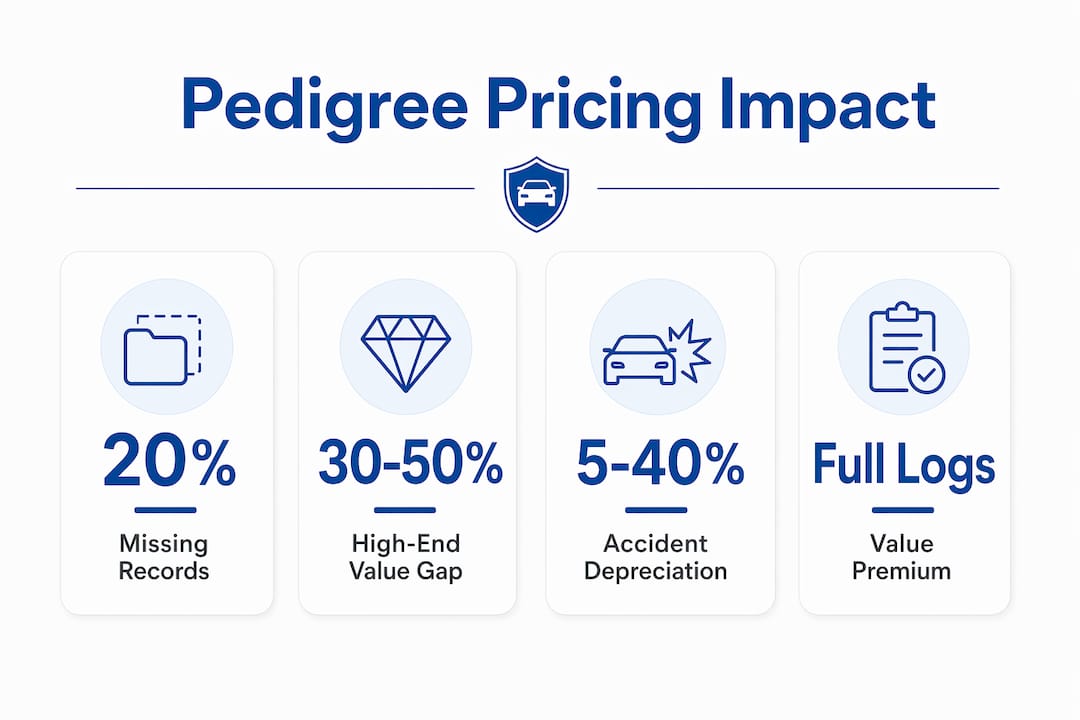
Vehicle pedigree is defined as the complete documented history of a car, covering ownership records, service logs, accident reports, and preservation treatments. Understanding how vehicle pedigree affects pricing is the single most important skill a luxury car buyer can develop. Missing or incomplete documentation can reduce resale value by 20% or more, while a fully documented history adds a 5–10% premium. The industry term for this concept is provenance, and it functions as verified proof that a vehicle was maintained, stored, and handled with care.
How vehicle pedigree affects pricing: the key elements
Pedigree is not a single data point. It is a collection of records that, together, tell a buyer exactly what a vehicle has been through. Each element carries its own weight in the final price calculation.
The core pedigree components that buyers and appraisers evaluate include:
- Maintenance and service facility records. Where a car was serviced matters as much as how often. Authorized dealer records add measurable value, while vague or missing maintenance history triggers a 20% or greater discount. A car serviced exclusively at a brand-authorized facility signals that factory standards were followed at every interval.
- Accident and damage history. Even a minor fender repair, if undisclosed, creates distrust. Buyers treat any gap in the accident record as a red flag, regardless of how the car looks today.
- Ownership lineage. A vehicle with one or two careful, documented owners commands more confidence than one with five owners in seven years. Frequent ownership changes suggest problems that prior buyers chose to exit.
- Detailing and preservation treatments. Documented preservation services such as ceramic coatings shift buyer perception from "used car" to "investment asset." This distinction matters most in the luxury segment.
- Storage history. A vehicle garaged in a climate-controlled facility depreciates more slowly than one parked outdoors year-round. Documented storage conditions are a legitimate pedigree signal.
The effects of these factors are not additive in a simple, linear way. A car with strong service records but a single severe accident does not average out to "medium pedigree." The accident record dominates the conversation and can override every other positive factor.
Pro Tip: Request a full digital service log, not just a printed summary. Digital logs with timestamped entries and facility identifiers are far harder to falsify than paper records.

How does accident history influence vehicle resale value?
Accident history is the most quantifiable pedigree factor in pricing. The impact follows a clear severity scale, and buyers who understand it negotiate from a position of real knowledge.
- Minor damage (5–10% value reduction). Cosmetic repairs with no structural involvement. Paint work, bumper replacement, and minor panel repairs fall here. The car drives and functions normally, but the Carfax notation exists.
- Moderate damage (10–20% value reduction). Frame or structural components were affected but repaired. Alignment, suspension geometry, and long-term reliability become legitimate concerns.
- Severe damage (20–40% value reduction). Major structural compromise, significant frame damage, or total-loss designation. Airbag deployment adds an additional 5–15% penalty on top of the base severity discount. Deployed airbags indicate the collision was forceful enough to trigger safety systems, which raises questions about hidden structural stress.
- Multiple accidents. Each additional incident compounds the discount. A car with two moderate accidents does not carry a 15% discount. It carries a compounded penalty that can push it into severe-damage pricing territory.
The buyer psychology behind these numbers is straightforward. Provenance gaps reduce enthusiasm and final sale prices even when the cosmetic condition appears strong. A buyer who cannot verify what happened to a car will price in the uncertainty. That uncertainty has a dollar value, and it always favors the buyer, not the seller.
Insurance companies and lenders apply similar logic. A vehicle with a severe accident history may be ineligible for certain financing products or may require a higher down payment. This limits the pool of qualified buyers and puts further downward pressure on price.
Why verified maintenance records matter for luxury buyers
Verified service records are the most direct way a seller can protect the asking price of a luxury vehicle. For buyers, they are the clearest signal that a car was treated as an investment rather than a tool.
The distinction between digital and paper records is significant:
- Digital service logs with timestamped entries, facility names, and technician identifiers are verifiable and tamper-resistant. They give buyers confidence that the history is accurate.
- Paper records are easier to lose, alter, or fabricate. A thick folder of paper receipts is better than nothing, but it carries less weight than a verified digital trail.
- No records is the most expensive outcome for a seller. The 20% or greater discount for missing documentation applies regardless of how well the car presents in person.
Buyers shopping for pre-owned luxury vehicles should specifically request records from authorized or brand-specialized service centers. A Porsche serviced at an independent shop with no brand affiliation carries less pedigree weight than one with a complete record from a Porsche-authorized facility. The same principle applies across all luxury marques.
Documented detailing treatments add a layer of pedigree that most buyers overlook. A ceramic coating applied by a certified detailer and logged in the service record tells a buyer that the previous owner cared about long-term preservation, not just day-to-day use. That signal has real value in price negotiations.
Pro Tip: Ask the seller to provide the name and contact information for the primary service facility. A quick call to verify the service history takes five minutes and can save thousands of dollars.
How pedigree influences price across vehicle price tiers
The relationship between pedigree and price is not uniform across all vehicle categories. It scales sharply with vehicle value, and understanding this curve helps buyers allocate their due diligence correctly.
For vehicles priced below $10,000, pedigree is a minor factor. Buyers in this segment prioritize mechanical function and immediate repair costs. A missing service record on a $7,000 commuter car is inconvenient but rarely a deal-breaker.
Above $25,000, pedigree becomes a primary pricing variable. Buyers at this level expect documentation and will discount aggressively when it is absent. Above $50,000, pedigree is non-negotiable. Two identical vehicles can show a 30–50% valuation spread based solely on the quality of their documented history. That spread represents tens of thousands of dollars on a single transaction.
At the collector and investment-grade level, pedigree creates what the market calls micro-economies. Bespoke tuning, limited production runs, and documented racing or competition history detach a vehicle's price from normal depreciation curves entirely. A car with verified competition history commands a narrative premium. 19% of collector car listings reference some form of competition pedigree, even when only 2% of those vehicles are actual racing cars. Sellers understand that history creates desirability, and desirability creates price.
The practical takeaway for buyers is this: the more you spend, the more pedigree documentation you should demand. A luxury car's ability to hold value over time depends directly on the quality of its paper trail.
What steps can buyers take to assess vehicle pedigree?
Evaluating pedigree before purchase is a structured process, not a gut-check. Buyers who follow a consistent approach avoid the most common and costly mistakes.
- Pull a vehicle history report from a recognized provider. Carfax and AutoCheck are the two widely accepted standards in the United States. These reports aggregate accident records, title changes, odometer readings, and service history from thousands of data sources. Odometer fraud affects 2.45 million US vehicles and increases at 14% per year, causing an average loss of $3,300 per affected car. A history report catches rollback flags before you sign anything.
- Request the complete service record, not a summary. Ask for every invoice, every service entry, and every facility name. Gaps in the timeline are as informative as the records themselves.
- Verify the VIN across all documents. The VIN on the report, the title, the dashboard, and the door jamb must all match. Mismatches indicate title washing or parts substitution.
- Check for title brands. Salvage, rebuilt, flood, and lemon law buyback titles are permanent pedigree penalties. No amount of cosmetic work removes a branded title from a vehicle's record.
- Use pedigree findings as negotiation leverage. A documented accident or a gap in service history is not just a warning sign. It is a concrete basis for a lower offer. Buyers who arrive with specific findings negotiate from a position of fact, not opinion.
For rare or high-value vehicles, a pre-purchase inspection by an independent specialist adds a final layer of verification. The inspection process for luxury vehicles should always include a pedigree review alongside the mechanical assessment.
Key takeaways
Vehicle pedigree directly determines price in the luxury segment, with documented history adding premiums and missing records triggering discounts that can exceed 20%.
| Point | Details |
|---|---|
| Missing records cost sellers | Incomplete documentation reduces resale value by 20% or more, regardless of condition. |
| Accident severity sets the discount | Minor damage cuts 5–10%; severe damage with airbag deployment can cut 35–55% combined. |
| Digital logs outperform paper | Timestamped digital service records are verifiable and carry more weight with buyers and appraisers. |
| Price tier amplifies pedigree impact | Above $50,000, two identical cars can differ by 30–50% based on documented history alone. |
| Buyers should use pedigree to negotiate | Specific documented findings give buyers factual grounds to reduce the asking price. |
Why I stopped treating pedigree as optional
Buyers consistently underestimate pedigree until they experience its financial consequences firsthand. I have watched buyers walk away from a well-priced luxury vehicle because the service records had a two-year gap, and I have watched others overpay for a car that looked perfect but carried a hidden structural repair. The market does not forgive either mistake.
The most common misconception I encounter is that a beautiful car speaks for itself. It does not. Cosmetic condition tells you what a car looks like today. Pedigree tells you what it has been through for its entire life. Those are two entirely different conversations, and only one of them predicts long-term value.
Buyers who prioritize pedigree alongside mileage and condition consistently make better purchases. They pay fair prices, retain more value at resale, and avoid the expensive surprises that come with undisclosed history. The digital shift in service documentation is accelerating this trend. Within the next few years, a car without a verifiable digital service trail will face the same market skepticism that a car with no history report faces today.
My advice is direct: treat pedigree documentation as a purchase requirement, not a nice-to-have. If a seller cannot produce it, price that gap into your offer or walk away.
— Allen
Verified luxury inventory at Autovendorsfl in Fort Lauderdale
Autovendorsfl curates a premium selection of luxury vehicles with documented histories, verified service records, and transparent ownership backgrounds. Every vehicle in the inventory reflects the dealership's commitment to quality and buyer confidence.
Autovendorsfl's team in Fort Lauderdale takes a hands-on approach to sourcing, which means buyers get access to vehicles where the pedigree has already been evaluated. You are not starting from scratch. You are working with a dealership that has done the verification work before the car reaches the lot. Browse the current available inventory and connect with the Autovendorsfl team to find a vehicle whose history matches its price.
FAQ
What is vehicle pedigree in the context of car pricing?
Vehicle pedigree is the complete documented record of a car's ownership, service history, accident reports, and preservation treatments. It directly affects pricing because buyers use it to verify authenticity and assess risk before purchase.
How much can a missing service record reduce a car's value?
Missing or incomplete documentation can reduce a vehicle's resale value by 20% or more. A fully documented history, by contrast, can add a 5–10% premium to the asking price.
Does accident history always lower a vehicle's price?
Accident history reduces value in proportion to severity, ranging from 5–10% for minor damage to 20–40% for severe structural damage. Airbag deployment adds an additional 5–15% penalty on top of the base discount.
Why does pedigree matter more for expensive vehicles?
Above $50,000, two otherwise identical vehicles can show a 30–50% valuation spread based solely on the quality of their documented history. At lower price points, buyers prioritize mechanical condition over provenance.
What documents should a buyer request to verify vehicle pedigree?
Buyers should request a vehicle history report, complete service invoices with facility names, the original title, and any documentation of preservation treatments such as ceramic coatings or specialized storage.