
Dealer incentives are financial and non-financial rewards that manufacturers pay directly to dealerships to influence which vehicles they prioritize, promote, and sell. The role of dealer incentives explained simply: they shape dealer behavior from the inside, affecting everything from showroom floor space to the price a buyer sees on a contract. For luxury car buyers, understanding how dealer incentive programs work is one of the most underused advantages in any negotiation. These programs operate largely out of public view, yet they directly determine how much room a dealer has to move on price.
What are the main types of dealer incentives and how do they work?
Dealer incentives fall into several distinct categories, each structured differently and paid at different times. Knowing the difference between them tells you a lot about when and why a dealer becomes motivated to deal.
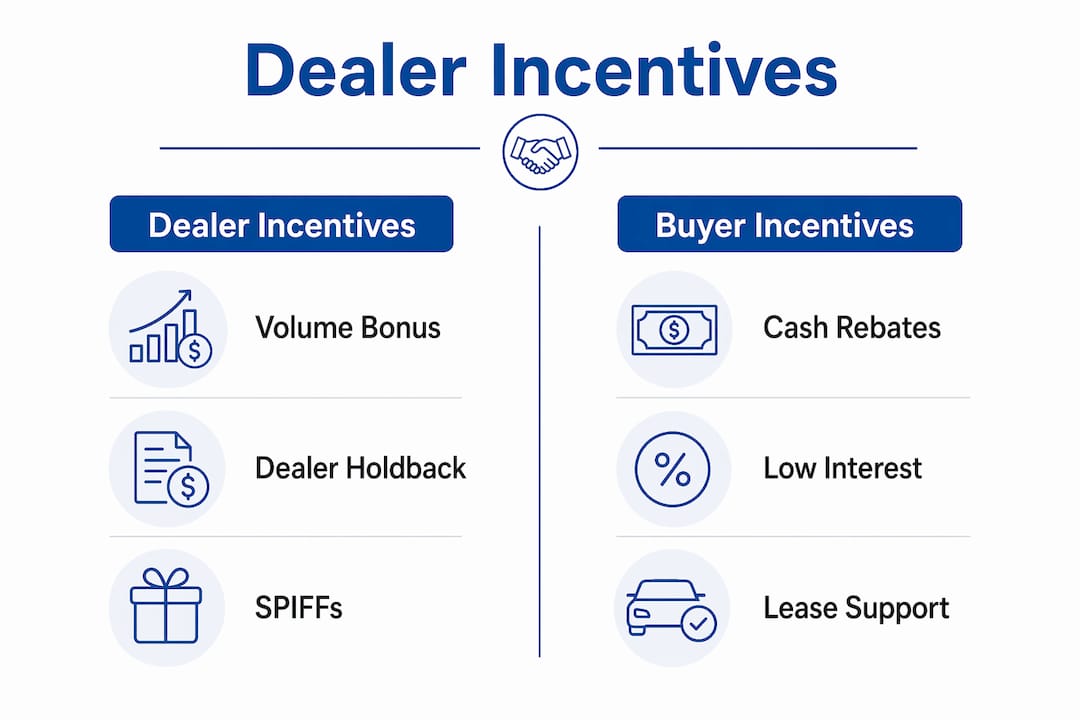
Volume bonuses reward dealers for hitting monthly or quarterly sales targets. Manufacturers set tiered thresholds, and dealers who cross each tier earn a bonus per unit sold. Stair-step incentives work similarly but accelerate the reward: selling one more unit can unlock a bonus that applies retroactively to every car sold that month. The math creates intense pressure near quota deadlines.

Dealer holdback is a separate payment built into the invoice price. Dealer holdback typically ranges from 1% to 3% of MSRP, returned to the dealer quarterly. This means a dealer can sell a car at invoice and still earn a profit. Buyers who negotiate to invoice price are not getting the dealer's true floor.
SPIFFs (Sales Performance Incentive Funds) are paid directly to individual salespeople, not the dealership as a whole. These are legal in the United States, with SPIFF payments above $2,000 triggering 1099-MISC reporting requirements. A salesperson earning a SPIFF on a specific model has a personal financial reason to steer you toward that vehicle.
Co-op advertising funds reimburse dealers for approved marketing spend on specific models. Training certification incentives reward dealerships whose staff complete manufacturer training programs. Both types shape which vehicles get promoted and which staff members are most prepared to sell them.
| Incentive Type | Who Receives It | Timing | Typical Value |
|---|---|---|---|
| Volume bonus | Dealership | Monthly or quarterly | Varies by tier and model |
| Dealer holdback | Dealership | Quarterly | 1%–3% of MSRP |
| SPIFF | Individual salesperson | Per unit sold | Hundreds to low thousands |
| Dealer cash | Dealership | Per unit, near quota | $500–$5,000+ per unit |
| Co-op advertising | Dealership | Campaign-based | Percentage of ad spend |
Pro Tip: Ask your salesperson directly which models are on a current SPIFF program. Dealers are not required to disclose this, but some will. The answer tells you exactly where their personal incentive lies.
How do dealer incentives impact luxury car pricing and dealer behavior?
The impact of dealer incentives on pricing is significant and often invisible to buyers. Dealer incentive spend reached 7.3% of average vehicle transaction price in mid-2025, up from 7.0% in 2024. That percentage represents real money sitting between the sticker price and the dealer's actual cost.
Invoice price is not the dealer's true floor. The dealer's true cost is lower than invoice because holdback, dealer cash, and volume bonuses layer on top of each other. A luxury dealer selling a vehicle at $500 below invoice may still net several thousand dollars in back-end incentive payments. This is why some dealers appear willing to lose money on a transaction. They are not losing money at all.
Dealers with multiple franchises make deliberate choices about where to focus their energy. Dealers allocate prime floor space and marketing efforts in proportion to how attractive each brand's incentive program is. A Mercedes-Benz franchise sitting next to a less incentivized brand will receive more staff attention, better showroom placement, and more aggressive local advertising when Mercedes-Benz's program is stronger.
Stair-step bonuses create predictable windows of opportunity for buyers. A dealer sitting three units short of a tier threshold on the last week of the month has a strong financial reason to close deals quickly. Dealers may sell below invoice near quota deadlines, substituting front-end margin for back-end incentive payouts. Timing a purchase near month-end or quarter-end is not a myth. It is a direct response to how incentive programs are structured.
| Factor | Effect on Dealer | Effect on Buyer |
|---|---|---|
| Holdback (1%–3% MSRP) | Profit even at invoice price | Invoice is not the real floor |
| Dealer cash ($500–$5,000+) | Invisible margin buffer | Room for below-invoice deals |
| Stair-step bonus | Urgency near quota deadline | Month-end negotiating leverage |
| Incentive spend (7.3% of price) | Significant back-end profitability | Pricing is more flexible than it appears |
Pro Tip: Use car buying strategies that account for back-end incentives. Negotiating only against MSRP leaves real money on the table.
What nuances should luxury buyers know about dealer incentives?
Luxury car buyers face a more complex incentive environment than mainstream buyers. The stakes are higher, the programs are more layered, and regional differences can be substantial.
Key facts every luxury buyer should understand:
-
Regional incentive variation is real. Incentives are factory-defined by zone, and differences between adjacent zones can exceed $1,500 for the same model. Expanding your search to a neighboring region can produce meaningful savings with no sacrifice in vehicle quality.
-
Incentive targets shift mid-cycle. Manufacturers adjust incentive goals dynamically, sometimes increasing requirements after dealers have already planned their sales approach. A dealer who was close to a bonus threshold last week may be further away this week. This affects how aggressively they negotiate.
-
Dealer cash and consumer rebates are different things. Dealer cash is paid to the dealership and never appears on your purchase agreement. Consumer rebates are applied directly to your purchase price and are visible. Both can exist on the same vehicle simultaneously.
-
Out-the-door quotes reveal more than sticker prices. Requesting an itemized out-the-door quote from multiple dealers forces transparency. Price spreads between dealers on the same model often reflect different incentive positions, not different costs.
-
Relationship-building has real value. A dealer who knows you are serious and informed will often work harder on pricing than one who senses a casual browser. Demonstrating knowledge of incentive timing signals that you are a buyer worth closing.
-
Shopping multiple dealerships is not disloyal. Invoice price is an imperfect baseline, and undisclosed dealer incentives create wide price spreads among dealers. Comparing three quotes on the same model is the single most effective way to see where the real floor sits.
Understanding dealer incentives explained through these nuances gives luxury buyers a genuine edge. The buyers who get the best deals are not the most aggressive negotiators. They are the most informed ones.
How do manufacturer incentives differ from consumer incentives?
Manufacturer incentives split into two distinct categories: those paid to dealers and those offered directly to buyers. The difference matters because each type affects your purchase in a completely different way.
Consumer-facing incentives include cash rebates, low-interest financing, and lease support. These are visible, advertised, and applied directly to your transaction. A $3,000 cash rebate on a luxury sedan shows up on your purchase agreement. A 0.9% financing offer from a captive lender like Mercedes-Benz Financial Services is clearly stated at signing.
Dealer-facing incentives work differently. Manufacturers use incentive programs to motivate dealers to prioritize models and meet volume goals without eroding brand value. A permanent price cut would signal weakness and damage the brand's premium positioning. A dealer incentive achieves the same sales result without touching the public price.
The key distinction for buyers:
- Consumer rebates reduce your purchase price directly and are negotiable in combination with dealer discounts.
- Dealer cash stays with the dealership unless the dealer chooses to pass some of it through as a discount.
- Both types can stack on the same vehicle, creating more total room than either type alone suggests.
Luxury brands like BMW, Mercedes-Benz, and Audi use dealer incentives heavily to protect residual values and brand perception. Offering a public discount on a flagship model would undermine the very exclusivity that justifies the price. Dealer incentives let manufacturers support sales volume without that cost. Understanding how dealer and consumer incentives interact gives buyers a clearer picture of the total discount available on any given vehicle.
Key Takeaways
Dealer incentives are the primary mechanism manufacturers use to control dealer behavior, protect brand value, and drive sales volume without public price cuts.
| Point | Details |
|---|---|
| Invoice is not the real floor | Holdback, dealer cash, and volume bonuses mean dealers profit even at invoice price. |
| Timing creates leverage | Month-end and quarter-end deadlines push dealers to close deals below their normal floor. |
| Regional variation is significant | Incentive differences between adjacent zones can exceed $1,500 on the same model. |
| Dealer and consumer incentives stack | Both types can apply simultaneously, creating more total room than either alone suggests. |
| Informed buyers get better deals | Understanding incentive structure gives luxury buyers a negotiating advantage most buyers never use. |
What I've learned negotiating luxury vehicle deals
Working in and around the luxury automotive market for years, the single biggest mistake I see buyers make is treating the invoice price as the finish line. It is not even close to the finish line. The real negotiation starts after you understand what the dealer is earning on the back end.
The buyers who consistently get the best deals share one habit: they shop at the right time. Month-end urgency is real. A dealer three units short of a stair-step bonus threshold will move in ways that would be unthinkable two weeks earlier. Showing up informed and ready to close on the last few days of the month is worth more than hours of aggressive back-and-forth at any other time.
I also think buyers underestimate regional incentive differences. A $1,500 gap between two dealers in adjacent zones on the same Mercedes-Benz model is not unusual. Most buyers never check. The ones who do drive a little farther and save a lot more.
The advice I give every luxury buyer is simple: get three itemized out-the-door quotes, time your purchase near a quota deadline, and ask directly about any current dealer cash programs. You will not always get a straight answer. But asking the question changes the dynamic of the conversation in your favor.
— Allen
Luxury vehicles at Autovendorsfl with incentive-aware pricing
Autovendorsfl at Auto Vendors Inc in Fort Lauderdale works directly with buyers who want to apply this knowledge to a real purchase.
The team at Autovendorsfl understands how dealer incentive programs affect pricing on premium models and uses that knowledge to help buyers get competitive deals. If you are considering a flagship luxury sedan, the Mercedes-Benz S-Class inventory at Autovendorsfl is a strong starting point. Each vehicle is curated for quality, and the buying process is built around transparency and personalized guidance. Reach out to Autovendorsfl directly to discuss current incentive availability and pricing on the models you are considering.
FAQ
What are dealer incentives in simple terms?
Dealer incentives are payments manufacturers make directly to dealerships to reward sales performance and encourage prioritization of specific models. They are separate from any discounts offered to buyers.
Does dealer holdback affect the price I pay?
Dealer holdback of 1%–3% of MSRP is returned to the dealer quarterly and is not shown on your purchase agreement. It gives dealers profit margin even when selling at invoice, which means invoice is not the buyer's best possible price.
When is the best time to buy a luxury car using incentive timing?
The last few days of a month or quarter are the strongest window. Dealers chasing stair-step volume bonuses are most motivated to close deals quickly and may price below their normal floor.
Are dealer incentives the same across all dealerships?
No. Incentives are defined by factory-assigned regional zones, and differences between adjacent zones can exceed $1,500 on the same model. Dealers within the same brand also vary based on their individual quota position and franchise agreements.
Can dealer incentives and consumer rebates apply to the same vehicle?
Yes. Both types can stack on a single transaction. A consumer rebate reduces your purchase price directly, while dealer cash stays with the dealership unless passed through as an additional discount.