
Dealership relationship managers are the primary liaison between automotive manufacturers, finance institutions, and dealer networks, responsible for driving sales volume, resolving dealer issues, and protecting institutional compliance. Known formally as dealer relationship managers or indirect auto dealer relationship managers, these professionals sit at the intersection of sales, service, and risk management. Their work shapes everything from how quickly a dealer responds to a customer inquiry to whether a finance contract meets compliance standards. Understanding the role of dealership relationship managers reveals why this position is one of the most operationally demanding in automotive retail.
What do dealership relationship managers actually do?
The core function of a dealer relationship manager is to build and maintain relationships with senior dealer staff, including Finance Directors, Sales Managers, General Managers, and dealer principals. These are not casual check-ins. Every interaction is designed to present company value, address dealer concerns, and move contract volume and efficiency goals forward. The relationship manager is, in practical terms, the face of the manufacturer or lender inside the dealership.
Day-to-day responsibilities span a wider range than most people expect. Here is a breakdown of the primary tasks:
- Dealer visits and relationship building. Industry standards require conducting a minimum of 100 face-to-face dealer visits per month. That frequency is not arbitrary. It reflects the reality that trust in automotive retail is built through consistent, in-person presence, not email chains.
- CRM documentation. Every dealer interaction, issue, and follow-up must be logged in CRM software such as Salesforce. Accurate documentation protects the institution and creates an auditable trail for compliance reviews.
- Issue escalation and fraud investigation. Relationship managers serve as the first line of defense against fraud accounts and unperfected liens. When a red flag appears, they investigate, document, and escalate to legal or compliance teams.
- Market intelligence and dealer training. Providing dealers with current market data, product knowledge, and process training is a core deliverable. This directly supports dealer sales performance and customer service quality.
- Cross-departmental coordination. High-performing managers coordinate across credit, funding, legal, inventory, and service departments to resolve multi-faceted dealer issues efficiently.
Pro Tip: Before each dealer visit, review the dealer's recent contract volume, any open compliance flags, and their last three CRM notes. Walking in prepared signals professionalism and saves time on both sides.
How are dealership relationship managers measured?

Performance measurement in this role centers on outcomes, not activity. The most important metrics fall into three categories: commercial production, relationship quality, and compliance health.
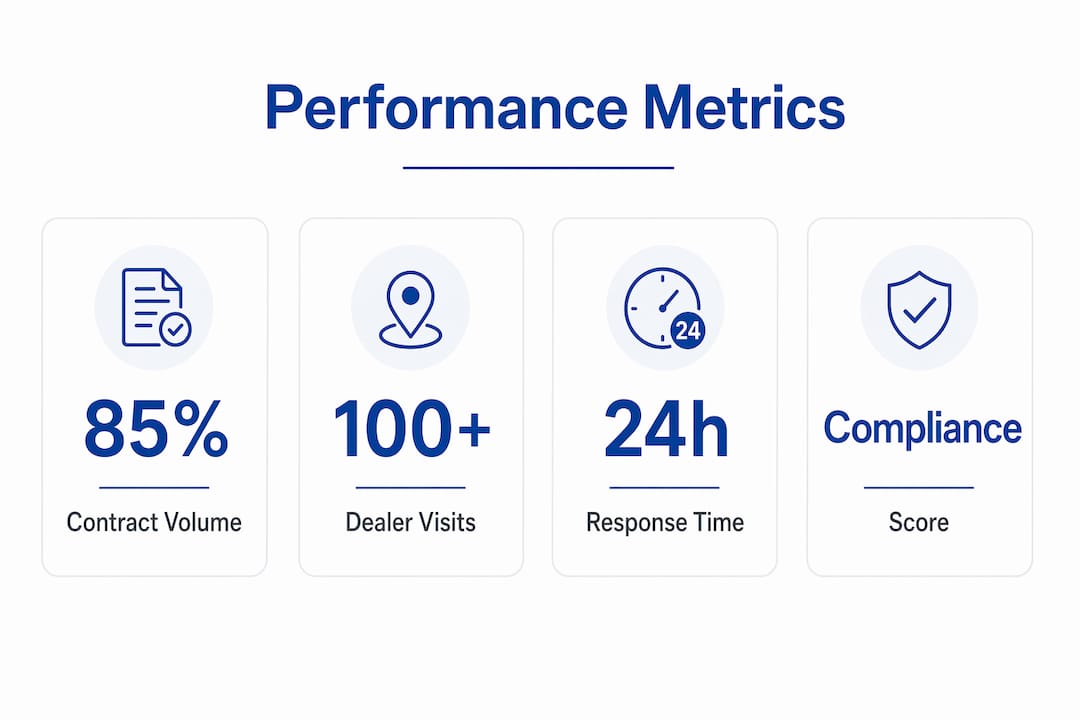
On the commercial side, managers are evaluated against monthly and quarterly targets for contract volume, loan or finance production, and penetration rates within their assigned dealer portfolio. Missing these targets consistently signals either weak dealer relationships or misaligned product positioning.
Key performance indicators used across the industry include:
- Contract volume and quality: Total contracts submitted, approval rates, and funding turnaround times
- Dealer visit frequency: Whether the manager is meeting the 100 visits per month benchmark and following up within agreed timeframes
- Customer inquiry response times: Dealers trained by strong relationship managers respond to online inquiries in under 15 minutes during business hours, a threshold tied directly to conversion rates
- Compliance and risk indicators: Number of fraud events identified, open compliance cases, and resolution speed
The table below shows how these metrics map to business outcomes:
| Metric | Business outcome |
|---|---|
| Contract volume vs. target | Measures direct revenue contribution and dealer engagement depth |
| Dealer visit frequency | Indicates relationship investment and proactive issue prevention |
| Response time to dealer inquiries | Reflects service quality and dealer satisfaction levels |
| Compliance red flags resolved | Protects institutional exposure and dealer trust simultaneously |
CRM activity is an input, not an outcome. Institutions that confuse logging calls with generating results tend to produce managers who are busy but not effective.
What challenges do dealership relationship managers face?
The role carries a set of structural challenges that separate average performers from exceptional ones. Understanding these challenges is the first step toward overcoming them.
- High travel demands. Covering a territory with dozens of active dealers requires careful weekly planning. Successful managers plan activities around key dealer KPI touchpoints to minimize paperwork lag and maximize face time with decision-makers.
- Balancing dealer expectations with company policy. Dealers want flexibility. Institutions want compliance. The relationship manager sits in the middle, which means delivering difficult messages without damaging trust.
- Leadership transitions at dealerships. When a Finance Director or General Manager leaves, months of relationship equity can disappear overnight. Managers who document relationships thoroughly in CRM and build connections across multiple levels of dealer leadership are far more resilient to this disruption.
- Siloed internal responses. Conflict between sales and service handoffs can fracture customer relationships and frustrate dealers. Relationship managers who coordinate cross-functionally resolve issues faster and build a reputation as true problem-solvers.
- Staying current on market conditions. Effective dealer relationship management requires market fluency and channel intelligence beyond pure sales management. Dealers notice quickly when a manager cannot speak credibly to local inventory trends or competitive pricing shifts.
Pro Tip: When taking over a new territory, spend the first 60 to 90 days in structured listening mode. Ask dealers what is working, what is not, and what they wish their previous contact had done differently. This approach builds trust faster than any sales pitch.
Why does this role matter for dealership customer experience?
The customer experience in automotive retail is a competitive battleground spanning multiple touchpoints, from the first online inquiry to post-sale service follow-up. Dealer relationship managers sit at the center of this experience, even though customers never meet them directly.
Consider how the connection works in practice. A relationship manager trains a dealer's finance team on response protocols. That training directly determines whether a customer who submits an online inquiry at 10 a.m. receives a call back within 15 minutes or waits three hours. The difference between those two outcomes is the difference between a sale and a lost customer.
The table below compares dealership customer experience outcomes with and without active relationship management support:
| Experience factor | Without active RM support | With active RM support |
|---|---|---|
| Online inquiry response time | Often exceeds 60 minutes | Consistently under 15 minutes |
| Sales-to-service handoff quality | Fragmented, inconsistent | Coordinated, documented |
| Dealer staff product knowledge | Inconsistent across team | Regularly updated through training |
| Compliance and contract accuracy | Higher error rates | Proactively monitored and corrected |
Customer experience is a continuous journey, and dealers that excel maintain contact and service excellence beyond the point of sale. Relationship managers reinforce this by coaching dealers on follow-up cadence, service appointment outreach, and loyalty program utilization. The result is a dealer that retains customers across multiple vehicle purchases, not just one transaction.
Full-service dealerships that invest in relationship management infrastructure consistently outperform those that treat dealer contacts as transactional. The compounding effect of trust, training, and consistent follow-through creates a dealer network that is genuinely harder for competitors to displace.
Key takeaways
Dealer relationship managers drive dealership performance through consistent presence, cross-functional coordination, and a disciplined focus on compliance, training, and measurable sales outcomes.
| Point | Details |
|---|---|
| Core liaison function | Managers connect manufacturers, lenders, and dealers to align on sales, service, and compliance goals. |
| Visit frequency standard | Conducting 100 or more face-to-face visits monthly is the industry benchmark for maintaining active dealer relationships. |
| Compliance as core duty | Fraud detection, lien investigation, and CRM documentation protect institutional exposure, not just commercial targets. |
| Customer experience impact | Relationship managers directly influence dealer response times and service quality, shaping the end customer's experience. |
| Trust over activity | Consistent follow-through and market knowledge build the dealer trust that sustains long-term performance. |
What I've learned about what actually makes this role work
I have spent enough time observing dealer relationship management to say with confidence that the professionals who excel in this role share one quality that rarely appears in job descriptions: they are genuinely curious about the dealer's business, not just their own numbers.
Transparency and direct communication between manufacturers and dealers improve relationship strength and mutual performance. Monthly discussions that cover both successes and failures build the kind of trust that survives leadership changes and difficult market conditions. Most relationship managers I have observed skip the failure conversations entirely. That is a mistake. Dealers respect honesty far more than polished presentations.
The other pattern I keep seeing is that the best managers treat compliance as a relationship tool, not a burden. When a manager catches a fraud flag early and handles it cleanly, the dealer sees a partner who protects them. When compliance issues are ignored until they become crises, the relationship suffers regardless of how strong the sales numbers look.
Finally, the managers who last in this role are the ones who resist the urge to direct change too quickly. Spending the first 60 to 90 days listening before prescribing solutions is not passive. It is the most efficient way to build the credibility needed to actually influence dealer behavior later. The automotive aftermarket rewards patience and preparation in equal measure.
— Allen
How Autovendorsfl supports premium dealership relationships
At Autovendorsfl, the principles behind effective dealer relationship management are built into every customer interaction. Auto Vendors Inc in Fort Lauderdale operates with the same commitment to consistent follow-through, personalized service, and product knowledge that defines high-performing dealer relationship managers.
Whether you are searching for a Mercedes-Benz S-Class or exploring the full range of Lexus models available in South Florida, Autovendorsfl brings the same hands-on approach to every transaction. The team understands that vehicle investment decisions require trust, and that trust is built through knowledge, transparency, and genuine attention to what each customer needs. Explore the current inventory at Autovendorsfl and experience what relationship-driven automotive retail looks like in practice.
FAQ
What is the role of a dealership relationship manager?
A dealership relationship manager serves as the primary liaison between a manufacturer or lender and dealer leadership, responsible for building dealer relationships, driving contract volume, and managing compliance. The role spans sales support, dealer training, fraud investigation, and cross-departmental coordination.
How many dealer visits does a relationship manager make per month?
The industry standard requires a minimum of 100 face-to-face dealer visits per month. This frequency supports proactive relationship building and allows managers to address dealer needs before they become problems.
What metrics are used to evaluate dealer relationship managers?
Performance is measured through contract volume, dealer visit frequency, customer inquiry response times, and compliance resolution rates. CRM activity is tracked as an input, but outcome-based metrics carry the most weight in performance reviews.
Why does dealer relationship management affect customer experience?
Relationship managers train dealer staff on response protocols and service alignment, which directly determines how quickly and effectively dealers respond to customer inquiries. Dealers with strong relationship manager support consistently deliver faster response times and more coordinated sales-to-service handoffs.
What are the biggest challenges for dealership relationship managers?
High travel demands, frequent dealer leadership transitions, and the need to balance dealer expectations with institutional compliance requirements are the most common challenges. Managers who document relationships thoroughly and coordinate cross-functionally are best positioned to handle these pressures without losing dealer trust.