
A curated dealership selection is a process where only pre-approved dealerships and their vehicle inventory are offered to buyers, guaranteeing quality, trust, and personalized service from the first search to final pickup. This model, sometimes called a curated marketplace in broader commerce, applies strict gatekeeping at every stage. Understanding how curated dealership selection works gives luxury car buyers a clear advantage: you know exactly what standards a vehicle and its seller must meet before you ever see a listing. Autovendorsfl applies this model at its Fort Lauderdale location, vetting every vehicle and dealership partner to protect buyers investing in Mercedes-Benz, Lexus, and other premium brands.
How does the curated dealership selection process work?
The curated dealership process operates through four distinct control points: seller onboarding, inventory review, ongoing monitoring, and the buyer transaction workflow. Each stage filters out risk before it reaches you.
Seller onboarding is the first gate. Marketplace operators use onboarding controls, product moderation, and performance monitoring to enforce high standards before any dealership is approved to list vehicles. A dealership must submit documentation, pass a background review, and agree to quality standards. Dealerships that cannot meet these requirements are rejected outright.
Inventory review follows seller approval. Every vehicle a dealership wants to list goes through a separate approval step. Curators check vehicle history, condition reports, and pricing accuracy. A dealer inspection checklist for luxury and classic vehicles typically covers mechanical condition, title status, and cosmetic standards. A car that passes the seller check but fails the inventory review does not get listed.

Ongoing monitoring keeps standards from slipping after approval. Post-onboarding quality monitoring is operationalized through performance thresholds such as seller responsiveness, accuracy, and dispute resolution to prevent decline in luxury buyer experience. A dealership that starts missing response windows or generating buyer complaints faces review and potential removal.
The buyer transaction workflow is where all that preparation pays off. Buyers browse a pre-vetted inventory online, place a deposit, and complete financing steps digitally. The process includes sending e-contracts before pickup and completing physical signatures at the dealership within 1–3 days. The paperwork is organized in advance, so the pickup visit is efficient rather than a half-day ordeal.
Pro Tip: Ask any dealership you consider to describe its seller approval process in specific terms. If the answer is vague or relies on reputation alone, the curation may be marketing language rather than an operational system.
Curated vs. traditional dealership models: what is the real difference?
The core difference between a curated model and a traditional or open dealership model is who controls quality and who absorbs the risk when something goes wrong.
In an open model, any dealership can list vehicles with minimal gatekeeping. Volume is the priority. Buyers carry most of the risk because the platform or network has not verified the seller or the vehicle. Tight gatekeeping with proactive vetting results in fewer disputes, counterfeit listings, and higher buyer satisfaction compared to open marketplace models. That finding is not surprising. What is surprising is how many buyers still default to open models without realizing the difference.
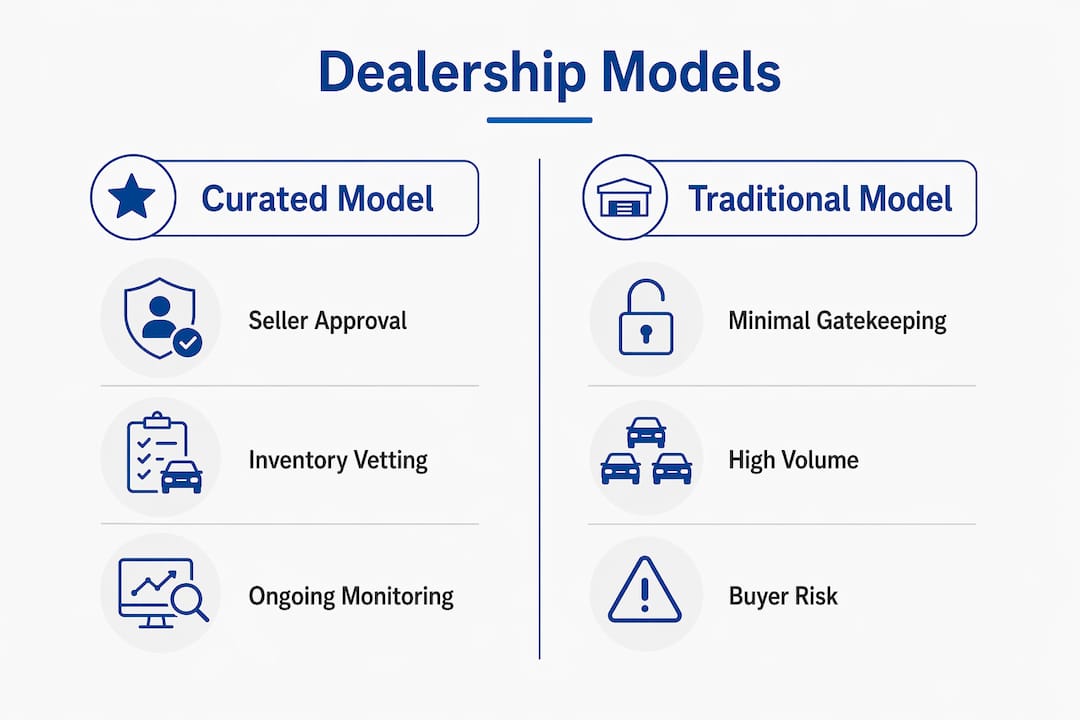
| Feature | Curated Model | Open/Traditional Model |
|---|---|---|
| Seller approval | Required, documented criteria | Minimal or self-reported |
| Vehicle verification | Pre-listing inspection and review | Buyer-dependent due diligence |
| Ongoing quality control | Performance monitoring with thresholds | Reactive, complaint-driven |
| Dispute handling | Operator-mediated with standards | Between buyer and seller only |
| Buyer risk level | Lower, underwritten by operator | Higher, transferred to buyer |
A curated model shifts operator focus from open listing volume to underwriting risk via strict seller approval and continuous quality review, increasing buyer trust. That shift matters most in the luxury segment, where a single transaction can represent a six-figure investment. The cost of a bad purchase is not just financial. It is the time, stress, and reputational damage of buying a vehicle that was misrepresented.
Without consistent intake criteria and enforcement, curation risks collapsing into mere marketing. Documented vetting and rejection rules are what separate a genuine curated network from a dealership that simply uses the word "curated" in its advertising.
What are the benefits of curated dealerships for luxury car buyers?
The benefits of curated dealerships concentrate around three outcomes: higher confidence, better service, and a cleaner transaction.
- Verified vehicle authenticity. Curated marketplaces improve buyer confidence by screening submissions, verifying claims, and explaining rules, treating trust as a measurable product. For luxury buyers, this means the vehicle history, mileage, and condition claims on a listing have been checked before you read them.
- Exclusive and personalized inventory. Boutique dealerships offer tailored experiences that prioritize customer service and rare inventory. A curated network does not need to list every vehicle available. It lists the right vehicles for its buyer profile, which means less noise and more relevant options.
- Reduced paperwork friction. The structured buying steps in a curated model improve transaction smoothness and buyer satisfaction. E-contracts, pre-arranged financing, and organized pickup appointments replace the traditional hours-long dealership visit.
- Lower dispute risk. Manual review, test orders, and documentation checks reduce low-quality listings. Fewer bad listings mean fewer post-sale disputes over vehicle condition or misrepresented features.
- Relationship-based service. Dealership relationship managers in curated networks act as advocates for the buyer, not just transaction processors. That relationship continues after the sale, covering service referrals, trade-in guidance, and future purchases.
Pro Tip: When evaluating a curated dealership network, look for a published set of seller standards or a stated vetting process on the website. Transparency about how sellers are approved is one of the clearest signals that the curation is real.
The high-trust marketplace checklist used by serious curators includes transparent review standards, timely communication, and rejection of weak listings to maintain credibility. Buyers who know what to look for can identify genuine curation quickly.
What steps should buyers expect in a curated dealership experience?
The buyer journey in a curated dealership network follows a clear sequence. Knowing each step in advance removes uncertainty and lets you focus on the vehicle itself.
- Browse vetted listings online. The digital car buying process in 2026 starts with an online inventory that has already been reviewed for accuracy. Photos, vehicle history reports, and condition summaries are available before you contact anyone.
- Request personalized assistance. Curated networks typically assign a relationship manager or specialist to your inquiry. This person knows the inventory in depth and can match your preferences to available vehicles, including models not yet publicly listed.
- Place a deposit and arrange financing. Once you select a vehicle, a deposit secures it while financing is finalized. Many curated dealerships offer financing options directly or through vetted lending partners, keeping the process within the network.
- Review and sign e-contracts. Digital contracts are sent before your pickup appointment. You review terms, ask questions, and sign electronically. This step eliminates the pressure of reading dense paperwork at the dealership counter.
- Schedule and complete vehicle pickup. The physical dealership visit is focused on final signatures, vehicle walkthrough, and key handover. Because paperwork is pre-completed, the visit typically takes under an hour.
- Access post-purchase support. Curated dealerships maintain the relationship after the sale. This includes service recommendations, warranty guidance, and priority access to new inventory as it becomes available.
The car buying process in a curated model is designed to remove the friction points that make traditional dealership visits frustrating. Each step is intentional, and the buyer is informed at every stage.
Key takeaways
A curated dealership selection works because it vets sellers and vehicles before listing, monitors quality continuously, and structures the buyer journey to reduce risk and friction at every stage.
| Point | Details |
|---|---|
| Seller vetting is mandatory | Documented approval criteria separate genuine curation from marketing claims. |
| Inventory review is separate from seller approval | Each vehicle must pass its own inspection before appearing in listings. |
| Ongoing monitoring prevents quality drift | Performance thresholds for responsiveness and dispute handling keep standards consistent over time. |
| Buyer workflow is pre-structured | E-contracts, deposits, and scheduled pickups reduce transaction friction significantly. |
| Trust is the measurable product | Curated models treat buyer confidence as an operational outcome, not a side effect. |
Why curation is the standard luxury buyers should demand
I have spent years watching buyers approach luxury vehicle purchases the same way they would buy a used sedan: a quick search, a test drive, and a handshake. That approach works fine at the lower end of the market. At the luxury level, it is a liability.
The vehicles are more complex, the prices are higher, and the misrepresentation risk is proportionally greater. A certified pre-owned label from a manufacturer is a start, but it does not tell you how the dealership operates, how disputes are handled, or whether the person selling you the car has any accountability to a larger network with standards to protect.
What I find most buyers miss is the difference between a dealership that claims to be curated and one that can show you the process. Ask for the intake criteria. Ask how many dealerships applied to join the network and how many were rejected. Ask what happens if a vehicle is misrepresented after purchase. A genuine curated network has answers to all three questions. A dealership using "curated" as a marketing adjective does not.
The operational rigor behind true curation is what makes the full-service dealership model worth seeking out. It is not about exclusivity for its own sake. It is about accountability built into the system before you ever browse a listing.
— Allen
Experience the Autovendorsfl curated selection in fort lauderdale
Autovendorsfl applies every principle described in this article to its Fort Lauderdale inventory. Sellers are vetted before listing. Every vehicle meets documented quality standards. And the buying process is structured so you spend your time on the vehicle, not the paperwork.
If you are looking for a Mercedes-Benz S-Class or exploring the full range of curated Mercedes-Benz vehicles available in South Florida, Autovendorsfl's inventory reflects exactly the standards this article describes. The team also maintains a curated Lexus selection for buyers who prioritize reliability alongside luxury. Contact Autovendorsfl directly to speak with a specialist who can match your preferences to available inventory before it is publicly listed.
FAQ
What is a curated dealership selection?
A curated dealership selection is a model where only pre-approved dealerships and their verified vehicle inventory are offered to buyers. Sellers must meet documented quality standards before any listing goes live.
How does curation differ from a standard dealership network?
A curated model vets sellers and vehicles upfront and monitors performance continuously, while open or traditional networks rely on buyer-driven due diligence. Curated models result in fewer disputes and higher buyer satisfaction.
What should i look for to confirm a dealership is truly curated?
Look for published seller approval criteria, a stated vetting process, and a clear dispute resolution policy. If a dealership cannot describe how sellers are approved and removed, the curation is likely a marketing claim rather than an operational system.
How long does the curated buying process take?
The timeline varies, but the structured workflow typically includes online browsing, deposit placement, digital contract review, and a physical pickup appointment completed within 1–3 days of vehicle selection.
Are curated dealerships only for new vehicles?
No. Curated dealership networks frequently specialize in pre-owned luxury vehicles, where vetting is most valuable. Vehicle history verification, condition review, and title checks are applied to both new and pre-owned inventory.