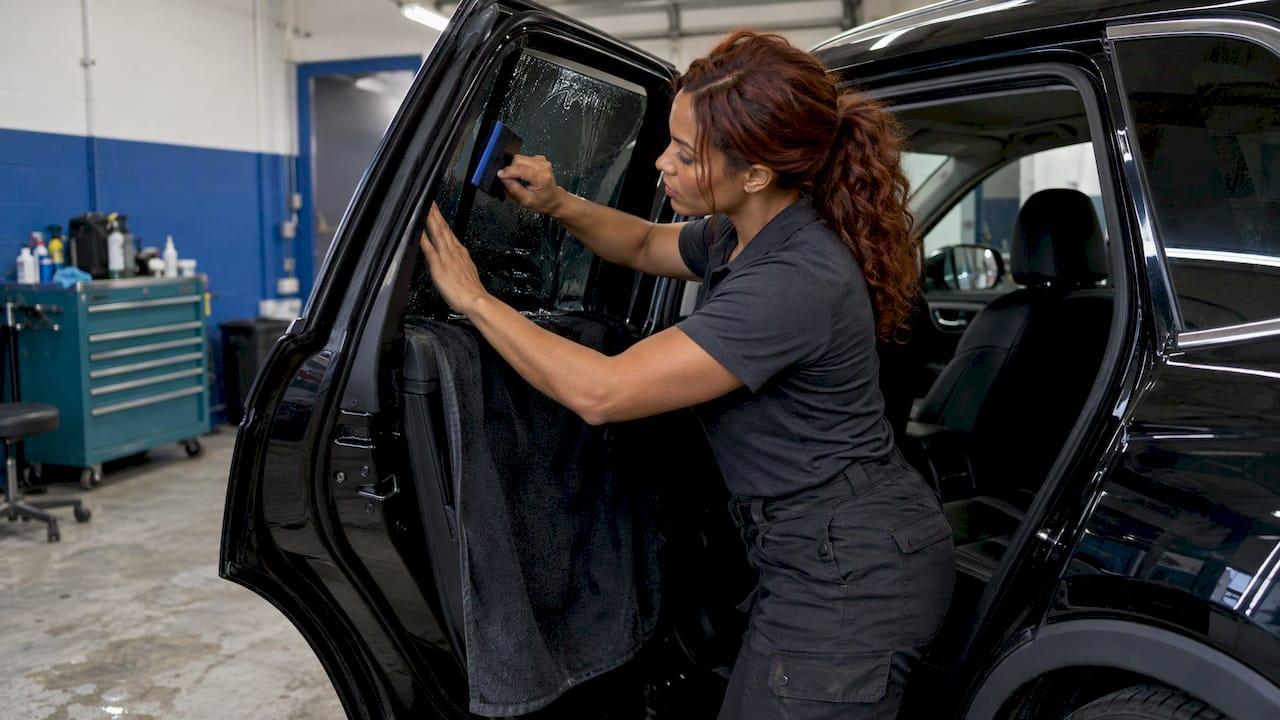
Ceramic tint rejects more heat than dyed tint, and it does so without needing to be dark. Dyed film is the budget choice: it gives privacy and a darker look, and it blocks UV rays, but it does less against infrared heat and tends to fade over time. If your car sits in the sun a lot, as most cars do in South Florida, ceramic is usually the better film. Below we explain what each film is made of, what the numbers mean, what each costs and how to decide.
TL;DR
- Ceramic film uses nonconductive ceramic particles to cut infrared heat. Dyed film uses dye to darken the glass and absorb light.
- Both can block most UV rays. The big gap is heat: ceramic is generally the stronger performer, and it doesn't need a dark shade to get there.
- Dyed film costs less up front but can fade or bubble in hot climates. AAA puts professional dyed installs at roughly $100 to $300 and ceramic at about $400 to $800.
- Compare TSER (total solar energy rejected) first, then VLT (how much light passes through), and check your state's tint law before choosing a shade.
Table of Contents
- What each film is actually made of
- Heat rejection: where the gap shows up
- UV protection: closer than you'd think
- Side-by-side comparison
- What it costs
- How to read a tint spec sheet
- Darkness, visibility and the law
- Which film fits which driver
- Perspective
- Finding the right car first
- Common mistakes when choosing tint
- FAQ
- Sources
What each film is actually made of
The two films look similar from the driver's seat, but they work differently.
Dyed film is the simple one. It is a polyester film with a layer of dye between an adhesive layer and a protective topcoat, as one installer explains. The dye absorbs light, which is what makes the glass look darker. AAA describes dyed tint as the most common and most affordable option, made by layering dyed film onto the glass.
Ceramic film skips the dye as its main working ingredient. Consumer Reports describes it as multilayered film infused with microscopic, nonconductive ceramic particles. Because those particles are nonmetallic, ceramic film doesn't interfere with the signals your phone, GPS or key fob rely on. It also targets the part of sunlight you feel as heat rather than simply making the glass darker.
That difference is the whole story in one line: dyed film works mostly by darkening, and ceramic film works by selectively filtering.

Heat rejection: where the gap shows up
Sunlight reaching your car is a mix of visible light, ultraviolet (UV) and infrared (IR). Visible light is what you see. UV is what fades upholstery and affects skin. Infrared is much of what makes a parked car feel like an oven.
Dyed film handles heat mostly by absorbing it. The dye soaks up solar energy, the glass warms, and some of that warmth still ends up in the cabin. Ceramic film is built to block a much larger share of the infrared portion. The Drive's buyer's guide says dyed film offers the least heat and UV protection of the main film types, while ceramic offers the strongest heat reduction. Consumer Reports' technician makes the same point: ceramic is generally more effective because it can deliver stronger UV protection and cooling without relying on darker tint.

AAA goes further on the practical effect. Its guide says ceramic film can often cut interior temperature by half. Treat that as the best case for a good film on a hot day, not a promise for every car, but it shows why drivers in hot, sunny places tend to move up to ceramic.
Why a dark dyed film isn't the same as a good ceramic film
A very dark dyed film can feel cooler simply because less light gets in. That is the trade many people make, and it has limits. Dark film reduces what you can see at night, and it may be illegal on certain windows. A lighter ceramic film can reject more heat while letting more light through, which is why it often wins on both comfort and visibility.
A fair summary: a super dark dyed film and a light ceramic film can feel similar at noon, but the ceramic film does it without making the car hard to see out of after dark.
UV protection: closer than you'd think
This is where many comparisons get muddy. Both films can block most ultraviolet rays. AAA notes that dyed tint can block UV, and the same guide says ceramic blocks over 99% of harmful UV rays. Consumer Reports reports that manufacturers claim ceramic blocks 99.9% of UV.
So if your only goal is UV protection for your skin and your seats, a quality dyed film isn't far behind. The catch is durability. AAA says dyed tint may fade over time, especially in hot climates. AutoZone's comparison adds that regular dyed tint can fade or bubble, and The Drive notes dyed film may eventually turn purple. A faded film still has a look problem, and its performance can slip along with its color.
Side-by-side comparison
| Factor | Dyed tint | Ceramic tint |
|---|---|---|
| How it works | Dye absorbs light and darkens the glass | Ceramic particles filter infrared and UV |
| Heat rejection | Lowest of the main film types | Generally the strongest |
| UV protection | Strong in many quality films | Over 99% claimed |
| Needs to be dark to perform | Often, for the best effect | No |
| Long-term look | Can fade, bubble or turn purple | Designed to hold color |
| Signal interference | None (nonmetallic) | None (nonmetallic, nonconductive) |
| Typical professional price | About $100 to $300 | About $400 to $800 |
The ceramic durability row reflects how the film is built: color comes from particles rather than from dye that can break down. Individual warranties vary, so read the one attached to the specific film.
What it costs
Prices depend on film, vehicle size and who does the work. AAA's older guide puts professional dyed installation at $100 to $200 and ceramic at about $400 to $800. AAA's 2025 guide estimates dyed film at $250 to $300 and ceramic at $400 to $800, and notes that price is affected by film type, vehicle size and installation. Consumer Reports says ceramic usually costs several hundred dollars more than nonceramic methods.
A minivan or full-size SUV has more glass, so expect to be at the upper end. A coupe has less glass and a simpler job.
When the extra money makes sense
The added cost tends to pay back when:
- You live somewhere hot and sunny. AAA says ceramic is well suited to hot, sunny climates because it gives strong heat and UV protection without excessive darkness. That describes most of Florida.
- You park outside. Less heat soaking into the seats and dash means the A/C works less to catch up.
- You carry kids or pets. A cooler cabin and less UV on the back seat matter in a family SUV or minivan.
- You keep your cars a long time. A film that doesn't fade pays off over years, not months.
- You want a lighter shade. If local law or night driving keeps you from going very dark, ceramic is how you still get heat control.
Dyed film still makes sense when you mainly want privacy and a darker look on a tight budget, or the car is a short-term vehicle.
How to read a tint spec sheet
Tint marketing is full of big percentages that can't be compared directly. A few terms cut through it.
TSER: start here
TSER is total solar energy rejected: the share of all the sun's energy the film plus glass keeps out. 3M's product documentation defines it that way, and higher TSER means less solar heat gets through. The IWFA automotive guide recommends asking for TSER first because it captures the whole picture, not just one slice of the spectrum.
IR rejection: handle with care
Infrared rejection figures are easy to inflate. BestCarAudio explains that manufacturers measure infrared over different wavelength bands, so two IR percentages only compare when the ranges and definitions match. The industry's own technical paper defines IRER as rejection across 780 to 2,500 nanometers and says standardized, full-spectrum data makes films comparable in a way isolated marketing numbers don't.
So when a shop quotes "98% infrared rejection," ask which wavelength range that covers and compare it only to figures measured the same way. Ranges such as 70% to 98% for quality ceramic film are common in marketing, which shows how much the measurement method matters.
VLT: how dark it looks
VLT is visible light transmission, the percentage of light that passes through the tinted glass. A higher VLT means a lighter tint and a lower VLT means a darker one. AAA says darker films in the 5% to 20% range generally give more privacy and heat rejection but can impair night visibility and may be illegal, while lighter films in the 35% to 70% range keep more visibility and give subtler protection.
The IWFA's 2026 guide adds that glare control is mostly about visible light, and that how a film looks also changes with the glass, the angle, the lighting and which side you view it from. Ask to see a sample on your own glass in daylight.
A short checklist for comparing films
- TSER, from the manufacturer's data sheet.
- VLT for each window you plan to tint.
- UV rejection.
- Optical clarity (no haze or distortion).
- Warranty terms, including fading and bubbling.
- Installer experience and how they handle edges and defrost lines.
- Signal compatibility.
- State-law compliance.
That list matches what the IWFA recommends comparing, and it works for both ceramic and dyed options.
Darkness, visibility and the law
Darker is not better. A dark film cuts glare and adds privacy, but it can make backing out of a driveway at night harder, especially if your eyes aren't young anymore. Consumer Reports advises checking your state's tint laws, remembering that front side windows and windshields can have different limits, and thinking about nighttime driving.
Tint law varies by state and by vehicle type, and many states treat SUVs and vans differently from sedans on the rear windows. Florida sets its own limits for how dark each window may be, so confirm the current numbers with the Florida Highway Safety and Motor Vehicles department or your installer before you pick a shade. If you're buying a used car, check that the existing tint is legal too; a reputable dealer will point out aftermarket tint on a vehicle you're considering.
Visibility is bigger than tint alone. If you're upgrading how clearly you see through your windshield, vehicle visibility upgrades such as fresh wiper blades work alongside whatever film you choose.
Which film fits which driver
The daily commuter in a hot city. Ceramic. You'll feel it every afternoon when you get into a car that's been parked in the sun.
The family with an SUV or minivan. Ceramic on all the rear glass, with a legal shade up front. Back-seat passengers get the most benefit, and kids are in the sun longer than the driver is.
The luxury buyer. Ceramic. Premium interiors, including leather and wood trim, are what the sun fades and dries out, and a clear ceramic film can protect them without changing the look of the car. If you're comparing other ways to protect a vehicle's finish, our guide to PPF vs. ceramic coating covers the paint side.
The budget-first buyer. Dyed film from a good installer is better than no film. Pick a quality film, not the cheapest one, because fading is what makes cheap dyed tint a poor value.
The EV driver. Cabin cooling draws on the battery, so reducing solar load helps. Our piece on EV range in hot weather shows how much heat can affect range.
Heat affects more than the cabin
Tint takes the edge off the interior, but a hot climate also stresses other parts of the car. If you want to see how temperature changes something as basic as your tires, read about how heat raises tire pressure and when to check it.
Perspective
When we help someone choose a used luxury vehicle, we look at the details that decide how it feels five years from now: the leather, the glass, the finish and how the car handles a Florida summer. Window film is one of those details.
Our view is simple. A premium car deserves a film that protects the interior without darkening the whole car, and ceramic does that best. It keeps the elegant, uncluttered look of factory glass while taking a real bite out of the heat. That fits how we think about every vehicle we curate: craftsmanship and quality that show up in daily use, not only on the showroom floor.
If a car you're considering already has tint, ask what type it is, whether it's in good shape and whether it's legal. If you want to start fresh, tell us. Part of our hands-on approach is helping buyers think through the whole ownership picture, not only the sticker.
Allen
Finding the right car first
Tint is a finishing touch. The car comes first. At Auto Vendors Inc in Fort Lauderdale, we specialize in used luxury and premium vehicles, and our Car Finder service is there for buyers who want help tracking down a specific make, model or body style. Our inventory search lets you filter by make, model, body style and price, and our trade-in valuation and financing options are part of the process.
Families can start with our SUVs for sale, where rear-seat comfort and heat control matter most. If you aren't sure what you want yet, browse all our used cars or tell us what you're after through our Car Finder.
When you tour a car with us, ask about its window film. We'd rather you know exactly what's on the glass before you sign. Dealers can charge a documentation fee, and our guide to Florida doc fees explains how to ask for the full out-the-door figure.
Common mistakes when choosing tint
- Choosing by darkness alone. A shade number says nothing about heat. Two 35% films can reject very different amounts of solar energy.
- Comparing mismatched numbers. One brand's IR figure and another's TSER are not the same measure.
- Going too dark on the front windows. It can mean a ticket and a forced removal, and it hurts night visibility.
- Skipping the warranty details. Ask what it covers (fading, bubbling, peeling, labor) and for how long.
- Picking the installer on price alone. Dust, trapped bubbles and poorly trimmed edges ruin a good film. A clean install bay and a track record matter as much as the film name.
- Forgetting the windshield. Clear ceramic films for the windshield are a separate decision, and local law limits what you can do there.
FAQ
Is ceramic tint really better than dyed tint?
For heat, yes. Ceramic is generally the stronger performer, and it can do the job without being dark. For UV alone the gap is smaller, since quality dyed film also blocks most UV. Ceramic's other advantage is that it is less likely to fade or bubble in hot climates.
Is dyed window tint good enough?
It can be, if your main goals are privacy, looks and a low price. Dyed film gives basic UV protection and darkening. The trade-off is less heat rejection and a greater chance of fading over time, so choose a quality film and a careful installer.
What is the best window tint for heat?
Ceramic film with a high TSER is the usual answer. Compare TSER figures from the data sheets, not only IR percentages, and pick a VLT that is legal in your state and comfortable for night driving.
Does ceramic tint interfere with phone or GPS signals?
No. Ceramic film is nonmetallic and nonconductive, so it shouldn't block cell, GPS or key fob signals. That sets it apart from older metallic films.
How much more does ceramic cost?
AAA's estimates put professionally installed ceramic at about $400 to $800, against roughly $100 to $300 for dyed film. Consumer Reports says ceramic usually adds several hundred dollars. Larger vehicles with more glass cost more.
Sources
- Is Ceramic Car Window Tinting Worth the Extra Cost? (Consumer Reports)
- 6 Types of Window Tint to Consider for Your Car (AAA)
- Car Window Tinting: A Complete Guide (AAA)
- Best Window Tints Review & Buying Guide (The Drive)
- Ceramic Vs. Regular Tint (AutoZone)
- The Differences Between Dyed, Metalized, & Ceramic Window Film
- Understanding the Basics of Window Tint Heat Rejection Specifications (BestCarAudio)
- 3M Automotive Window Film product documentation
- Automotive Education Guide (IWFA, 2024)
- Automotive Education Guide (IWFA, 2026)
- Infrared Energy Rejection for Window Films Application (EWFA/IWFA)
- Top Vehicle Visibility Upgrades
- 1 psi per 10°F: How Heat Raises Tire Pressure