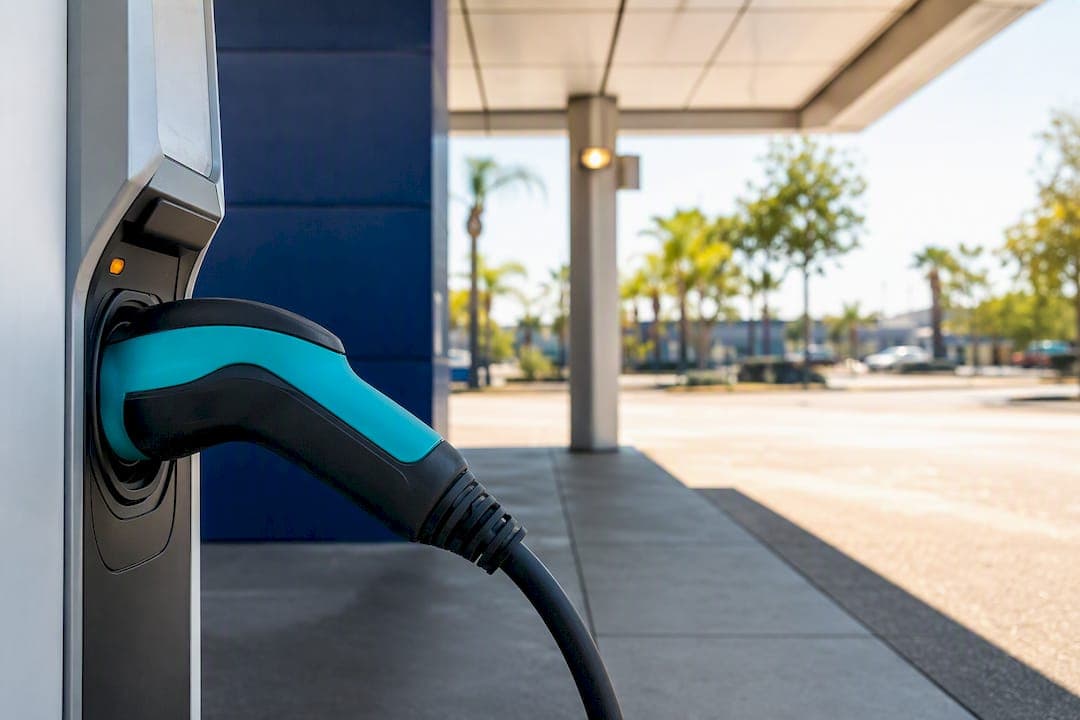
Most EVs lose only a modest slice of range around 90°F, but that number climbs fast once temperatures cross 100°F. For daily commuting, that's rarely a dealbreaker. For road trips in extreme heat, it's worth planning around.
TL;DR:
- EV range loss in extreme heat can reach 17 to 20 percent at 115 to 122°F, mainly due to increased HVAC energy consumption.
- Running the air conditioning compressor and cooling system is the largest heat-related energy drain, especially on hot days.
- Slowing down by 10 to 15 mph on highways typically recovers more range than reducing air conditioning use during summer trips.
- Charging in cooler parts of the day and preconditioning while plugged in can significantly reduce thermal stress and improve long-term battery health.
- Proper thermal management features like heat pumps improve efficiency in extreme heat, but their presence varies between vehicle models.
Table of Contents
- What the research says about EV range in hot weather
- Why heat drains an EV's battery in the first place
- Does speed matter more than air conditioning in the heat?
- How heat affects charging speed and long-term battery health
- A prioritized checklist for hot-weather EV driving
- Auto Vendors Inc's take on buying an EV for hot climates
- Sources
What the research says about EV range in hot weather
Multiple independent studies now agree on the shape of the problem, even if the exact numbers shift by model and driving style. AAA's testing found an average 8.5% range loss at 95°F compared with a 75°F baseline, and extreme conditions between 115°F and 122°F pushed total reductions into the mid-teens to low-twenties.
Recurrent's analysis of nearly 29,700 real-world vehicles tells a similar story: about 5% range loss at 90°F, climbing to 17% or 18% once temperatures hit 100°F or higher. A controlled laboratory study published in ScienceDirect confirms the same pattern under lab conditions, identifying HVAC energy draw as the single biggest variable in the equation.
The variability across these numbers comes down to vehicle design, driving speed, and how aggressively the battery management system compensates for heat.
| Temperature Band | Typical Range Loss | Source |
|---|---|---|
| 90°F | ~5% | Recurrent |
| 95°F | ~8.5% | AAA |
| 100°F+ | ~17-18% | Recurrent |
| 115°F-122°F | Mid-teens to low-20s% | AAA |
Why heat drains an EV's battery in the first place
Usable battery energy, or UBE, shrinks as ambient temperature climbs because the battery management system throttles output to protect cell chemistry. That's the mechanism behind every number in the table above.
Air conditioning is the biggest single energy draw layered on top. Running the compressor, fans, and coolant pumps pulls electricity directly from the pack, and the ScienceDirect study identifies HVAC load as the dominant factor in range loss during hot weather. The battery's own thermal management system compounds this: when it actively cools the pack, that cooling itself costs energy, but if it doesn't cool the pack enough, the battery can throttle power output to avoid overheating.
Vehicles with a heat pump handle this more efficiently than those with conventional resistive HVAC systems, because heat pumps move thermal energy rather than generating it from scratch. That difference shows up directly in range numbers during extreme heat, which is one reason thermal management design varies so much between models.
Does speed matter more than air conditioning in the heat?
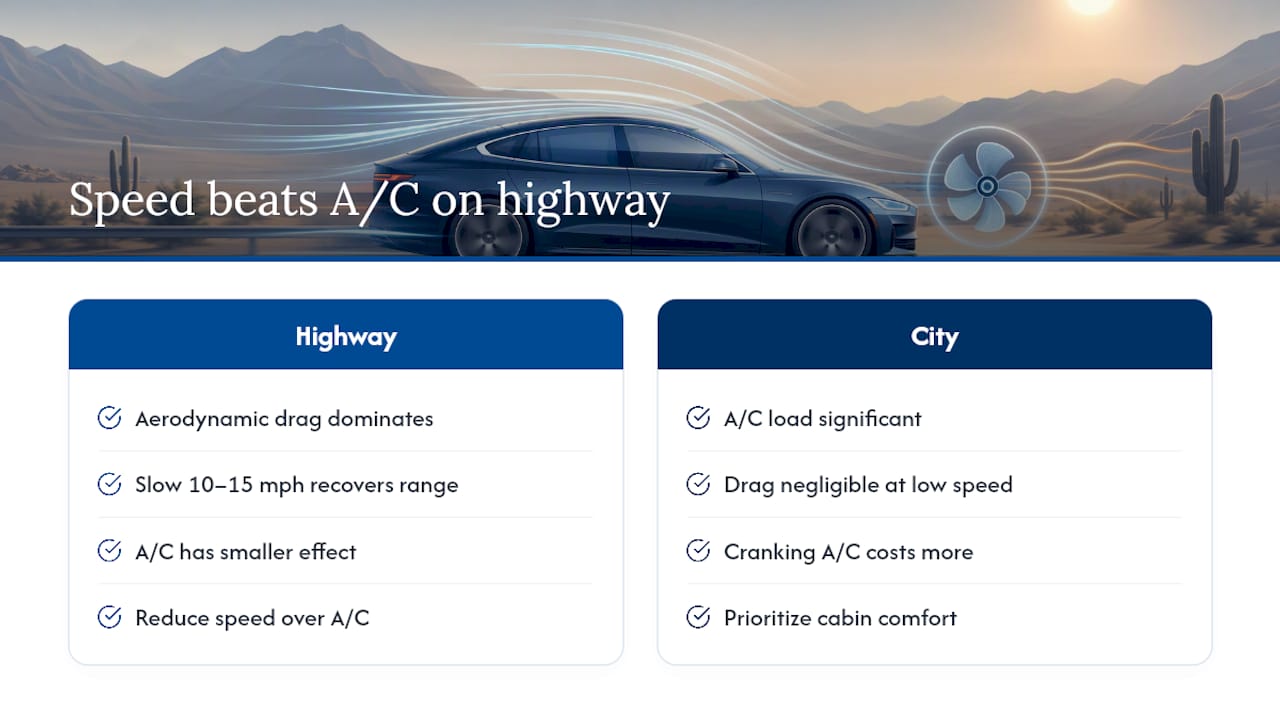
For highway driving, yes, often by a wide margin. Geotab's telematics analysis found that speed and aerodynamic drag frequently cost more range at highway speeds than air conditioning does, and dropping speed by just 10 to 15 mph can recover a meaningful chunk of range. Forbes' coverage of that same study put it plainly: summer heat usually isn't the biggest drain on an EV's battery.
The tradeoff flips depending on where you're driving. In stop-and-go city traffic, A/C load becomes proportionally more significant because aerodynamic drag barely factors in at low speeds. On the highway, drag dominates energy use so heavily that a driver debating between cranking the air conditioning down or slowing from 70 mph to 60 mph will usually get more range back from the speed change.
Trip planning should follow this logic: on a summer road trip, moderate cabin temperature and focus on speed discipline. Around town, the A/C tradeoff barely registers against your total range.
How heat affects charging speed and long-term battery health
Battery chemistry works best within a specific temperature window, and once cells run hot, the charging system limits how much power it accepts to protect the pack. That's why DC fast charging sessions during a heatwave sometimes feel slower than they did in spring. The same thermal management systems that fight heat while driving also have to work harder while charging, pulling extra energy just to keep cells in range.
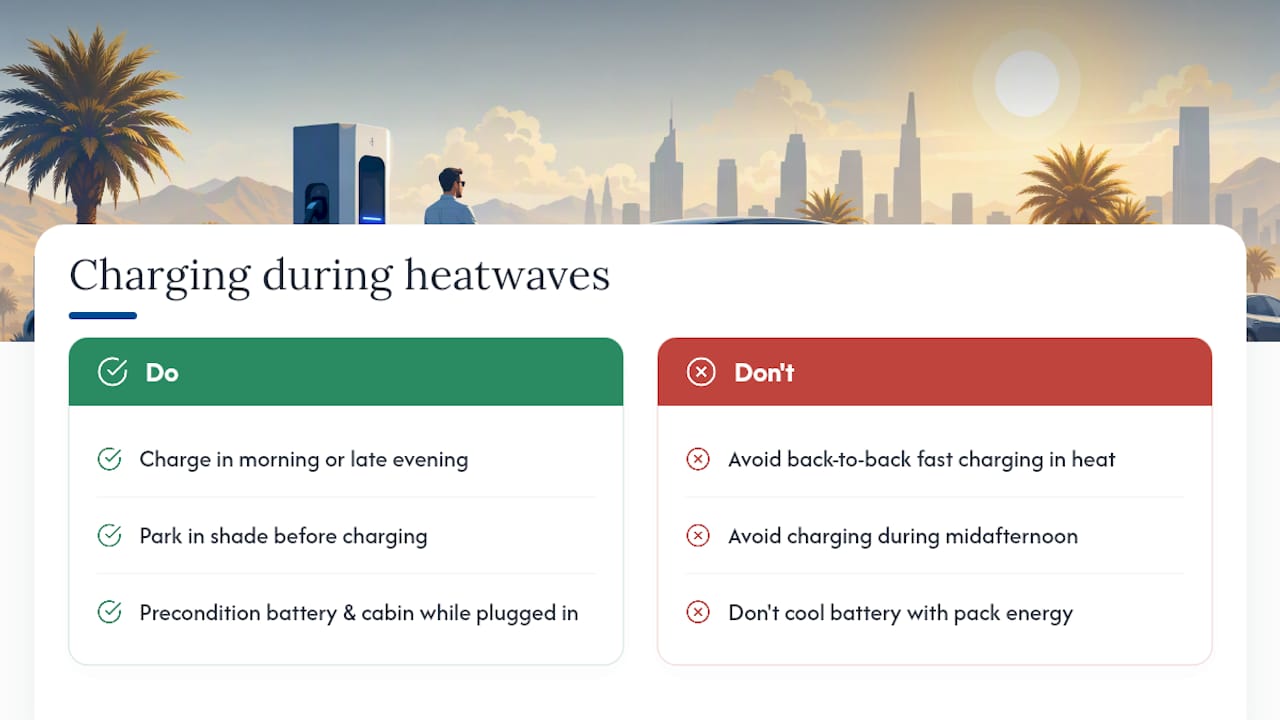
Repeated, back-to-back high-power fast charging in extreme heat adds cumulative thermal stress that can accelerate long-term degradation, so spacing out sessions matters more in July than in April. Fueleconomy recommends preconditioning the cabin and battery while still plugged in, since that draws grid electricity instead of pulling stored energy out of the pack.
A few habits make a real difference during heatwaves. Charge during cooler parts of the day, morning or late evening, rather than midafternoon. Park in shade before you plug in if you can, since a battery that starts hotter takes longer to safely accept a full charging rate. Pre-cooling the battery and cabin while connected to a charger, especially one paired with home solar setups designed around EV charging loads, avoids drawing that cooling energy from the pack itself later.
A prioritized checklist for hot-weather EV driving
Small, consistent habits add up to meaningfully less range anxiety once the temperature climbs. Work through this list roughly in order of impact:
- Precondition while plugged in. Set your cabin temperature and let the car cool down before you disconnect from the charger.
- Charge during cooler hours. Early morning or late evening charging reduces the extra cooling energy your battery management system needs to spend.
- Manage highway speed first. Dropping 10 to 15 mph typically saves more range than adjusting the A/C, especially on longer trips.
- Use gentle acceleration and regenerative braking. Smooth inputs reduce total energy draw regardless of temperature.
- Park in shade whenever possible. A reflective windshield cover and window shades keep cabin and battery temperatures lower before you even start driving.
- Check tire pressure regularly. Heat changes tire pressure, and underinflated tires increase rolling resistance and cut range further.
- Set cabin temperature a few degrees higher than usual. Every degree of cooling demand pulls directly from your battery.
Pro Tip: If your EV has a scheduled departure or preconditioning feature, use it every time temperatures cross 90°F. It's the single easiest way to shift cooling costs onto grid power instead of your battery.
Auto Vendors Inc's take on buying an EV for hot climates
When Allen evaluates an EV for a customer in a hot, humid market, the test drive tells you more than the spec sheet. Run the A/C at full load for ten minutes and watch how the range estimate reacts. Check whether the vehicle offers scheduled preconditioning, and ask whether the model displays real-time battery temperature, since not every dashboard does.
Auto Vendors Inc walks customers through exactly which thermal management features matter most before they commit, drawing on our luxury SUV test-drive checklist for the specific checks worth running in person.
— Allen
Sources
- AAA Study Reveals Temperature Impacts on EV and Hybrid Efficiencies and Costs
- How Hot Summer Weather Affects EV Range
- Summer Heat vs Speed: What Really Impacts EV Range
- Effects of ambient temperature on electric vehicle range considering battery Performance, powertrain Efficiency, and HVAC load
- How Weather Affects Fuel Economy & Emissions