
A dealer demo vehicle is defined as a new car that a dealership registers and uses for its own purposes before selling it to the public, making it legally classified as used the moment the dealer puts it in service. The industry term is "demonstrator vehicle," though most buyers and salespeople simply call it a demo. These cars are sold at a discount compared to a brand-new equivalent, often with the original manufacturer's warranty still active. Understanding what a dealer demo vehicle means before you sign anything can save you thousands and prevent some costly surprises.
What does dealer demo vehicle mean in practice?
A dealer demo vehicle is a car that a dealership titles and registers in its own name, then uses for specific operational purposes before offering it for sale. Once registered by the dealer, the vehicle is legally considered used, regardless of how new it looks or how few miles it carries. That legal distinction matters for taxes, registration fees, and financing terms.
Dealerships use demo vehicles in three main ways. First, as customer test drive cars parked on the showroom floor. Second, as executive or manager vehicles driven daily by dealership staff. Third, as service loaners given to customers whose cars are in for repair. Each use creates a different ownership experience for the next buyer.

The mileage on a demo vehicle reflects how it was used. Demo vehicles typically accumulate 2,000 to 15,000 miles depending on their role. That range is wide, and the type of use matters as much as the number on the odometer.
How are demo vehicles used and what types exist?
Not all demo vehicles are equal. The category breaks into three distinct types, and each carries a different risk profile for buyers.
- Showroom or sales demos: These are the cars sitting on the floor or in the lot specifically for customer test drives. They tend to have the lowest mileage, often under 5,000 miles, and are driven carefully because they represent the brand. Staff are generally instructed to keep them clean and presentable.
- Manager or executive demos: These are assigned to dealership managers or sales executives as daily drivers. Mileage varies widely. A manager who commutes 30 miles each way can put 10,000 miles on a car in six months. The vehicle gets regular use but is typically maintained by the dealership's own service department.
- Service loaners: These are the highest-risk demo category. Service loaners often exceed 15,000 miles and are driven by many different customers, some of whom treat a borrowed car with less care than their own. Frequent short trips and varied driving styles can accelerate wear on the engine and brakes.
Dealer disclosure obligations vary by state, but reputable dealerships are required to tell you the vehicle's prior use. Always ask in writing whether the car served as a loaner, a manager vehicle, or a showroom demo. That single question changes the conversation.
Pro Tip: Request the vehicle history report through Carfax or AutoCheck before any test drive. A demo vehicle should show the dealership as the sole prior owner. Multiple registrations or service records from different drivers are a red flag.
How are dealer demo vehicles priced and discounted?
Demo vehicle pricing follows a clear logic. The car has depreciated through use, so the dealer must discount it to reflect that reality. Experts recommend targeting a 15–22% discount off the original MSRP for demo vehicles in luxury, midsize, and truck segments. That discount range accounts for both the mileage accumulated and the warranty time already consumed.
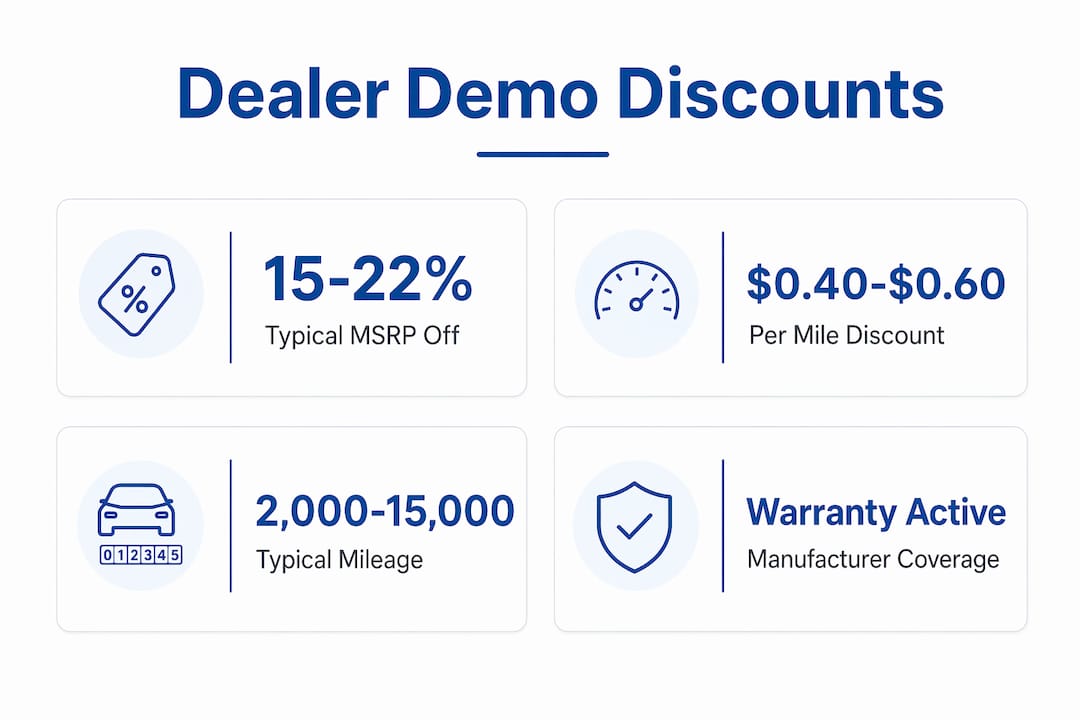
A useful negotiation tool is the per-mile rule. Negotiate $0.40 to $0.60 off the asking price for every mile already on the odometer. On a vehicle with 8,000 miles, that translates to a $3,200 to $4,800 additional reduction from the starting price. Use this as a floor, not a ceiling.
Here is how demo pricing compares to the two most common alternatives:
| Vehicle type | Typical discount vs. MSRP | Warranty status | Mileage at purchase |
|---|---|---|---|
| New vehicle | 0–5% | Full factory warranty | 0–10 miles |
| Dealer demo | 15–22% | Partial remaining warranty | 2,000–15,000 miles |
| Certified pre-owned (CPO) | 20–30% | Extended CPO warranty | 15,000–60,000 miles |
The demo sits between new and CPO in both price and condition. It offers near-new quality at a meaningful discount, but only if the warranty math works in your favor.
Pro Tip: Always ask the dealer for the original window sticker (Monroney label) so you can calculate the discount from the true MSRP, not an inflated "market price" the dealer may quote.
One critical factor that buyers consistently overlook is the warranty clock starting at the dealer's in-service date, not the date you buy the car. A vehicle put in service eight months ago has already consumed eight months of its factory warranty. On a three-year, 36,000-mile bumper-to-bumper warranty, that leaves you with roughly 28 months of coverage from day one of ownership.
What warranty and legal protections apply to demo vehicles?
The warranty situation on a demo vehicle requires careful attention. The manufacturer's warranty begins at the dealer's in-service date, which is the date the dealership first registered the car. Buyers who do not ask about this date often assume they are getting a full warranty. They are not.
Here is what to verify before signing any purchase agreement:
- In-service date: Get this in writing. Calculate exactly how much warranty time remains on both the bumper-to-bumper and powertrain coverage.
- Legal classification: Confirm the vehicle is titled as used. This affects your state's sales tax rate, registration fees, and financing options.
- Lemon law eligibility: Demo vehicles qualify for lemon law protection in states like California, provided the manufacturer's warranty is still active at the time of sale. If the warranty has expired, lemon law coverage does not apply.
- Factory incentives: Some manufacturer rebates and incentives are reserved for new vehicle purchases only. A demo, classified as used, may not qualify for those programs.
- Odometer disclosure: Federal law requires dealers to provide a written odometer disclosure statement for any vehicle under ten years old. Verify the mileage matches the odometer reading on the day of purchase.
Getting all of this in writing protects you. Verbal assurances from a salesperson carry no legal weight once you drive off the lot.
What are the pros and cons of buying a dealer demo vehicle?
Demo vehicles offer a specific value proposition. They are not the right choice for every buyer, but for the right situation, they represent one of the better deals in the automotive market.
Advantages of buying a demo vehicle:
- Discounted pricing on a near-new car. The 15–22% reduction off MSRP is real money, often $5,000 to $15,000 on a luxury vehicle.
- Dealership-maintained service history. Demos are serviced by the dealership's own technicians, using manufacturer-approved parts and fluids.
- Active manufacturer's warranty. Unlike a standard used car, a demo often comes with significant factory coverage still in place.
- Immediate availability. No waiting for factory orders or production delays. The car is on the lot and ready.
- Fully optioned vehicles. Dealers tend to demo their best-equipped models to impress customers, so you often get premium trims and packages.
Disadvantages to weigh carefully:
- Reduced warranty coverage. Every month the car sat in the dealer's fleet is a month subtracted from your warranty.
- Unknown driver behavior. Multiple drivers, especially in service loaner scenarios, mean you cannot fully account for how the car was treated.
- Limited selection. You are choosing from what the dealer has, not configuring a vehicle to your exact specifications.
- EV rebate disqualification. Electric vehicle demo buyers face a specific risk. EV demos can lose eligibility for government rebates if the vehicle has been driven beyond minimal mileage thresholds before the sale.
Pro Tip: For EV shoppers, confirm the vehicle's mileage against your state or federal rebate program's eligibility rules before negotiating price. A $7,500 federal tax credit lost to a technicality erases most of the demo discount.
The pros and cons of demo cars ultimately come down to one question: does the discount adequately compensate for the warranty time and mileage already used? Run that math before you fall in love with the car.
Key takeaways
A dealer demo vehicle offers real savings, but only buyers who verify the in-service date, mileage type, and remaining warranty will capture the full value.
| Point | Details |
|---|---|
| Legal classification | Demo vehicles are legally used once registered by the dealer, affecting taxes and financing. |
| Warranty start date | The factory warranty clock begins at the dealer's in-service date, not your purchase date. |
| Discount target | Aim for 15–22% off MSRP and negotiate an additional $0.40–$0.60 per odometer mile. |
| Demo type matters | Showroom demos carry less risk than service loaners, which often have higher mileage and more wear. |
| EV buyers beware | Electric vehicle demos may disqualify buyers from federal or state rebates if mileage thresholds are exceeded. |
What I have learned from watching buyers navigate demo purchases
I have seen buyers walk away from demo deals that were genuinely exceptional, and I have seen others overpay for demos that were barely better than a standard used car. The difference almost always comes down to one thing: preparation.
The in-service date is the single most important number in any demo transaction. Most buyers never ask for it. They focus on the sticker price and the odometer, which are both visible. The in-service date is invisible unless you request it, and it determines how much warranty protection you actually receive. I have watched buyers assume they were getting a full three-year warranty, only to discover six months of coverage remained.
My honest advice is to treat a demo purchase like a pre-owned luxury car inspection. Get the vehicle history report. Ask for the in-service date in writing. Request a third-party inspection from a mechanic you trust, not one the dealer recommends. And if the car is an EV, check rebate eligibility before you negotiate anything else.
The best demo deals I have seen involve low-mileage showroom vehicles from luxury brands, where the original MSRP was high enough that even a 15% discount represents serious savings. A Mercedes-Benz or similar luxury model with 3,000 miles and 28 months of factory warranty remaining is a compelling purchase. A service loaner with 14,000 miles and four months of warranty left is not, regardless of how attractive the price looks on paper.
— Allen
Find quality demo and near-new vehicles at Autovendorsfl
Autovendorsfl, operating as Auto Vendors Inc in Fort Lauderdale, curates a premium selection of near-new and quality pre-owned vehicles with a focus on luxury models. The team provides personalized assistance to help buyers identify vehicles that match their standards for condition, mileage, and value.
If you are considering a demo or near-new luxury vehicle, Autovendorsfl's current inventory includes well-maintained models from top-tier brands. Buyers interested in the Mercedes-Benz S-Class will find competitively priced options with verified service histories. Contact the Fort Lauderdale team directly to discuss current availability, pricing, and any remaining warranty details on specific vehicles. The dealership's hands-on approach means you get real answers, not a generic sales pitch.
FAQ
What is the dealer demo car definition in simple terms?
A dealer demo car is a vehicle the dealership registers and uses for its own purposes, such as test drives or staff use, before selling it to the public. It is legally classified as a used vehicle once registered, even if it has very low mileage.
How much should I expect to pay for a demo vehicle?
Target a discount of 15–22% off the original MSRP, plus an additional $0.40 to $0.60 off per mile already on the odometer. The exact discount depends on the vehicle's mileage, remaining warranty, and how it was used by the dealership.
Does a dealer demo vehicle still have a warranty?
Most demo vehicles are sold with the original manufacturer's warranty still active, but the warranty clock started at the dealer's in-service date. Buyers should request the in-service date in writing to calculate exactly how much coverage remains.
Are demo vehicles covered by lemon laws?
Demo vehicles qualify for lemon law protection in states like California, provided the manufacturer's warranty is still active at the time of purchase. If the warranty has expired before the sale, lemon law protections generally do not apply.
Is a demo vehicle better than a certified pre-owned car?
A demo vehicle typically has lower mileage than a certified pre-owned vehicle and may carry more remaining factory warranty. However, CPO vehicles often come with extended coverage and a more thorough inspection process, making them a stronger choice if warranty length is your top priority.