
Dealer allocation is the manufacturer-controlled process of distributing new vehicles to dealerships based on sales performance, inventory turnover, and market demand. Understanding how dealer allocation systems work gives dealership managers a direct advantage: the dealers who master these mechanics receive more units, better trims, and priority access to high-demand models. This guide breaks down every layer of the allocation process, from the formulas manufacturers use to the ordering strategies that separate top-performing dealerships from the rest.
How dealer allocation systems work: the core mechanics
Dealer allocation systems are built on a simple but demanding principle: manufacturers reward dealers who sell quickly and penalize those who hold inventory too long. The system is circular by design. Dealers must sell more to earn more allocation, which means performance improvement is not optional. It is the engine that drives the entire distribution model.
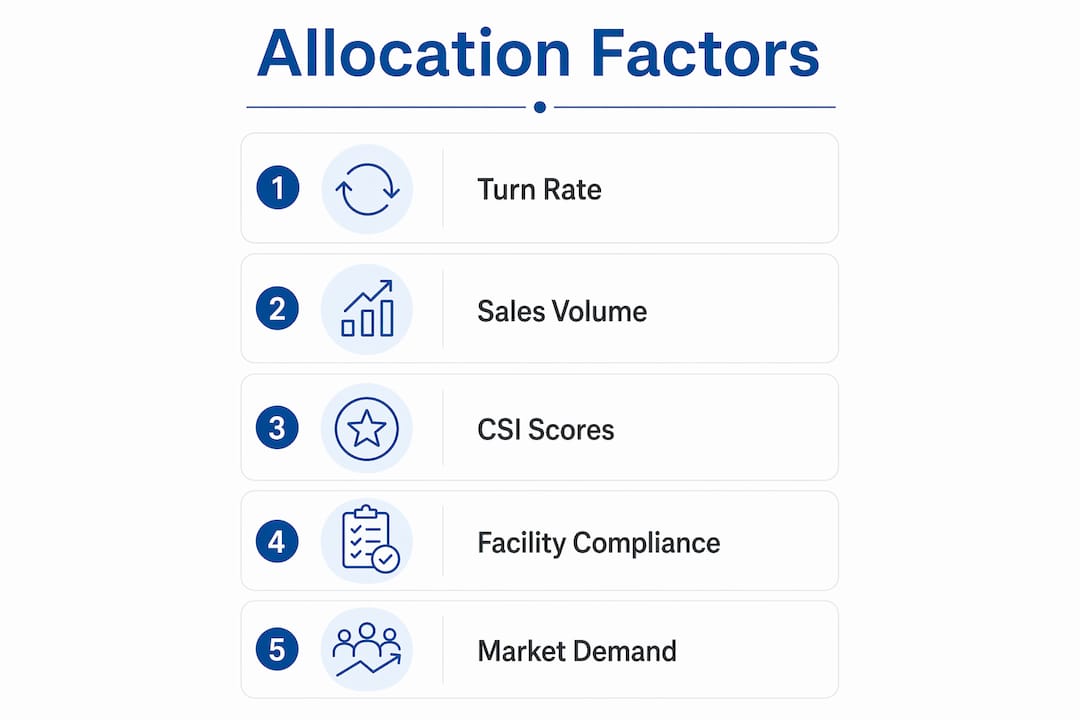
Manufacturers calculate allocations using a combination of inputs:
- Historical sales volume: The number of units a dealer sold in prior periods, typically measured monthly and quarterly.
- Inventory turn rate: How fast a dealer moves vehicles off the lot. Dealers maintaining a 35-day supply secure preferential allocation, while those sitting on a 90-day supply often face cuts.
- Customer Satisfaction Index (CSI) scores: Manufacturer surveys measuring buyer experience. Low CSI scores can reduce allocation eligibility, particularly for premium and specialty models.
- Facility compliance: Whether the dealership meets brand standards for showroom design, signage, and staff certification.
- Market demand data: Regional sales trends and competitive pressure that manufacturers factor into territory-level distribution.
The turn-and-earn model is the most direct expression of this logic. A dealer who turns inventory in 35 days signals strong local demand and operational discipline. That dealer earns more units the following cycle. A dealer sitting on 90-day-old stock signals the opposite. Manufacturers respond by reducing that dealer's share of the next production run.
Manufacturers also deploy predictive algorithms to prioritize popular trims for dealers with strong sales histories and specialized staff. This keeps overall inventory tight, which protects manufacturer profitability. The practical result: two dealers in the same metro area can receive very different allocations of the same model, based entirely on their performance records.
Pro Tip: Track your rolling 30-day and 60-day turn rates by model line, not just overall. Manufacturers score by segment, and a weak turn rate on one nameplate can drag down your allocation eligibility across the board.
What factors drive manufacturer allocation decisions?
Manufacturers do not distribute vehicles arbitrarily. The allocation formula is a weighted calculation, and each input carries real consequences for what arrives on your lot.
CSI scores carry more weight than most dealers realize. A dealership with strong sales volume but poor customer satisfaction ratings can still lose access to limited-production trims. Manufacturers protect brand image by restricting specialty models to dealers who demonstrate both sales capability and buyer experience quality. Specialty vehicles are allocated selectively to dealers with proven sales records, high satisfaction scores, and trained staff.
Facility compliance is another factor that often surprises newer managers. A dealership that has not completed a required brand renovation or staff certification program may be flagged in the manufacturer's system. That flag can cap allocation levels regardless of sales performance. Compliance is not just about aesthetics. It is a gating requirement for full allocation access.
Market demand data adds a regional layer to the formula. A dealer in a market with high SUV demand but low sedan sales will receive an allocation mix that reflects those local patterns. Manufacturers use zip-code-level registration data and competitive sales reports to calibrate territory allocations. Understanding your market's demand profile helps you anticipate what the manufacturer will send and where you can push for adjustments.
Stock orders vs. sold orders: what is the right mix?
The dealer allocation process distinguishes between two types of orders, and the balance between them shapes both your inventory flexibility and your customer relationships.
Stock orders are speculative units ordered for the showroom floor. They give you physical inventory to sell on the spot and support walk-in traffic. Sold orders are customer-committed units tied to a specific buyer, often with a deposit. They reduce speculative risk but depend entirely on allocation availability.
Experts recommend a mix of 70–80% stock orders for floor traffic and 20–30% sold orders for customer commitments. That ratio reflects the reality that most retail sales still happen from in-stock inventory, while sold orders serve buyers with specific configuration needs.
The challenge with sold orders is customer expectation management. Some configurations may never be fulfilled due to allocation constraints. A buyer who orders a specific trim or powertrain combination may wait months, only to learn the unit was never allocated to your store. Transparency gaps between what a dealer promises and what allocation delivers create disputes, reputation damage, and legal exposure.
Written communication on allocation dependencies and deposit refund policies is not optional. It is a legal and operational necessity. Every sold order should include a clear written statement explaining that fulfillment depends on manufacturer allocation and that timelines are estimates, not guarantees.
Pro Tip: Create a one-page sold order disclosure form that explains allocation dependency, estimated lead times, and your deposit refund policy. Have every customer sign it before you submit the order. This one document prevents the majority of allocation-related disputes.
Strategic approaches to maximize your allocation
High-performing dealerships treat the allocation process like a portfolio, balancing certainty, risk hedging, and optionality across their order book. This framework, often called the three-bucket strategy, gives managers a structured way to think about every order they place.
-
Core certainty orders: Units you are confident will sell within 30 days based on recent sales velocity. These are your proven movers, the trims and configurations your market consistently absorbs. They form the foundation of your allocation request.
-
Lead-time hedging orders: Units ordered to cover anticipated demand shifts, seasonal trends, or incoming competitive pressure. These carry moderate risk but protect against gaps in your inventory during high-traffic periods.
-
Optionality orders: Speculative units ordered to test new configurations, support promotional campaigns, or capture incremental demand. These carry the highest risk and should represent the smallest share of your total order.
Ordering by past success alone is a common mistake. Dealers who rely solely on historical data risk mismatches with current production realities. Manufacturers adjust production schedules based on supply chain conditions, and an order that made sense six months ago may not align with what the factory can actually build today.
Dealer Management Systems play a critical role here. DMS platforms integrate sales, parts, and service data to provide the turn and performance insights needed to make allocation decisions with confidence. Dealertrack is one widely used DMS that connects these data streams into a single operational view. Without full DMS integration, dealerships face disconnected workflows that limit their ability to track inventory turn and respond to allocation signals in real time.

Understanding your dealership relationship manager's role in the allocation process also matters. These manufacturer representatives influence how allocation requests are reviewed and can advocate for your store when supply is constrained.
How allocation affects specialty models and dealer groups
Not all vehicles move through the allocation system the same way. Specialty models, limited-production trims, and high-demand configurations follow a more selective path that rewards dealer capability over volume alone.
The table below compares how allocation operates across different vehicle categories:
| Vehicle Type | Allocation Basis | Key Requirement |
|---|---|---|
| Standard production models | Sales volume and turn rate | Consistent 35-day inventory turn |
| Specialty and limited trims | Sales history and staff certification | Trained staff and high CSI scores |
| Demo and loaner vehicles | Retail unit allocation count | Kept to minimum to protect retail share |
| Fleet and sold orders | Customer deposit and allocation availability | Written disclosure and allocation confirmation |
Demo and loaner vehicles deserve special attention in any allocation strategy. Demo units represent 5–8% of annual sales for many dealerships, and every demo allocated counts as a retail unit. That means every demo vehicle reduces the inventory available for actual retail sales. Keeping the demo fleet lean directly frees up allocation capacity for revenue-generating units.
Dealer groups have a structural advantage in this area. A group with multiple rooftops can share inventory across locations, effectively expanding the available pool for any single store. A unit that sits unsold at one location can transfer to another where demand is stronger, improving the group's overall turn rate and protecting allocation eligibility across all stores. Independent dealers can partially replicate this by building transfer relationships with non-competing dealers in adjacent markets.
Aligning allocation planning with showroom traffic patterns and promotional calendars also pays dividends. Ordering units to arrive ahead of a planned sales event or seasonal demand spike improves turn rates and signals strong sales velocity to the manufacturer. You can explore curated inventory selection strategies to see how this alignment works in practice.
Key takeaways
Dealer allocation systems reward consistent inventory turn, strong CSI scores, and data-driven ordering, making performance improvement the most direct path to securing better vehicle distribution.
| Point | Details |
|---|---|
| Turn rate drives allocation | Maintain a 35-day supply to earn preferential allocation; 90-day supply triggers cuts. |
| Order mix matters | Target 70–80% stock orders and 20–30% sold orders to balance floor traffic and customer commitments. |
| Sold orders need written disclosure | Document allocation dependency and deposit policies to prevent disputes and legal exposure. |
| Use the three-bucket strategy | Categorize orders into core certainty, lead-time hedging, and optionality to manage risk across your order book. |
| Demo vehicles reduce retail allocation | Keep the demo fleet lean. Every demo unit counts against your retail allocation capacity. |
What dealers get wrong about allocation
Most dealership managers I have worked with understand that allocation is performance-based. Fewer understand just how unforgiving the feedback loop is. A single quarter of slow turns does not just hurt your next allocation cycle. It resets the manufacturer's perception of your store's demand profile, and rebuilding that perception takes consistent performance over multiple periods.
The biggest misconception I see is treating allocation as a fixed entitlement. Managers assume that because they received a certain number of units last year, they will receive the same this year. That assumption is wrong. Allocation is earned continuously. The moment you stop demonstrating velocity, the manufacturer starts redirecting those units to dealers who are moving product.
The second mistake is underestimating the value of slower-turn models in a well-constructed order book. A model that takes 50 days to sell is not automatically a liability. If it drives trade-ins, supports a promotional campaign, or fills a gap in your showroom lineup, it contributes strategic value that pure turn metrics do not capture. The best allocation strategies balance certainty and strategic value, not just volume.
Technology is the area where most independent dealers fall furthest behind. Without a DMS that connects sales, service, and parts data into a single view, you are making allocation decisions with incomplete information. That is a structural disadvantage that compounds over time. Investing in the right systems is not a cost. It is the foundation of a competitive allocation position.
— Allen
Source your next premium unit through Autovendorsfl
For dealership managers navigating allocation constraints on luxury models, Autovendorsfl offers a direct path to premium inventory in Fort Lauderdale. Auto Vendors Inc specializes in curating high-quality vehicles, with particular depth in luxury makes and models that are often the hardest to secure through standard allocation channels.
If your allocation for a flagship sedan has been cut or delayed, Autovendorsfl's personalized sourcing approach can fill that gap. The team's long-standing expertise in the luxury segment means they understand exactly what dealership professionals need when standard distribution falls short. Explore available Mercedes-Benz S-Class inventory to see current stock and connect with the Autovendorsfl team about sourcing options that work around allocation limitations.
FAQ
What is dealer allocation in the automotive industry?
Dealer allocation is the manufacturer-controlled process of distributing new vehicles to dealerships based on sales performance, inventory turnover, and market demand. Each dealer receives a share of production output determined by metrics like historical sales volume, CSI scores, and facility compliance.
How does the turn-and-earn model affect allocation?
The turn-and-earn model rewards dealers who move inventory quickly with larger future allocations. Dealers maintaining a 35-day supply earn preferential treatment, while those holding 90-day stock typically face allocation reductions.
Can a dealer request specific trims or configurations?
Dealers can request specific trims, but fulfillment depends on allocation availability and the dealer's performance record. Manufacturers prioritize popular trims for dealers with strong sales histories and certified staff, so eligibility is earned through consistent performance.
What happens when a sold order cannot be fulfilled?
When allocation constraints prevent a sold order from being fulfilled, the dealer must communicate the situation to the customer. Clear written policies on deposit refundability and allocation dependency protect both parties and reduce the risk of disputes.
How do dealer groups gain an allocation advantage?
Dealer groups can share inventory across multiple locations, improving overall turn rates and protecting allocation eligibility at every store. This shared inventory model gives groups more flexibility to respond to local demand shifts without sacrificing performance metrics at any single rooftop.