
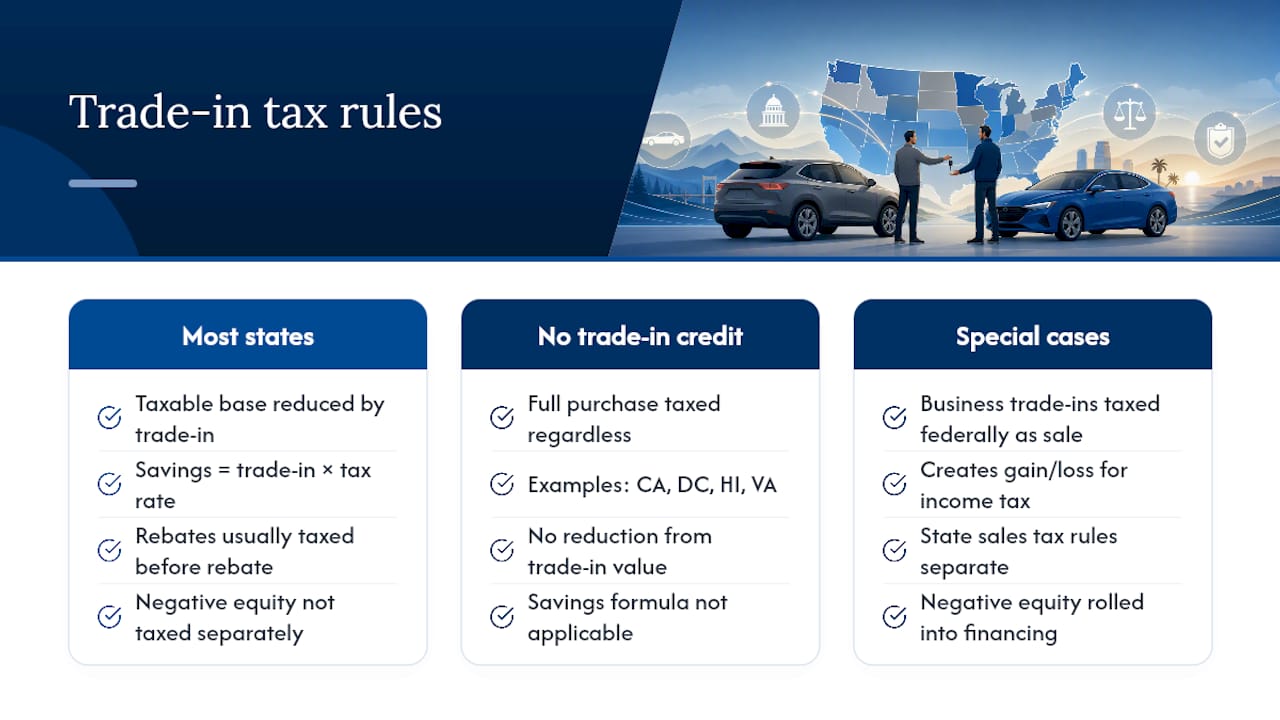
Yes, trading in your vehicle reduces the sales tax you owe on a replacement car in most U.S. states, but it does not work everywhere. Nearly all states subtract your trade-in's value from the new car's price before calculating tax, which shrinks the amount you actually pay tax on. A handful of states, including California, DC, Hawaii, and Virginia, tax the full purchase price regardless of what you trade in.
Quick math: your typical savings equal trade-in value multiplied by your combined state and local tax rate.
Before you sign anything, check your dealer's buyer's order for one specific number: the taxable amount after trade-in credit. If that line still shows the full sticker price, ask why.
Key Takeaways
Trading in a vehicle lowers your sales tax bill in most states because the trade-in value reduces the taxable base, but California, DC, Hawaii, and Virginia tax the full price regardless.
| Point | Details |
|---|---|
| Know your state's category | Full credit, capped credit, no credit, or no sales tax at all changes your math entirely. |
| Use the savings formula | Multiply trade-in value by your combined tax rate to estimate real dollar savings. |
| Verify the buyer's order | Confirm the taxable amount reflects price minus trade-in, not the sticker price. |
| Watch for caps and edge cases | Michigan caps, Washington luxury tax rules, and business trades follow different math. |
| Choose a transparent dealer | Auto Vendors Inc structures trade-ins into the same transaction to protect your tax credit. |
Table of Contents
- How the Trade-In Tax Advantage Actually Works
- Which States Give Full Trade-In Tax Credit?
- How Much Could You Actually Save?
- When the Trade-In Tax Advantage Doesn't Apply
- What to Check on Your Buyer's Order
- Why Trade-In Documentation Matters More Than Buyers Realize
- Why State-Specific Guidance Beats General Advice
- Trade In Your Vehicle With Full Tax Transparency
- Frequently Asked Questions
- Sources
How the Trade-In Tax Advantage Actually Works
Most states calculate sales tax on what's called the "taxable base," not the sticker price. The taxable base is the new vehicle's price minus your trade-in allowance. That's the whole mechanic behind the trade-in tax advantage: lower base, lower tax bill.
Here's how the calculation typically flows at the dealership:
- Start with the negotiated price of the new or used vehicle.
- Subtract the agreed trade-in allowance for your old car.
- Apply your combined state and local sales tax rate to that reduced figure.
- Add back any taxable fees the state doesn't allow to be offset (documentation fees, for example, are often taxed separately).
This is different from treating a trade-in like a cash down payment, which doesn't reduce your taxable base at all. In a net-taxation state, the trade-in lowers what's taxed. In a gross-taxation state, you're taxed on the full price no matter how the trade-in is structured, and the trade-in only functions as a straightforward equity offset against what you owe.
One frequent point of confusion: manufacturer rebates usually don't get the same treatment. Most states tax the vehicle price before the rebate is applied, since a rebate is a manufacturer incentive rather than a reduction in the sale price the dealer negotiated.
Which States Give Full Trade-In Tax Credit?
State trade-in rules break down into four rough categories, and knowing which one your state falls into changes how you should shop.
- Full credit states. The large majority of states, roughly 43 of 51 U.S. jurisdictions, let you deduct the full trade-in value from the taxable price with no cap.
- Conditional or limited-credit states. Some states apply the credit only up to a certain dollar amount or under specific transaction conditions. Michigan has phased in a cap on how much trade-in value can be deducted, and South Carolina applies its own maximum sales tax on vehicle purchases that can interact unexpectedly with trade-in math.
- No-credit states. California, the District of Columbia, Hawaii, and Virginia tax the vehicle's full purchase price. Your trade-in still has value as equity toward the new car, but it does nothing to lower your tax bill.
- No sales tax states. Alaska, Montana, New Hampshire, and Oregon don't charge state sales tax on vehicle purchases at all, so the trade-in credit question doesn't apply.
Washington state adds another wrinkle: its luxury vehicle tax structure can interact with trade-in credits in ways that reduce the expected savings on higher-priced purchases. If you're buying in a state with any of these quirks, don't rely on a national explainer. Check your state comptroller or DMV's official guidance directly, since these agencies publish the actual statutory language dealers must follow.
| Category | Example states | What it means for you |
|---|---|---|
| Full credit | Most states (roughly 43 of 51) | Trade-in value fully deducted before tax is calculated |
| Conditional or capped | Michigan, South Carolina | Deduction limited by a dollar cap or state maximum tax rule |
| No credit | California, DC, Hawaii, Virginia | Full purchase price taxed regardless of trade-in |
| No sales tax | Alaska, Montana, New Hampshire, Oregon | No vehicle sales tax applies at all |
How Much Could You Actually Save?
The formula stays simple across every full-credit state: savings = trade-in value × combined tax rate.
- Taxable base without trade-in: the vehicle price.
- Taxable base with trade-in: vehicle price minus trade-in value.
- Tax owed is calculated accordingly, so the total savings reflect the reduction by the trade-in value times the tax rate.
Scale that formula and you get a feel for the range. A $30,000 trade-in at 9% saves $2,700, according to the calculation logic used by industry tax tools. Bigger trade-ins in higher-tax states produce the biggest wins.
One detail that surprises a lot of buyers: rolled-in negative equity, where you owe more on your old loan than the car is worth, typically doesn't increase your taxable price. It gets folded into your new financing balance, but the tax calculation still runs off the vehicle's sale price and trade-in allowance.

When the Trade-In Tax Advantage Doesn't Apply
Not every deal works out the way the basic formula suggests. A few situations change the outcome, sometimes significantly.
- States that tax the gross purchase price mean your trade-in adds equity to the deal but never touches your tax bill.
- Dollar caps in states like Michigan can limit how much of a large trade-in actually counts toward the deduction.
- Some jurisdictions apply luxury or supplemental taxes on higher-priced vehicles that offset part of your trade-in savings.
- Business vehicle trades follow separate federal income tax rules entirely. The IRS treats a business trade-in as a sale of the old vehicle and a separate purchase of the new one, triggering its own gain or loss calculation independent of any state sales tax savings.
Pro Tip: If you're weighing a dealer trade-in against selling privately, run the "breakeven" math first. Add your state's tax savings to the dealer's offer, then compare that combined number against what you'd realistically net from a private sale after fees and hassle. The tax advantage often closes the gap faster than buyers expect.
What to Check on Your Buyer's Order
The paperwork is where trade-in tax savings either show up or quietly disappear. Before you sign, verify these items line by line.
- The taxable amount or selling price listed reflects the price after your trade-in allowance, not before it.
- Your trade-in allowance appears as a deduction from the selling price, not lumped in as a cash-down payment.
- Local taxes and fees are itemized separately so you can confirm nothing is taxed twice.
- Your trade-in offer is documented in writing before you finalize the deal.
If anything looks off, ask the finance manager to walk through the math with you:
- Confirm the pre-trade-in vehicle price.
- Confirm the trade-in allowance amount.
- Confirm the resulting taxable base matches price minus allowance.
- Confirm the tax rate applied matches your local combined rate.
Why Trade-In Documentation Matters More Than Buyers Realize
Most sales tax disputes over trade-ins trace back to paperwork, not policy. Auto Vendors Inc documents every trade-in as part of the same transaction as the new purchase on a single buyer's order, which is the structure state comptroller offices generally require to apply the credit correctly. Processing a trade-in as a separate, standalone sale can jeopardize the credit entirely in some jurisdictions.
When a state's rule feels ambiguous, our team tells buyers the same thing every time: pull the actual statute or call the comptroller's office before assuming a percentage. A five-minute call beats a surprise on delivery day.
This piece was written with input from Allen, whose writing on trade-in valuation and luxury vehicle appraisal informs how Auto Vendors Inc structures trade-in offers for buyers across Florida.
Why State-Specific Guidance Beats General Advice
The conventional advice to "just subtract your trade-in from the price" works often enough that most buyers never question it, until they buy in California or Virginia and get blindsided. The real skill isn't understanding the formula. It's knowing whether your state uses it at all.
What gets underestimated is how much documentation matters versus how much the policy itself matters. Two buyers in the same state can end up with different outcomes if one dealer structures the trade-in as part of the purchase and another treats it as a separate transaction. The rule matters less than whether your paperwork reflects it correctly.
Prioritize verification over calculation. Knowing the formula is easy. Confirming your buyer's order actually applies it, and understanding how negative equity gets carried into financing, takes five extra minutes that most buyers skip entirely, often to their own cost.
Trade In Your Vehicle With Full Tax Transparency
Auto Vendors Inc in Fort Lauderdale builds every trade-in into your purchase paperwork the way state comptrollers expect, so your tax credit shows up where it should instead of getting buried in a rushed buyer's order.

If you're weighing a private sale against a dealer trade-in, the math in this guide only works in your favor when the trade-in and the new purchase happen on the same transaction. That's exactly how Auto Vendors Inc structures every deal, with personalized vehicle finding assistance and trade-in valuation handled by the same team from start to finish, so nothing gets processed as a separate sale that could cost you the credit. Buyers considering an EV as their next vehicle should also weigh how federal EV charger tax credits factor into total cost before the June 30, 2026 deadline. Browse current inventory at Auto Vendors Inc or reach out to get a written trade-in offer before you commit to your next purchase.
Frequently Asked Questions
Does trading in a car always reduce sales tax? No. Most states reduce your taxable base by the trade-in value, but California, DC, Hawaii, and Virginia tax the full purchase price regardless of any trade-in.
How do I calculate my trade-in tax savings? Multiply your trade-in's value by your combined state and local sales tax rate.
Do manufacturer rebates reduce my taxable price the same way a trade-in does? Usually not. Most states tax the vehicle price before the rebate is subtracted, since a rebate isn't treated the same as a negotiated trade-in credit.
Does rolled-in negative equity increase what I'm taxed on? Typically no. Negative equity gets added to your financing balance, but the tax calculation still runs off the sale price and trade-in allowance separately.
Are business vehicle trade-ins taxed differently? Yes. For federal income tax, business trade-ins are treated as a sale of the old vehicle and a separate purchase, creating gain or loss calculations apart from state sales tax rules.
Sources
- Does a Trade-In Reduce Sales Tax? - NerdWallet
- Trade-In Tax Savings by State: Sales Tax Credit Guide (2026)
- How to Calculate Sales Tax on a Car With Trade-In - Accounting Insights
- Business Vehicle Trade-In Tax Treatment Rules - LegalClarity