
Deferred interest auto financing is a promotional loan structure where interest accrues on the full balance from day one, but payment of that interest is suspended for a set promotional period, typically 6–24 months. The industry term for this arrangement is "deferred interest promotion," and it differs sharply from true 0% APR financing. According to Experian, if any balance remains unpaid at the end of the promotional period, all accrued interest from the original purchase date is charged retroactively. That single mechanic is what makes deferred interest car loans far riskier than they appear at the dealership.
What is deferred interest auto financing and how does it work?
Deferred interest works through a straightforward but punishing sequence of events. Interest begins accumulating on your full loan balance the moment you sign the contract. The lender suspends collection of that interest during the promotional window, which creates the illusion of a no-interest deal.
Here is the step-by-step sequence most car buyers encounter:
- You sign the loan. Interest starts accruing daily on the full purchase price, often at rates exceeding 20% APR on retail financing products.
- You make minimum payments. During the promo period, your required monthly payments are typically low. They rarely cover enough principal to clear the balance before the deadline.
- The promo period ends. If your balance is not fully paid to zero, every dollar of interest that accrued silently since day one is added back to your principal in a single charge.
- Your loan balance spikes. You now owe more than you expected, and the remaining loan term carries standard interest on top of that inflated balance.
A practical example makes this concrete. On a $25,000 auto loan at 7% APR with a 90-day no-payment deferral, approximately $437.50 in interest accrues and gets added to the principal. That addition also raises your effective APR by 0.4–1.2 percentage points over the life of the loan.
Pro Tip: Set a calendar reminder 60 days before your promotional period ends. That gives you time to arrange a lump-sum payoff or refinance before the retroactive charge hits.

What are the risks and potential costs of deferred interest auto loans?
The biggest risk in deferred interest car loans is the all-or-nothing payoff rule. Even a balance of 50 cents remaining at the end of the promotional period triggers retroactive interest on the full original loan amount, not just the unpaid portion. That is a critical distinction most car buyers miss.
The financial risks stack up quickly:
- Silent interest accumulation. Rates on deferred interest products often exceed 20% APR, meaning a large balance accrues fast even when you make regular payments.
- Retroactive charges on the full balance. The interest charge applies to the original purchase amount, not what you still owe. A $30,000 loan paid down to $2,000 still generates retroactive interest on $30,000 if you miss the deadline.
- Loan term extension. A 90-day deferral adds roughly $400–$500 in interest to the loan and can extend the effective repayment period by months.
- Bundled dealer fees. Dealer financing with deferred interest often includes inflated vehicle prices or additional fees, making the total cost higher than the advertised APR suggests.
- Minimum payment traps. Minimum payments during the promo period are designed to keep you engaged, not to clear your balance. Paying only the minimum almost guarantees a retroactive charge.
"Deferred interest is not inherently bad, but it is risky without disciplined payment planning. Minimum payments usually will not prevent accrued interest from hitting at the end of the promotional period." — Bankrate
The compounding effect is what catches most car buyers off guard. Interest accruing daily on a large balance grows faster than most people expect, especially at rates above 20%. By the time the promo period ends, the retroactive charge can easily exceed $1,000 on a mid-size auto loan.
How does deferred interest compare to 0% APR and other auto financing options?
True 0% APR financing and deferred interest promotions look identical in a dealership brochure. They are fundamentally different products. Understanding the gap between them is the most useful skill a car buyer can develop before signing any financing agreement.
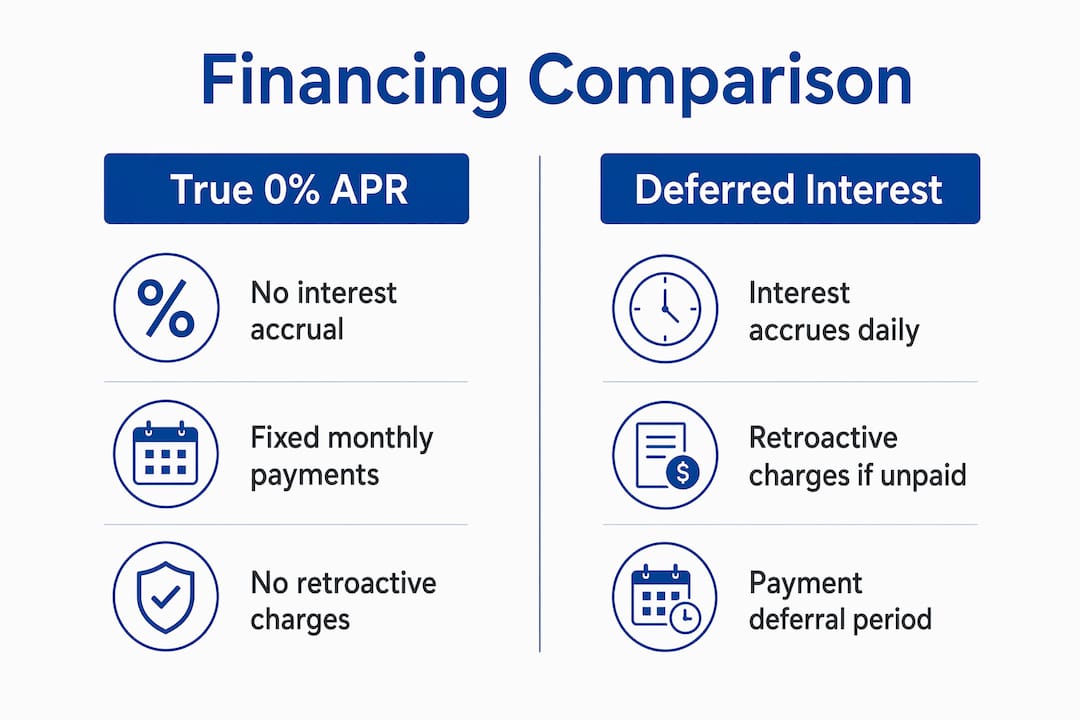
With a true 0% APR offer, no interest accrues at any point during the promotional period. If you pay off the balance on time, you owe exactly what you borrowed. With deferred interest, interest accrues every single day. You only avoid paying it if you clear the full balance before the deadline.
| Feature | True 0% APR | Deferred Interest | Traditional Auto Loan |
|---|---|---|---|
| Interest accrual during promo | None | Daily from day one | Ongoing from day one |
| Retroactive charge risk | None | High if balance remains | None |
| Typical promotional period | 12–60 months | 6–24 months | No promo period |
| Qualification requirements | Strong credit required | Varies, often easier | Standard credit check |
| Best for | Buyers who can pay in full | Buyers with strict payoff discipline | Buyers who want predictable payments |
Cash-back rebates add another layer to this comparison. Rebates typically range from $1,500 to $5,000 and can reduce the principal you finance through a bank or credit union. Financing a lower principal at a standard rate sometimes costs less overall than accepting a deferred interest promotion tied to the full sticker price.
Pro Tip: Calculate the all-in cost of each option before you commit. Take the cash-back rebate amount, subtract it from the vehicle price, and run the numbers on a standard loan. Compare that total to the deferred interest scenario, including the worst-case retroactive charge.
Reviewing your pre-approval financing options before visiting a dealership gives you a concrete benchmark. When you already know your rate from a bank or credit union, a deferred interest offer is much easier to evaluate objectively.
What practical strategies can car buyers use to manage deferred interest pitfalls?
Deferred interest offers can work in your favor, but only with a clear payoff plan in place before you sign. Bankrate confirms that the benefit depends entirely on strict payoff discipline. Without it, the promotion becomes a liability.
Follow these steps to protect yourself:
- Calculate your required monthly payment. Divide the full loan balance by the number of months in the promotional period. Pay that amount every month, not the minimum.
- Pay the accrued interest early. Paying the accrued interest amount during the deferral window stops compounding and reduces total loan cost. Ask your lender for the current accrued interest figure and write a separate check for it.
- Read the fine print on the promo end date. Confirm the exact date the promotional period expires. Some lenders count from the contract date; others count from the first payment date.
- Avoid the 90-day no-payment offer unless necessary. Dealerships use this tactic as a closing tool. The interest still runs during those 90 days, and skipping payments only increases the balance you need to clear.
- Negotiate the vehicle price separately from financing. Dealers sometimes inflate the price when offering promotional financing. Lock in the purchase price first, then discuss financing terms.
- Set automatic payments above the minimum. Automatic payments prevent missed deadlines and keep you on track to clear the balance before the promo period ends.
Reviewing time-saving car buying strategies before you visit a dealership helps you recognize these tactics in real time. Knowledge of how 90-day deferrals and deferred interest promotions function gives you a clear advantage at the negotiating table.
Key Takeaways
Deferred interest auto financing accrues interest daily from purchase and charges it all retroactively if the full balance is not cleared before the promotional period ends, making payoff discipline the single most important factor in avoiding significant extra cost.
| Point | Details |
|---|---|
| Interest accrues from day one | Unlike true 0% APR, deferred interest builds daily on the full original balance. |
| All-or-nothing retroactive charge | Even a tiny unpaid balance at promo end triggers interest on the full original loan amount. |
| 90-day deferrals cost real money | A $25,000 loan at 7% APR generates roughly $437.50 in added interest during a 90-day deferral. |
| True 0% APR is the safer option | No interest accrues with genuine 0% APR, making it a lower-risk choice for qualified buyers. |
| Payoff discipline is the key safeguard | Paying the full balance before the promo deadline is the only way to avoid retroactive charges. |
My honest read on deferred interest financing
I have watched car buyers walk into dealerships excited about a "no interest" promotion and walk out with a loan that cost them thousands more than expected. The phrase "deferred interest" does not appear in large print on most financing agreements. It shows up in the fine print, buried under promotional language designed to make the deal feel like a gift.
The offers are not fraudulent. They are legal, and they can genuinely benefit buyers who pay off the balance on time. The problem is that most people do not. Minimum payments feel manageable in the moment, and the deadline feels distant. Then the promo period ends and a large retroactive charge lands without warning.
My advice is direct: treat a deferred interest promotion like a short-term loan with a hard deadline, not like a flexible payment plan. If you cannot commit to clearing the full balance before the period ends, a standard auto loan or a true 0% APR offer is a better fit. The math rarely lies, and the math on deferred interest is unforgiving.
— Allen
Financing options worth exploring at Autovendorsfl
Car buyers who want transparent financing terms and clear cost breakdowns have a reliable resource in Autovendorsfl.
Autovendorsfl specializes in premium and luxury vehicles and takes a hands-on approach to financing education. The team helps buyers compare real loan structures, including the difference between deferred interest promotions and straightforward financing agreements, so there are no surprises after signing. Whether you are financing a first luxury purchase or upgrading your current vehicle, explore your options directly with a team that prioritizes clarity over sales pressure. Autovendorsfl builds lasting relationships with buyers by making sure every financing decision is fully understood before the contract is signed.
FAQ
What is the main risk of deferred interest auto financing?
The main risk is the retroactive interest charge. If any balance remains at the end of the promotional period, all interest accrued from the original purchase date is added to the loan, not just interest on the remaining balance.
How is deferred interest different from 0% APR financing?
True 0% APR means no interest accrues during the promotional period. Deferred interest accrues daily from day one and is only forgiven if the full balance is paid before the promo deadline.
Can a 90-day no-payment auto loan deferral hurt me financially?
A 90-day deferral on a $25,000 loan at 7% APR adds approximately $437.50 in interest to the principal. It also raises your effective APR and can extend the loan term.
What happens if I make only minimum payments on a deferred interest loan?
Minimum payments during the promotional period rarely reduce the balance enough to avoid a retroactive charge. Paying only the minimum almost always results in the full accrued interest being added to your loan at the end of the promo period.
Is deferred interest auto financing ever a good deal?
It can be, but only if you pay the full balance before the promotional period ends. Bankrate notes that the benefit depends entirely on strict payoff discipline. Without a clear plan to clear the balance, the risks outweigh the benefits.