
Pre-approval luxury auto financing is the process of securing a formal loan commitment before you set foot in a dealership, giving you a confirmed budget and real negotiating power. Unlike pre-qualification, which uses a soft credit inquiry to produce rough estimates, pre-approval involves a hard credit inquiry and produces loan details that rarely change. That distinction matters enormously when you are shopping for a six-figure vehicle where every percentage point on your APR translates to thousands of dollars. Autovendorsfl works with buyers who want clarity before they commit, and this guide walks you through every step of the process for 2026.
What documents and credit factors are required for pre-approval luxury auto financing?
Luxury auto loan pre-approval demands more documentation than a standard car loan. Lenders who specialize in high-end vehicles apply stricter underwriting because exotic and classic cars carry unique valuations that standard appraisal models do not always capture reliably.
Required documents
The standard document checklist for luxury auto loan pre-approval includes the following:
- Government-issued photo ID (driver's license or passport)
- Proof of income (recent pay stubs or a profit-and-loss statement for self-employed buyers)
- Federal tax returns for the past two years
- Bank and investment account statements covering the past two to three months
- Proof of insurance or a binder letter from your insurer
- Purchase agreement or vehicle details if you have already identified a specific model
Each document serves a specific purpose. Tax returns confirm income consistency. Bank statements prove you have the liquidity for a down payment and reserves. The purchase agreement helps the lender assess loan-to-value ratio against the actual vehicle.
Credit score and loan-to-value expectations
Most lenders financing luxury vehicles expect a credit score of 700 or higher, with the best rates reserved for scores above 740. Luxury auto loans typically require a down payment of 10–20%, and lenders generally cap loan-to-value ratios between 80% and 90%. That cap exists because high-end vehicles can depreciate quickly, and lenders want a cushion against negative equity.

Lenders also review your debt-to-income ratio, which is your total monthly debt payments divided by your gross monthly income. A ratio below 43% is the standard threshold for approval, though luxury lenders often prefer to see it below 36%.
Pro Tip: Pull your credit report from AnnualCreditReport.com at least 60 days before applying. Dispute any errors and pay down revolving balances to push your score above the next tier threshold before a hard inquiry hits.
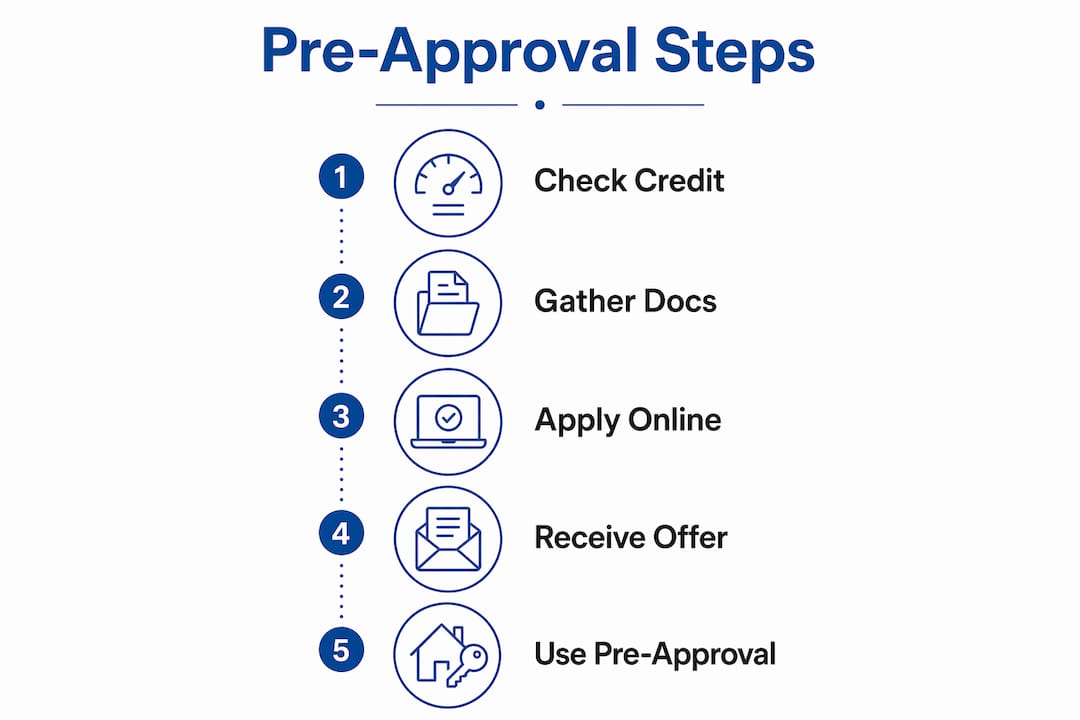
How to apply for pre-approval: step-by-step process
Applying for pre-qualified luxury car financing is straightforward when you approach it methodically. The goal is to collect multiple competitive offers without damaging your credit score in the process.
-
Research lenders who specialize in luxury vehicles. Banks, credit unions, and specialty finance companies each offer different rate structures. Credit unions frequently offer lower APRs than traditional banks for well-qualified borrowers.
-
Understand the difference between soft and hard inquiries. A soft inquiry has no impact on your credit score and is used during pre-qualification. A hard inquiry, which occurs during formal pre-approval, can lower your score by a few points temporarily. Time your applications carefully.
-
Submit applications within a short window. Multiple pre-approval applications submitted within a 14-day window count as a single credit inquiry under most scoring models. That window lets you shop aggressively without compounding the credit impact.
-
Complete each application with your full financial picture. Include your desired loan amount, preferred term length, and the vehicle details if you have them. Incomplete applications slow the process and can result in conditional approvals that change at closing.
-
Use online pre-approval tools where available. Online pre-approval applications let you explore lending options at your own pace and often return decisions within minutes. Many luxury-focused dealers and lenders offer these forms directly on their websites.
-
Compare every offer side by side. Look beyond the monthly payment. Reviewing APR, loan term, fees, and prepayment rules is the only way to identify which offer costs the least over the life of the loan. Two offers at the same interest rate can have very different total costs if one carries origination fees or prepayment penalties.
Pro Tip: Set a calendar reminder for your pre-approval expiration date. Most offers are valid for 30–60 days. If your purchase timeline extends beyond that window, you will need to reapply, which means another hard inquiry.
How does pre-approval strengthen your negotiating position?
Pre-approval positions you as a cash buyer in the eyes of a dealership. That framing changes the entire dynamic of the negotiation.
When you walk in with a confirmed loan amount, you shift the conversation from monthly payments to the out-the-door price. Dealers often use monthly payment framing to obscure the true cost of a vehicle by extending loan terms or bundling add-ons. Pre-approval removes that tactic from the table.
Here is what pre-approval specifically enables during the purchase process:
- Price focus over payment focus. You negotiate the vehicle price directly, not a payment structure the dealer controls.
- Resistance to unnecessary add-ons. Extended warranties, paint protection packages, and gap insurance are easier to decline when you are not dependent on dealer financing.
- Faster paperwork. Your financing is already approved. The dealer simply needs to verify the details and process the sale.
- Accurate total cost budgeting. Knowing your loan amount and rate lets you calculate taxes, registration fees, insurance premiums, and first-year maintenance costs before you sign anything.
- Trade-in clarity. Understanding how luxury vehicle trade-in appraisal works alongside your pre-approved loan amount gives you a complete picture of your net purchase cost.
The buyers who get the best deals on luxury vehicles are almost always the ones who separated the financing decision from the vehicle selection decision. Pre-approval makes that separation possible.
Common mistakes to avoid when seeking luxury auto loan pre-approval
Most problems in the pre-approval process come from one of a handful of predictable errors. Recognizing them in advance saves time, money, and credit score points.
- Treating pre-qualification as pre-approval. Pre-qualification gives you an estimate. Pre-approval gives you a commitment. Buyers who confuse the two often arrive at a dealership believing they have secured financing when they have only received a rough range.
- Submitting incomplete applications. Missing a tax return or a bank statement forces the lender to issue a conditional approval. Conditional approvals can change or fall through entirely when the missing documents reveal unexpected information.
- Applying too early. If your purchase is six months away, applying now wastes a pre-approval that will expire before you are ready to buy. Apply when you are 30–60 days from a realistic purchase date.
- Focusing only on the monthly payment. A lower monthly payment achieved through a longer loan term costs significantly more in total interest. Always calculate the full loan cost, not just the monthly figure.
- Ignoring the down payment impact. A larger down payment reduces your loan-to-value ratio, which can unlock better rates and eliminate the need for gap insurance on a depreciating asset.
The single most expensive mistake a luxury car buyer can make is walking into a dealership without pre-approval and letting the finance office control the terms. At that point, you are negotiating blind against professionals who do this every day.
Checking time-saving car buying strategies before you start the process gives you a clear framework for avoiding these pitfalls from the beginning.
Key Takeaways
Pre-approval luxury auto financing secures your budget and negotiating position before you shop, making it the single most effective step a luxury car buyer can take before visiting a dealership.
| Point | Details |
|---|---|
| Pre-approval vs. pre-qualification | Pre-approval uses a hard inquiry and locks in loan terms; pre-qualification is only an estimate. |
| Documentation matters | Prepare ID, tax returns, pay stubs, and bank statements at least 60 days before applying. |
| Apply within a 14-day window | Multiple applications in 14 days count as one inquiry, protecting your credit score. |
| Negotiate the price, not the payment | Pre-approval lets you focus on the out-the-door price and resist dealer payment framing. |
| Compare total loan cost | APR, fees, term length, and prepayment rules determine the true cost of any offer. |
Why I think most buyers underestimate pre-approval timing
The conventional advice says to get pre-approved before you shop. That is correct, but it misses the more important point: timing your pre-approval to your actual purchase readiness is what separates a smooth transaction from a frustrating one.
I have seen buyers get pre-approved in january, fall in love with a vehicle in march, and discover their approval expired. They reapply, take another hard inquiry hit, and sometimes find that rates have shifted. The 30–60 day window before your intended purchase date is the right target.
The 2026 market adds another layer of complexity. Promotional APRs on select luxury SUVs and EVs can generate significant savings compared to baseline loan rates, but those offers are time-limited and model-specific. A buyer with pre-approval in hand can move quickly when a promotional rate aligns with their target vehicle. A buyer still gathering documents cannot.
My strongest recommendation is to get pre-approvals from at least two sources: a credit union or bank you already have a relationship with, and a lender that specifically handles luxury or exotic vehicles. The reasons luxury dealers offer payment plans are worth understanding too, because dealer financing is sometimes genuinely competitive, especially when manufacturer incentives are in play. Walk in with external pre-approval, compare it to what the dealer offers, and choose the better deal. That approach costs you nothing and can save you thousands.
— Allen
Autovendorsfl is ready to support your luxury financing process
Autovendorsfl has spent years helping buyers in Fort Lauderdale and beyond find the right high-end vehicle at the right financial terms. The team understands that financing options for luxury cars require a different level of attention than standard auto loans.

When you are ready to move forward, Autovendorsfl connects you with lenders experienced in luxury vehicle underwriting, helps you understand what your pre-approval means in practice, and guides you through the vehicle selection process with full transparency. The goal is a purchase that fits your budget and your standards. Visit Autovendorsfl to start the conversation, or explore the benefits of dealership vehicle sourcing to understand how a specialized dealership approach changes the buying experience.
FAQ
What is the difference between pre-qualification and pre-approval?
Pre-qualification uses a soft credit inquiry to produce an estimated loan range, while pre-approval uses a hard inquiry and produces a firm loan commitment with specific terms that rarely change before closing.
What credit score do I need for luxury auto loan pre-approval?
Most luxury vehicle lenders require a minimum credit score of 700, with the most competitive rates available to borrowers above 740.
How much down payment is required for a luxury auto loan?
Luxury auto loans typically require 10–20% down, with lenders capping loan-to-value ratios between 80% and 90% to protect against depreciation risk.
How long does a luxury auto loan pre-approval last?
Most pre-approvals remain valid for 30–60 days. Apply when you are within that window of your intended purchase date to avoid reapplying and taking an additional hard inquiry.
Does applying to multiple lenders hurt my credit score?
Multiple applications submitted within a 14-day window count as a single credit inquiry under most scoring models, so shopping multiple lenders in that period has minimal impact on your score.