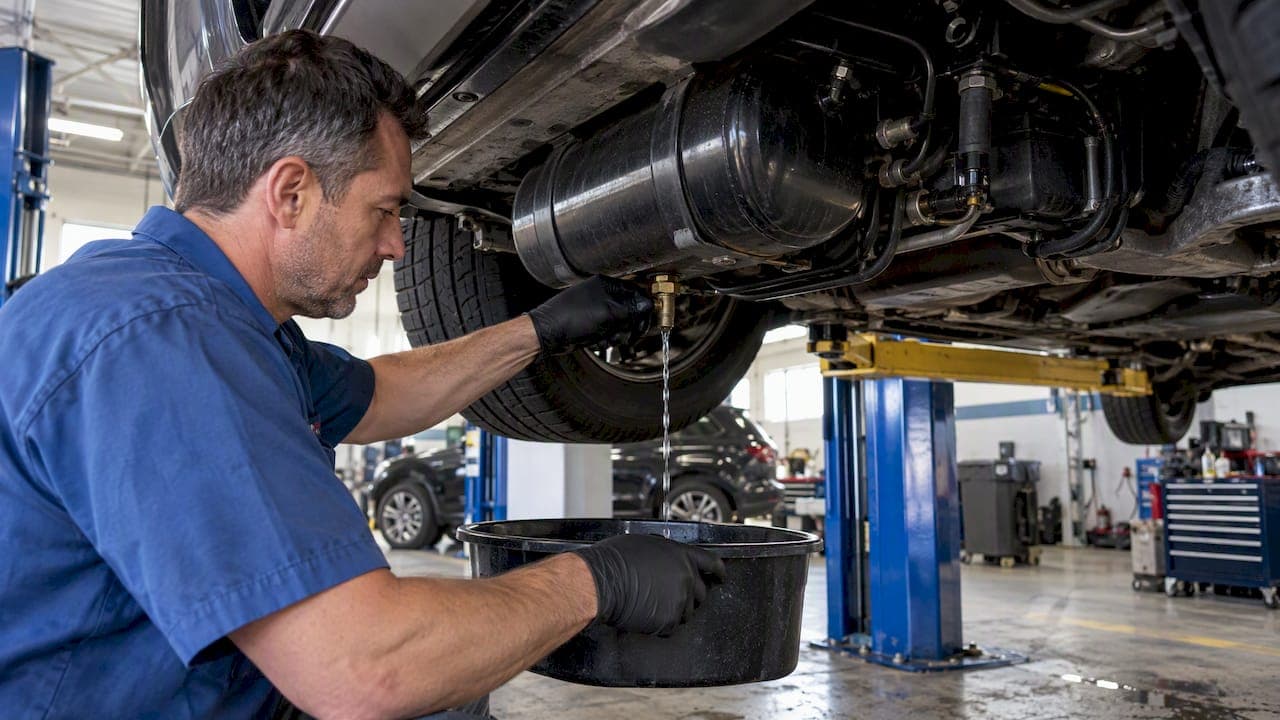
Air suspension stays reliable when owners drain the air tank monthly, inspect springs and lines visually for cracks or chafing, and keep moisture out of the compressor and dryer system. Most failures trace back to neglected fittings or accumulated moisture rather than worn components. Persistent pressure loss, rapid deflation, electrical faults, or an unusually loud compressor warrant a professional diagnostic rather than a home fix.
TL;DR:
- Regularly inspecting air springs, lines, and fittings helps prevent leaks caused by chafing or improper routing, which are common failure points.
- Draining the air tank monthly and replacing desiccant reduces moisture buildup that can lead to corrosion and freezing in cold weather.
- A slow pressure loss over hours often indicates external leaks, while rapid cycling of the compressor suggests internal faults or moisture issues.
- Maintaining proper torque on suspension fasteners and avoiding lifts on air springs prevents damage and ensures safety during repairs.
- Documented maintenance history significantly lowers repair costs and extends the lifespan of air suspension components.
Table of Contents
- Quick owner checks and visual inspection steps
- Diagnosing leaks and pressure problems
- Compressor, dryer, tank, and valve block maintenance
- A maintenance schedule you can actually follow
- Common failures, expected lifespans, and repair costs
- Safe jacking, lifting, and OEM torque notes
- When to DIY and when to call a technician
- Software and ECU diagnostics for air suspension systems
- Height sensor faults and how to maintain them
- What we have learned about preventable failures
- Prefer a vehicle with documented suspension care?
- FAQ
- Sources
Quick owner checks and visual inspection steps
A five-minute visual inspection catches most developing problems before they strand a vehicle. We recommend doing this monthly, ideally when the tank is drained anyway, since both tasks take you under the vehicle at the same time.
Start with the air springs themselves. Look for cracking, abrasion marks, or any spot where the rubber bellows looks glazed or thin. The springs need at least a half-inch of clearance from moving suspension parts and exhaust components, a standard, as outlined by Air Lift Company in its basic maintenance guidance. Rubbing against a control arm or driveshaft will wear through a bellows far faster than normal aging.

Next, trace the air lines from the springs back to the valve block. Heat exposure near exhaust routing, kinks from improper routing, and chafing against frame edges are the usual culprits behind slow leaks. Push-to-connect fittings deserve a close look, since a line that was not cut square or fully seated often leaks intermittently rather than constantly, making it easy to miss on a quick glance.
Finally, check the valve block connectors for corrosion and look around the shock bodies for oil or wetness, which can indicate a separate hydraulic issue rather than an air-system fault.
A few inexpensive tools make these checks far more useful:
- A small spray bottle filled with a mild soap-and-water solution for leak detection.
- A digital tire-pressure or air-pressure gauge to spot-check system pressure.
- A sharp hose cutter for clean, square cuts if a line needs to be reseated.
- A flashlight to inspect valve block connectors and shock bodies in low light.
Diagnosing leaks and pressure problems
Once a visual check raises a flag, or if ride height looks uneven, a short diagnostic sequence usually isolates the cause without a shop visit.
- Park on level ground and measure ride height at each corner, recording the distance from a fixed reference point on the fender to the center of the wheel hub.
- Compare the four measurements against each other and against the figures in the owner's manual, noting any corner that sits noticeably lower.
- Mix a soap-and-water solution, about a tablespoon of dish soap per quart of water, and spray it on suspect fittings, seams, and line connections, watching for bubbles, a method Air Lift Company describes as a basic but effective test.
- Avoid spraying soap directly on electrical connectors or desiccant housings, since moisture there causes more problems than it solves.
- Connect a pressure gauge and watch the compressor's run cycle: a system that loses pressure slowly over hours points to a small external leak, while a compressor that runs constantly or cycles rapidly often signals a dryer or compressor fault instead.
If the leak traces to a push-to-connect fitting, the fix is often mechanical rather than a parts replacement. Cut the line square with a dedicated hose cutter, confirm the cut edge is clean, and reseat the fitting fully until it clicks home, a technique Air Lift Company's fitting guide notes resolves a large share of intermittent micro-leaks that owners mistake for compressor trouble.
Pro Tip: Mark each corner's baseline ride height with tape or a paint pen the first time you measure it, so future checks take seconds instead of a full remeasure.
Compressor, dryer, tank, and valve block maintenance
These four components work together, and moisture is the thread connecting most of their failures. Draining the air tank monthly releases condensation before it rusts the tank from the inside or freezes in the lines during cold weather, a core step in Air Lift Company's maintenance routine.
Beyond the tank, a short checklist keeps the rest of the system healthy:
• Check compressor mounts for looseness or cracked rubber isolators, which let vibration damage electrical connections over time.
- Clear the intake filter of dust and debris so the compressor is not working harder than it needs to.
- Inspect electrical connectors at the compressor for corrosion, especially on vehicles exposed to road salt.
- Watch for a compressor that runs longer than usual to reach target pressure, an early sign of internal wear or a slow leak elsewhere in the system; more signs and how to check them are detailed in Warm air and odd noises: signs your AC compressor is failing.
- Replace desiccant in the dryer on a schedule suited to your climate, since saturated desiccant lets moisture reach the valve block and cause corrosion or frozen ports in cold conditions, as VB-Airsuspension notes for systems in humid or freezing environments.
Valve blocks rarely fail outright; they tend to develop one bad solenoid or a stuck port from debris. A simple electrical test with a multimeter across each solenoid, combined with a visual check for corrosion at the connector pins, usually finds the problem before it leaves you with one corner that will not inflate.
Pro Tip: If a single corner consistently lags behind the others during inflation, test that corner's solenoid before assuming the air spring itself has failed.
A maintenance schedule you can actually follow
Consistency matters more than intensity with air suspension. A simple recurring schedule, logged somewhere you will actually check it, prevents the gradual neglect that leads to expensive failures.
- Monthly: drain the air tank, spray-test fittings and connections with soap solution, and run a visual check of each air spring for cracking or rubbing.
- Before winter: inspect the desiccant cartridge for saturation and replace it if the system has seen heavy use or high humidity through the year.
- After winter or heavy road-salt exposure: check valve block connectors and compressor wiring for corrosion that salt spray can accelerate.
- Annually: bench test the compressor's run time and pressure output, run a diagnostic scan on the valve block if the vehicle supports it, and assess whether any air spring is approaching the end of its service life.
Keep a simple log with four columns: date, mileage, what you observed, and any parts replaced. This record pays off twice, once by helping you (or a technician) spot patterns like recurring leaks at the same corner, and again if you ever sell the vehicle, since documented maintenance reassures a buyer far more than a verbal assurance.
Common failures, expected lifespans, and repair costs
Air springs typically last 6 to 10 years or 50,000 to 100,000 miles, while compressors and valve manifolds commonly run 3 to 5 years depending on use and climate, according to AccuAir. Moisture, road salt, and repeated overwork from an undetected leak are the three factors most likely to shorten those lifespans, since a compressor forced to run constantly to compensate for a slow leak wears out far faster than one operating under normal cycles.

Industry commentary from Carbuzz frames this plainly: air suspension can be as reliable as coil springs when properly maintained, and its reputation for fragility usually follows neglected preventative maintenance rather than a design flaw. That distinction shapes how we think about repair versus replace decisions, since a system with a documented maintenance history rarely needs the dramatic repairs that give air suspension its bad name.
Repair costs vary widely by vehicle and part, so we will not quote a figure here that no source confirms for your specific model. As a general pattern, isolated fitting or line repairs cost far less than replacing a full air spring or compressor assembly, and catching a leak early almost always keeps you in the cheaper category.
For used-car buyers, the practical rule is simple: favor a vehicle with documented recent air spring replacement, or one still covered by an extended warranty, since Carbuzz's coverage of used luxury ownership costs notes that service history dramatically changes the economics of owning a car with air suspension. Our guide on used luxury car warranties covers what coverage to look for.
Safe jacking, lifting, and OEM torque notes
Working under an air-suspended vehicle carries risks that do not apply to coil-spring cars, and OEM manuals are specific about them. Several manufacturer manuals warn against running the engine while the vehicle is jacked and require selecting the suspension's normal mode before lifting, guidance echoed in the 2025 Nissan Armada owner's manual.
A short safety checklist covers the basics:
- Jack only at the manufacturer's designated points, never on an air spring or line.
- Select the system's normal ride-height mode before lifting, not a raised or lowered setting.
- Support the vehicle on stands rated for its weight before working underneath it, never relying on the jack alone.
- Torque certain suspension fasteners only with the vehicle's weight on the wheels, since tightening them while unloaded can damage bushings or create incorrect clamp loads, a point Ford's service instructions make for suspension fastener sequencing.
When in doubt, the OEM service manual for your specific model is the final word on jack points and torque sequence.
When to DIY and when to call a technician
Some symptoms are safe to investigate yourself; others mean the vehicle needs a shop visit before you drive it further. Rapid deflation, visible smoke, dashboard error codes, a loud or grinding compressor, or a system that resets repeatedly are red flags that call for professional diagnostics rather than home troubleshooting.
Before you book an appointment, run a few quick checks and write down what you find: which corner is affected, how fast it loses height, whether the compressor runs continuously, and any recent weather or road conditions that might be relevant. That record shortens a shop's diagnostic time considerably. Our owner checklist for Mercedes air suspension leaks walks through a similar triage process for one of the more common platforms.
Ask any shop whether the repair is covered under an existing warranty before authorizing work, since that single question often changes the entire repair-versus-replace decision.
Software and ECU diagnostics for air suspension systems
Modern air suspension is managed by an electronic control unit that monitors ride height sensors, compressor cycles, and valve block commands, and it stores fault codes when something falls outside expected ranges. A scan tool capable of reading manufacturer-specific suspension codes, not just generic engine codes, is often the fastest way to confirm whether a problem originates in a sensor, a solenoid, or the control module itself.

Many late-model vehicles also let a technician run a calibration or self-test routine through the ECU after a repair, confirming that ride height sensors and solenoids respond correctly before the vehicle leaves the shop. Skipping this step after a repair is a common reason owners see the same symptom return within weeks.
For owners without access to manufacturer-level diagnostic software, a generic OBD-II reader with suspension coverage can still pull basic fault codes and clear them after a repair, though it will not match the depth of dealer-level tools for calibration work. If a fault code keeps returning after clearing it, that is a strong signal the underlying component, not just the code, needs attention.
Height sensor faults and how to maintain them
Ride height sensors tell the ECU what each corner is doing, and a failing sensor often produces symptoms that mimic a leak: uneven ride height, a dashboard warning, or a system that refuses to level properly even when air pressure checks out fine.
Common sensor faults include a loose or disconnected linkage arm, corrosion at the sensor's electrical connector, and physical damage from road debris since these sensors typically mount low near the control arms. A sensor that has simply worked its way loose is one of the cheapest fixes in the entire system, which makes it worth checking before assuming a more expensive component has failed.
Maintenance here is mostly preventive: keep the sensor and its linkage free of mud and debris, check that the mounting bolts remain tight during routine inspections, and inspect the wiring harness for chafing in the same pass where you check air lines. A sensor reading that does not match the physical ride height you measured by hand is the clearest sign it needs attention.
What we have learned about preventable failures
Most of the preventable failures we encounter trace back to moisture and neglected fittings rather than worn-out parts. A spring that looks tired at year eight is normal wear. A valve block corroded at year three because desiccant never got replaced is a maintenance gap.
When we prepare pre-owned vehicles with air suspension, documenting a suspension check, not just a test drive, gives buyers something concrete to evaluate. A recorded inspection that catches a loose fitting before it becomes a leak is a small thing on paper, but it is the difference between a vehicle that keeps its ride quality and one that needs a repair within months of sale.
— Allen
Prefer a vehicle with documented suspension care?
Diagnosing and maintaining air suspension yourself takes time, tools, and a willingness to get under the car regularly. If that is not how you want to spend your weekends, buying a pre-owned vehicle with documented maintenance history solves the same problem from the other direction. At Auto Vendors Inc, our personalized Car Finder service helps match you with inspected pre-owned vehicles, including luxury models where air suspension condition matters most to ride quality and resale value.

- Browse our current inventory for vehicles with documented service history.
- Use our pre-owned luxury inspection checklist to evaluate any suspension-equipped vehicle you are considering.
- Ask about a vehicle's suspension maintenance records before you commit to a purchase.
If you are weighing a specific model, Mercedes-Benz S-Class listings may include vehicles with documented air suspension history. We can help you understand what a specific car's records show.
FAQ
How long will air suspension last?
Air springs typically last 6 to 10 years or 50,000 to 100,000 miles, while compressors and valve manifolds commonly last 3 to 5 years depending on use and climate, according to AccuAir. Regular moisture control and inspection tend to push components toward the higher end of those ranges.
What is the major problem with air ride suspension?
Moisture intrusion is the single biggest driver of air suspension failures, since it corrodes valve blocks, damages desiccant, and can freeze lines in cold weather. Neglected preventative maintenance, more than any design flaw, is why air suspension earns a reputation for unreliability, according to Carbuzz.
What are the common problems with air ride suspension?
The most frequent issues are slow leaks at push-to-connect fittings, saturated desiccant allowing moisture into the valve block, and failing height sensors that mimic leak symptoms. Cracked air springs from rubbing against nearby components and corroded electrical connectors at the compressor round out the common failure list.
Does air suspension ruin ride quality?
Air suspension does not ruin ride quality when properly maintained; it can match the reliability of coil springs, according to Carbuzz. Ride quality typically degrades only when a leak, worn spring, or failing compressor goes unaddressed long enough to affect ride height and damping.
Sources
- How long does air suspension last? | AccuAir (blog)
- Basic Air Ride Maintenance | Air Lift Company
- Air suspension: what it is plus the pros and cons | Carbuzz
- 2025 Nissan Armada owner's manual — jack and air suspension warnings (excerpt)