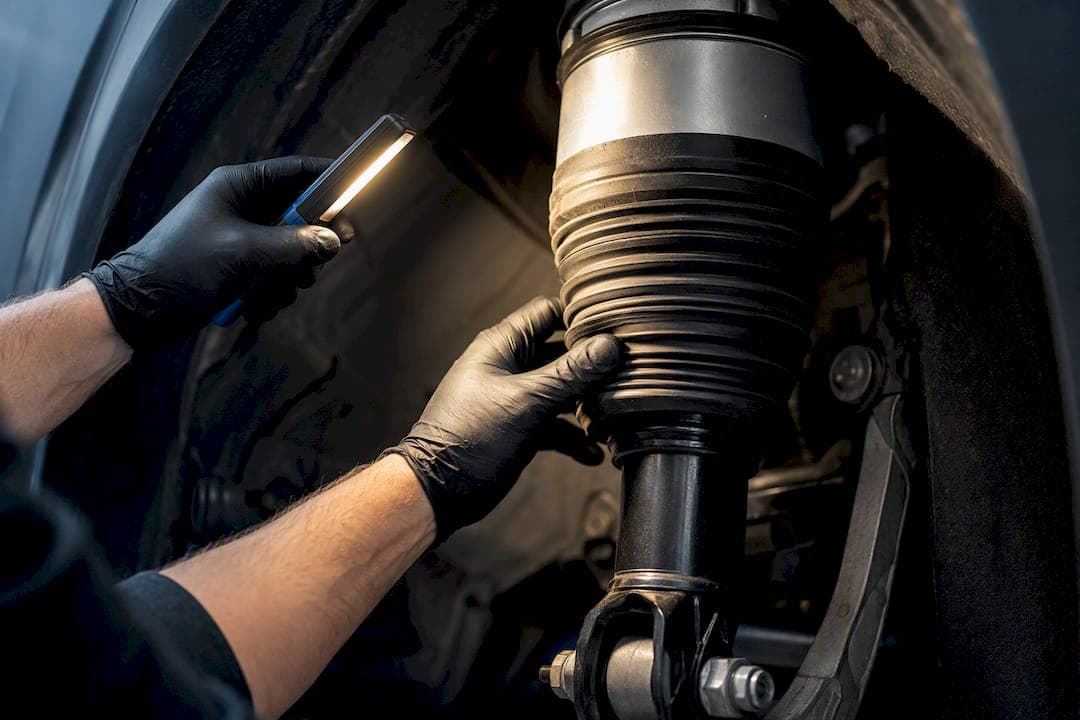
Most Mercedes air suspension failures follow a predictable pattern: a slow leak in a strut or fitting forces the compressor to run overtime, and an overworked compressor eventually drags the valve block and relay down with it. The immediate move is simple. Check the ride height overnight, listen for hissing near the wheel wells, and skip long highway trips until you know whether air is escaping. Catching the first leak early is often the difference between a modest repair bill and a cascade of failures that costs thousands.
TL;DR:
- Early signs of air suspension leaks include overnight ride height drops and hissing sounds, which can be checked with simple owner tests.
- Compressor cycling exceeding a few seconds regularly or lasting over a minute indicates a likely leak requiring professional diagnosis.
- The most common failure points are the rubber bellows in air struts, the valve block, and the system's moisture dryer, especially in older vehicles.
- Proper diagnosis involves pressure testing, ECU fault code reading, and isolating leaks to prevent unnecessary part replacements.
- Regular maintenance checks, including ride height measurements and visual inspections, can significantly reduce repair costs and prevent cascade failures.
Table of Contents
- Understanding Mercedes Airmatic Issues: Which Parts Fail and Why
- Signs of Air Suspension Failure You Can Check Yourself
- What a Professional Air Suspension Diagnosis Involves
- Mercedes Suspension Repair Tips: Costs, Timelines, and Repair Order
- Mercedes Suspension Troubleshooting: A Maintenance Routine That Actually Works
- What a Thorough Inspection Report Should Include
- Why Small Signs Matter More Than the Warning Light
- Book an Air Suspension Inspection Before It Becomes a Bigger Repair
- Sources
- FAQ
Understanding Mercedes Airmatic Issues: Which Parts Fail and Why
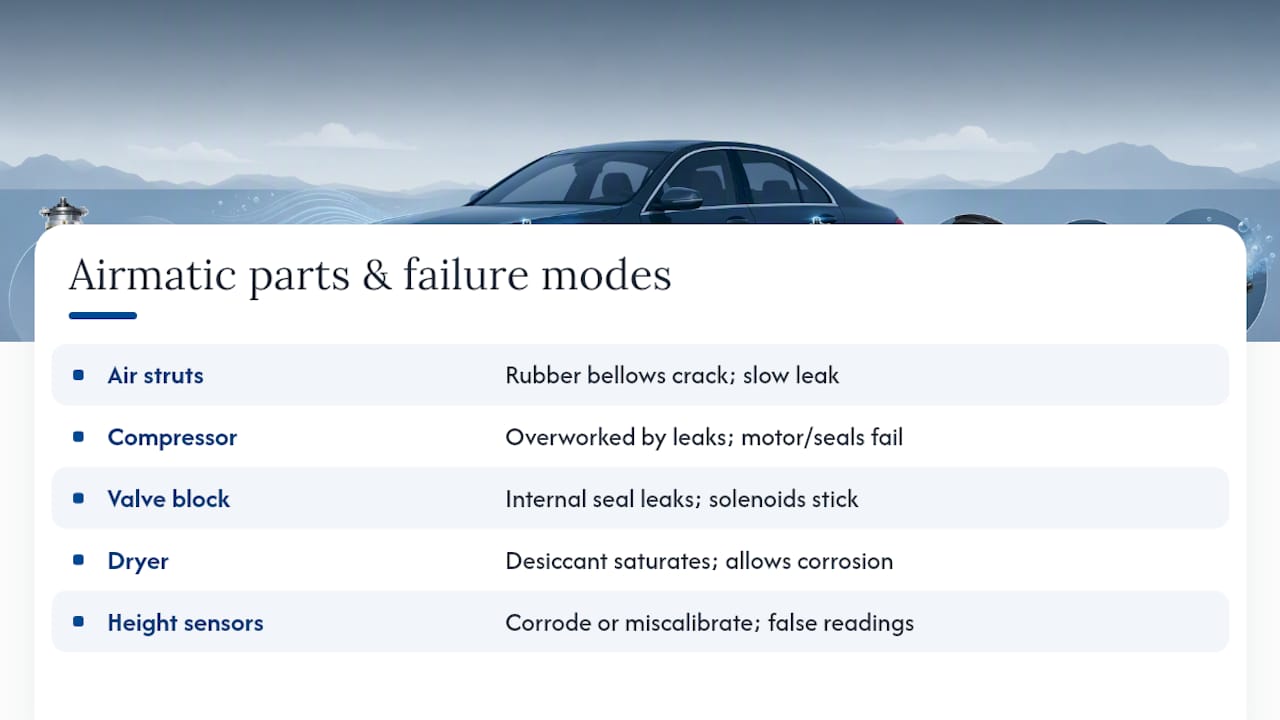
AIRMATIC and Active Body Control systems rely on several parts working in sequence, and each one has its own way of wearing out. The air struts (sometimes called air springs) use a rubber bellows that stiffens and cracks with age and heat, especially in vehicles that spend summers in hot climates. Once that bellows develops even a pinhole, the compressor has to work harder to hold ride height, and continuous cycling shortens its life.
The compressor itself has a duty cycle it isn't meant to exceed, and constant demand from a leaking strut pushes it past that limit until the motor or piston seals give out. The valve block, which directs air to each corner through a set of solenoids, is a common failure point too. Its internal seals leak air silently, and corrosion around the electrical connectors can cause individual solenoids to stick open or closed.
Two supporting parts get overlooked. The dryer, which contains a desiccant to keep moisture out of the system, saturates over time and stops protecting the compressor from the corrosion that kills it early. Height sensors, mounted near each wheel, corrode or lose calibration, sending the ECU inaccurate data that triggers uneven ride height or warning lights for no obvious mechanical reason. Older S-Class sedans and certain SUV generations tend to show these issues more often simply because of accumulated mileage and years of exposure, not because of a single design flaw.
Signs of Air Suspension Failure You Can Check Yourself
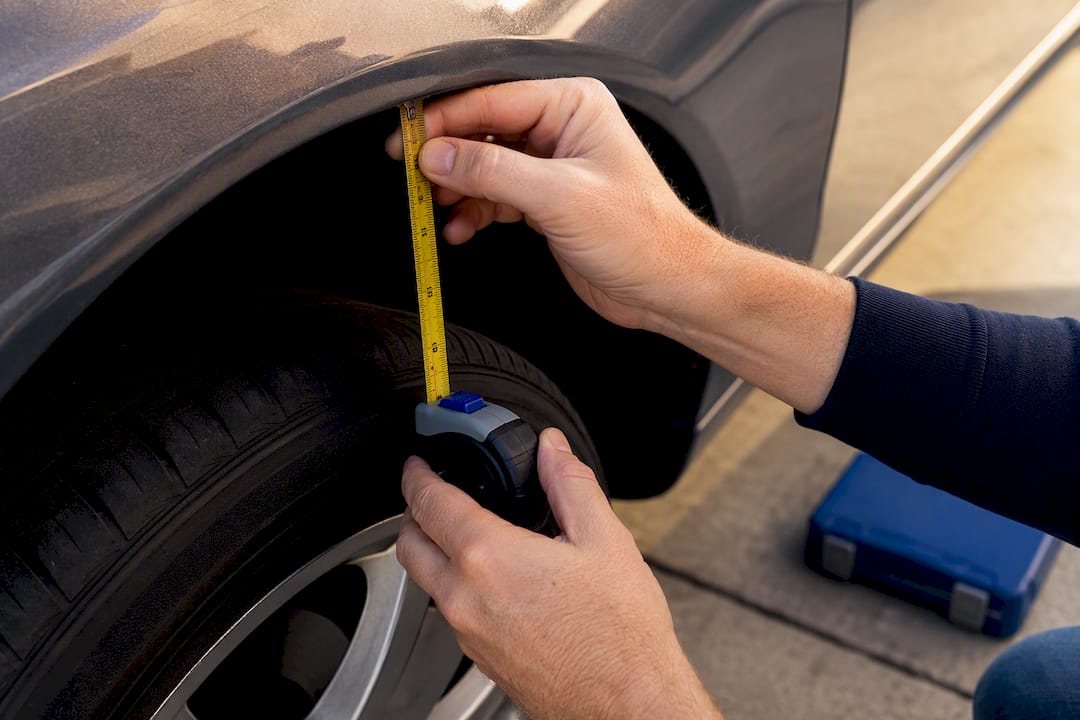
Before booking a shop visit, a handful of owner checks can tell you a lot. The most useful is an overnight ride-height test: measure from the center of each wheel hub to the fender lip at all four corners after the car has settled, then compare those numbers again the next morning. A tape-measure test like this catches sag before any warning light appears, since physical symptoms usually show up before the electronics do.
Here's a short sequence worth running through:
- Park on level ground, note the four corner measurements, and check them again after 8 to 12 hours.
- Listen near each wheel well with the engine off for a faint hissing sound, which usually points to an external air leak.
- Time how long the compressor runs when it kicks in. A few seconds every so often is normal; runs lasting a minute or more, especially overnight, suggest the system is fighting a leak.
- Mix dish soap with water in a spray bottle, coat the fittings and strut seams while the system is pressurized, and watch for bubbles forming at a joint or bellows crack.
- Check the compressor relay and fuse box for obvious corrosion or a burnt smell, both easy visual clues.
Steps one through four are safe for most owners to do in a driveway. Anything involving the valve block itself, internal leak isolation, or reading live pressure data needs a lift and factory-level diagnostic equipment, which is where a professional shop takes over.
What a Professional Air Suspension Diagnosis Involves
A methodical shop starts by pressure-testing the system rather than guessing which part failed. This step alone prevents one of the costliest mistakes in air suspension repair: replacing an expensive component that was never actually broken. Because a sagging corner can trace back to a leaking strut, a stuck valve block, or a faulty sensor, isolating the actual fault first avoids paying for parts you didn't need.
A typical diagnostic sequence includes:
- Pressurizing each air line and holding pressure to confirm whether the leak is external or internal
- Connecting factory-level tools like Xentry or Star Diagnosis to read suspension ECU fault codes and live pressure values at each corner
- Checking relay function, fuse condition, and voltage at the compressor to rule out an electrical cause before touching mechanical parts
- Isolating valve block ports individually to find which solenoid is leaking or stuck
Once repairs are complete, the system needs calibration so the ECU recognizes correct ride height at each corner. Skipping that step is one reason a repair that seemed to go fine still throws warnings a week later.
Mercedes Suspension Repair Tips: Costs, Timelines, and Repair Order
The order repairs happen in matters as much as the repairs themselves. Fixing the leak always comes first. Replacing a compressor without addressing the leak that killed it, and without swapping the relay at the same time, is a near guarantee the new compressor fails again within months.
Realistic price ranges, using OEM+ parts, look something like this:
- Single air strut replacement: roughly $1,200 to $2,000, depending on model and labor rates
- Compressor replacement: typically $800 to $1,500
- Valve block repair or replacement: varies widely depending on whether individual solenoids or the full unit needs replacing
- Relay and dryer service: usually the smallest line item, but skipping it is what turns a single repair into a repeat visit
A minor leak left unaddressed can force replacement of the compressor, valve block, and relay all at once, turning what should have been a few hundred dollars of work into a multi-thousand-dollar bill. That domino effect is the single most expensive mistake owners make with this system.
Diagnosis alone can take an hour or two on a lift; a full strut and compressor job often runs a full day once calibration and test drives are factored in. For owners tired of chasing air suspension repairs on high-mileage cars, a coil-spring conversion is sometimes considered. It trades ride quality and factory height adjustability for long-term simplicity, which makes sense for some daily drivers but rarely makes sense on a car being kept close to original condition.
Mercedes Suspension Troubleshooting: A Maintenance Routine That Actually Works
Prevention here isn't complicated, but it does require consistency. A short routine catches problems while they're still cheap to fix.
- Once a month, check ride height at all four corners and listen for compressor cycling that seems longer or more frequent than usual.
- At every oil change, visually inspect strut tops, air line fittings, and wheel wells for cracking, corrosion, or dust buildup that hints at a slow leak.
- Have the dryer and desiccant checked on a service interval appropriate to your model and mileage, and request a pressure test if the compressor seems to be running more than it used to.
- Clean wheel wells periodically. Road salt and grime accelerate corrosion on height sensors and electrical connectors.
- Address even a tiny leak immediately rather than waiting for a warning light, and replace the relay whenever the compressor is replaced.
A monthly check paired with an annual code scan meaningfully reduces the odds of a cascade failure.
Pro Tip: Keep a written log of your four corner measurements every few months. A gradual half-inch drop on one side over a year is far easier to catch on paper than by memory alone, and it gives a shop a head start on diagnosis.
What a Thorough Inspection Report Should Include
A proper pre-purchase or diagnostic inspection documents more than "suspension looks fine." It should include actual ride-height measurements at all four corners, photos of strut condition and wheel well corrosion, and notes on compressor runtime during the test. That paper trail matters more on a used luxury car than almost anywhere else, since AIRMATIC issues aren't always visible during a short test drive.
Dealer-level diagnostics tend to be the better route for module, ECU, or valve block work, where factory tools read data an independent scan tool sometimes cannot. For strut replacement or general leak repair, an experienced independent specialist often delivers comparable results at a lower cost. Some dealers working with luxury Mercedes models can point buyers toward the inspection details that matter most before a purchase decision, along with guidance on what a transparent seller should disclose about known suspension history.
Why Small Signs Matter More Than the Warning Light
The single habit that saves owners the most money is treating a faint hiss or a half-inch of overnight sag as a real problem, not a wait-and-see situation. By the time a dashboard warning appears, the compressor has often already been overworking for weeks. Measure, write it down, and get the leak sourced before it becomes a bigger job.
I'd rather see an owner spend twenty minutes with a tape measure and a spray bottle than gamble on a guess. A shop that pressure-tests and isolates the fault before replacing parts will almost always save you money over one that starts by swapping the most obvious-looking component.
— Allen
Book an Air Suspension Inspection Before It Becomes a Bigger Repair
If you're shopping for a used Mercedes or already own one showing early signs of sag, a focused inspection beats guesswork every time. A thorough approach to used luxury vehicles includes checking exactly the details this article covers: ride height at all four corners, compressor behavior, and photo documentation of strut and fitting condition, so you know what you're dealing with before committing to a repair or a purchase.
That kind of detail matters most when you're comparing a used S-Class or SUV against another listing that skips these checks entirely. Browse current Mercedes-Benz S-Class inventory or the full Mercedes-Benz selection, and ask about scheduling an inspection focused on air suspension condition before you buy. You'll walk away with a written report covering measurements, compressor notes, and photos, giving you a real basis for negotiating price or moving forward with confidence.
Sources
- Mercedes air suspension problems (ECC Service)
- Mercedes air suspension problems: What fails & how to fix it (Cherish Your Car)
- Mercedes Airmatic suspension repair guide (VPX Performance)
FAQ
How much does it cost to replace air suspension in a Mercedes?
A single air strut typically runs $1,200 to $2,000 with OEM+ parts, while a compressor replacement falls between $800 and $1,500. Costs climb sharply if the valve block or relay also needs attention, which happens often when a leak goes unaddressed too long.
How do I reset the Airmatic suspension in my Mercedes?
Calibration after a repair generally requires factory-level diagnostic equipment like Xentry or Star Diagnosis to reset ride-height values at each corner. This isn't a task most owners can complete safely at home, since it involves reading and writing live suspension data.
How much does it cost to fix the suspension on a Mercedes-Benz?
Total repair cost depends heavily on how many components are involved. A single-part fix like a strut or relay stays in the low thousands, but a full cascade involving the compressor, valve block, and relay together can push the bill well past that.
Can you drive a Mercedes with bad air suspension?
Driving is risky once you see warnings like "Stop, Vehicle Too Low" or notice the car sitting on its bump stops, since continued driving in that state can damage the chassis. A mild leak with normal ride height is lower risk short term, but it should still be diagnosed before it worsens.