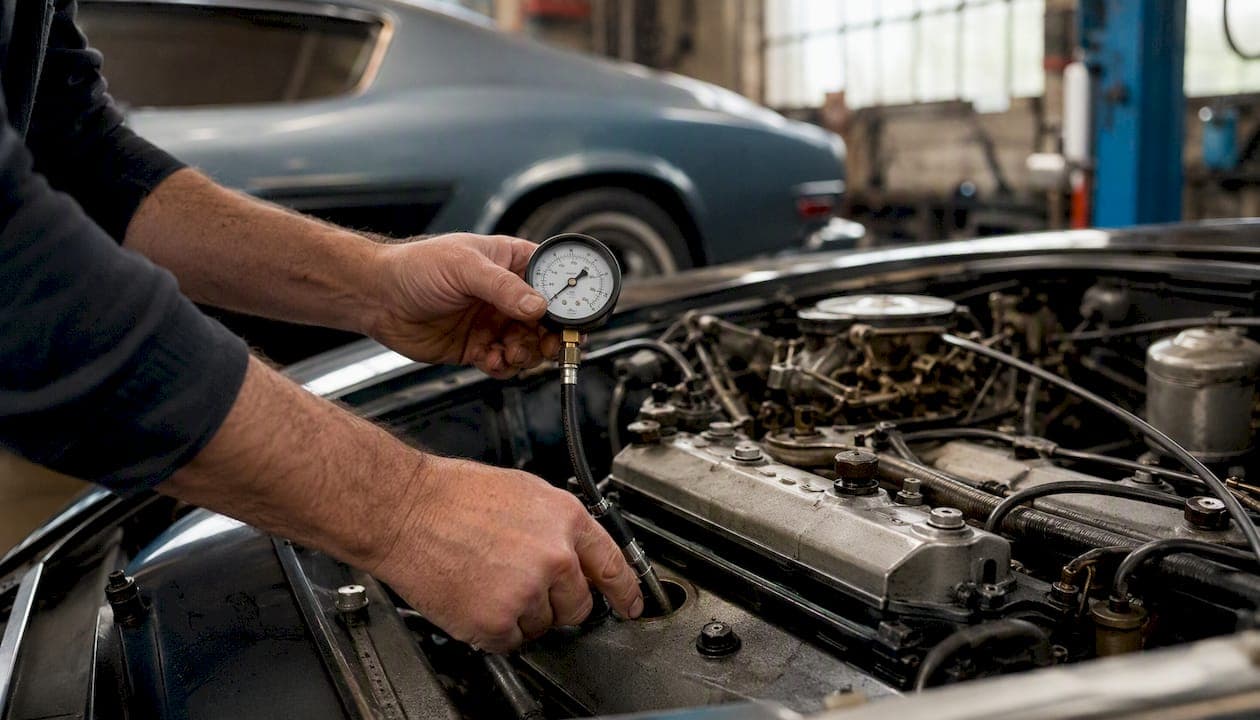
Only buy if the engine, structural integrity, and provenance checks below pass — or if a specialist independently confirms them. If any of the three fail on first viewing, either walk away or negotiate a price adjustment backed by documented evidence. Classiccars as the four pillars of any serious classic car evaluation, and that framework holds whether you're looking at a 1967 Shelby GT500 or a low-production European sports car.
Three immediate on-site checks at first viewing:
- Engine cold-start and visible leaks (pass/fail): Ask the seller not to warm the car before your arrival. A cold start reveals hard-start behavior, smoke color, rough idle, and any leaks that disappear once seals expand. Oil pooling under the car or blue smoke on startup is a fail.
- Panel gaps and hidden rust probe (pass/fail): Run your fingers along door and hood gaps. Uneven gaps wider than a pencil suggest prior accident repair. Press a small magnet against lower body panels, rocker panels, and wheel arches. If it falls or sticks weakly, filler or severe rust lies beneath.
- Service record verification (pass/fail): Ask to see the physical service file before you open the hood. A credible file has dated receipts, mileage stamps, and bills for major work. No records on a high-value rare car is a fail until the seller produces them.
If all three pass, proceed to the full mechanical inspection and test drive below. If any fail, request an independent specialist inspection before committing a dollar.
Key Takeaways
Evaluating a rare car's mechanical condition requires a structured approach: verify provenance first, inspect mechanically second, and use specialist tests to confirm what your eyes and ears suggest.
| Point | Details |
|---|---|
| Verify provenance before anything else | Check VIN across all locations, review service records, and confirm matching numbers before the test drive. |
| Use diagnostic tests for engine health | Compression and leak-down tests give measurable data; request both alongside a borescope inspection on any high-value engine. |
| Structural rust is a walk-away condition | Rust in floor pans, rocker panels, or subframe mounts typically costs $5,000–$20,000 or more to repair and often exceeds the car's adjusted value. |
| Hire a specialist inspector | Pre-purchase inspections typically cost a few hundred dollars and routinely identify defects worth multiples of that cost before the sale closes. |
| Autovendorsfl supports rare car buyers | Autovendorsfl offers curated inventory, personalized sourcing, and inspection facilitation for buyers pursuing rare and luxury vehicles. |
Table of Contents
- How to evaluate rare car mechanical condition: engine, drivetrain, and brakes
- What electrical and diagnostic checks reveal about older cars
- How to spot hidden rust and structural damage on a rare car
- What interior wear patterns tell you about a car's real history
- How to verify VIN, title, service records, and matching numbers
- What a proper test drive reveals that a static inspection cannot
- Which diagnostic tests matter most for a rare car's long-term health
- Common red flags on rare cars and what they cost to fix
- When should you hire a classic car specialist inspector?
- Your printable inspection checklist for first viewing
- Questions to ask the seller before and during your visit
- How to turn inspection findings into a purchase decision
- What a credible inspection report looks like
- What buyers consistently get wrong when inspecting rare cars
- Autovendorsfl helps you find and evaluate rare vehicles with confidence
- Sources
How to evaluate rare car mechanical condition: engine, drivetrain, and brakes
Before touching a wrench or opening a hood, verify the engine and transmission numbers. On most American classics and many European sports cars, the engine block carries a stamped or cast number that should match the vehicle's build sheet or title documentation. A non-matching engine does not automatically kill the deal, but it changes the car's value and authenticity profile significantly. Confirm this before the emotional pull of a running engine clouds your judgment.
With numbers confirmed, request a cold start. Watch the exhaust carefully during the first 30 seconds:
- Blue smoke on startup that clears quickly suggests worn valve stem seals. Persistent blue smoke points to ring wear or a more serious oil-burning condition.
- White smoke that lingers past warm-up indicates coolant entering the combustion chamber, a head gasket failure or cracked head.
- Black smoke signals a rich fuel mixture, which on a carbureted classic often means a stuck choke or a fuel delivery problem.
Listen for knocking, ticking, or rattling at idle. A light valve tick on a cold engine is common and often benign; a deep knock from the lower end is a red flag for worn rod or main bearings. Check all visible hoses, belts, and clamps for cracking, swelling, or fraying. Coolant hoses that feel spongy or show surface cracking are overdue for replacement.
For the transmission, engage each gear slowly and deliberately. Manual gearboxes should shift cleanly without grinding or jumping out of gear. Clutch engagement should feel progressive, not abrupt or slipping. Automatic transmissions should shift smoothly under light throttle; a harsh or delayed shift suggests worn bands or low fluid. Pull the transmission dipstick if accessible and check fluid color. Dark brown or burnt-smelling fluid indicates heat damage.
Brakes deserve a ground-level check. Look for fluid seeping from calipers or wheel cylinders, and inspect disc surfaces for deep scoring or heavy rust pitting. On drum-brake cars, check for brake dust or fluid staining around the drum backing plates. Sagging springs and worn rubber bushings show up as uneven ride height or excessive body roll when you push down on each corner of the car.
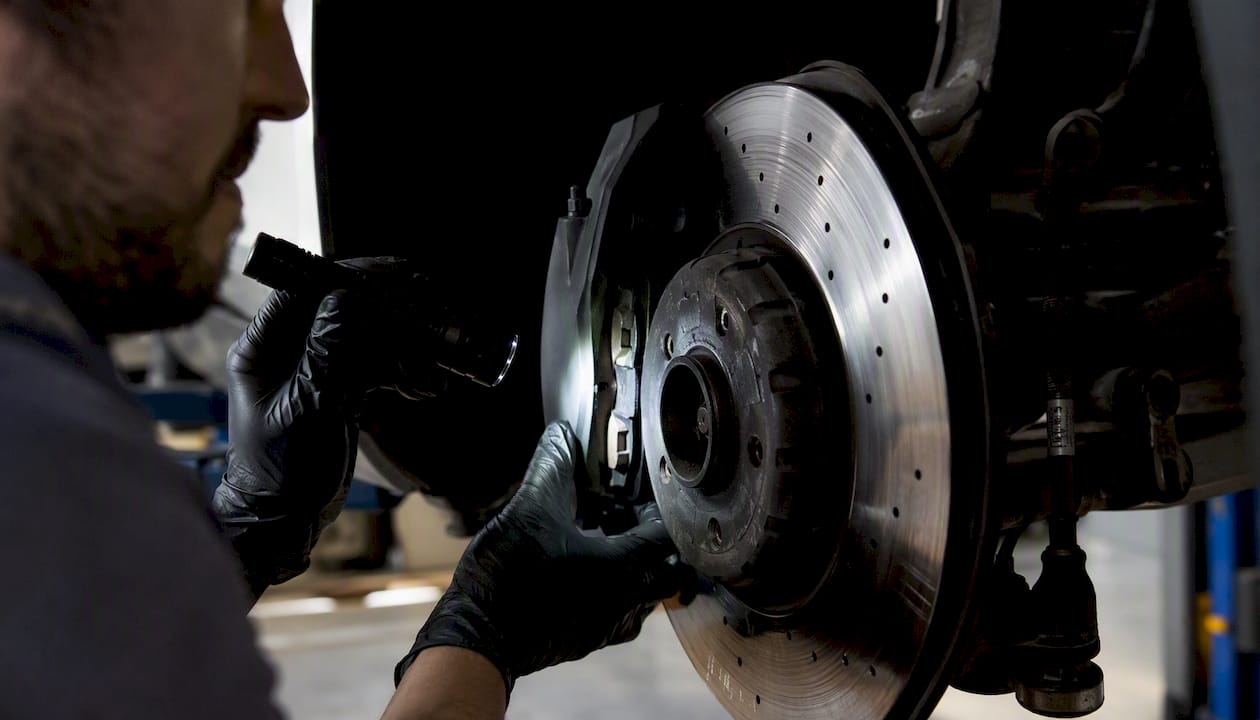
Document everything with photos and short video clips. A 15-second clip of blue smoke on startup is worth more in a price negotiation than any verbal description.
Pro Tip: Bring a small UV flashlight. Many oil and coolant leaks leave fluorescent residue that's invisible in normal light but glows clearly under UV, especially around valve covers, water pump seals, and transmission pan gaskets.
What electrical and diagnostic checks reveal about older cars
Electrical problems are the most common reason rare and classic cars sit undriven. They're also the easiest to underestimate at a casual viewing. A systematic approach catches the gremlins before they become your problem.
Start with the basics:
- Battery: Check the date code on the battery label. A battery more than four years old on a car that sits frequently is a liability. Look for corrosion at the terminals and swelling on the case.
- Alternator output: With the engine running, a healthy charging system reads 13.8–14.4 volts at the battery terminals. Anything below 13.5 volts suggests alternator wear or a charging circuit fault.
- Starter behavior: A slow, labored crank on a warm engine points to a weak battery or starter motor drawing excessive current.
- Visible wiring: Look for brittle insulation, taped splices, or non-original wiring colors. Aftermarket alarm systems and stereo installations are common sources of grounding problems and intermittent faults on classics.
Turn on every switch, gauge, and light in the car. Intermittent gauges, warning lamps that flicker, or instruments that read erratically often trace back to a single bad ground strap rather than a failed instrument. That's a $20 fix. But the same symptoms can also indicate a failing instrument voltage regulator or a corroded connector deep in the harness, which is a multi-day job on a rare car with limited parts availability.
For restomods and later classics equipped with an ECU, request a live OBD-II scan before the test drive. Stored fault codes tell you what the car has experienced, not just what it's doing right now. A scan tool like a Autel MaxiSys or even a basic Bluetooth OBD-II reader paired with a smartphone app can pull pending codes the seller may not know exist.
For pre-OBD cars (generally pre-1996), a multimeter and basic continuity checks are your tools. Test for voltage drop across the main power and ground circuits. A drop greater than 0.5 volts across a ground circuit indicates resistance that will cause erratic behavior across multiple systems.
Pro Tip: A smoke machine test, where low-pressure smoke is introduced into the intake or wiring harness, can locate vacuum leaks and wiring breaches that are otherwise invisible. Ask the inspector if they offer this service. On a rare car with aging rubber and brittle wiring, it's worth the extra cost.
When a smoke test, oscilloscope trace, or wiring continuity check is appropriate depends on the symptoms. Intermittent electrical faults that appear and disappear with temperature changes almost always require an oscilloscope to catch. Don't accept "it's probably just a loose connection" from a seller who hasn't traced it.
How to spot hidden rust and structural damage on a rare car
A car that looks perfect from ten feet away can hide tens of thousands of dollars in problems when inspected closely, as Classic Cars Arena's pre-purchase checklist makes clear. The gap between appearance and reality is widest on rare cars, where sellers often invest in cosmetic work to mask structural issues.
Crouch down and view the car at a low angle in good natural light. Surface ripples, orange-peel texture inconsistencies, or color variation between panels suggest bodywork or a respray. Uneven panel gaps, particularly around doors, hood, and trunk lid, are among the most reliable early-warning checks for prior accident repair.
Key areas to probe for hidden rust:
- Inner wheel arches: Reach up inside the arch and feel for soft, flaking metal or thick underseal applied over rust.
- Rocker panels: These are the most commonly rusted structural members on American and European classics. Tap them with a knuckle. A hollow thud instead of a solid ring suggests rot inside.
- Subframe mounts and floor pans: Get under the car with a flashlight and a small screwdriver or pick. Probe seam welds and floor pan sections. Rust-through here is a structural failure, not a cosmetic issue.
- Rear spring pockets and trunk floors: On body-on-frame cars, rear spring perches carry enormous load. Rust here is a safety issue and a restoration nightmare.
- Fresh undercoating in isolated spots: New undercoating applied only to specific areas is a classic concealment technique. It should be uniform across the entire underbody if it's legitimate protection.
Bring a paint thickness gauge (also called a paint meter) to every viewing. Original factory paint on steel panels typically measures 100–150 microns. Readings above 250 microns indicate filler beneath the paint. Readings near zero on a panel suggest bare metal or a stripped respray. A borescope lets you peer into inner cavities, door skins, and rocker panel interiors without cutting anything open.
A strong magnet is the simplest tool in your kit. Body filler is non-magnetic; steel is. A magnet that falls off a panel or sticks weakly where it should hold firmly tells you filler is present.
What interior wear patterns tell you about a car's real history
Interiors are honest in ways sellers sometimes aren't. The wear patterns on a seat bolster, the condition of a headliner, and the smell of a carpet tell a story that's hard to fabricate convincingly.
Check these areas carefully:
- Carpets and floor mats: Lift them. Water stains, mildew smell, or rust on the floor pan beneath are signs of past flooding or chronic water intrusion from leaking windshield seals or door weatherstripping.
- Headliner and door jambs: Water stains on a headliner often trace to a sunroof seal or a leaking windshield. Check door jambs for paint overspray, which indicates a respray that wasn't done with full disassembly.
- Trunk interior: A musty smell or stained trunk liner suggests water intrusion through the trunk seal or a past flood event.
- Seat bolster and pedal wear: Heavy bolster wear on a car declared at 30,000 miles is a mileage discrepancy signal. Pedal rubber worn through to the metal on a "low mileage" car is a stronger one. Cross-reference mileage claims against wear patterns before accepting the odometer reading at face value.
- Electrical and heat damage: Melted switch surrounds, discolored plastics near the fuse box, or a faint burnt smell suggest a past electrical fire or chronic overheating of a circuit. These are not cosmetic issues.
Pro Tip: Check whether replacement parts are period-correct or sympathetic to the car's original specification. A rare car fitted with generic aftermarket switches, incorrect seat fabric, or non-original trim tags loses collector value even if the replacements look clean. Originality commands a premium; sympathetic restorations using correct-spec parts hold value better than mismatched upgrades.
On trim authenticity, look for the trim tag (usually on the firewall or door jamb) and verify it against the car's build documentation. A thorough classic car inspection should verify casting numbers, trim tags, and date codes where relevant, as American Classic Appraisals notes. A trim tag that doesn't match the interior color or option codes is a provenance flag worth investigating.
How to verify VIN, title, service records, and matching numbers
Paperwork is where rare car purchases are won or lost. A mechanically sound car with clean provenance commands a premium. A car with gaps in its history, title brands, or mismatched documentation is a financial risk regardless of how it looks or drives.
Start with the VIN:
- Locate all VIN positions: On most American cars, the primary VIN is on the dashboard (visible through the windshield), the door jamb sticker, and the firewall. European and imported cars may have additional chassis stamps. Verify that all positions match each other and the title.
- Check for tampering: Look for VIN plates that appear re-stamped, re-riveted, or inconsistent in font with the surrounding metal. A VIN that doesn't match across all locations is a serious legal and financial risk.
- Run a vehicle history report: Services like Carfax or AutoCheck pull title brands, accident reports, odometer discrepancies, and ownership transfers. A salvage or rebuilt title on a rare car dramatically affects insurability and resale value.
For foreign-market or imported models, verify that the import documentation is complete and that the car has been properly titled in the U.S. Incomplete import paperwork can make a car impossible to register or insure.
Service records to request:
- Dated receipts with mileage stamps for oil changes, timing belt or chain replacements, clutch work, and any engine or transmission rebuilds.
- Receipts for major suspension or brake work, particularly on cars with known wear-prone components.
- Restoration documentation: photos of the car before, during, and after restoration, along with receipts for parts and labor.
Red flags in paperwork:
- Title brands: Salvage, rebuilt, flood, or lemon law buyback designations are deal-altering facts, not minor footnotes.
- Frequent ownership transfers: Three or more owners in five years on a rare car suggests recurring problems that each owner discovered and passed on.
- Absent documentation: A seller who "lost" all service records on a $60,000 rare car is asking you to buy on faith. That's a negotiation lever, not an acceptable gap.
The FTC's Used Car Rule requires dealers to display a Buyers Guide disclosing key mechanical and warranty information. Private sellers carry no equivalent obligation, which makes independent documentation verification even more critical in a private-party transaction.
What a proper test drive reveals that a static inspection cannot
A test drive is a diagnostic tool, not a formality. Run it as a structured script, not a casual loop around the block.
Test drive sequence:
- Cold start and warm-up: Note idle quality, any misfires, and smoke behavior during the first two minutes. The car should settle to a stable idle within 60–90 seconds.
- Slow-speed checks (parking lot or quiet street): Turn the steering wheel lock to lock at low speed. Listen for clunking, binding, or power steering whine. Apply the brakes firmly from 10 mph. The car should stop straight without pulling.
- Medium-speed stability (30–50 mph): Note any shimmy, vibration through the steering wheel, or wandering. These suggest wheel balance issues, worn tie rod ends, or steering gear wear.
- Acceleration and load test: Accelerate briskly through the gears. Listen for hesitation, flat spots, or misfires under load. A carbureted engine that stumbles on acceleration often has a worn accelerator pump or lean jetting.
- Gear changes (manual): Each gear should engage cleanly. A transmission that jumps out of third gear under load, or a clutch that slips at highway speed, needs immediate attention.
- Climb and descend: Find a hill. Engine braking on descent should feel controlled. Brake fade on a short descent suggests glazed pads or a brake fluid issue.
After the drive, park and look under the car immediately. New drips that weren't there before the drive indicate leaks that only appear under operating temperature and pressure. Smell the engine bay for burning oil or coolant. A sweet smell near the firewall often means a heater core leak.
Which diagnostic tests matter most for a rare car's long-term health
Advanced diagnostic tests translate subjective impressions into measurable data. They give you numbers to negotiate with and a clear picture of what the engine has left.
| Test | What it reveals | Buyer action |
|---|---|---|
| Compression test | Cylinder pressure uniformity; low readings indicate ring or valve wear | Negotiate repair cost or walk if multiple cylinders are low |
| Leak-down test | Percentage of air escaping each cylinder; pinpoints rings, valves, or head gasket | Walk if leak-down exceeds 20% on any cylinder; negotiate 10–20% |
| Borescope inspection | Visual condition of combustion chambers, cylinder walls, valve seats | Walk if scoring, heavy carbon, or coolant deposits are visible |
| Paint meter check | Measures paint thickness to detect filler or respray | Negotiate if multiple panels show filler; walk if structural panels are filled |
| Chassis alignment check | Reveals frame twist or collision damage affecting geometry | Walk if frame damage is confirmed; negotiate if alignment is adjustable |
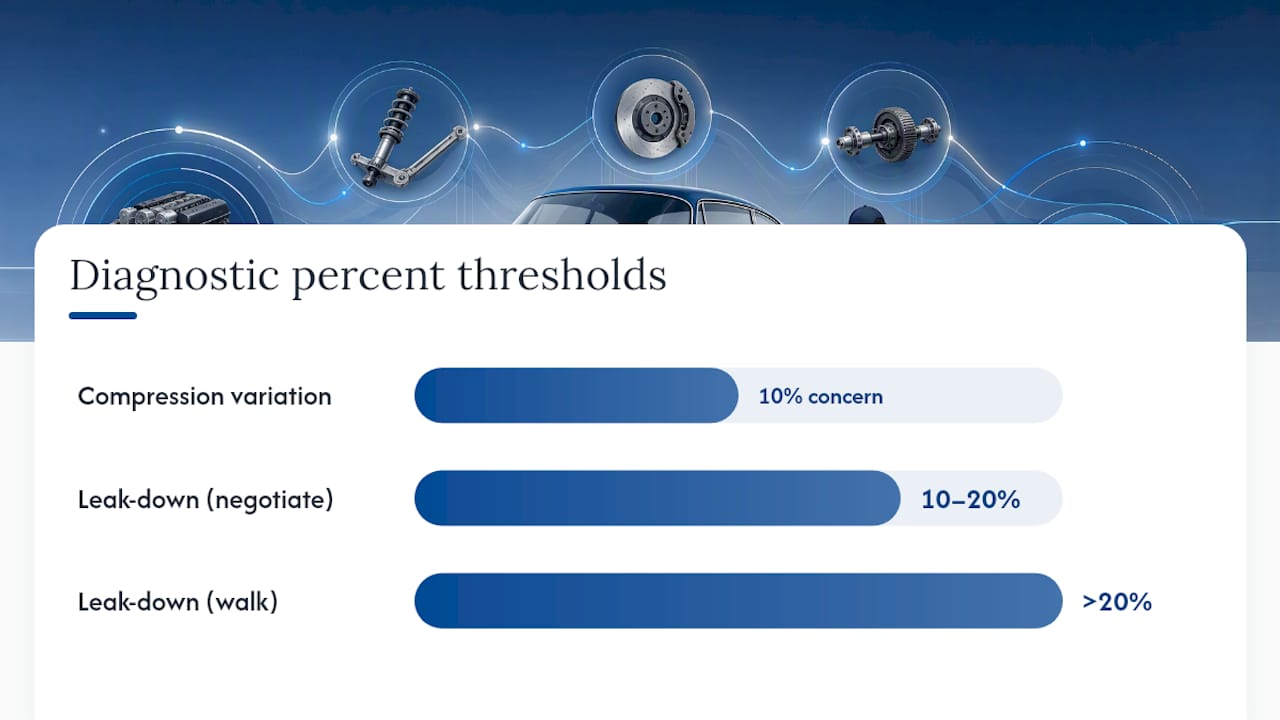
A compression test is the starting point for any engine evaluation. Healthy readings vary by engine, but cylinder-to-cylinder variation greater than 10% is a concern regardless of the absolute numbers. A leak-down test goes further: it pressurizes each cylinder and measures how quickly that pressure escapes, and where. Air escaping from the exhaust indicates exhaust valve wear. Air from the intake suggests intake valve problems. Bubbling in the coolant reservoir points directly to a head gasket failure.
Pro Tip: A borescope inspection of the combustion chambers costs very little additional time when a mechanic is already performing a compression test. The visual evidence of scoring, coolant deposits, or heavy carbon buildup often tells a clearer story than numbers alone. Request both together.
For paint meter checks, bring a digital gauge or ask the inspector to use one. Original factory paint on steel panels typically reads 100–150 microns. A reading of 400+ microns on a quarter panel means significant filler is present. On a rare car where panel originality affects value, this matters beyond the cosmetic.
Common red flags on rare cars and what they cost to fix
Not every defect is a deal-breaker. The distinction between a fatal flaw and a negotiable repair is what separates experienced buyers from expensive mistakes.
High-impact red flags (often deal-breakers):
- Structural rust in the frame, floor pan, or subframe mounts: Repairing structural rust on a rare car typically runs $5,000–$20,000 or more depending on severity and parts availability. On a unibody car, structural rust can make the vehicle unsafe to drive and nearly impossible to restore economically.
- Missing or non-matching original engine: For many rare cars, the original engine is 30–50% of the car's total value. A numbers-matching muscle car with its original drivetrain commands a substantial premium over an identical car with a replacement engine.
- Evidence of flood damage: Flood cars corrode from the inside out. Electrical systems, brake lines, and structural members continue to degrade for years after the event. A flood-branded title is a walk-away for most buyers.
- Incomplete or incorrect restoration: A restoration that used non-period-correct parts, incorrect colors, or improper techniques can cost more to undo than to start fresh. Magnet testing and floor pan probing catch many of these issues before they become your liability.
Negotiable issues with ballpark costs:
- Minor mechanical service (tune-up, belts, fluids, filters): $500–$2,500 depending on the car and parts availability.
- Brake system rebuild (calipers, master cylinder, lines): $1,500–$4,000 on a rare car with specialty parts.
- Major engine work (head gasket, valve job, top-end rebuild): $3,000–$8,000 for a competent shop; more for rare engines with limited parts supply.
- Electrical rewiring (partial harness replacement): $2,000–$6,000; full rewiring on a complex car can exceed $10,000.
- Cosmetic bodywork (minor rust, paint correction): $1,500–$5,000 for localized work; full respray on a rare car runs $8,000–$25,000.
When presenting a price adjustment to a seller, bring written estimates from two independent shops. A verbal "it'll probably cost around X" carries no weight. Documented estimates do. Frame the conversation as: "The inspection found these specific items. Here are two written estimates. I'd like to adjust the price by the lower estimate." That's a professional, evidence-based approach that most serious sellers respect.
When should you hire a classic car specialist inspector?
The short answer: always, for any rare car above $15,000. A pre-purchase inspection typically costs a few hundred dollars and routinely saves buyers multiples of that cost by identifying defects before the transaction closes. The economic case for pre-inspection is straightforward: the inspection fee is the cheapest insurance you can buy on a five- or six-figure purchase.
A specialist inspector goes beyond what a general mechanic offers. Generic point-check inspections often miss marque-specific problems, as Drewmotive's vintage inspection guidance explains. A specialist brings:
- VIN and trim tag authentication: Verifying that all identification numbers match and are consistent with the car's claimed history.
- Period-correct parts verification: Identifying non-original components that affect value or authenticity.
- Structural and frame assessment: Using alignment equipment and physical inspection to find collision damage or frame flex.
- Coachwork quality evaluation: Assessing the quality of any bodywork, paint, or restoration work against period standards.
How to vet an inspector:
- Ask for sample reports from previous inspections of similar vehicles. A credible report includes dated photos, numbered findings, measured test results (actual compression figures, not just "good"), and an itemized repair estimate.
- Request marque-specific references. An inspector who has worked extensively on Ferraris may not be the right choice for a rare American muscle car, and vice versa.
- Confirm they will perform compression, leak-down, and borescope tests as part of the inspection. An inspector who declines these on a high-value engine is not giving you a complete picture.
- Check for professional affiliations with organizations like the American Society of Certified Auto Appraisers (ASCAA) or marque-specific clubs that vet their members.
Pro Tip: Insist on a written report with numbered findings, dated photos, and an itemized estimate for any recommended repairs. A verbal summary after a walkthrough is not an inspection report. You need a document you can use in price negotiations and, if necessary, in a dispute.
Your printable inspection checklist for first viewing
Use this list in order. Check off each item, photograph evidence, and note the odometer reading at the start of the visit.
High-priority items (complete at every viewing):
- Verify VIN on dashboard, door jamb, and firewall against the title.
- Review service records: dates, mileage stamps, receipts for major work.
- Cold-start engine: observe smoke color, idle quality, and any warning lights.
- Check for oil, coolant, and fuel leaks under the car before and after start.
- Probe rocker panels, floor pans, and wheel arches with a magnet and pick.
- Check panel gaps at all four doors, hood, and trunk lid for uniformity.
- Use a paint meter on at least six body panels (two front, two rear, two sides).
- Inspect all lights, gauges, and switches for function.
- Check battery terminals, visible wiring, and charging voltage.
- Complete the test drive script (cold start, slow-speed, medium-speed, load, post-drive leak check).
Secondary items (complete if time allows or commission to a specialist):
- Compression and leak-down test on all cylinders.
- Borescope inspection of combustion chambers and cylinder walls.
- OBD-II scan (for 1996 and later cars or restomods with ECUs).
- Wiring continuity checks on key circuits (charging, ignition, lighting).
- Chassis alignment check if frame damage is suspected.
- Interior trim tag verification against build documentation.
Documentation protocol: photograph every defect, record a short video of any smoke or unusual noise, and note the odometer reading at the start and end of the visit. This timestamped evidence is your negotiation file.
Questions to ask the seller before and during your visit
The right questions surface problems before you spend time and money on a full inspection. Use these in phone or email contact, and again in person.
Ownership and history:
- How long have you owned the car, and how many owners has it had before you?
- Do you have the original title, and is it clean (no salvage, flood, or rebuilt brands)?
- Can you provide the complete service history, including receipts for major work?
Mechanical specifics:
- Has the timing belt or chain been replaced? When, and do you have the receipt?
- Has the engine or transmission ever been rebuilt or replaced? If replaced, is the original available?
- Are there any known mechanical issues, leaks, or warning lights?
Restoration and bodywork:
- Has the car been repainted? If so, when, and do you have photos of the car before the work?
- Has any bodywork been done? Are there receipts from the shop?
- Are all trim and interior components original, or have any been replaced?
Practical logistics:
- Will you allow an independent pre-purchase inspection by a specialist of my choosing?
- Can I arrange a test drive at a time when the car has been sitting overnight (cold start)?
Script for phone contact: "I'm very interested in the car. Before I arrange a visit, I'd like to confirm a few things. Can you tell me about the service history and whether you have receipts for the timing belt and any major engine work? And would you be open to an independent inspection by a specialist before we finalize anything?" A seller who resists an independent inspection on a high-value rare car is a red flag in itself. Sourcing rare models often involves remote sellers, which makes these pre-visit questions even more critical.
How to turn inspection findings into a purchase decision
Every inspection produces one of three outcomes. The three-box model keeps the decision clean.
Green (accept as-is or with minor adjustments): The car passes all high-priority checklist items. Any defects are cosmetic or minor mechanical items with documented repair costs under $1,500. The provenance is clean and the seller is transparent. Proceed with purchase at or near the asking price.
Yellow (negotiate with documented evidence): The inspection reveals fixable mechanical or cosmetic issues with documented repair estimates. The provenance is mostly clean with minor gaps. Present a line-item repair list with two written estimates and propose a price reduction equal to the lower estimate. Consider requesting a conditional purchase agreement subject to a specific repair being completed before delivery, or an escrow arrangement where a portion of the purchase price is held until the repair is verified.
Red (decline):
- Structural rust in load-bearing components.
- Non-matching or missing original engine on a numbers-matching car.
- Title brands (salvage, flood, rebuilt).
- Evidence of concealed damage or misrepresented history.
- Seller refuses independent inspection.
Walk-away items are not negotiating positions. A seller who drops the price dramatically when you identify structural rust is not offering you a deal; they're transferring a problem. The trade-in and valuation mechanics that apply to luxury cars apply here too: structural and provenance defects compress value far more than mechanical wear, and they're harder to recover.
What a credible inspection report looks like
A professional inspection report is a specific document, not a verbal summary or a one-page pass/fail sheet. Knowing what a good report contains lets you evaluate the inspector's competence before you pay for their work.
Essential report features:
- Dated photographs of every finding, with the VIN visible in at least one image to confirm the car inspected.
- VIN and trim tag verification section confirming all identification numbers match.
- Scope of inspection clearly stated (what was tested, what was not accessible).
- Measured test results: actual compression figures for each cylinder, not "compression good." Leak-down percentages. Paint meter readings by panel.
- Prioritized findings: safety-critical, value-affecting, and cosmetic items listed separately.
- Itemized repair estimate or cost range for each finding.
Inspector trust signals:
- Marque-specific experience with the type of car you're buying.
- Willingness to share sample reports from previous inspections.
- Client references from buyers who purchased (or declined) based on the report.
- Professional affiliations or certifications relevant to classic and collector vehicles.
Pro Tip: Red flags in a report include vague language ("engine appears OK," "body looks straight"), no photographs, or an inspector who refuses to perform compression or leak-down tests because "the engine runs fine." A running engine can still have 40% leak-down on two cylinders. Insist on measured data, not impressions.
What buyers consistently get wrong when inspecting rare cars
Three inspection misses come up repeatedly, and they share a common thread: buyers let the car's visual appeal or emotional pull override methodical checking.
The first is hidden rust. A car that presents beautifully at a show or in photos can carry serious structural corrosion in its rocker panels, floor pans, and subframe mounts. Fresh paint and new undercoating are inexpensive compared to the cost of the rust repair they're concealing. The magnet test and a flashlight under the car take five minutes and catch this consistently. Buyers who skip it because "the car looks great" are the ones who discover the problem after the title transfers.
The second is swapped engines. On numbers-matching muscle cars and rare European sports cars, the original drivetrain is a substantial portion of the total value. A replacement engine that runs perfectly is still a value-destroying substitution if the car's appeal is its authenticity. Verify casting numbers and engine stamps against the build sheet before the test drive, not after.
The third is incomplete maintenance. A car that has been stored for years without a timing belt replacement, fresh coolant, or brake fluid service is not a "preserved" car. It's a car with deferred maintenance that will surface as failures shortly after purchase. Ask specifically about belt and fluid service intervals, and treat "it hasn't needed anything" as an answer that requires documentation to be credible.
The broader point is this: the emotional reason to buy a rare car, whether it's a specific engine note, a trim combination, or a piece of personal history, should become an inspection priority, not a reason to skip one. If the Busso V6 sound is why you're buying a specific Italian sports car, make the mechanical proof of that engine's health the first thing you verify, not the last.
Autovendorsfl helps you find and evaluate rare vehicles with confidence
Buying a rare or classic car is one of the most rewarding purchases you can make, and one of the riskiest without the right support. Autovendorsfl curates a premium selection of luxury and rare vehicles, with each car held to high standards for mechanical integrity and documentation before it reaches the inventory.
Beyond the inventory itself, Autovendorsfl offers personalized vehicle-finding assistance for buyers seeking specific makes, models, or specifications that aren't currently in stock. The team can help connect buyers with specialist inspectors, facilitate pre-purchase inspection arrangements, and support the financing and trade-in process so the transaction moves smoothly from first viewing to final purchase. Whether you're trading in a current vehicle or need financing structured around a rare acquisition, the process is handled with the same attention to detail that goes into every car on the lot.
If you've found a rare car you're serious about, or if you want help sourcing one that meets your exact criteria, contact Autovendorsfl to request inspection support or discuss your search.
Sources
For buyers who want to go deeper on specific areas of the inspection process, these resources provide authoritative guidance:
- Classic car inspection checklist — Progressive
- Used Car Rule — Federal Trade Commission (FTC)
- How to Inspect a Used Car to Avoid Costly Repairs — Consumer Reports
- Classiccars
- Classic car pre-purchase inspection checklist — Classic Cars Arena