
Super low mileage cars are defined as vehicles driven significantly fewer miles than the average for their age, typically well below the standard 10,000–15,000 miles per year that indicates regular, healthy use. These vehicles attract serious attention from buyers because less accumulated mileage often signals reduced mechanical wear and a longer remaining lifespan. But the real story is more nuanced. Understanding why super low mileage cars matter means looking beyond the odometer and examining maintenance history, storage conditions, and actual vehicle condition. That complete picture is what separates a genuine find from an expensive mistake.
Why super low mileage cars matter: wear, longevity, and limits
Mileage is a direct measure of how much mechanical work a vehicle has performed. Every mile adds wear to the engine, transmission, suspension, brakes, and dozens of moving parts. A car with 20,000 miles on a 5-year-old frame has experienced far less stress on those systems than one with 75,000 miles. That gap translates into more remaining life on components like timing belts, water pumps, and wheel bearings, all of which carry predictable replacement cycles tied to mileage thresholds.
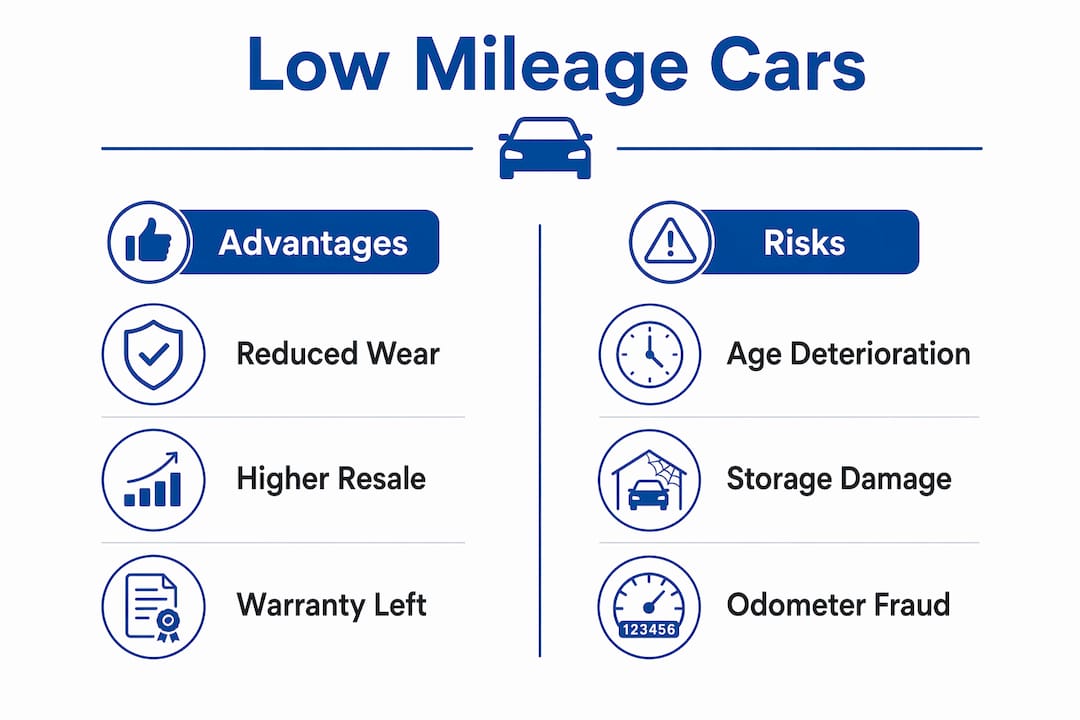
The low mileage car advantages are real, but they come with a ceiling. Age-related deterioration does not pause because a car sits in a garage. Rubber seals, hoses, gaskets, and belts degrade over time regardless of miles driven. A 12-year-old vehicle with 18,000 miles may still need a full cooling system inspection and rubber component replacement simply because of calendar age. The chemistry of degradation does not care about the odometer.

Regular use also matters more than most buyers realize. Engines designed to run benefit from consistent operation. Daily highway driving actually prevents certain mechanical issues that plague cars used only for short city trips or stored long-term. Lubrication reaches all internal surfaces, moisture burns off, and seals stay conditioned. A car driven 12,000 highway miles per year is mechanically healthier than one driven 4,000 city miles per year in many respects.
Key mileage thresholds worth knowing:
- Under 30,000 miles: Most original wear items are intact; brakes, tires, and filters may still be near-new.
- 30,000–60,000 miles: First major service interval zone; timing belts, spark plugs, and fluid flushes become relevant.
- 60,000–100,000 miles: Suspension components, water pumps, and transmission fluid are common attention points.
- Over 100,000 miles: Comprehensive inspection required; value depends heavily on service history.
Pro Tip: When evaluating a low mileage vehicle, check the tire manufacture date stamped on the sidewall. Tires older than 6 years carry safety risks regardless of tread depth, and a car with 15,000 miles on 9-year-old tires needs new rubber immediately.
Does maintenance history outweigh mileage alone?
A comprehensive, time-stamped service record often tells you more about a vehicle's future reliability than the odometer reading. Oil changes, fluid flushes, brake inspections, and scheduled services documented with dates and mileage give you a clear picture of how the previous owner treated the car. That paper trail is the closest thing to a health history a vehicle can have.
The "Documentation vs. Odometer" trap catches buyers every year. A car with 28,000 miles and zero service records is a gamble. The owner may have skipped oil changes, run the engine low on coolant, or ignored warning lights. None of that shows up on the odometer. A higher-mileage vehicle with full service history is often a better investment than a low-mileage vehicle lacking verifiable maintenance. The documented car tells a story you can trust.
| Scenario | Mileage | Documentation | Likely Outcome |
|---|---|---|---|
| Best case | Low (under 30,000) | Complete, time-stamped | Excellent condition, justified premium |
| Common trap | Low (under 30,000) | Missing or partial | Hidden deferred maintenance costs |
| Underrated option | Moderate (60,000–80,000) | Full dealer service history | Reliable, often better value |
| Risky purchase | High (over 100,000) | No records | Unknown condition, high repair risk |
The golden window for used cars sits at 3 to 5 years old with 28,000 to 47,000 miles. That range balances depreciation savings, remaining warranty coverage, and predictable maintenance cycles. A car in that window with complete records often beats a 10-year-old low mileage car with gaps in its service history.
Pro Tip: Request a CARFAX or AutoCheck report and cross-reference it with the physical service booklet. Discrepancies between reported service intervals and actual records are a clear warning sign.
Common pitfalls buyers face with super low mileage cars
The biggest misconception about low mileage vehicles is that the number alone guarantees quality. It does not. Several specific failure modes target cars that have been driven very little, and buyers who skip a thorough inspection pay for that assumption.
Cars sitting unused for long periods suffer from dry rot affecting rubber seals and hoses, battery failure, and fuel degradation. A 15-year-old car with 20,000 miles may need more immediate repairs than a well-maintained high-mileage vehicle. Gasoline degrades within 3 to 6 months without a fuel stabilizer. Brake calipers seize. Coolant becomes acidic. None of these problems appear on the odometer.
Short-trip syndrome is a specific and underappreciated risk. Engines that do not reach optimal operating temperature suffer accelerated internal damage even with few miles logged. Short city trips cause oil dilution from unburned fuel and carbon buildup on intake valves. A car driven exclusively 2 miles to the grocery store and back accumulates real mechanical damage despite a low odometer reading.
Odometer tampering adds another layer of risk. Signs of wear inconsistent with mileage may indicate odometer rollback or neglect. Watch for these red flags:
- Worn driver's seat bolster and steering wheel leather that does not match claimed mileage
- Brake pedal rubber worn thin on a supposedly low-use vehicle
- Scuffed door sills and faded interior plastics inconsistent with light use
- Mismatched paint panels suggesting unreported accident repairs
- Tires with significant wear on a car claiming under 20,000 miles
A professional pre-purchase inspection by an independent mechanic is the single most effective defense against these risks. Autovendorsfl recommends reviewing a pre-owned luxury car inspection checklist before committing to any purchase, regardless of the mileage shown.
When paying a premium for low mileage is actually worth it
The premium for a super low mileage vehicle is justified when three conditions align: the car is in genuinely better condition, the documentation is complete, and the remaining useful life is meaningfully longer than comparable alternatives. When all three hold, the price difference often pays for itself through lower near-term repair costs and better resale value down the road.
Vehicle type matters significantly. Luxury sedans like the Mercedes-Benz S-Class, full-size trucks, and premium SUVs carry higher component replacement costs. A low mileage S-Class with verified service history avoids expensive repairs on air suspension, transmission, and electronics that can run into thousands of dollars. The premium makes financial sense when the alternative is absorbing those costs within the first two years of ownership.
| Vehicle type | Why low mileage premium is justified | Typical high-cost repairs avoided |
|---|---|---|
| Luxury sedan (e.g., Mercedes-Benz S-Class) | Complex electronics and air suspension | Air strut replacement, transmission service |
| Full-size truck | Heavy towing wear accumulates fast | Differential, transfer case, brake system |
| Premium SUV | All-wheel drive system wear | Transfer case, front differential, air suspension |
| Sports car | Track or aggressive driving history | Clutch, brakes, suspension bushings |
Low mileage cars often retain more remaining warranty coverage and require fewer repairs initially. That combination reduces total cost of ownership in the first 2 to 3 years. The key is comparing nearby listings for the same model, year, and trim. If the low mileage example commands a 15% price premium but saves you from a $3,000 transmission service within 18 months, the math works in your favor. Understanding how luxury vehicle trade-in appraisal works also helps you calculate the resale advantage when you eventually sell.
The market frequently overvalues low mileage without buyers verifying usage and maintenance. That overvaluation means you can sometimes negotiate the premium down when documentation is incomplete. Use missing records as direct negotiating leverage.
Key Takeaways
Super low mileage cars offer genuine advantages in wear reduction and resale value, but only when verified condition and complete documentation support the odometer reading.
| Point | Details |
|---|---|
| Mileage is a starting point | Low miles reduce mechanical wear but do not account for age-related or storage-related deterioration. |
| Documentation outranks the odometer | A complete, time-stamped service record predicts reliability better than mileage alone. |
| Storage risks are real | Cars driven very little can suffer dry rot, fuel degradation, and seized components regardless of mileage. |
| Premium needs three justifications | Pay more only when condition, documentation, and remaining useful life all support the price difference. |
| Inspection is non-negotiable | An independent mechanical inspection catches odometer fraud and hidden wear before you commit. |
What I have learned buying low mileage cars over the years
I have looked at hundreds of low mileage vehicles, and the pattern that surprises buyers most is this: the car with 19,000 miles on a 14-year-old frame is almost never the deal it appears to be. I once inspected a pristine-looking luxury sedan with 22,000 original miles. The paint was flawless, the interior was immaculate, and the owner was proud of how little it had been driven. The independent inspection found seized rear brake calipers, a cracked coolant reservoir, degraded fuel injector seals, and tires that were 8 years old. The repair estimate before the car was safe to drive exceeded $2,800.
The shift I have seen in serious buyers is exactly right. Buyer psychology is moving away from buying the odometer and toward buying the condition. That is the correct instinct. Mileage is a number. Condition is reality.
My honest advice: treat low mileage as a filter, not a verdict. Use it to narrow your search, then verify everything else with documentation and a hands-on inspection. When the mileage, the records, and the physical condition all tell the same story, you have found something worth paying for. When they conflict, walk away without hesitation. The negotiation leverage you gain from a missing service record or a mismatched wear pattern is real. Use it.
If you are evaluating a luxury vehicle, do not skip the specialist. An automotive personal shopper or a marque-specific independent mechanic will catch things a general inspection misses. That $150 inspection fee has saved buyers from $5,000 mistakes more times than I can count.
— Allen
Find inspected low mileage luxury vehicles at Autovendorsfl
Autovendorsfl at Auto Vendors Inc in Fort Lauderdale curates a premium selection of pre-owned luxury vehicles, with a particular focus on models where low mileage genuinely matters. The Mercedes-Benz S-Class is one of the clearest examples. Its air suspension, advanced electronics, and precision engineering make verified low mileage and complete service documentation critical to long-term ownership satisfaction.

Every vehicle in the Autovendorsfl inventory is evaluated against strict condition and documentation standards before it reaches buyers. If you are ready to explore low mileage S-Class models with verified histories, the Fort Lauderdale team is available for personalized guidance, test drives, and direct vehicle-finding assistance. Contact Autovendorsfl to start your search with confidence.
FAQ
What qualifies as super low mileage for a used car?
A vehicle driven well below 10,000–15,000 miles per year for its age qualifies as super low mileage. For example, a 5-year-old car with under 25,000 miles falls clearly into that category.
Are low mileage cars always in better condition?
Low mileage does not guarantee better condition. Cars stored for long periods can suffer dry rot, fuel degradation, and seized components that require costly repairs regardless of the odometer reading.
Why does maintenance history matter more than mileage?
A complete, time-stamped service record predicts future reliability more accurately than mileage alone. Two cars with identical mileage can be in vastly different condition depending on how consistently they were maintained.
How do I spot odometer tampering on a low mileage car?
Look for wear inconsistencies: a worn driver's seat, thin brake pedal rubber, or scuffed door sills that do not match the claimed mileage. A CARFAX report and independent inspection are the most reliable verification tools.
Is it worth paying a premium for a super low mileage luxury car?
The premium is worth it when low mileage is supported by complete documentation and verified condition. For high-cost vehicles like the Mercedes-Benz S-Class, avoiding major component repairs in the first two years often justifies the higher purchase price.