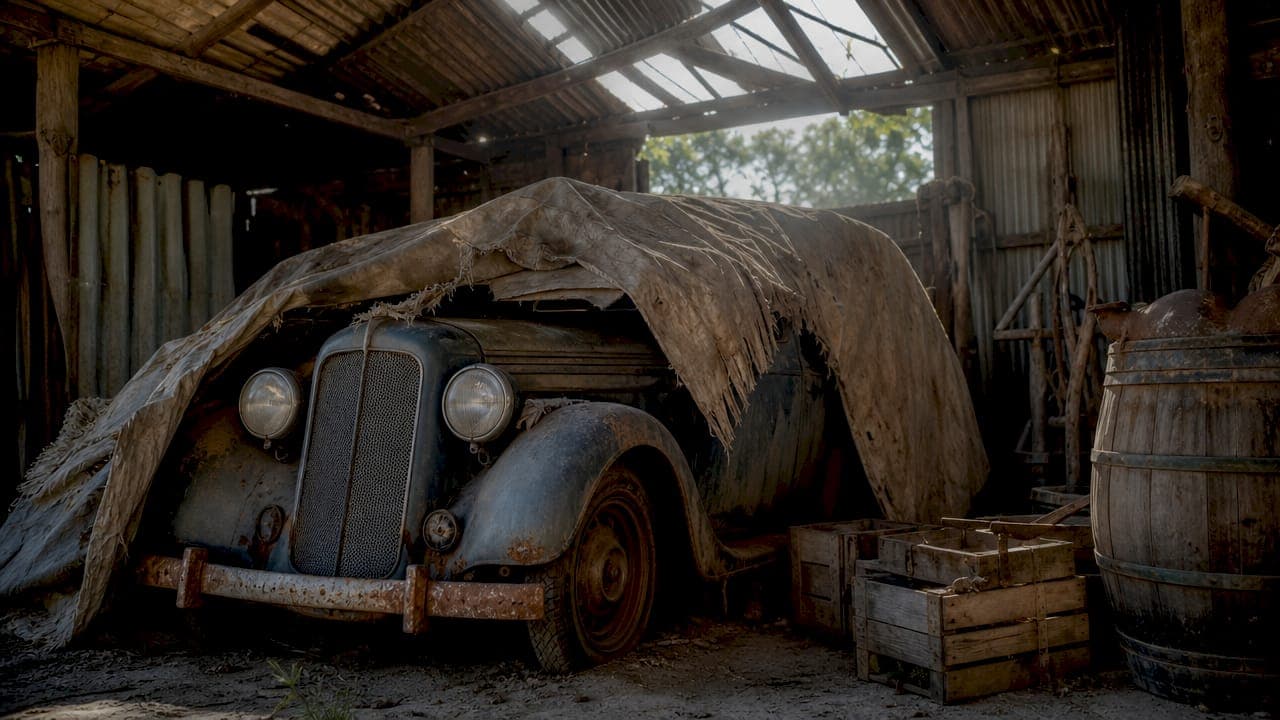
Barn find cars are classic vehicles whose untouched originality and historical authenticity make them highly valuable to collectors and enthusiasts. The term "barn find" is informal; the recognized industry term is "survivor car," meaning a vehicle that has never been restored and retains its factory components, original paint, and authentic patina. The US barn find vehicle market has appreciated about 12% as of march 2026, reflecting rising collector demand. Understanding why barn find cars hold value requires looking at three core drivers: rarity, originality, and the emotional pull of authenticity. Collectors increasingly view barn finds as tangible assets that blend genuine enjoyment with serious investment potential.
Why barn find cars hold value: the originality factor
Collector preference has shifted decisively toward survivor cars that retain original paint, factory components, and patina over vehicles that have been restored. That shift matters because it changes what the market rewards. A barn find with its factory finish intact tells a story no restored car can replicate. Provenance and documented history amplify that story, making a vehicle with a paper trail worth considerably more than one without.
Several specific attributes drive barn find car value:
- Original paint and bodywork. Factory finishes carry a chemical and visual signature that modern resprays cannot match. Collectors and auction houses treat unrestored paint as direct evidence of authenticity.
- Factory mechanicals. Numbers-matching engines and transmissions confirm a car has not been modified. Swapped components reduce value significantly, even when the replacement part is of higher quality.
- Authentic patina. Surface wear, aged chrome, and period-correct grime are not flaws. They are physical proof of age and originality that collectors actively prize.
- Documented provenance. Build sheets, window stickers, service records, and original titles create a verifiable chain of ownership. Each document adds credibility and collector desirability.
Pro Tip: Before purchasing any survivor car, request a VIN decode report and cross-reference it against the physical stampings on the firewall, door jamb, and engine block. Mismatches are a red flag for swapped components.
Over-restoring a barn find can permanently erase the factory DNA that collectors prize, often lowering the car's value below that of a comparable survivor. That is a counterintuitive reality many first-time buyers miss. A car that looks perfect after a full restoration may actually be worth less than one with faded paint and original upholstery, provided both are the same model and year. Understanding vehicle appraisal factors like originality and condition helps collectors make that distinction before they spend money on work that hurts rather than helps.
How does the barn find market compare with restored classics?
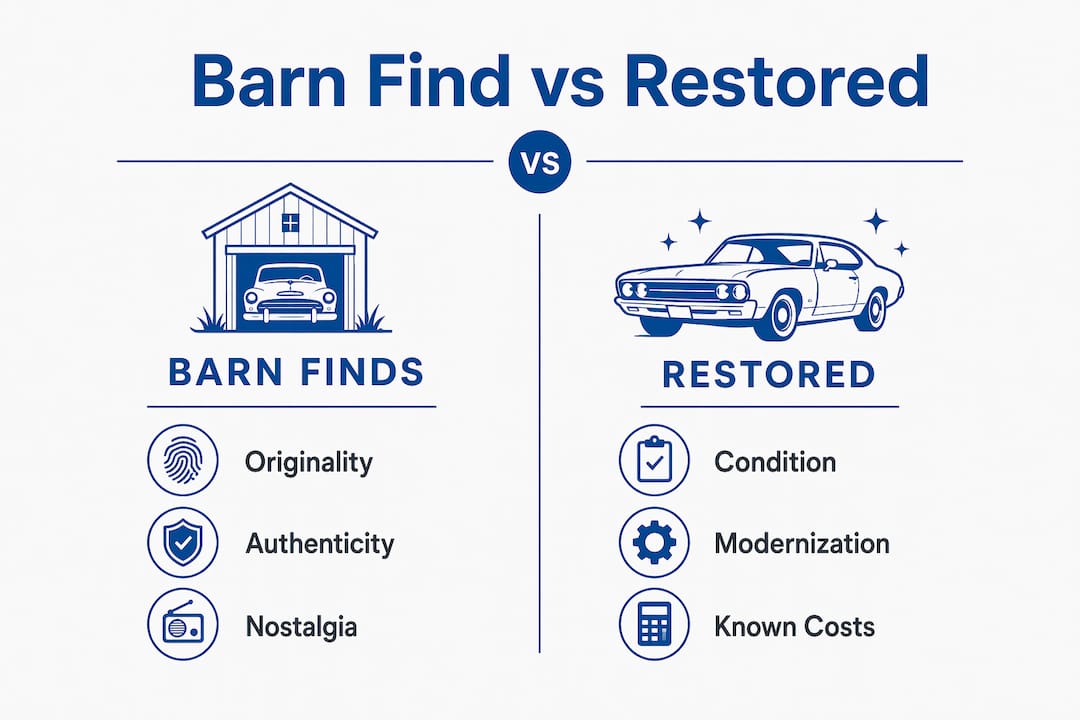
The barn find market and the restored classic car market operate on different value logic. Restored vehicles appeal to buyers who want a car that looks and drives like new. Survivor cars appeal to buyers who want proof of history. Those two groups rarely compete for the same car, but their preferences create a measurable price gap.
Auction results illustrate the gap clearly. A 1967 Ferrari 330 GTS sold for $2.1 million after sitting for 44 years following an engine fire, exceeding the price of a comparable restored example. That result was not an anomaly. Barn find auctions reward story and originality, frequently producing prices that exceed those of restored equivalents. No-reserve auction formats amplify this effect by creating competitive bidding among collectors who recognize scarcity.
The investment dynamics also differ between the two categories. Restored cars carry known costs: the restoration bill is already spent, and the market has largely priced in that labor. Barn finds carry unknown costs but also unknown upside. A survivor car in strong original condition can appreciate faster than a restored equivalent because the pool of genuine survivors shrinks every year. Collectors who understand rare vehicle sourcing strategies position themselves to find undervalued survivors before the broader market catches up.
Barn finds also function as tangible time capsules, evoking nostalgia particularly among baby boomers and Gen Xers who grew up with these models. That emotional connection translates directly into premium bids at auction. Restored cars can be beautiful, but they cannot replicate the feeling of encountering a car exactly as it left the factory decades ago.
What pitfalls should buyers watch for when purchasing barn finds?
Buying a barn find without rigorous evaluation is one of the most expensive mistakes a collector can make. The romance of discovery often clouds judgment, and sellers sometimes price on sentiment rather than condition.
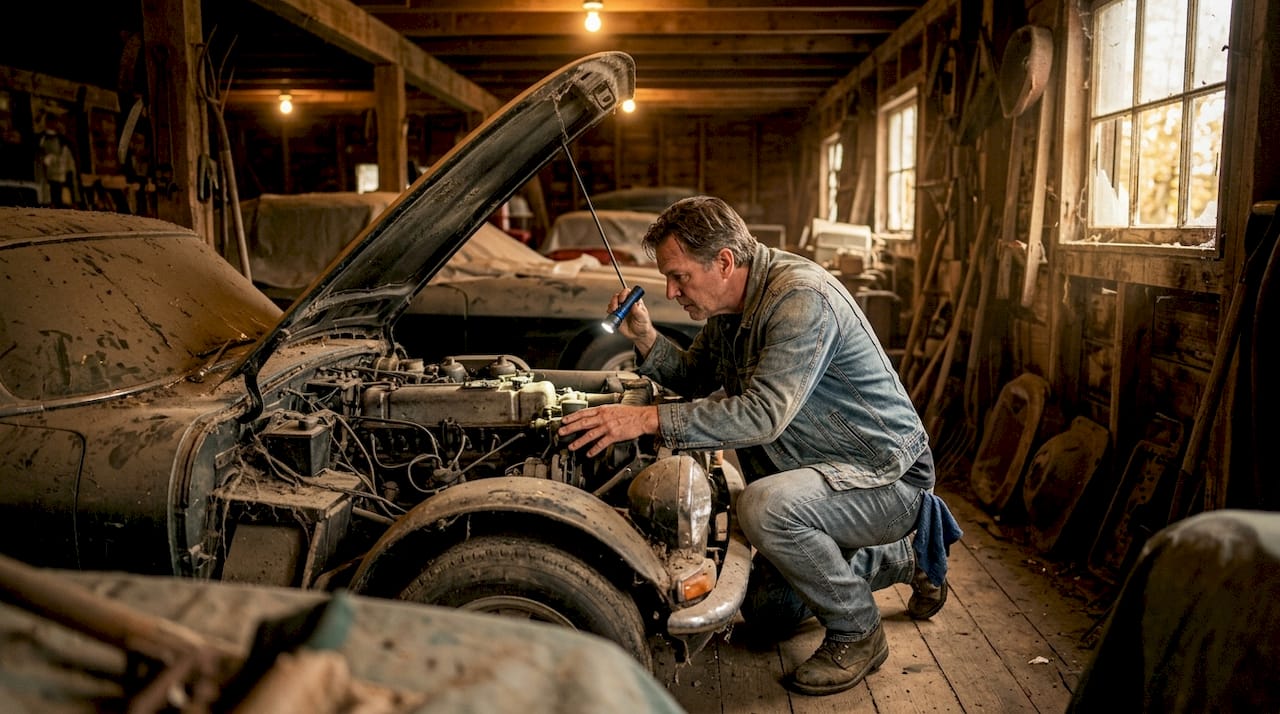
Grime hides structural rust and swapped parts, making thorough inspection non-negotiable. The most dangerous rust sits in frames and floor pans, where it compromises structural integrity without being immediately visible. A car that looks solid from ten feet away can have frame rails that crumble under a screwdriver.
Common pitfalls to evaluate before committing to a purchase:
- Frame and floor pan rust. Probe every structural surface with a pick or screwdriver. Surface rust is cosmetic; frame rust is a rebuild cost that can exceed the car's value.
- Swapped or incorrect components. Non-original engines, transmissions, and rear axles reduce value and complicate restoration. Always verify numbers against factory build records.
- Title and registration issues. Paperwork for long-dormant barn finds can be legally complex. An incomplete title can turn a valuable collector car into a display-only asset that cannot be registered or driven.
- Emotional overvaluation. Buyers frequently overpay because the story of a find creates excitement that overrides clear-eyed appraisal. Set a firm budget before you see the car, not after.
Pro Tip: Hire an independent inspector who specializes in the specific make and model you are evaluating. A marque expert will spot incorrect parts and hidden damage that a general mechanic will miss.
When structural damage is severe, a restomod build may be more practical than preservation. Restomods replace mechanical components while retaining the body and interior, producing a drivable car without the premium of full survivor status. That approach suits drivers more than investors.
How can collectors preserve and maximize barn find value?
Preservation is the current best practice for maintaining barn find car value. The goal is not to make the car look new. The goal is to keep it honest.
The recommended approach follows a clear sequence:
- Document everything before touching the car. Photograph every panel, the engine bay, the interior, and the undercarriage. This documentation becomes part of the car's provenance and supports future valuations.
- Recommission mechanically without altering the appearance. Recommissioning to run safely while maintaining the outward untouched condition preserves both the historical narrative and the collector premium. Replace fluids, seals, and safety-critical components without repainting or re-trimming.
- Stabilize, do not strip. Treat surface rust with a penetrating stabilizer rather than grinding it back to bare metal. Preserve original finishes wherever structurally sound.
- Secure specialist insurance. Agreed-value policies from collector car insurers protect the full appraised value rather than the depreciated market value. Standard auto policies are inadequate for survivor cars.
- Build and maintain a documentation file. Collect every piece of paperwork: the original title, service records, auction catalogs, and appraisal reports. Each document adds to the car's story and its resale value.
The trade-off between concours restoration and survivor preservation is real. A concours-quality restoration can win trophies, but it rarely recovers its cost at resale. A sympathetically maintained survivor car, by contrast, can appreciate steadily because its authenticity becomes rarer with each passing year. Understanding why luxury cars hold value through originality and condition applies directly to the survivor car market.
Key Takeaways
Barn find cars hold value because their unrestored originality creates a scarcity that the market consistently rewards with premiums over restored equivalents.
| Point | Details |
|---|---|
| Originality drives value | Original paint, factory mechanicals, and authentic patina command collector premiums that restoration cannot replicate. |
| Market appreciation is real | The US barn find market has appreciated about 12% as of march 2026, confirming sustained collector demand. |
| Over-restoration destroys value | Full restoration erases factory DNA and frequently lowers a car's value below comparable survivor condition. |
| Inspection is non-negotiable | Hidden rust in frames and floor pans, plus swapped components, are the most common and costly surprises in barn find purchases. |
| Recommissioning beats restoration | Making a car mechanically safe without altering its appearance preserves both the historical narrative and the investment premium. |
The romance is real, but so is the math
I have watched collectors walk away from genuinely valuable survivor cars because the grime put them off, and I have watched others pay twice what a car was worth because the story got to them first. Both mistakes are expensive, and both are avoidable.
What I find most compelling about the barn find market is that the emotional and financial cases actually align. A car that evokes genuine nostalgia, that carries its original factory finish and a documented history, is not just a sentimental object. It is a scarce asset in a market where scarcity is accelerating. Every year, more survivors get restored, parted out, or crushed. The pool of genuinely unmolested examples shrinks, and the premiums for the ones that remain grow.
My advice to serious collectors is straightforward. Treat the inspection as the most important part of the purchase, not the story. The story adds value only when the car underneath it is structurally sound and genuinely original. Get a marque expert on-site before you commit. Budget for recommissioning costs before you negotiate the price. And resist the temptation to restore anything you do not have to. The patina is not a problem to solve. It is the asset.
Barn finds are one of the few collector categories where passion and investment logic point in the same direction. That alignment is rare. Use it wisely.
— Allen
Premium vehicles worth your attention at Autovendorsfl
Collectors who appreciate originality and craftsmanship in barn finds often apply the same standards to their broader vehicle investments.

Autovendorsfl curates a premium selection of luxury vehicles in Fort Lauderdale, with a hands-on approach to sourcing and appraisal that mirrors the rigor serious collectors bring to survivor car evaluation. The team at Autovendorsfl specializes in finding vehicles that meet high standards for condition and provenance, whether you are adding to a collection or investing in a single standout model. Collectors interested in well-preserved luxury inventory can explore the current Mercedes-Benz S-Class selection or connect directly with the Autovendorsfl team for personalized sourcing assistance.
FAQ
What makes a barn find car more valuable than a restored one?
A barn find retains its original factory components, paint, and patina, which collectors treat as direct proof of authenticity. Restored cars erase that evidence, and the market consistently pays a premium for cars that have never been touched.
How do I verify a barn find's originality before buying?
Request a VIN decode report and physically cross-reference the numbers stamped on the firewall, engine block, and door jamb. Hire a marque specialist to inspect for non-original components and hidden structural rust.
Can a barn find lose value after purchase?
Yes. Over-restoration permanently removes the factory DNA that drives collector premiums. Incomplete or missing title documentation can also reduce a car to display-only status, eliminating its resale market entirely.
What is recommissioning, and why do collectors prefer it?
Recommissioning means making a car mechanically safe to drive without altering its outward appearance. Collectors prefer it because it preserves the car's historical narrative and original condition, which are the primary sources of its value.
Are barn finds a reliable investment?
The US barn find market has appreciated about 12% as of march 2026, and auction results regularly show survivor cars fetching premiums over restored equivalents. Like any collector asset, value depends on condition, provenance, and the specific model's desirability.