
Most families make the same eight or nine mistakes when shopping for a family vehicle, and nearly all of them are avoidable with a five-minute checklist. The biggest one is focusing on the monthly payment instead of the total cost of ownership. Others include buying a vehicle sized for an imagined future instead of your actual weekly routine, skipping a real car-seat fit test, trusting a spec sheet over a vehicle history report, and rushing a ten-minute test drive that never touches a highway on-ramp.
Here's the quick list, with a one-line fix for each. Every section below unpacks one of these in more detail.
- Payment tunnel vision — calculate 3 year ownership cost, not just the loan quote.
- Wrong size for real life — count seats and cargo you use weekly, not annually.
- Skipping the car-seat test — bring your actual seats to every test drive.
- Ignoring safety scores — check IIHS and NHTSA ratings before you fall for a trim package.
- Skipping used-car diligence — pull a history report and pay for an independent inspection.
- Loan terms stretched too long — cap financing near 60 months.
- Underestimating running costs — price tires, insurance, and maintenance before you sign.
- Rushing the test drive — load real gear and drive a real commute.
- Falling for dealership add-ons — know your walk-away price before you sit down.
New vehicles typically lose 20% to 30% of their value in the first year alone — a fact that should shape almost every decision below.
Key Takeaways
Avoiding the costliest family car buying mistakes comes down to testing car seats in person, checking safety subtest scores, verifying used-car history, and calculating three-year ownership cost before signing anything.
| Point | Details |
|---|---|
| Calculate total ownership cost | Add insurance, fuel, maintenance, and registration before comparing monthly payments. |
| Match size to weekly use | Choose cargo and seating capacity based on routine needs, not annual trips. |
| Test car seats in person | Install your actual seats and check LATCH, legroom, and door width before buying. |
| Verify used-car history | Pull a vehicle history report and get an independent mechanical inspection. |
| Keep loan terms reasonable | Target 60 months or fewer to avoid negative equity and excess interest. |
Table of Contents
- Common Family Car Buying Oversights In The Budget
- Choosing The Wrong Size Or Body Style For Your Family
- Testing Car Seats Before You Buy, Not After
- Checking Safety Ratings And Driver-Assist Features That Actually Matter
- Skipping Vehicle History And Independent Inspections On Used Cars
- Financing Mistakes That Quietly Inflate The Real Price
- Rushing The Test Drive And Skipping Real-World Usability Checks
- Deciding What To Compromise: Space, Cost, Safety, Or Features
- How Autovendorsfl Helps Families Avoid These Exact Mistakes
- Where To Check Safety, Depreciation, And Ownership-Cost Data
- What Actually Matters When You Buy A Family Car
- Frequently Asked Questions
- Sources
Common Family Car Buying Oversights In The Budget
The most expensive mistake in family car shopping rarely shows up on the sales contract. It shows up eighteen months later, in the gap between what you expected to spend and what you're actually spending. Buyers commonly fixate on the monthly payment and overlook the full ownership picture: insurance, fuel or electricity, maintenance, tires, registration, parking, and the interest baked into the loan itself.
A three-year projection takes less time than a single dealership visit, and it changes which vehicles actually make sense.
- Get real insurance quotes for each model you're considering, not estimates. Premiums can swing by hundreds of dollars a year between a sedan and a similarly priced SUV.
- Add up fixed annual costs — registration, an oil change schedule, a tire replacement every 3 to 4 years, and typical repair frequency from Consumer Reports reliability data.
- Multiply by three, then compare against your actual budget, not the number the finance manager suggests fits.
Depreciation deserves its own line item. That 20 to 30 percent first-year value drop is exactly why a certified pre-owned family SUV often makes more financial sense than a brand-new one carrying the same options. A CPO vehicle has already absorbed the steepest part of the depreciation curve, usually still carries manufacturer warranty coverage, and costs less to insure.
Before you negotiate anything, collect three numbers: your realistic insurance quote, an estimated annual maintenance figure, and your total available budget across 36 months. Walking in with those numbers changes the conversation from "what can I afford monthly" to "what does this vehicle actually cost me."
Choosing The Wrong Size Or Body Style For Your Family
Families buy for the vacation they take once a year instead of the school run they take 400 times a year, and that single miscalculation drives a lot of the buyer's remorse in this category. A minivan that seats eight sounds practical until you realize you drive two kids to school and rarely fill the third row. A compact crossover feels efficient until stroller, groceries, and hockey bags won't all fit at once.
Match the vehicle to your actual week, not your best-case weekend:
- Sedans work for families with one or two kids, minimal cargo needs, and no regular third-row demand.
- Small and midsize crossovers balance cargo space and parking ease for most two-child households.
- Midsize SUVs earn their size when you regularly haul sports gear, a dog, or extended family.
- Large SUVs and minivans make sense only if you consistently use the third row, not just twice a year.
Take a family of four with two kids in travel sports. Their gear alone often eats a trunk's worth of space before luggage or groceries enter the picture, which pushes them toward a midsize SUV even though a sedan would handle daily commuting fine.
Pro Tip: Count how many times in the last month you actually needed the third row or the extra cargo space. If the answer is zero or one, you're probably paying for size you don't use.
Testing Car Seats Before You Buy, Not After
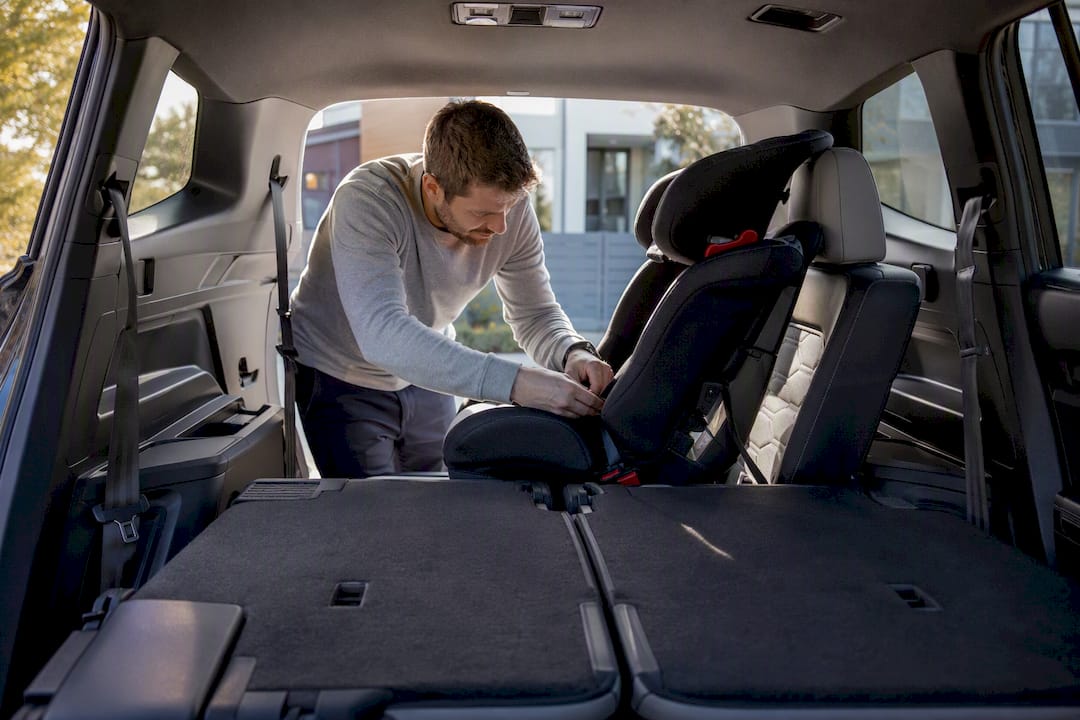
A spec sheet listing three LATCH anchors tells you almost nothing about whether three car seats will actually fit side by side. Seat shape, headrest geometry, and buckle placement vary enough between models that even vehicles with identical anchor counts can behave completely differently once real seats go in. Testers consistently recommend installing your own seats during the test drive rather than trusting the brochure.
Run this sequence at every dealership visit:
- Bring your actual car seats, not a rental or a demo model. Booster, convertible, and infant seats all install differently.
- Test every LATCH anchor you'd realistically use, including the center position if you're fitting three across.
- Measure front-seat legroom with a rear-facing seat installed. Tall drivers often lose several inches of comfortable seating position.
- Check rear door width and swing angle with a seat already buckled in. Some doors don't open wide enough to load a child comfortably in a tight garage or parking spot.
- Test third-row access with second-row child seats installed. On many vehicles, a fixed convertible seat blocks the walk-through path entirely.
Three-across fitting is where most families get surprised. Even generously rated midsize SUVs can fail to accommodate two bulky convertible seats and a booster without redoing the buckle order every time you drive. If you need three-across capacity, this is not a detail to guess on. It's the single test that should make or break a purchase decision.
Checking Safety Ratings And Driver-Assist Features That Actually Matter
Not every star rating means the same thing, and not every driver-assist feature performs the way the trim brochure implies. The National Highway Traffic Safety Administration and the Insurance Institute for Highway Safety run different but complementary tests, and for families, some subtests matter more than the overall headline score.
Prioritize these when comparing models:
- Side-impact protection, since intersection collisions are common and disproportionately dangerous for rear-seat passengers.
- Child occupant protection ratings, which specifically evaluate how well a vehicle's rear seats and anchors protect young passengers.
- Roof strength scores, relevant if you're considering a rollover-prone body style like a taller SUV.
- Automatic emergency braking and blind-spot monitoring, the two ADAS features with the most consistent real-world safety payoff.
Technology can create false confidence, though. Lane-keep assist and adaptive cruise control vary widely in how well they actually work, and a feature listed on a spec sheet isn't the same as a feature that performs reliably in stop-and-go traffic with kids in the back seat. Test these systems yourself during the drive rather than taking a salesperson's description at face value, and check the NHTSA site directly for open recalls before you sign anything.
Skipping Vehicle History And Independent Inspections On Used Cars
A clean-looking used SUV can hide a salvage title, a rolled-back odometer, or flood damage that never shows up in a walk-around. Buying pre-owned reduces your depreciation exposure significantly, but only if you do the homework a new-car purchase doesn't require.
Follow this order before you commit to any used vehicle:
- Pull a vehicle history report and treat any of these as a hard stop: a salvage or rebuilt title, an odometer inconsistency, flood damage, or a title that's changed hands unusually often in a short window.
- Pay for an independent pre-purchase inspection from a mechanic with no connection to the seller. A thorough inspection checks brake wear, suspension components, frame integrity, fluid leaks, and evidence of prior collision repair.
- Verify open recalls and confirm completed service bulletins using the vehicle's VIN, since a recall that was never addressed can turn into an expensive repair right after purchase.
Pro Tip: Never let a seller's own inspection report substitute for your own. A independent mechanic with no stake in the sale is the only inspection result you should trust.
Financing Mistakes That Quietly Inflate The Real Price

A lower monthly payment often means a longer loan, and a longer loan often means paying thousands more in interest while owing more than the car is worth for years. Mechanics and industry veterans routinely warn against stretching loan terms to 72 or 84 months, because that structure practically guarantees negative equity if you need to trade in before the loan is paid off.
Guardrails worth following:
- Target 60 months or fewer on financing whenever your budget allows it.
- Put down at least 10 to 20 percent to avoid starting the loan underwater.
- Run the math on total interest paid, not just the payment amount, before you agree to any term.
- Consider leasing only if your mileage is predictable and you're comfortable with wear-and-tear charges at turn-in, since leases penalize the unpredictable driving that comes with growing kids and changing routines.
A lease versus buy comparison can clarify which structure fits your specific mileage pattern before you sit down with a finance manager who has every incentive to steer you toward the longest term available.
Rushing The Test Drive And Skipping Real-World Usability Checks
A ten-minute loop around the block tells you almost nothing about how a vehicle performs with a full load, on a highway on-ramp, or during a three-point parking job with kids yelling in the back seat. A staged family test drive that mimics your actual routine reveals problems a short demo conveniently avoids.
Build your own test drive around these steps:
- Install your car seats first, before you even start the engine, and note how long it takes.
- Load the stroller, a week's worth of groceries, or your usual cargo to see whether the trunk configuration matches your daily reality.
- Drive your actual commute, including a highway merge, to test acceleration, wind noise, and braking feel under real speed.
- Park and unload everything the way you would at home, checking liftgate height and door swing in a tight space.
- Test the tech you'll use daily — phone pairing, USB-C ports, rear climate controls, and hands-free liftgate operation, since these small frictions compound over years of ownership.
Short test drives also mask edge cases dealers rarely volunteer, including brake feel with a full load or third-row ingress when both second-row seats are occupied by child seats. A detailed test-drive checklist built for larger family vehicles can help you catch these before you're back at the finance desk.
Deciding What To Compromise: Space, Cost, Safety, Or Features
No family gets every priority in one vehicle, so the smarter move is ranking what's non-negotiable before you start comparing trims. A simple three-tier matrix works better than a wish list: must-haves (say, top-tier side-impact protection and confirmed car-seat fit), nice-to-haves (heated seats, a panoramic sunroof), and avoid (anything that fails your car-seat test or blows your three-year cost projection).
| Priority axis | What to check | Why it matters for families |
|---|---|---|
| Space | Weekly cargo and seat usage | Prevents paying for size you rarely use |
| Running cost | Insurance, fuel, maintenance estimate | Avoids budget surprises after purchase |
| Safety | IIHS and NHTSA subtest scores | Protects the passengers most at risk |
| Car-seat install | Actual LATCH and fit test | Confirms compatibility specs can't guarantee |
Consider a family choosing between a loaded midsize SUV and a simpler crossover with fewer features but a confirmed three-across car-seat fit. Once cost and safety are equal, the crossover wins, because a comfortable ride with heated seats means nothing if the middle child seat won't buckle correctly.
How Autovendorsfl Helps Families Avoid These Exact Mistakes
Every oversight above shares a root cause: buyers don't have the time, tools, or leverage to verify claims before they sign. Autovendorsfl built its process around closing that gap for families shopping the luxury and premium used-vehicle market.
- Personalized vehicle-finding assistance matches specific family requirements, from cargo needs to car-seat compatibility, against real inventory instead of generic listings.
- Pre-sale inspection support helps confirm mechanical condition before you commit, addressing the exact due-diligence gap that causes the costliest used-car regrets.
- Trade-in valuation gives you a clear number upfront, so you're negotiating from real data rather than guesswork.
- Financing guidance steers families toward manageable terms instead of the longest available loan.
- Family-focused test-drive support means bringing your own car seats and cargo is expected, not an inconvenience.
If you're weighing new against pre-owned, Autovendorsfl's guide on pre-owned luxury value breaks down exactly where the savings come from. And if your biggest constraint is time rather than money, a vehicle-finding service can save you hours that would otherwise go to dealership visits that don't pan out. You can start that search directly at Autovendorsfl.
Where To Check Safety, Depreciation, And Ownership-Cost Data
- NHTSA — official crash-test ratings and VIN-based recall lookup.
- IIHS — subtest scores for side impact, roof strength, and child occupant protection.
- Consumer Reports — reliability data and projected maintenance costs by model.
- State Farm's depreciation guide — first-year value loss figures for budgeting.
- Schwab's car-buying mistakes overview — a concise rundown of the financial traps buyers repeat most.
What Actually Matters When You Buy A Family Car
Most car-buying advice treats safety, cost, and comfort as separate categories, when in practice they're the same decision viewed from different angles. A vehicle that fails your car-seat test isn't really "safe" for your family regardless of its crash rating, and a vehicle that blows your three-year cost projection isn't really "affordable" regardless of its sticker price.
The conventional advice oversells the test drive as a formality and undersells it as the single best tool you have. A staged drive with real seats and real cargo will tell you more in twenty minutes than a week of spec-sheet comparisons. If you take away one priority from this whole checklist, make it that one: verify fit and function yourself, in person, before the numbers on a loan document even enter the conversation.
Frequently Asked Questions
What is the single biggest family car buying mistake? Focusing on the monthly payment instead of total ownership cost. Insurance, maintenance, and depreciation often outweigh the loan amount over three years.
How do I know if a car seat will fit before I buy the vehicle? Bring your actual car seats to the test drive and install them yourself, checking LATCH anchors, legroom, and door clearance rather than relying on spec sheets.
Is a certified pre-owned vehicle a smarter choice than new for families? Often, yes, since new vehicles lose 20 to 30 percent of their value in the first year, and a CPO vehicle typically still carries manufacturer warranty coverage.
How long should a family car loan term be? Aim for a relatively short loan term to avoid excessive interest and reduce the risk of owing more than the car is worth.
What used-car red flags should stop a purchase immediately? A salvage or rebuilt title, an inconsistent odometer reading, evidence of flood damage, or a pattern of frequent, unexplained title transfers.
Sources
- How to Calculate Vehicle Depreciation | State Farm
- 7 car-buying mistakes that could cost you | Schwab
- How to shop for a family car | Good Housekeeping Institute
- National Highway Traffic Safety Administration (NHTSA)
- Consumer Reports — Cars