
For a luxury vehicle in the U.S., plan on putting down 10% to 20% of the purchase price, with 20% as the target for a new or exotic model. Leasing usually asks for far less cash upfront, and strong credit can occasionally soften that range, but every lender assumes you're anchoring your purchase with a real down payment before financing the rest.
TL;DR:
- A down payment for a luxury vehicle typically ranges from 10% to 20%, with 20% recommended for new or exotic models to offset depreciation risks.
- Leasing generally requires less cash upfront than financing, but money paid into cap cost reduction is not refundable if the vehicle is totaled or leased early.
- Using a trade-in as a down payment depends on positive equity; negative equity can be rolled into the new loan, increasing your total financing amount.
- A larger down payment improves the loan-to-value ratio, potentially lowering interest rates and helping you build equity faster to avoid owing more than the vehicle’s value.
- For short-term ownership, a 20% or higher down payment is advisable, while a 15% down may suffice for long-term ownership, especially with strong credit.
Table of Contents
- How Much Down Payment Do You Need for a Luxury Car?
- Financing vs. Leasing: Which Needs More Cash Upfront?
- Can You Use a Trade-In as Your Down Payment?
- Why Your Down Payment Changes Your Interest Rate
- Buying Luxury With Limited Cash or Average Credit
- How Auto Vendors Inc Structures Down Payments for Luxury Buyers
- What's the Smartest Down Payment Strategy for You?
- Ready to Structure Your Down Payment the Right Way?
- Sources
How Much Down Payment Do You Need for a Luxury Car?
Lenders financing luxury and exotic vehicles typically want 10% to 20% down, with the higher end recommended for new models, according to LendingTree's exotic car financing guidance. That's a wider cushion than the average car buyer puts down. CNBC Select reports that the typical new-car down payment sits in the mid-teens percentage range, but conservative guidance still points to 20%, since luxury vehicles depreciate faster in the first two to three years and lenders want a buffer against that drop.
Put those percentages into real numbers and the stakes become obvious. On a $60,000 vehicle, 10% down is $6,000; 20% is $12,000. On an $80,000 purchase, that gap widens to $8,000 versus $16,000. On a $100,000 luxury car, you're choosing between a $10,000 down payment and a $20,000 one, a $10,000 swing that changes your monthly payment by roughly $150 to $180 a month, based on the $15 to $18 reduction per $1,000 down that NerdWallet's financing calculators show across typical terms and APRs.
What should guide your target?
- Short-term ownership (under three years): lean toward 20% or more to offset fast depreciation.
- Long-term ownership (five-plus years): 15% is often sufficient since you'll build equity naturally over time.
- Strong credit profile: you may qualify at 10%, but your monthly payment and total interest will run higher.
Financing vs. Leasing: Which Needs More Cash Upfront?
Leasing a luxury car almost always demands less cash at signing than financing, but that lighter upfront cost comes with tradeoffs worth understanding before you sign.
- Cap cost reduction. This is the lease equivalent of a down payment. It lowers your capitalized cost (the negotiated price the lease payment is based on), and every dollar you put here reduces your monthly payment.
- Acquisition fee. Most luxury leases charge this fee, often several hundred dollars, to open the lease.
- Security deposit. Some lenders waive this with strong credit; others require it, typically equal to one month's payment rounded up.
- First month's payment. Due at signing, separate from any cap cost reduction you choose to pay.
Here's the catch: money put into cap cost reduction doesn't come back to you the way equity does in a financed purchase. If the vehicle is totaled or you total the lease early, that cash is often gone. A better rule of thumb: use a small cap cost reduction (or none) if you plan to lease again in two to three years, and reserve financing with a real down payment for vehicles you intend to own outright and build equity in.
Can You Use a Trade-In as Your Down Payment?
Yes, but only the positive equity counts. If your current vehicle is worth more than what you owe on it, that difference can be applied directly toward your new down payment. If you owe more than it's worth, that's negative equity, and the FTC warns that dealers can roll that shortfall into your new loan, quietly inflating the amount you finance and the interest you'll pay for years.
Trade-ins are convenient, but Investopedia notes that dealers often offer less than what a private-party sale would bring, since they need margin to resell the car. A private sale usually nets more cash for your down payment, at the cost of your time and some paperwork.
Before you decide either way:
- Request a written 10-day payoff quote on any financed trade-in, since balances shift with each payment cycle, a step detailed in Auto Vendors Inc's guide to trading in a liened car.
- Handle minor cosmetic repairs, including wheel alignment if needed, since a car that drives straight and looks clean appraises higher.
- Pull recent comps for your exact trim and mileage so you know whether a dealer's offer is fair.
Why Your Down Payment Changes Your Interest Rate
Lenders lean heavily on loan-to-value, or LTV, when pricing a luxury auto loan. LTV compares how much you're financing against the vehicle's value; the smaller that ratio, the less risk the lender carries if the car needs to be repossessed and resold. A LendingTree's LTV and payment guidance shows how a stronger down payment directly improves that ratio, and lenders often reward it with a lower APR or approval for a shorter loan term.
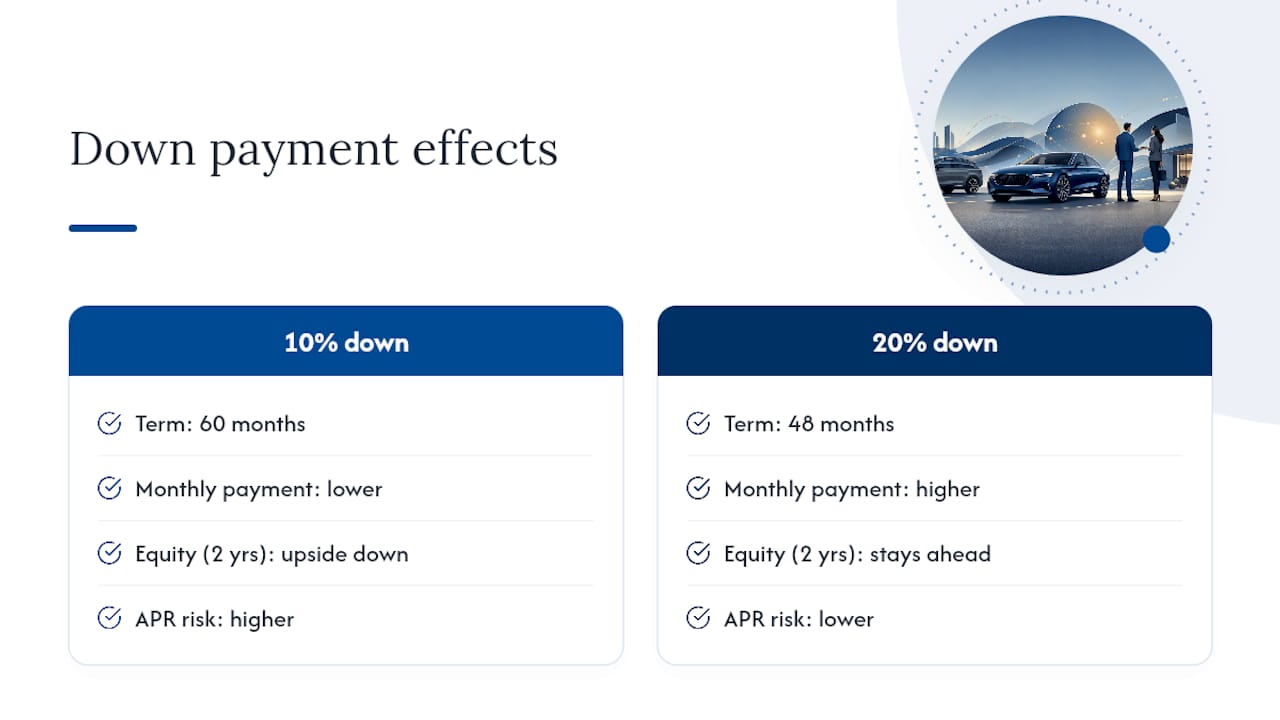
This matters more with luxury and exotic vehicles than with mainstream cars, since resale markets for high-end models are thinner and depreciation can outrun a slow-building equity position. A 60-month term with 10% down might leave you upside down for the first two years; the same vehicle financed over 48 months with 20% down builds equity fast enough to stay ahead of depreciation almost the entire time. If you can manage the higher monthly payment, a 48 to 60 month term paired with a strong down payment is the safest combination for luxury ownership.
Buying Luxury With Limited Cash or Average Credit
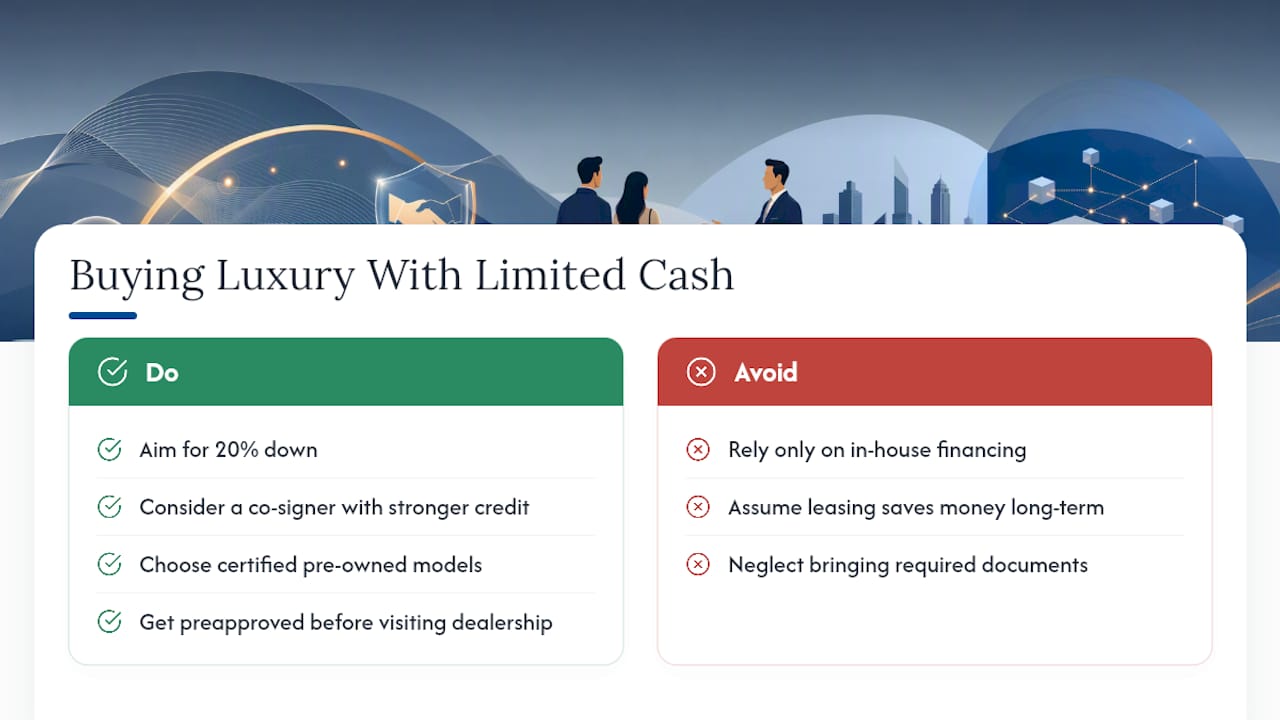
You don't need flawless credit or a six-figure savings account to buy a luxury vehicle responsibly, but you do need a plan. A larger down payment is your strongest lever if your credit score is average. Putting more cash down lowers the lender's risk regardless of your score, often unlocking approval or a better rate than your credit alone would earn.
Other options worth considering: a co-signer with stronger credit, a certified pre-owned luxury model (which often qualifies for better rates than a used non-certified vehicle), or combining a modest trade-in with saved cash to hit that 20% target. If cash is tighter than credit, leasing can conserve capital, though it may cost more over years of repeated lease cycles compared to owning one vehicle long term.
Pro Tip: Get preapproved before you visit a dealership. A preapproval locks in your rate and gives you real negotiating leverage, since you're no longer at the mercy of in-house financing offers. Bring pay stubs, proof of insurance, and your ID to move the process along quickly.
How Auto Vendors Inc Structures Down Payments for Luxury Buyers
This dealership works with luxury buyers to match down payment strategy to the actual vehicle and buyer situation, rather than applying a one-size answer. The dealership's personalized vehicle finding service helps identify models where a 10% to 20% down payment realistically fits your monthly budget, and its trade-in appraisal process is built to protect your equity rather than lowball it.
When you schedule an appointment, come prepared with a preapproval letter if you have one, your trade-in's payoff amount, a government-issued ID, and recent proof of income. That preparation lets the team structure an offer around your numbers instead of guessing at them.
What's the Smartest Down Payment Strategy for You?
If you're leasing for two to three years and plan to cycle into a new vehicle, keep your cap cost reduction light and preserve your cash. It builds equity fast enough to outrun depreciation on almost any luxury model. If your budget is tight, don't force a lease just to lower the monthly number. A slightly smaller financed purchase with a real down payment usually beats a lease you can't comfortably renew.
Whatever path fits, get preapproved and get a real trade-in estimate before you start negotiating. Walking in with both numbers in hand is the single biggest advantage a luxury buyer can have at the table.
— Allen
Ready to Structure Your Down Payment the Right Way?
Auto Vendors Inc gives you what a calculator alone can't: a real person matching your down payment budget to an actual luxury vehicle in inventory, not a hypothetical one.
That combination, personalized vehicle sourcing, honest trade-in valuation, and financing help, means you leave with a plan that fits your actual budget, not a generic percentage pulled from a blog post. If you're ready to see what a realistic down payment looks like on the model you want, request a valuation or financing consultation through Auto Vendors Inc's Fort Lauderdale page and get numbers specific to your situation.
Sources
- Auto trade-ins and negative equity — Federal Trade Commission (FTC)
- How much is a down payment for a car? — CNBC Select
- How much down payment should you make when buying a car? — NerdWallet