
Most affluent U.S. buyers finance exotic cars through specialty lenders or dealer-arranged programs, because standard auto loans aren't built to underwrite six-figure, low-production vehicles correctly. Expect loan amounts well above typical auto financing, down payments often involve a moderate percentage, and underwriting that weighs provenance and appraised value alongside credit. The smartest next move is a soft pre-qualification, or a direct conversation with a dealer like Auto Vendors Inc that can pre-check financing before you're bidding at auction.
TL;DR:
- Specialty lenders typically require 10% to 20% down payments, with loan-to-value caps protecting against market value fluctuations.
- Rates tend to be higher than standard auto loans, especially for ultra-low-production vehicles, and longer terms significantly increase total interest paid.
- Qualification criteria include strong credit scores, full provenance documentation, and a solid asset picture, especially for high-value and rare cars.
- Pre-approval steps like soft pre-qualification and early appraisal of provenance can expedite funding and reduce auction-day delays.
- Working with a dealer experienced in exotic car financing can streamline documentation, sourcing, and timing, especially for private sales or auction purchases.
Table of Contents
- What Is Exotic Car Financing, and How Is It Different?
- What Do Rates, Terms, and Down Payments Actually Look Like?
- Who Qualifies, and What Documents Do Lenders Need?
- How Does the Financing Process Actually Work, and How Long Does It Take?
- Loan, Lease, or Something Else: Which Structure Fits Your Goals?
- Financing a Private Sale or Auction Purchase: Title, Escrow, and Timing
- How Do You Choose the Right Lender for an Exotic Purchase?
- A Dealer's-Eye View: Common Provenance Red Flags
- Why the Standard Financing Playbook Falls Short Here
- Get White-Glove Financing Help from Auto Vendors Inc
- Sources
What Is Exotic Car Financing, and How Is It Different?
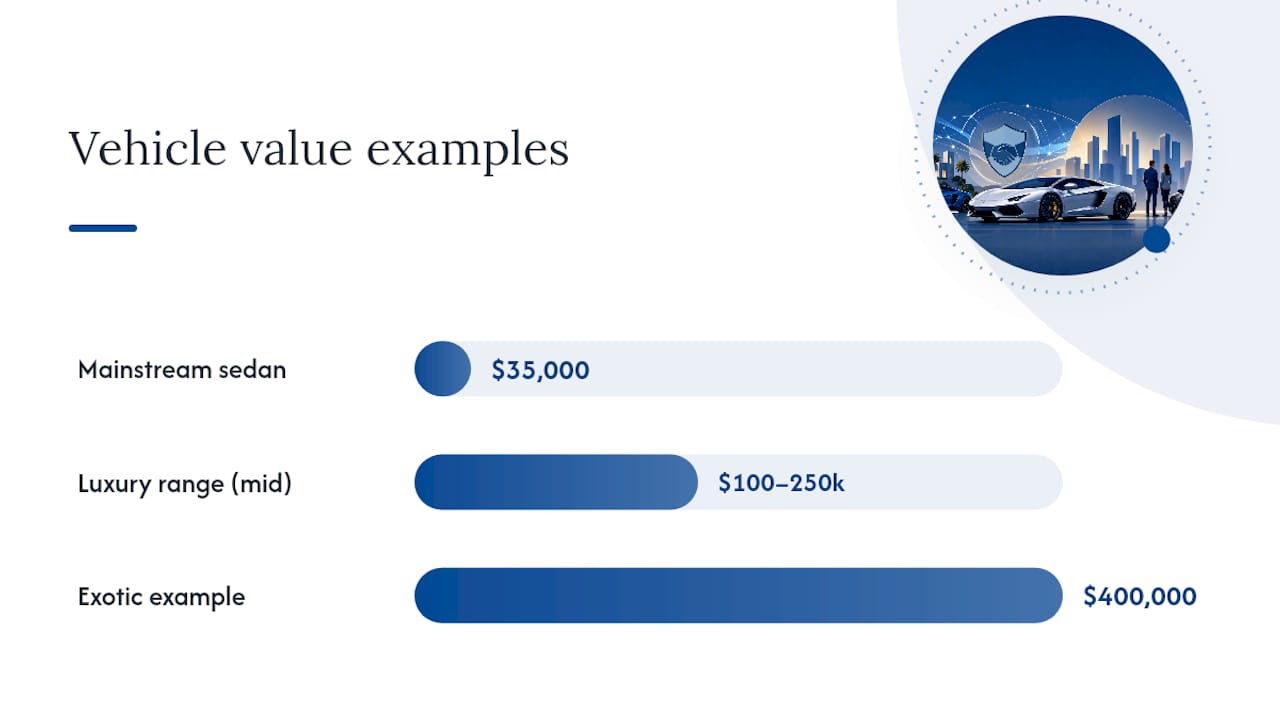
Exotic car financing is a loan product built specifically for vehicles that mainstream lenders treat as too risky, too illiquid, or too hard to value using standard depreciation tables. A credit union financing a $35,000 sedan and a specialty lender financing a $400,000 Lamborghini are solving completely different problems, even though both call it an "auto loan."
The core difference is what the underwriter actually looks at. Standard auto lending leans almost entirely on your credit score and debt-to-income ratio, because the car itself is a known, predictable asset with published resale values. Specialty lenders underwrite exotic vehicles differently, weighing provenance, condition, and appraised value as heavily as the borrower's financial profile. A car with a documented ownership history and complete service records is a fundamentally different risk than an identical model with a gap in its paper trail.
That asset focus changes the mechanics of the loan itself:
- Provenance and appraisal replace blue-book pricing. Lenders often require a third-party appraisal rather than relying on a standard valuation guide.
- Model risk gets priced in. Limited-production vehicles or brands with volatile resale markets can affect your rate more than your credit score does.
- Service levels run higher. Many exotic programs assign a dedicated underwriter rather than routing you through a call center, and some assist directly with title work.
- Reporting can differ. Some specialty loans are structured and reported differently than a conventional installment loan, which matters if you're managing multiple financed assets.
Price bands matter here, too. Vehicles in the $100,000 to $250,000 range from brands like Porsche, Aston Martin, or higher-trim Mercedes-AMG often still qualify for financing through well-established luxury auto lenders. Once you cross into ultra-low-production territory (Ferrari limited editions, McLaren, vintage Porsche air-cooled models, or classic muscle cars with collector status) you're almost always in true specialty-lender territory, where appraisal and provenance review become mandatory rather than optional.
What Do Rates, Terms, and Down Payments Actually Look Like?
Exotic financing rates and terms vary more than conventional auto loans, because the lender is pricing both you and the asset. Rates in the specialty market commonly run higher than mainstream new-car financing, reflecting the added asset risk lenders absorb on low-volume vehicles. Loan terms can stretch well beyond typical auto financing, with some specialty programs advertising terms up to 144 months, though a longer term means more total interest paid over the life of the loan even when the monthly payment looks manageable.
Down payments behave differently, too. Where a conventional loan might accept 0% to 10% down from a qualified borrower, exotic programs frequently ask for 10% to 20%, and sometimes more on vehicles with thinner resale markets. Loan-to-value limits are the mechanism behind this: lenders cap how much of the appraised value they'll finance, which protects them if the car's market value softens before the loan is paid off.
Here's how that plays out in practice:
- $150,000 purchase, 15% down ($22,500), 84-month term: financing roughly $127,500. At a specialty-market rate in the higher single digits, expect a monthly payment in the range of $1,900 to $2,100, depending on the lender's rate tier and your credit profile.
- $500,000 purchase, 20% down ($100,000), 120-month term: financing roughly $400,000. Stretched over a longer term to manage cash flow, monthly payments commonly land between $4,200 and $4,800, though the total interest paid over ten years is substantial compared to a shorter amortization.
Pro Tip: Run the same purchase at two term lengths before you sign anything. A 144-month term lowers your monthly payment, but on a $400,000 loan the difference in total interest paid versus an 84-month term can run into the tens of thousands of dollars.
Four factors move your rate more than anything else:
- Vehicle rarity and resale liquidity. A widely collected model with strong resale demand prices better than a niche or discontinued nameplate.
- Loan-to-value ratio. Larger down payments consistently earn better pricing.
- Credit depth, not just score. Lenders weigh established credit history length alongside the raw number.
- Documentation completeness. A vehicle with full provenance and service records reduces underwriting friction, and friction shows up in pricing.
Who Qualifies, and What Documents Do Lenders Need?
Qualification for exotic financing runs on a wider set of inputs than a conventional loan application. Credit still matters. Dedicated exotic lenders typically look for strong credit history, often citing 700 or above as the preferred range, but liquidity and net worth can meaningfully offset a mid-tier score. A buyer with $40,000 in reserves and a clean asset picture is often a better risk in a lender's eyes than someone with a slightly higher score and no liquidity cushion.
Assembling your documentation before you shop saves real time later:
- Financial documents. Recent bank and brokerage statements, two years of tax returns, and business documentation if you're financing through an LLC or corporate entity.
- Identity and income verification. Standard for any large secured loan, but exotic lenders often request more recent statements than a conventional auto lender would.
- Vehicle-specific paperwork. Title history, a provenance report, complete service records, and a third-party appraisal, especially on vehicles above $200,000. Our guide on exotic car provenance breaks down exactly what a clean documentation trail should include.
- Insurance confirmation. Most programs require proof of comprehensive coverage, and many exotic policies come with mileage caps or agreed-value clauses that differ from a standard auto policy.
- Storage and custody details. Some lenders ask where and how the vehicle will be stored, particularly for seasonal or collector-grade cars that spend part of the year off the road.
Building this packet in advance is one of the highest-leverage moves a buyer can make. It's also worth reviewing general consumer credit protections through the FTC before signing anything on a large secured loan, so you know what disclosures and rights apply.
How Does the Financing Process Actually Work, and How Long Does It Take?
The path from first inquiry to funded purchase runs through a handful of predictable stages, and understanding each one helps you plan around an auction deadline or a seller who wants to close fast.
- Soft pre-qualification. Most reputable specialty lenders and platforms like Rizz Lending start with a soft credit pull that gives you an estimated rate range without affecting your score. This step usually takes minutes to a day.
- Formal application and hard credit pull. Once you've selected a vehicle and lender, a hard inquiry runs alongside full documentation review. This typically takes one to three business days.
- Vehicle verification. The lender or a third party confirms title status, provenance, and often orders an independent appraisal. On a well-documented car this can move fast; on one with gaps in its history, this stage can stretch out.
- Funding and disbursement. Many specialty programs advertise funding within one to three business days once documents are complete, which matters enormously if you're racing an auction settlement window.
Pro Tip: If you're bidding at auction, get your soft pre-qualification done a week ahead, not the morning of. Auction houses often expect payment within 48 to 72 hours of the gavel, and that window is too tight to start a financing application from zero.
The most common source of delay isn't the lender, it's incomplete paperwork on the vehicle side, which is why a used car pre-purchase inspection is vital for reducing surprises and lender risk. A missing service record or an appraisal that hasn't been ordered yet can add days to a process that otherwise moves quickly. A pre-inspection before you commit catches most of these issues before they become funding-day surprises.
Loan, Lease, or Something Else: Which Structure Fits Your Goals?
The right financing structure depends on whether you're optimizing for ownership, cash flow, or flexibility. Purchase financing builds equity and gives you full control over mileage, modifications, and hold period, but it ties up more capital upfront and exposes you fully to the vehicle's depreciation curve. Leasing preserves cash and often comes with lower monthly payments, but you're bound by mileage limits and a fixed term, and you build no equity in a car that, for some exotic models, might actually appreciate.
A few structures worth knowing:
- Interest-only loans. Popular with collectors bridging to an expected sale event, these keep monthly payments low by deferring principal, but they typically require high appraised-value minimums and specific loan-to-value limits, and they need careful planning around renewal dates.
- Long amortization with a balloon payment. Useful when you expect to refinance, sell, or pay off a lump sum before the balloon comes due.
- Secured lines of credit. An alternative for buyers who already hold significant liquid assets and want speed and flexibility over traditional installment structure.
- Subscription or short-term access. A newer option for buyers who want exotic-car experience without any long-term financial commitment.
Business use adds another layer. Vehicles used substantially for business purposes may carry different depreciation and deduction treatment, but the rules are specific and the vehicle's business-use percentage matters. This is a conversation for your tax advisor, not a blog post, given how much individual circumstances affect the outcome.
Financing a Private Sale or Auction Purchase: Title, Escrow, and Timing
Buying outside a dealer transaction adds steps that a standard dealership purchase handles automatically. Lenders still need clean title work and confirmed funds movement, they just can't rely on a dealer to manage it for them.
Here's what typically changes:
- Escrow becomes standard practice. Reputable lenders coordinate with escrow or title services to release funds only once title transfer conditions are met, protecting both buyer and seller.
- Auction deadlines demand faster paperwork. Expedited funding is available at many specialty lenders, but only if your documentation, appraisal, and title verification are already lined up before the auction closes.
- Title and VIN checks matter more, not less. A private-sale or out-of-state vehicle needs a full title history and VIN check to rule out salvage history or liens before any funds move.
- Interstate purchases add registration steps. A car bought in one state and registered in another triggers shipping logistics and state-specific registration requirements that can affect your funding timeline.
The inspection checklist you'd use for a dealer purchase applies here too, arguably with more urgency, since there's no dealership standing behind the transaction if something surfaces later.
How Do You Choose the Right Lender for an Exotic Purchase?
Not every lender that advertises "exotic car financing" actually has appetite for your specific vehicle, and finding that out after you've made an offer is the wrong time to learn it.
Evaluate lenders against a short list of criteria:
- Funding speed. Ask directly how many business days from complete documentation to disbursed funds, not just "typically fast."
- Brand and price appetite. A lender comfortable financing a Porsche 911 may have zero appetite for a vintage Ferrari or a heavily modified build.
- Prepayment terms. Confirm whether early payoff triggers a penalty, especially if you expect to sell or refinance within a few years.
- Title assistance. Programs that handle title work directly remove one of the biggest friction points in private-sale and auction purchases.
- Discretion. High-net-worth buyers often value a lender that doesn't require excessive documentation review calls or public-facing loan servicing.
Pro Tip: Ask every lender the same three questions: "What's your typical time from complete file to funding?" "Do you finance this specific make and model?" and "Is there a prepayment penalty?" The answers reveal more about a lender's actual appetite than their marketing page does.
Red flags worth walking away from include vague answers about underwriting criteria, fees that only appear in the fine print, and any lender unwilling to explain how they'll handle title transfer on a private sale. Compare offers on total effective cost, meaning rate, term, and fees together, not monthly payment alone.
A Dealer's-Eye View: Common Provenance Red Flags
After years of coordinating financing on high-value vehicles, Allen at Auto Vendors Inc keeps a short checklist to prevent auction-day surprises: confirm the title is clean and matches the seller's name, verify service records span the ownership history without unexplained gaps, and get the appraisal ordered before, not during, the financing application.
Provenance red flags worth watching for include mismatched VINs between title and vehicle, service gaps longer than a year on a low-mileage collector car, and sellers who can't produce a documented chain of ownership. A dealer that handles both the vehicle sourcing and the financing coordination, like Auto Vendors Inc does, can often catch these issues before they slow down funding, because the same team reviewing the paperwork is the team talking to the lender.
Why the Standard Financing Playbook Falls Short Here
Most financing advice treats exotic cars like expensive versions of a regular auto loan, and that's the mistake. The research is clear that these lenders are pricing an asset with provenance risk and thin resale liquidity, not just a borrower's credit file. Buyers who walk in focused only on their credit score are solving the wrong half of the problem.
The bigger gap in conventional advice is timing. Most guides mention rates and terms but skip how brutally fast auction and private-sale windows actually move. A soft pre-qualification done casually a week before an auction is worth more than a perfect credit score discovered too late to matter, because most delays come from incomplete vehicle documentation, not weak borrower financials.
If there's one priority to take from all of this, it's sequencing: get provenance documentation and appraisal moving before you've even won the bid, not after. Lenders can move in one to three business days when the paperwork is ready. They cannot move that fast when it isn't, no matter how strong your balance sheet looks.
— Allen
Get White-Glove Financing Help from Auto Vendors Inc
This service provides an alternative to piecing together financing on your own across scattered lenders and auction-day guesswork. The process can include coordinated vehicle search, finance packet assembly, and title work under one roof to streamline efforts before a deadline.

A hands-on approach can include personalized vehicle sourcing matched to budget and brand preferences, assistance assembling lender-required documentation, and trade-in valuation when rolling equity from a current vehicle into the next purchase. If you already know the model you want, our personal car buying service can also source it directly rather than waiting on the right auction listing to surface.
The best way to start is a soft pre-qualification conversation before you're actively bidding. Reach out to Auto Vendors Inc through our pre-approval financing guide or visit our Fort Lauderdale dealership to get your finance packet reviewed and know your real numbers before you ever set foot at auction.
Sources
- Exotic Car Financing: How It Works and Where to Find Loans — LendingTree
- Exotic car financing — SoFi
- Exotic Car Financing & Loans Built for Enthusiasts — Woodside Credit