
The main types of auto loan structures are secured purchase loans, unsecured personal loans, dealer-arranged (indirect) financing, direct bank or credit-union loans, simple-interest and precomputed-interest loans, and specialized options including buy-here-pay-here (BHPH), title loans, lease-buyout loans, and refinance products. Each structure carries a different cost profile, approval threshold, and level of repossession risk. The right starting point is to match your credit profile and financing source before you ever step onto a lot.
This guide uses current Experian rate data and CFPB consumer warnings to flag which structures carry the highest risk, and which ones give buyers the most negotiating leverage.
- Secured purchase loan: vehicle serves as collateral; lower APR, repossession risk if you default
- Unsecured personal loan: no collateral required; higher APR, requires strong credit
- Direct financing: arranged through a bank, credit union, or online lender before purchase
- Dealer-arranged (indirect) financing: dealer submits your application to multiple lenders and may add a markup
- Simple-interest loan: interest accrues daily on the outstanding balance; extra payments reduce total interest
- Precomputed-interest loan: total interest is fixed at signing; early payoff rarely saves money
- Buy-here-pay-here (BHPH): dealer acts as lender; targets thin-credit borrowers at higher rates
- Title loan: uses a paid-off vehicle as collateral; carries extreme APR and high repossession rates
- Lease-buyout loan: finances the residual value of a leased vehicle at lease-end
- Refinance / cash-out refinance: replaces an existing loan to lower the rate, adjust the term, or extract equity
Pro Tip: Compare your credit profile and financing source first. The structure that saves you the most money is almost always the one you arrange before the dealer gets involved.
Key Takeaways
The most effective way to reduce the total cost of an auto loan is to get a direct-lender preapproval before visiting any dealership, then compare APRs and confirm whether the loan uses simple or precomputed interest.
| Point | Details |
|---|---|
| Preapproval is your best tool | A bank or credit-union preapproval benchmarks dealer offers and exposes rate markups before you sign. |
| Simple interest saves money | Simple-interest loans let extra principal payments reduce total interest; precomputed loans do not. |
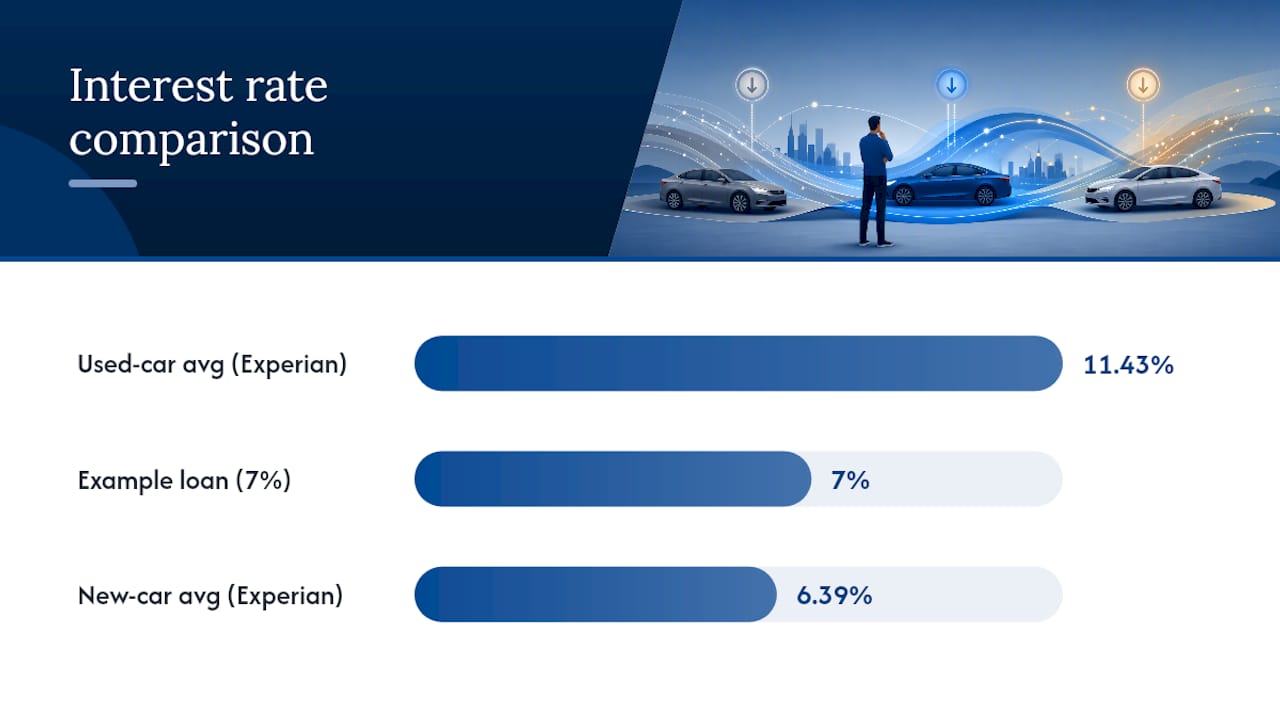
| Used-car rates run higher | Average used-car loan rates were near 11.43% in early 2026 versus 6.39% for new cars (Experian). |
| Title loans carry extreme risk | The CFPB reports APRs of 300%+ and roughly 1 in 5 borrowers losing their vehicle to repossession. |
| Autovendorsfl simplifies the process | Autovendorsfl assists luxury and used-vehicle buyers with financing, trade-ins, and inventory search in one place. |
Table of Contents
- What are the main types of auto loan structures?
- How do secured and unsecured auto loans actually differ?
- Where do auto loans actually come from?
- How loan pricing and repayment structure determine what you actually pay
- High-risk financing options and the red flags to know
- When does refinancing make sense, and how do lease buyouts work?
- How to choose the right loan structure for your situation
- Quick glossary of auto loan terms
- An honest perspective on dealership financing
- Financing assistance at Autovendorsfl
- Sources
What are the main types of auto loan structures?
Understanding the full range of financing options is the clearest way to avoid overpaying. Here is a concise reference for each structure, including who typically uses it and what it costs.
- Secured new-car loan: The vehicle is collateral. Experian's early-2026 data show average new-car loan rates near typical levels reported by Experian. Best for buyers with good-to-excellent credit who want the lowest possible APR.
- Secured used-car loan: Same collateral structure, but used-vehicle risk pushes average rates higher compared to new cars according to the same Experian data. Common for buyers purchasing a certified pre-owned or off-lease vehicle.
- Unsecured personal loan: No lien on the vehicle. Rates run higher than secured loans and approval typically requires strong credit. Useful when buying from a private seller whose title situation complicates a secured lien.
- Direct financing (bank, credit union, online lender): Buyer arranges the loan independently before shopping. Credit unions often price below banks for the same credit tier; how credit union auto loans differ from bank products is worth reviewing before you apply.
- Indirect / dealer-arranged financing: Dealer submits your application to a network of lenders and presents the best (or most profitable) offer. Convenient but potentially marked up above the lender's actual buy rate.
- BHPH (buy-here-pay-here): Dealer is the lender. Targets borrowers with low or no credit. Higher rates, shorter terms, and sometimes weekly payment schedules.
- Title loan: Borrower pledges a vehicle they already own outright. Extremely high APR and significant repossession risk. Covered in detail in the specialized-loans section below.
- Lease-buyout loan: Finances the residual value stated in a lease agreement at lease-end. Payments often rise compared to the lease because the loan covers a larger balance.
- Balloon loan: Lower monthly payments with a large lump-sum payment due at the end of the term. Useful for buyers who expect a windfall or plan to sell before the balloon is due.
- Subprime loan: Structured for borrowers with credit scores typically below 620. Higher APR and stricter terms; can be offered through banks, online lenders, or dealers.
- Private-party loan: Covers a vehicle purchased from an individual rather than a dealer. Many lenders cap the loan-to-value ratio more tightly and exclude taxes and registration fees from the loan amount.
- Refinance loan: Replaces an existing auto loan, ideally at a lower rate or shorter term.
Pro Tip: Subprime and BHPH loans can help you rebuild credit if payments are reported to the major bureaus. Before signing, confirm the lender reports to Equifax, Experian, and TransUnion.
How do secured and unsecured auto loans actually differ?
Most auto loans are secured, meaning the lender holds a lien on the vehicle until the loan is paid off. If you miss payments, the lender can repossess the car without going to court in most U.S. states. That legal shortcut is precisely why secured loans generally carry lower rates than unsecured alternatives: the lender's risk is bounded by the vehicle's resale value.
Unsecured personal loans used to buy a vehicle carry no lien. The lender's only recourse if you default is a lawsuit and a judgment, which is slower and less certain than repossession. Lenders price that extra risk into the rate, often several percentage points above a comparable secured loan. Approval also tends to require a higher credit score and a lower debt-to-income ratio.
A co-signer changes the math on both structures. Adding a co-signer with strong credit to a secured loan can push the rate down meaningfully, because the lender now has two sources of repayment and the vehicle as collateral. On an unsecured loan, a co-signer matters even more, since the vehicle itself provides no backstop.
Key differences at a glance:
- Collateral: Secured loans use the vehicle; unsecured loans use only your creditworthiness
- APR: Secured loans are typically priced lower for the same credit profile
- Repossession risk: Present on secured loans; absent on unsecured (though default still damages credit and triggers legal action)
- Approval threshold: Unsecured loans usually require stronger credit and lower debt-to-income ratios
- Co-signer impact: Reduces rate on both structures, but is especially valuable on unsecured loans where no collateral exists
Pro Tip: If your credit score sits in the mid-600s, a secured loan with a co-signer often beats an unsecured loan on rate, even if the co-signer's credit is only modestly better than yours.
Where do auto loans actually come from?
The financing source shapes the rate, the terms, and how much room you have to negotiate. There are five main channels.
Direct lenders include banks, credit unions, and online lenders. You apply before you shop, receive a preapproval letter, and walk into the dealership knowing your maximum rate. Credit unions tend to price competitively because they are member-owned and not profit-driven in the same way banks are. Online lenders often approve quickly and can be useful for borrowers with non-traditional credit profiles. Getting preapproved for luxury auto financing before you shop is one of the highest-leverage moves a buyer can make.
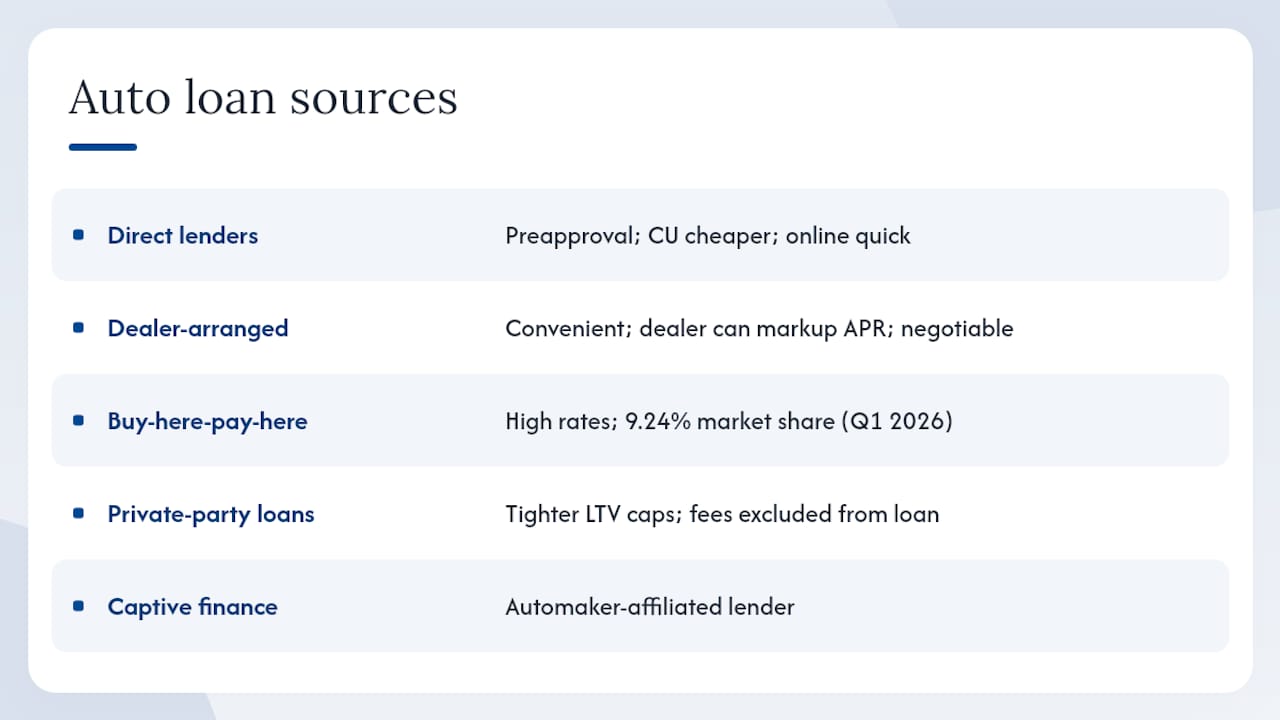
Dealer-arranged (indirect) financing is convenient but carries a structural conflict of interest. The dealer submits your application to a lender network, receives an approved "buy rate," and is typically allowed to mark that rate up before presenting it to you. The CFPB explicitly advises treating dealer-arranged financing as a negotiable product and using a bank or credit-union preapproval as a benchmark to expose any markup. The difference between the best and worst dealer-arranged offer for the same buyer can be several percentage points of APR.
Buy-here-pay-here dealers act as both seller and lender. As of Q1 2026, BHPH loans accounted for 9.24% of all U.S. auto loans. They serve borrowers who cannot qualify elsewhere, but the rates and fees reflect that risk. Weekly or bi-weekly payment schedules are common, and many BHPH lenders install GPS tracking or starter-interrupt devices on vehicles.
Private-party loans finance a purchase from an individual seller. Many lenders cap the loan-to-value ratio more tightly on private-party transactions, and most exclude taxes, registration fees, and title transfer costs from the loan amount. Budget for those costs separately.
Captive finance companies are the financing arms of automakers (think manufacturer-affiliated lenders).
Statistic callout: BHPH loans made up 9.24% of U.S. auto loans as of Q1 2026, a meaningful share of the market given that these loans typically carry the highest rates outside of title loans.
Pro Tip: Before visiting any dealership, get a preapproval in writing from a bank or credit union. Hand it to the finance manager and ask them to beat it. That single step is the most reliable way to expose dealer markups.
How loan pricing and repayment structure determine what you actually pay
Two loans with the same principal and the same stated rate can cost very different amounts depending on how interest is calculated and how payments are applied.
Simple-interest loans accrue interest daily on the outstanding principal balance. Every dollar you pay above the minimum reduces the principal immediately, which reduces the interest that accrues the next day. Investopedia confirms that simple-interest loans enable real savings from early principal payments. Most bank and credit-union auto loans use this structure.
Precomputed-interest loans calculate the total interest for the full loan term at signing and add it to the principal. Your payment schedule is fixed regardless of how fast you pay down the balance. Early payoff typically does not reduce the total interest you owe. This structure is more common in BHPH and some subprime products. For a deeper look at how deferred and precomputed interest mechanics work, the deferred interest auto financing guide covers the mechanics clearly.
A quick example illustrating the difference:
- Loan A: $20,000 at 7% simple interest over 60 months. Standard monthly payment is roughly $396. If you pay an extra $100 toward principal each month starting in month 1, you pay off the loan in about 50 months and save several hundred dollars in interest.
- Loan B: $20,000 at 7% precomputed interest over 60 months. The total interest ($3,761 at that rate) is fixed at signing. Paying extra each month does not reduce the total interest owed; it only shortens the time until the final payment.
APR vs. nominal rate is the other pricing distinction worth understanding. The nominal rate is the base interest rate. APR folds in fees, such as origination charges or dealer-arranged financing fees, to give a truer picture of annual cost. Always compare APRs across offers, not nominal rates.
Term length compounds everything. Experian's early-2026 data show average used-car loan rates near 11.43% versus 6.39% for new cars, so the term-length effect is even sharper on used-vehicle financing.
Pro Tip: Before signing, ask the lender whether the loan is simple-interest or precomputed, and confirm that extra payments apply to principal first, not to future interest or fees. Get that in writing.
High-risk financing options and the red flags to know
Some loan structures carry risks that go well beyond a high monthly payment. Three categories deserve specific attention.
Title loans are the highest-risk product in the auto-financing space. The borrower pledges a vehicle they already own outright as collateral for a short-term loan, typically 30 days. The CFPB reports that title loans can carry APRs of 300% or more, and estimates that roughly 1 in 5 title-loan borrowers ultimately has their vehicle repossessed for nonpayment. That is not a fringe outcome; it is a documented pattern. Title loans are best treated as a last resort, and only when no other credit source is available.
Buy-here-pay-here financing occupies a different risk tier. BHPH can be a legitimate path for borrowers with no other options, but the cost is real. Rates run well above bank or credit-union averages, terms are often shorter, and payment schedules are sometimes weekly rather than monthly. Some BHPH lenders do not report payment history to credit bureaus, which means on-time payments may not help rebuild your credit score. Confirm bureau reporting before you sign.
Subprime and dealer-arranged financing for thin-credit borrowers can trap buyers in negative equity quickly, especially when the loan term is long and the rate is high. Rolling negative equity from a trade-in into a new loan amplifies the problem. The risks of negative equity in auto trades are worth understanding before you finalize any trade-in.
Red flags to scan for before signing:
- APR above 25% on a standard purchase loan (not a title loan)
- Weekly or bi-weekly payment schedules with no monthly option
- Balloon payment due at the end of a short term with no refinance guarantee
- Refusal to provide written loan terms before you sign the purchase agreement
- Fees rolled into the loan that were not disclosed in the initial offer
- No confirmation that the lender reports to all three major credit bureaus
When does refinancing make sense, and how do lease buyouts work?
Refinancing replaces your current auto loan with a new one, ideally at a lower rate or a more favorable term. The timing matters. The best candidates for refinancing are borrowers whose credit score has improved since the original loan, or those who took a dealer-arranged loan at a marked-up rate and now qualify for a direct-lender rate.
Cash-out auto refinancing is possible when the vehicle carries positive equity, but it is often constrained because many borrowers owe close to the vehicle's current market value. Extracting cash through a refinance also increases the loan balance, which can push the loan-to-value ratio above what lenders will approve.
When refinancing typically makes sense:
- Your credit score has improved by 40 or more points since the original loan closed
- Market rates have dropped and your current rate is at least 1.5 percentage points above current averages
- You took a dealer-arranged loan and suspect a markup was added above the lender's buy rate
- You want to shorten the term to pay off the vehicle faster and reduce total interest
Lease-buyout loans finance the residual value stated in your lease agreement when the lease ends. The residual is the price the leasing company set for the vehicle at the start of the lease. If the vehicle's market value at lease-end is higher than the residual, buying it out can be a good deal. If the market value is lower, you are paying above market.
Steps for arranging a lease buyout:
- Request the residual value and any purchase-option fee from the leasing company at least 60 days before lease-end
- Get the vehicle independently appraised or check market values through a third-party pricing source
- Apply for a lease-buyout loan through a bank, credit union, or online lender (not all lenders offer this product)
- Compare the buyout loan's total cost against the cost of leasing or buying a comparable replacement vehicle
One practical note: monthly payments on a lease-buyout loan are almost always higher than the lease payment was, because the loan covers the full residual balance rather than just the depreciation portion.
How to choose the right loan structure for your situation
The decision framework is straightforward when you work through it in order.
Step-by-step checklist:
- Pull your credit report and score before you apply anywhere. Know your tier: excellent (720+), good (660–719), fair (620–659), or subprime (below 620). Your tier determines which structures are realistically available and at what rate.
- Set a total-cost limit, not just a monthly payment target. Calculate the total interest you will pay over the full term, not just whether the monthly payment fits your budget.
- Get preapproval from at least one direct lender (bank, credit union, or online lender) before visiting a dealership. This gives you a concrete benchmark and the negotiating leverage the CFPB recommends.
- Compare APRs across all offers, not nominal rates. Include any fees the lender charges.
- Confirm whether the loan is simple-interest or precomputed and whether extra payments apply to principal.
- Ask about prepayment penalties. Some lenders charge a fee for paying off the loan early.
- Verify what the loan covers. Private-party and many specialized loans exclude taxes, registration, and dealer fees. Plan for those costs out of pocket.
Questions to ask lenders and dealers:
- What is the buy rate, and is there a markup above it?
- Is this a simple-interest or precomputed-interest loan?
- How are extra payments applied: to principal, to future interest, or to fees?
- Is there a prepayment penalty?
- Does the loan amount cover out-the-door costs, or only the vehicle price?
- Do you report payment history to all three major credit bureaus?
Down payment guidance: A larger down payment reduces the loan-to-value ratio, which can lower your rate and improve approval odds. A common heuristic is the "$3,000 rule": putting at least $3,000 down on a used vehicle reduces the risk of going immediately underwater on the loan.
Co-signers can unlock better rates or approval when your credit profile alone does not qualify. The co-signer is equally liable for the debt, so both parties should understand the commitment before signing.
State-specific protections: Consumer protection rules for auto loans vary by state. Some states cap dealer markups or require specific disclosures. Check your state attorney general's website or your state's consumer protection office for rules that apply to your purchase.
Red flags:
- APR above 25% on a standard purchase loan
- Weekly payment schedules presented as the only option
- Refusal to provide written terms before signing
- Fees that appear only at the signing table
For a practical workflow that covers preapproval, trade-in prep, and signing, the time-saving car buying strategies guide walks through the full sequence.
Quick glossary of auto loan terms
- APR (Annual Percentage Rate): The true annual cost of a loan, including interest and fees, expressed as a percentage
- Simple interest: Interest calculated daily on the outstanding principal balance; extra payments reduce total interest owed
- Precomputed interest: Total interest calculated at signing and added to the principal; early payoff typically does not reduce total interest
- Principal: The original loan amount, excluding interest and fees
- Term: The length of the loan repayment period, typically expressed in months (36, 48, 60, 72, or 84)
- Balloon payment: A large lump-sum payment due at the end of a loan term after a series of smaller regular payments
- Buy rate: The interest rate a lender approves for a borrower before any dealer markup is added
- Dealer markup / reserve: The percentage points a dealer adds above the buy rate when presenting a loan offer; this is the dealer's profit on the financing
- BHPH (buy-here-pay-here): A financing arrangement where the dealership acts as the lender, typically for borrowers with low or no credit
- Title loan: A short-term, high-APR loan secured by a vehicle the borrower already owns outright
- Refinance: Replacing an existing loan with a new one, usually to obtain a lower rate or adjust the term
- Cash-out refinance: A refinance where the new loan exceeds the existing payoff amount, with the difference paid to the borrower in cash
- Lease buyout: Purchasing a leased vehicle at the end of the lease term, typically financed through a lease-buyout loan
- Private-party loan: A loan used to purchase a vehicle from an individual seller rather than a dealership
An honest perspective on dealership financing
Most buyers walk into a dealership focused on the vehicle and treat the financing as an afterthought. That sequencing costs money. The finance office is where dealerships often recover margin they gave up on the vehicle price, and the tools available to a finance manager, including rate markups, add-on products, and extended terms, are all designed to increase the total amount you pay.
That is not a criticism of dealerships as a category. It is simply how the business model works, and understanding it puts buyers in a much stronger position. The single most effective counter is a preapproval from a direct lender. The dealer can still offer a competitive rate through their lender network, but the markup ceiling is visible. One buyer who came through a dealership with a credit-union preapproval in hand ended up with a rate 1.8 percentage points below the dealer's initial offer, simply because the benchmark existed.
Dealerships that work with multiple lenders can genuinely find competitive rates for buyers, especially for luxury vehicles where captive finance companies sometimes offer favorable terms. The key is knowing the difference between a dealer who is working to find you the best rate and one who is presenting the most profitable offer first. Preapproval is the clearest way to tell the difference.
Disclosure: This perspective reflects general dealership financing dynamics. Autovendorsfl assists buyers with financing options as part of its vehicle-purchase process. The guidance above is intended to be impartial and educational.
Financing assistance at Autovendorsfl
Buying a luxury or premium used vehicle involves more moving parts than a standard transaction, and financing is often the most complex piece. Autovendorsfl simplifies that process by working with buyers directly on financing options alongside inventory search and trade-in valuation, so you are not left coordinating three separate conversations at once.
The team at Autovendorsfl brings hands-on experience with the financing structures that matter most for luxury buyers: secured purchase loans, lease-buyout financing, and dealer-assisted indirect financing where the goal is finding the most competitive rate available for your credit profile. Trade-in values are assessed as part of the same conversation, which means you can see the full picture of your purchase cost before committing.
If you are ready to explore inventory or want guidance on which financing structure fits your situation, visit Autovendorsfl to start the conversation.
Sources
The figures and guidance in this article draw on the following primary sources. Readers who want to verify specific numbers or read full regulatory guidance should consult these directly.
- Experian: Average car loan interest rates by credit score
- CFPB: Can I negotiate the interest rate on an auto loan with the dealer?
- Investopedia: Understanding the different types of auto loans
For state-specific consumer protections, check your state attorney general's website or your state's consumer protection office, as dealer markup rules and disclosure requirements vary significantly by state.
This article is general information, not a substitute for advice from a qualified financial advisor. Consult a qualified financial professional about your own circumstances before acting on anything here.