
How credit union auto loans differ from bank and dealership financing
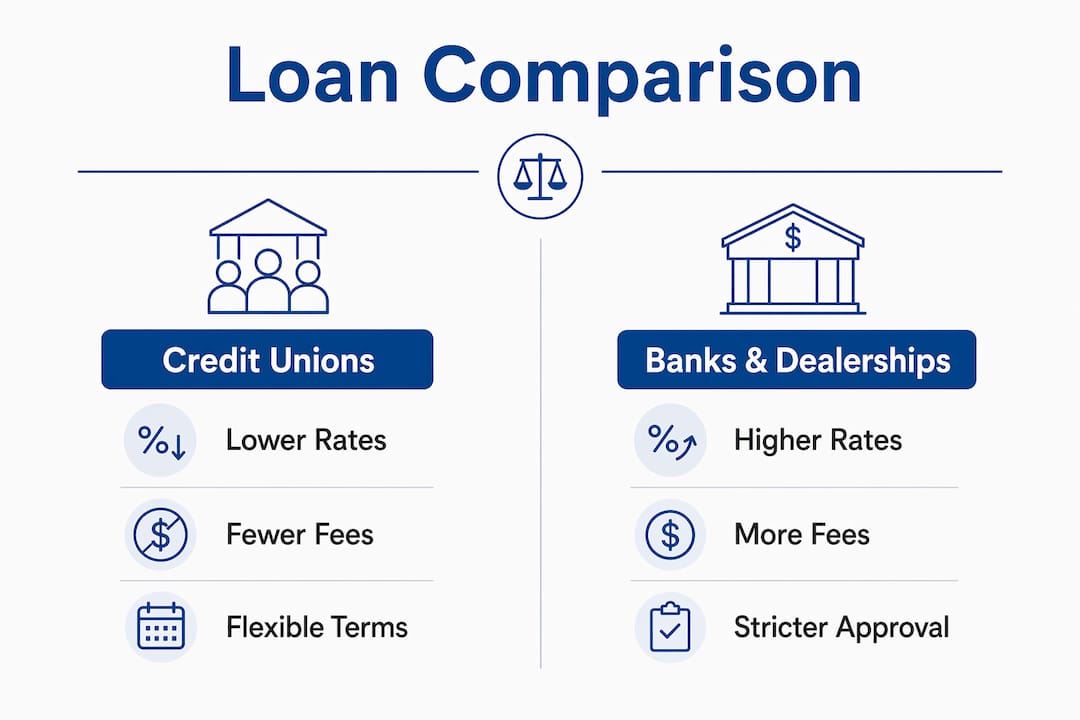
Credit union auto loans consistently deliver lower interest rates, fewer fees, and more borrower-friendly terms than banks or dealership financing. The core reason is structural: credit unions are not-for-profit cooperatives that return earnings to members as better loan pricing rather than distributing profits to shareholders. Banks answer to investors; dealerships answer to their finance and insurance departments. Credit unions answer to you.
Here is a quick side-by-side of the key differences:
| Factor | Credit Union | Bank | Dealership |
|---|---|---|---|
| Interest rates | Lower (avg. 6.51% APR for new cars) | Higher (avg. 7.92% APR for new cars) | Highest, often marked up |
| Fees | Minimal, rarely any prepayment penalty | Origination fees common | Add-ons and hidden fees frequent |
| Loan terms | 36–96 months, flexible | 36–72 months, standard | Varies, often inflexible |
| Approval criteria | Flexible for members, holistic review | Credit-score driven | Dealer-dependent, often strict |
| Customer service | Personalized, member-focused | Transactional | Sales-oriented |
| Private-party financing | Commonly available | Rarely offered | Not applicable |
Core differences at a glance:
- Credit unions average 6.51% APR on new-car loans versus 7.92% at banks, a gap that adds up to roughly $1,800 in savings on a $28,000, 60-month loan.
- No prepayment penalties at most credit unions, unlike many bank and dealership contracts.
- Membership is required before applying, which banks and dealerships do not require.
- Credit unions regularly finance private-party purchases, a service most banks either skip or charge a premium for.
- Underwriting tends to favor established members, often with more tolerance on credit scores.
Pros and cons of financing through credit unions, banks, and dealerships
Every lending source has a real case for it, depending on your priorities. Here is an honest breakdown.
Credit unions
- Pros: Lower APRs, minimal fees, no prepayment penalties, personalized service, flexible underwriting for members, private-party financing available.
- Cons: Membership required before applying; funding typically takes 24–72 hours after approval; fewer physical branches than major banks.
Banks
- Pros: No membership barrier, potentially faster same-day funding, existing relationship discounts possible, wide branch and ATM access.
- Cons: Higher average APRs, origination fees more common, underwriting is largely credit-score driven with less flexibility for borderline borrowers.
Dealership financing
- Pros: Convenient one-stop shopping, occasional manufacturer promotional rates (0% APR on select models), fast approval at the point of sale.
- Cons: Dealership financing often includes marked-up interest rates tied to kickbacks from lenders, aggressive upselling of add-ons like extended warranties and GAP insurance, and less transparency overall.
The cooperative model is the credit union's biggest structural advantage. Because there are no outside shareholders demanding returns, the savings flow directly to members as lower loan rates and better deposit yields. Banks operate on the opposite logic: profit margins on lending products support shareholder dividends. Dealership finance offices sit somewhere in between, but their incentive structure leans heavily toward maximizing revenue per transaction rather than finding you the best rate.

A detailed look at rates, terms, fees, and approval processes
Interest rates
The APR gap between credit unions and banks is not trivial in dollar terms. Per 2024 Experian data, banks average 7.92% APR on new-car loans while credit unions average 6.51%. On a $28,000 loan over 60 months, that 1.41-percentage-point difference translates to approximately $1,800 in total interest savings. Navy Federal Credit Union, for example, advertises new-car loan rates starting at 3.89% APR for qualified borrowers on terms up to 36 months.
| Lender type | Avg. new-car APR | Avg. used-car APR |
|---|---|---|
| Credit union | 6.51% | Higher, varies by age |
| Bank | 7.92% | Higher still |
| Dealership | Varies, often above bank rates | Varies |
Loan terms
Credit union auto loan terms typically run 36–72 months, with some institutions extending to 96 months. Experian data from 2024 puts the average new-car loan length at about 69 months. Longer terms lower your monthly payment but raise total interest paid, so a 96-month loan at a higher rate can cost more overall than a 60-month loan at a lower one. Banks generally cap terms at 72 months for standard loans, while dealership terms depend on the lender they route your application to.
Fees
Credit unions generally charge fewer fees and rarely impose prepayment penalties. Banks more commonly include origination fees and may charge for early payoff. Dealership contracts frequently bundle in add-ons, documentation fees, and dealer-arranged financing markups that are not always disclosed upfront.
Approval process
Credit unions use the same FICO credit reports as banks but often apply more flexible underwriting for members with a solid account history. An established member may qualify for the same APR tier with a credit score 20–40 points lower than what a bank would require. Banks run largely automated, score-driven approvals with less room for human judgment. Dealerships submit your application to multiple lenders simultaneously, which can result in multiple hard inquiries on your credit report.

Pro Tip: Get preapproved by your credit union before visiting a dealership. You will know your rate and budget in advance, and the dealer cannot use financing uncertainty as a negotiating lever.
How to choose the best auto loan for your specific needs
The right loan depends on your credit profile, timeline, and how much you value rate savings versus convenience. A few factors to weigh:
- Rate savings vs. speed. If saving money over the life of the loan is the priority, a credit union is usually the better path. If you need same-day funding, a bank or dealership may be faster.
- Membership eligibility. Many credit unions are open to anyone who lives, works, or worships in a specific area, or who belongs to a qualifying employer or association. Check eligibility before assuming you cannot join.
- Credit score. Borrowers with scores in the mid-600s often find credit unions more accommodating than banks, particularly if they have an existing account relationship.
- Loan term trade-offs. A longer term reduces monthly payments but increases total interest. Use a loan amortization calculator to see exactly what each term costs over its full life before committing.
- Private-party purchase. Buying from an individual seller rather than a dealership? A credit union is often the only realistic financing option, since most banks either decline or charge a premium for private-party loans.
- Refinancing potential. If you already have a high-rate loan from a dealership, a credit union is often the best place to refinance it down.
Key decision factors summarized:
- Compare total interest cost, not just monthly payment.
- Confirm credit union membership eligibility early in the process.
- Apply to at least two lenders to create a real comparison.
- Factor in funding timeline if you need the vehicle quickly.
- Ask specifically about prepayment penalties before signing.
Pro Tip: Applying to multiple lenders within a 14-day window typically counts as a single hard inquiry under FICO scoring models, so shopping around costs you nothing on your credit report.
For a broader look at car buying strategies that include financing tactics, Autovendorsfl covers the full picture.
What to expect from the credit union auto loan application process
Joining a credit union and applying for an auto loan involves a few more steps than walking into a bank, but the process is straightforward once you know what to expect.
Step-by-step application process
- Confirm eligibility. Check the credit union's field of membership. Common qualifiers include geographic area, employer, school affiliation, or family member who is already a member.
- Open a membership account. Most credit unions require a small deposit, often as little as $5–$25, to establish your share account. Online membership applications are now common, and some credit unions activate accounts within hours.
- Submit the loan application. Provide income documentation, proof of insurance, vehicle information (VIN, mileage, purchase price), and consent for a credit check.
- Receive a credit decision. Many credit unions return a decision within one business day; complex files may take longer.
- Review and sign loan documents. Documents can often be signed electronically or at a branch.
- Wait for funding. Funding typically takes 24–72 hours after approval, compared to same-day funding that banks with dedicated auto lending desks can sometimes offer.
- For private-party purchases, bring the vehicle title, a bill of sale, and a vehicle history report. The credit union will verify the vehicle's value before releasing funds.
Documents you will typically need:
- Government-issued photo ID
- Proof of income (pay stubs or tax returns)
- Proof of residence (utility bill or lease agreement)
- Vehicle information (year, make, model, VIN, odometer reading)
- Proof of auto insurance
- Bill of sale or purchase agreement
The customer service experience during this process tends to be more personal than at a bank. Credit union loan officers often have more authority to discuss your file directly, explain decisions, and work through documentation questions without routing you through a call center.
Expert insights on what makes credit union lending genuinely different
The not-for-profit charter is not just a marketing point. The NCUA confirms that credit unions return earnings to members through better loan rates and higher savings yields rather than distributing profits to outside investors. That structural difference shows up in every line of a loan agreement: lower APR, fewer fees, and terms written with the borrower in mind rather than the lender's margin.
Transparency is another area where credit unions pull ahead of dealership financing. The Consumer Financial Protection Bureau has documented that dealership finance offices frequently mark up interest rates through arrangements with lenders, a practice that is legal but rarely disclosed to the buyer. Credit unions do not operate on that model. The rate you are quoted is the rate the credit union earns, with no middleman markup.
On the access side, limited branch networks are the most common objection to credit unions, but the reality is more nuanced. Most credit unions participate in shared branching networks that give members access to over 5,000 branches nationwide. That footprint rivals many regional banks and makes the branch-access argument less compelling than it once was.
Underwriting flexibility is perhaps the least-discussed advantage. Credit unions use the same FICO scoring as banks, but established members often benefit from a more holistic review. A borrower with 18 months of consistent account activity and a 640 FICO score may qualify for the same APR tier that a bank would reserve for a 680. That leniency reflects the cooperative's interest in serving its membership rather than minimizing risk at every margin.
Additional benefits: discounts, rebates, and loyalty rewards
Beyond the base rate advantage, many credit unions offer benefits that banks and dealerships rarely match. These vary by institution but are worth asking about directly.
Rate discounts for automatic payments. Many credit unions reduce your APR by 0.25%–0.50% if you set up automatic payments from your credit union checking account. Over a 60-month loan, that discount adds up.
Loyalty pricing for long-term members. Some credit unions offer tiered rate discounts based on how long you have held an account or how many products you use. A member with a checking account, savings account, and prior loan history may qualify for a preferred rate tier unavailable to new members.
GAP coverage at lower cost. Guaranteed Asset Protection insurance, which covers the difference between what you owe and what your car is worth if it is totaled, is often available through credit unions at a fraction of what dealerships charge for the same product.
Debt protection programs. Some credit unions offer payment protection plans that suspend or cancel loan payments if you experience job loss, disability, or other qualifying hardships. These programs are typically priced more fairly than similar products sold through dealership finance offices.
Referral and community programs. Credit unions occasionally run member referral bonuses or community-focused promotions tied to local events, employer partnerships, or seasonal campaigns. These are not universal, but they reflect the cooperative model's orientation toward member benefit rather than profit extraction.
How refinancing works differently at credit unions
Refinancing an existing auto loan through a credit union is one of the most underused financial moves available to borrowers who originally financed through a dealership. If you signed a dealership contract at 9% or 10% APR and your credit has improved since then, a credit union refinance can meaningfully reduce both your monthly payment and total interest cost.
The process mirrors a standard auto loan application. You apply with your current loan details, the credit union pulls your credit, and if approved, it pays off the original lender and issues you a new loan at the lower rate. Most credit unions do not charge application fees for refinancing, and prepayment penalties on the original loan are worth checking before you proceed.
Timing matters. Refinancing in the first 12–24 months of a loan captures the most interest savings because early payments are weighted heavily toward interest under standard amortization. Waiting until year four of a five-year loan leaves little interest left to save.
Banks do offer refinancing, but their rates typically mirror what you would have gotten at origination. Dealerships do not refinance loans at all; once you drive off the lot, the finance office's role is done. The credit union's member-first model makes it the natural destination for borrowers looking to correct a high-rate loan they took in a hurry. For context on how dealership payment structures work and why they often leave room for refinancing, Autovendorsfl has covered that dynamic in detail.
Key Takeaways
Credit union auto loans consistently offer lower rates, fewer fees, and more flexible underwriting than banks or dealership financing, making them the strongest option for most borrowers who qualify for membership.
| Point | Details |
|---|---|
| Rate advantage | Credit unions average 6.51% APR on new-car loans versus 7.92% at banks, saving roughly $1,800 on a $28,000, 60-month loan. |
| Fee structure | Credit unions rarely charge prepayment penalties or origination fees, unlike most banks and dealership contracts. |
| Membership requirement | Joining requires a small deposit and eligibility check, but most Americans qualify through geography, employer, or family. |
| Funding timeline | Expect 24–72 hours for funding after approval, compared to potential same-day disbursement at banks. |
| Refinancing opportunity | Borrowers who financed through a dealership at a high rate can often refinance with a credit union at a significantly lower APR. |