The out-the-door price (OTD) is the single total you must pay to drive a car off the lot: vehicle price, plus every tax, title fee, registration fee, doc fee, and any add-ons you've agreed to. It's the number that matters, not the sticker price and not the monthly payment a finance manager quotes you.
MSRP is a starting point for negotiation. A monthly payment can be stretched over 72 or 84 months to look smaller while you pay more interest overall. OTD is the only figure that tells you the real cost of the transaction, which is why it should be the number you anchor every conversation to.
Before you ever walk into a dealership:
- Ask for the OTD price in writing, tied to a specific VIN.
- Confirm the vehicle is actually on the lot.
- Treat that written number as the price you're holding the dealer to when you arrive.
Key Takeaways
The out-the-door price protects buyers because it forces every tax, fee, and add-on into one number a dealer must justify in writing before you sign anything.
| Point | Details |
|---|---|
| OTD is the real total | It includes vehicle price, tax, title, registration, doc fees, and any agreed add-ons, not just the sticker number. |
| Get it in writing first | Email the dealer for a written OTD quote tied to a specific VIN before visiting the lot. |
| Budget roughly 10% extra | Set aside about 10% of the vehicle price for taxes, title, registration, and doc fees as a planning buffer. |
| Match the buyer's order | Verify the signed total, VIN, rebates, and financing terms exactly match your written OTD quote. |
| Choose transparency upfront | Autovendorsfl provides written OTD quotes and personalized vehicle-finding so the math is clear before you visit. |
Table of Contents
- What Makes Up the Out-the-Door Price
- How Do You Calculate an Out-the-Door Price Estimate?
- How Do You Negotiate Using the Out-the-Door Price?
- Which Fees Should You Challenge Before Signing?
- What Should You Verify Before Signing the Buyer's Order?
- Why Most Car-Buying Advice Undersells the Out-the-Door Number
- Get a Written Out-the-Door Quote Before You Ever Visit
- Where to Verify Fees and Learn More
- Sources
What Makes Up the Out-the-Door Price
The out-the-door price is built from several distinct pieces, and knowing which ones are fixed by government and which ones the dealer controls changes how you negotiate each line.
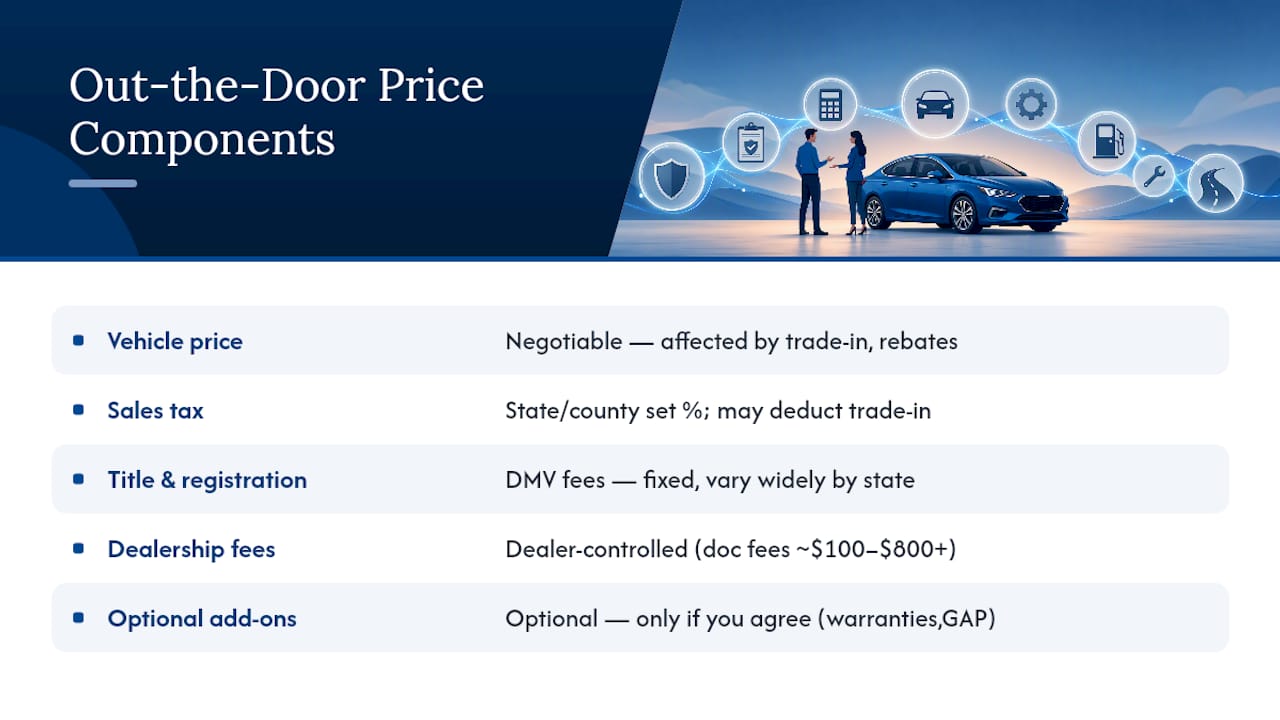
Vehicle price is the negotiated number before anything else gets added. It's affected by trade-in value, manufacturer rebates, and dealer discounts, and it's the only line item that's fully up for discussion.
Sales tax is set by your state and often your county or city, and it's calculated as a percentage of the taxable price. Many states let you subtract your trade-in value from the taxable base first, which lowers the tax bill. Others tax the full purchase price regardless of trade-in, so checking your state's own rules matters before you assume your math is right.
Title and registration fees go to your state's DMV. These are fixed, non-negotiable amounts, but they vary widely from state to state, sometimes by a factor of ten.
Dealership fees, like documentation charges, prep fees, or "market adjustments," are where things get murky. Doc fees alone commonly range from around $100 to $800 or more depending on the dealer and state, and some states cap them by law.
Add-ons like extended warranties, GAP insurance, and appearance packages are optional. They should never appear on your OTD total unless you specifically agreed to them.
Pro Tip: A reasonable planning buffer is about 10% of the vehicle's price set aside for taxes, title, registration, and doc fees. It won't be exact, but it keeps you from being blindsided.
How Do You Calculate an Out-the-Door Price Estimate?
You don't need a finance degree to build a reliable OTD estimate before you ever contact a dealer. The formula is straightforward:
OTD estimate = vehicle price + (vehicle price × local tax rate) + title fee + registration fee + doc fee + any add-ons you actually want.
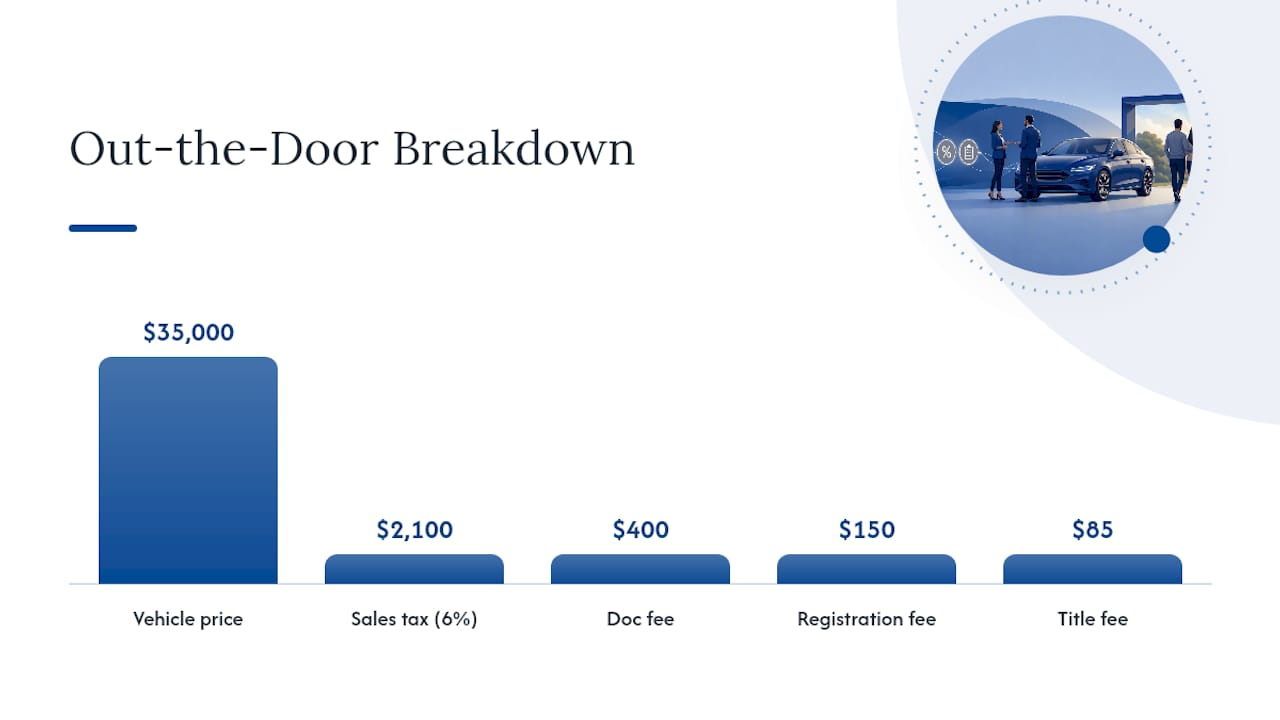
Here's how that plays out with round numbers. Say you're negotiating a $35,000 vehicle price, your local sales tax rate is 6%, your state's title fee is $85, registration runs $150, and the dealer's doc fee is $400.
- Vehicle price: $35,000
- Sales tax at 6%: $2,100
- Title fee: $85
- Registration fee: $150
- Doc fee: $400
- Estimated OTD total: $37,735
If you're trading in a car valued at $5,000 and your state taxes only the difference, your taxable base drops to $30,000, which lowers the tax line to $1,800 and the OTD total by roughly $300. That's real money, and it's why confirming your state's trade-in tax treatment before you negotiate is worth the ten minutes it takes.
Before you finalize your number, pull your exact title and registration fees from your state DMV's website and check your local sales tax rate through your state or county tax office. Generic online calculators get you close, but only your DMV has the exact figures for your address.
How Do You Negotiate Using the Out-the-Door Price?
Opening with an OTD target instead of a trade-in value or a monthly payment forces the dealer to work backward to a vehicle price, which makes any fee they try to slide in visible immediately. That's the core of why OTD anchoring works: it removes the dealer's ability to negotiate one number while quietly adjusting another.
A simple email before you visit does most of the heavy lifting:
- "I'm interested in [Year/Make/Model, VIN if listed]. Please send me your best out-the-door price in writing, including tax, title, registration, and all fees, with no add-ons."
- If a number changes at the desk: "This doesn't match the OTD quote I received on [date]. Can you show me where the difference is coming from?"
If a dealer won't put a number in writing, or the number at signing doesn't match what you were promised, that's your signal to walk. Screenshot the email, print it, and bring it with you. This isn't paranoia; it's just how you protect a large purchase.
Financing deserves the same scrutiny. Rebates and incentives should reduce your OTD total, but some carry eligibility restrictions, like financing through a specific lender, that must be spelled out before you sign. If a salesperson steers the conversation toward "What payment are you comfortable with?" redirect back to the total. A payment can be manipulated by stretching the loan term; the OTD total can't hide the same way, especially once you understand how dealer-arranged financing can quietly inflate what you owe.
Which Fees Should You Challenge Before Signing?
Some charges on a buyer's order are legitimate. Others are opportunistic, and knowing the difference saves you real money.
- Unrequested accessories: nitrogen-filled tires, VIN etching, or fabric protection you never asked for.
- Duplicate fees: the same charge listed under two different names on the same order.
- Unexplained "market adjustments": a markup with no clear justification tied to demand or scarcity.
- Doc fees above your state's cap: since some states regulate these, a quick check of your state DMV site tells you if a fee is out of bounds.
Behavior matters as much as line items. A dealer who won't provide an OTD quote in writing, claims the advertised vehicle "just sold" when you arrive, or introduces new financing terms at the last minute is showing you exactly what to watch for. The FTC's own guidance gives you a formal path if a dealer misrepresents price or eligibility; you're entitled to walk away and report it.
What Should You Verify Before Signing the Buyer's Order?
Run through this before you sign anything:
- Match the total. The buyer's order total should equal the OTD number you received in writing, dollar for dollar.
- Confirm the VIN and specs. Model, trim, and options should match exactly what you were quoted on.
- Check that discounts and rebates are listed. Any promised incentive needs to appear as a line item, not a verbal promise.
- Verify trade-in value and tax treatment. Make sure the trade-in allowance and its tax effect were applied correctly.
- Confirm add-ons are opt-in. Every optional product should carry your separate initials, not a blanket signature.
- If financing, check the APR, term, and total financed amount. These numbers should match what was discussed, with add-on products itemized separately.
Why Most Car-Buying Advice Undersells the Out-the-Door Number
Most advice on car buying treats OTD as a definition to memorize rather than a tool to wield. That's backward. The real value isn't knowing what OTD stands for; it's using it as leverage before you ever sit across from a salesperson.
Conventional wisdom tells buyers to "negotiate hard" on the sticker price, which is almost beside the point if the tax, fee, and add-on math gets rearranged later. I'd argue the smarter move is spending less time haggling over the vehicle price and more time locking in a written OTD number you can hold a dealer to. That single document does more work than any negotiating tactic.
What gets underestimated is how much the paperwork itself protects you. A buyer who shows up with a printed email and a firm number rarely gets surprised at the desk. A buyer who shows up ready to "see what they can work out" almost always does. If you're shopping for something with real value on the line, luxury or otherwise, that discipline matters even more, because the dollar swings on fees and add-ons scale right along with the price.
— Allen
Get a Written Out-the-Door Quote Before You Ever Visit
Autovendorsfl builds every deal around a written, itemized OTD quote instead of a sticker price and a promise. Reach out with the make, model, or trim you're considering, and you'll get a real number that reflects vehicle price, tax, title, registration, and doc fees before you set foot on the lot, not a moving target once you arrive.
Auto Vendors Inc in Fort Lauderdale specializes in curating luxury and premium used vehicles, and that focus comes with a personalized vehicle-finding service most volume dealers don't offer. If you already know your budget but haven't found the right car, the team can search by make, model, body style, and price on your behalf, and walk you through trade-in valuation and financing side by side with your OTD math, so nothing gets buried in a separate conversation later. Request an out-the-door quote through the Autovendorsfl inventory search and start the process with numbers you can trust before you negotiate a single dollar in person.
Where to Verify Fees and Learn More
Check your numbers against sources built for accuracy, not sales:
- FTC guidance on dealer ads and promotions for your rights before and during a visit.
- NerdWallet's OTD explainer for budgeting fundamentals.
- Autovendorsfl's guide to dealer red flags for warning signs before you sign.
- Trade-in tax treatment across state lines if you're comparing how different markets handle trade-in value.
Sources
- Car Dealer Ads and Promotions: Know Before You Go | Consumer Advice
- What Does ‘Out-the-Door’ Price Mean? - NerdWallet
- What to Know About a Car's Out the Door Price | Chase