
Rate shopping auto loans is a short, focused process: get a preapproval benchmark, compare three to four lenders within the credit-scoring shopping window, and choose the lowest total-cost offer, not the lowest monthly payment. Done this way, it is safe and often saves thousands over the life of a loan.
Here is what to do before you set foot on a dealer lot:
- Pull your credit reports and check your score at all three bureaus.
- Get one soft-pull prequalification from a credit union or online bank first.
- Apply to two or three more serious lenders within the same two- to three-week window.
- Compare APR and total cost across offers, not the advertised monthly payment.
That sequence, done in that order, is the entire playbook. Everything below explains why it works and how to execute each step without tripping over credit-score myths or dealer financing tricks.
Key Takeaways
Rate shopping auto loans works best when you secure one outside preapproval as a benchmark and compare three to four lenders' total cost within a single credit-scoring window.
| Point | Details |
|---|---|
| Shop within one window | Submit hard-pull applications within 14 to 45 days so inquiries get grouped as one. |
| Prequalify before you preapprove | Use soft pulls to preview rates, then reserve hard pulls for your top two or three lenders. |
| Compare total cost, not payment | A longer term lowers your monthly bill but often raises total interest by thousands. |
| Bring an outside benchmark to the dealer | An independent preapproval gives you a concrete rate the dealer has to beat. |
| Ask Auto Vendors Inc to compare offers | Auto Vendors Inc arranges dealer financing and will weigh it against any outside preapproval you bring in. |
Table of Contents
- How Rate Shopping Auto Loans Affects Your Credit Score
- Where to Find and Compare Current Auto Loan Rates
- What Is the Step-by-Step Process for Comparing Auto Loan Rates?
- What Determines the Rate a Lender Offers You?
- How Do You Compare APR, Monthly Payment, and Total Cost?
- What Are Typical Auto Loan Rates by Credit Tier?
- How Many Lenders Should You Compare, and When?
- What Should You Ask Lenders, and What Red Flags Should You Watch For?
- A Publisher Perspective From Auto Vendors Inc.
- Get a Transparent Financing Quote From Auto Vendors Inc.
- Frequently Asked Questions
- Sources
How Rate Shopping Auto Loans Affects Your Credit Score
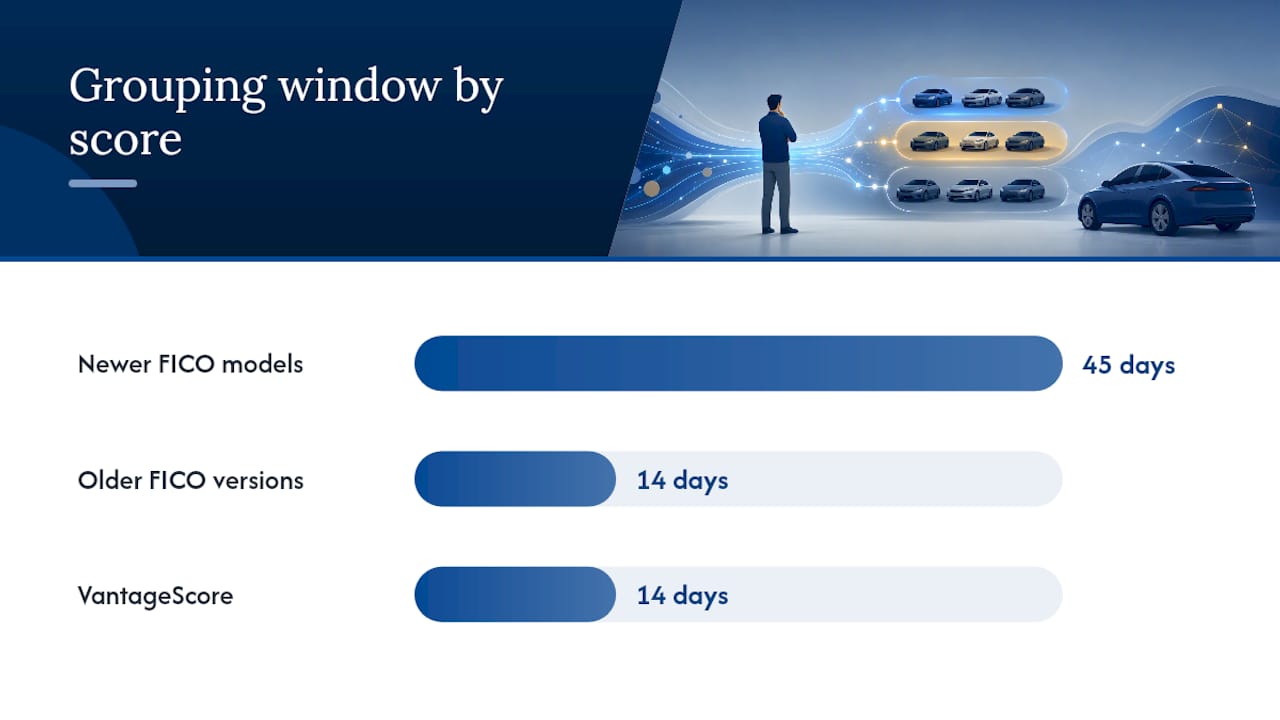
Short, focused rate shopping usually costs you only a few points, and those points typically come back within a couple of months. Credit scoring models were built to expect this behavior, so they group multiple auto loan inquiries made close together into a single event for scoring purposes.
The exact window depends on which score is being pulled. Experian explains that newer FICO models use a 45-day grouping window, older FICO versions use 14 days, and VantageScore uses a 14-day window. That is the range you will see referenced across the industry: 14 to 45 days.
Statistic Callout: Credit scoring models can treat multiple auto loan inquiries submitted within a short period as a single inquiry for scoring purposes, with the exact window varying by model.
There is a real distinction between two stages of the process, and it matters for your score:
- Prequalification usually relies on a soft pull, which does not affect your score and lets you preview rates.
- Preapproval or a full application typically triggers a hard pull, which is the type that gets grouped within the shopping window.
Pro Tip: Ask every lender directly, "Is this a soft pull or a hard pull?" before you submit anything. The CFPB recommends asking this outright, and a lender that cannot answer clearly is a lender to skip.
One catch: grouping only applies when inquiries are coded as auto-related. If you apply for a personal loan alongside your auto shopping, that inquiry stands alone and will not get grouped with the rest.
Where to Find and Compare Current Auto Loan Rates
Start with credit unions and online banks, then use a marketplace to widen your view, and treat dealer financing as one more quote to beat rather than your default choice. Each channel serves a different purpose in your search for the best auto loan rates.
- Credit unions like Navy Federal Credit Union, PenFed Credit Union, and Digital Federal Credit Union (DCU) often post some of the lowest APRs available, especially for members with strong credit.
- Online banks and lenders such as LightStream and Capital One let you prequalify in minutes with a soft pull, which is useful when you want a fast benchmark rate.
- Traditional banks like Bank of America extend competitive rates to existing customers, sometimes with relationship discounts for autopay or linked accounts.
- Marketplaces and aggregators like LendingTree, Autopay, and NerdWallet's lender directories let you compare several lenders' quotes side by side without submitting separate applications to each one.
- Dealer-adjacent retailers such as CarMax and Carvana bundle financing into the buying process, which can be convenient but is worth stacking against an outside offer.
Before you trust any quote, verify the lender is legitimate. Check NMLS Consumer Access to confirm licensing, and search the Better Business Bureau for complaint history. This takes five minutes and rules out the handful of predatory outfits that operate at the edges of the auto lending market.
What Is the Step-by-Step Process for Comparing Auto Loan Rates?
The process runs in six stages: prepare, prequalify, preapprove, compare, negotiate, and sign. Skipping the preparation stage is the single most common mistake shoppers make, because it leaves you negotiating against a dealer's numbers instead of your own.
- Check your credit reports at all three bureaus and fix any errors before you apply anywhere.
- Set a target price and loan amount based on the vehicle you actually want, not a rough guess.
- Get soft-pull prequalifications from two or three sources, credit unions, online banks, or a marketplace like LendingTree, to see a realistic rate range.
- Choose one or two lenders for full preapproval, which involves a hard pull, and submit those applications within the same window, ideally inside 14 days to stay safe across every scoring model.
- Bring your strongest outside preapproval to the dealer as your benchmark. Consumer Reports notes that dealers can mark up bank-quoted rates, so an outside offer gives you a concrete number to beat.
- Compare every offer on APR, term, fees, and total cost, using identical numbers across each one.
- Watch for add-ons like extended warranties or gap insurance folded into the loan, and ask whether the rate is locked or subject to change before signing.
- Sign only after your outside preapproval and the dealer's counteroffer are both in hand, so you can pick the better one on the spot.
Pro Tip: Screenshot or save a PDF of every quote the moment you receive it, including the date, APR, term, and any conditions attached. Rate offers often expire or shift, and having a paper trail keeps lenders honest when you're comparing three or four offers a week apart.
If you have not pulled your credit report in the last few months, that is genuinely the first move. A free report shows you exactly where you stand before a single lender sees your file, and it often reveals errors worth disputing before you shop.
What Determines the Rate a Lender Offers You?
Your credit score, the loan term, and the vehicle's age are the three factors that move your auto loan interest rate the most. Everything else, down payment, debt-to-income ratio, and lender-specific discounts, adjusts the rate at the margins.
- Credit score is the single biggest lever. Borrowers in the top tiers routinely see rates several points lower than those in subprime ranges.
- Loan term cuts both ways. A long term auto loan like an 84 month car loan lowers your monthly payment but stretches out interest charges and raises your risk of owing more than the car is worth.
- Vehicle type and age matter because used cars and older models typically carry higher rates than new ones, reflecting the lender's added risk.
- Down payment size reduces the loan amount and can nudge your rate down slightly by lowering the lender's exposure.
- Discounts for autopay enrollment or credit union membership, common at lenders listed on LendingTree, can shave a meaningful chunk off your APR.
Pro Tip: If your first round of quotes comes back higher than expected, try increasing your down payment by even a few hundred dollars or shortening the term by 12 months before you assume your credit is the problem. Small adjustments to the loan structure often move the needle more than another round of shopping.
How Do You Compare APR, Monthly Payment, and Total Cost?
Always compare the APR and the total of all payments, never the monthly payment alone. A lower payment can hide a far more expensive loan once you stretch the term.
Here is a worked example using a $35,000 loan, a common price point for a used luxury sedan:
Offer C looks the most attractive on the showroom floor because the payment is smallest. It is also the most expensive loan of the three, costing $3,700 more in interest than Offer A despite carrying the same APR. That is the trap of extending a car loan term purely to shrink the payment.

The monthly payment comes from a standard amortization formula: payment equals the loan amount times the monthly interest rate, divided by one minus (one plus the monthly rate) raised to the negative power of the number of payments. You do not need to run this by hand. Capital One's calculator and most bank sites do it instantly, but it defaults to 60 months, so reset the term manually every time you plug in a new offer or you will end up comparing apples to oranges.
Pro Tip: On a $35,000, 60-month loan, a 1% swing in APR changes total interest by roughly $900 to $1,000. That single percentage point is worth fighting for, and it's exactly what an outside preapproval gives you leverage to negotiate.
What Are Typical Auto Loan Rates by Credit Tier?
New-car loans generally carry lower APRs than used-car loans at every credit tier, and the gap between superprime and subprime borrowers can span 10 percentage points or more. Where your quote lands tells you quickly whether a lender is offering something competitive or padding their margin.
These ranges reflect the kind of marketplace snapshots you will see on rate-tracking sites like Autoloanrate, and they shift with broader interest rate conditions, so treat them as a reference point rather than a guarantee.
Statistic Callout: Refinance rates often track closely with new-purchase APRs for the same credit tier, which makes refinancing worth a look if your original loan was written when rates were higher.
Your actual offer depends on the specific lender, your debt load, and the vehicle itself, so a quote that lands outside these ranges is not automatically wrong. It is a signal to ask why.
How Many Lenders Should You Compare, and When?
Compare three to four serious lenders, and keep every hard-pull application inside one focused window, 14 days if you want safety across every scoring model, up to 45 days if you are using a newer FICO score exclusively.
- Three to four offers give you enough spread to spot a genuinely competitive rate without burning weeks on redundant applications.
- Going beyond four lenders rarely turns up meaningfully better terms and just adds paperwork.
- Applying in a tight cluster, rather than spacing applications out over months, is what keeps inquiries grouped together on your report.
Timeline Callout: Experian confirms that potential interest savings from comparing several lenders typically outweigh the minor, temporary score dip from clustered hard inquiries, provided the shopping happens inside the grouping window.
What Should You Ask Lenders, and What Red Flags Should You Watch For?
Prioritize four questions with every lender: the APR, the total of payments, the fees included, and whether the rate is locked. Vague or evasive answers on any of these are your cue to move on.
- "Is this quote a soft pull or a hard pull?"
- "Is this APR locked, and for how long?"
- "What fees are rolled into this quote, and can I see them itemized?"
- "Is there a prepayment penalty if I pay this off early?"
Watch for these red flags before you sign anything:
- No clear APR disclosed, only a monthly payment.
- Vague or shifting answers about fees.
- Pressure to add extended warranties or insurance products on the spot.
- An unusually high required down payment with no clear justification.
- Insistence that you must finance through the dealer to get the advertised price.
A Publisher Perspective From Auto Vendors Inc.
We see the same pattern play out on our lot every week: buyers who arrive with an outside preapproval negotiate from a position of strength, and buyers who don't often end up accepting the first number a finance office quotes them. That is why our team treats an outside offer as a starting point for a real conversation, not an obstacle. Our approach to dealer-arranged financing works the same way we'd advise any shopper to work: compare, then decide.
Pro Tip: Bring your preapproval letter printed or saved on your phone, with the APR and term clearly visible, so our finance team can respond to your actual number instead of a vague "I got a better rate somewhere else."
Get a Transparent Financing Quote From Auto Vendors Inc.
Auto Vendors Inc arranges dealer financing on every vehicle we sell, and we'll compare it directly against whatever outside preapproval you bring in the door. That's the real advantage here: you're not stuck choosing between a dealer's opaque number and a bank's generic offer. You get both, side by side, before you commit to anything.
We're upfront about fees and encourage every buyer to compare APR and total cost, not just the payment we quote you. If you're shopping our inventory of pre-approval luxury auto financing options, bring your outside rate with you and we'll tell you plainly whether we can beat it. Ready to see what that looks like for the vehicle you have in mind? Get a personalized financing quote and start the comparison today.
Frequently Asked Questions
Does rate shopping for an auto loan hurt my credit score? It causes a small, temporary dip at most. Multiple hard inquiries made within the same short window, typically 14 to 45 days depending on the scoring model, are usually grouped as a single inquiry.
What's the difference between prequalification and preapproval? Prequalification typically uses a soft pull and gives you an estimated rate with no credit impact. Preapproval usually involves a hard pull and a firmer offer, so ask the lender directly which type they're running before you apply.
How many lenders should I compare before choosing an auto loan? Three to four serious lenders is generally the practical limit. Beyond that, additional applications rarely produce a meaningfully better rate and just add more paperwork to sort through.
Is a 72 month auto loan or 84 month car loan a bad idea? Not automatically, but stretching the term to lower your payment usually raises total interest and increases the odds you'll owe more than the car is worth for a stretch of the loan.
Where should I start looking for the best auto loan rates? Start with a credit union or online bank for a soft-pull benchmark, then check a marketplace for a wider comparison, and bring your strongest offer to the dealer as leverage.
This article is general information, not a substitute for advice from a qualified financial advisor. Consult a qualified financial professional about your own circumstances before acting on anything here.
Sources
Use each of these for a specific job, not as a catch-all research stop.
- Where to Shop for a Car Loan - Consumer Reports
- Multiple Inquiries When Shopping for a Car Loan - Experian
- How will shopping for an auto loan affect my credit? - CFPB