
Borrowers with prime or super-prime credit scores, generally 661 and above on VantageScore or 670 and above on the base FICO scale, typically qualify for the lowest auto loan APRs. Experian's data from Q1 2026 shows the average VantageScore for new-car borrowers was 751, while used-car borrowers averaged 682. The practical consequence is significant: Bankrate's early 2026 market tables show new-car loans averaging about 6.39% APR and used-car loans averaging about 11.43% APR across all tiers, but those averages mask a wide spread between super-prime and subprime borrowers.
Key benchmarks used throughout this article:
- Experian and VantageScore for credit-tier definitions and average applicant scores
- Bankrate for current APR market averages by credit tier
- CFPB (consumerfinance.gov) for consumer rights guidance on cosigners and underwriting
If your score sits in the prime or super-prime range, applying now makes sense. If you're below 661, consider improving your score first, adding a co-signer, increasing your down payment, or shopping credit unions before you submit a formal application.
Key Takeaways
A prime or super-prime credit score, generally 661 or above on VantageScore, gives you the strongest position for auto loan approval and the lowest available APRs, but credit score is only one of four underwriting pillars lenders evaluate.
| Point | Details |
|---|---|
| Score band for best rates | Prime (661+) and super-prime (781+) borrowers typically qualify for the lowest APRs on new and used vehicles. |
| Four underwriting pillars | Lenders weigh DTI, LTV/down payment, vehicle age, and loan term alongside your credit score. |
| Shop with preapproval | Get offers from at least three lender types and compare written APR, total finance charge, and total of payments. |
| Cosigner responsibility | A cosigner improves approval odds for scores below ~670 but assumes full legal liability for the debt under CFPB guidance. |
| Autovendorsfl financing help | Autovendorsfl connects Fort Lauderdale buyers to personalized financing assistance and transparent loan comparisons. |
Table of Contents
- How your auto loan credit score is actually calculated by lenders
- Is there a minimum credit score to buy a car?
- Sample APR benchmarks and what they cost on a $30,000 loan
- What lenders look at beyond your credit score
- How to improve your credit before applying for an auto loan
- How a cosigner changes your auto loan approval odds and risks
- How to shop for the best auto loan and use preapproval effectively
- A practical note on working with buyers across the credit spectrum
- Autovendorsfl can help you connect financing to the right vehicle
- Sources
How your auto loan credit score is actually calculated by lenders
Most consumers check their score through a monitoring app and assume that number is what a lender sees. It often isn't. Experian explains that lenders may pull a base FICO score, a FICO Auto Score (an industry-specific model), or a VantageScore, and the bureau they pull from can vary too.
The three models work differently:
- Base FICO (Score 8 or Score 9): The most widely used general-purpose model, scored 300–850.
- FICO Auto Score: An industry-specific version that places heavier weight on your history with auto installment loans. Some versions use a 250–900 scale, so a "good" number looks different than on the standard 300–850 range.
- VantageScore 3.0 / 4.0: A competing model developed jointly by the three major bureaus (Equifax, Experian, TransUnion), also scored 300–850. Many free monitoring tools display this score.
The gap between your monitoring-app score and the lender's pull can easily be 20–40 points, sometimes more, depending on which bureau the lender queries and which model version they use. A borrower who sees 720 on their app might find the dealer's lender pulled a FICO Auto Score of 695 from a different bureau.
Pro Tip: Before applying, ask any prospective lender which scoring model and which bureau they use. Most will tell you. That single question lets you pull the right version of your report and check for errors before the hard inquiry hits.
Is there a minimum credit score to buy a car?
There is no universal minimum. Every lender sets its own cutoffs, and some subprime and deep-subprime lenders will approve buyers with scores well below 600, though at substantially higher rates and stricter terms. The more useful frame is understanding the tier system lenders commonly use.
Standard credit tiers for auto lending (using VantageScore ranges as a reference):
- Super-prime: 781–850. Best available rates, minimal documentation scrutiny.
- Prime: 661–780. Competitive rates, standard approval process.
- Near-prime: 601–660. Higher rates, lenders may require a larger down payment.
- Subprime: 501–600. Significantly higher APRs, stricter loan-to-value limits.
- Deep subprime: 300–500. Approval is possible but often requires a large down payment, a cosigner, or both.
The distinction between "approval" and "good terms" matters here. A lender might approve a 580-score borrower, but the APR could be double or triple what a 720-score borrower pays on the same vehicle. That gap translates directly into hundreds of dollars per month and thousands over the loan life.
Credit score tier boundaries can create sharp pricing cliffs, where slipping a few points below a cutoff produces a disproportionate rate jump. Being at 662 versus 659 can mean the difference between prime and near-prime pricing on the same loan.
Pro Tip: If your score is within 10–15 points of a tier boundary, pull your credit report from AnnualCreditReport.com and look for quick fixes before applying. A single corrected error or a paid-down card balance can push you across the line.
Sample APR benchmarks and what they cost on a $30,000 loan
APR benchmarks give you a reference point for judging whether a lender's offer is reasonable. The table below uses Bankrate's early 2026 market data as a guide. These are market averages, not guarantees. Your actual rate depends on loan term, vehicle age, loan-to-value ratio, and the specific lender.
| Credit Tier | VantageScore Range | Sample New-Car APR | Sample Used-Car APR |
|---|---|---|---|
| Super-prime | 781–850 | ~5.0% | ~7.5% |
| Prime | 661–780 | ~6.5% | ~9.5% |
| Near-prime | 601–660 | ~9.5% | ~13.5% |
| Subprime | 501–600 | ~13.0% | ~18.5% |
| Deep subprime | 300–500 | ~15.0%+ | ~21.0%+ |
To put those numbers in context, consider a $30,000 new-car loan over 60 months. At typical prime-tier APRs, the monthly payment and total interest are lower, while at higher subprime APRs, the monthly payment and total interest are considerably higher, leading to significant differences in total cost over the life of the loan for the same vehicle.
Loanyzer notes that APR benchmark tables are a market guide, not a guarantee, and that the only fair comparison is written APRs for the same vehicle, the same term, and the same amount financed. A lower monthly payment achieved by stretching the term from 60 to 72 months can easily cost more in total interest than a higher-rate 60-month loan.
What lenders look at beyond your credit score
Credit score is one input in a multi-factor underwriting decision. Lenders weigh four additional pillars that can move your rate or approval status even when your score is solid.
Debt-to-income ratio (DTI). Cornell Law defines DTI as your total monthly debt payments divided by your gross monthly income. A borrower with a 700 score but a 50% DTI may get pushed into near-prime pricing because the lender sees limited repayment capacity. Most auto lenders prefer DTI below 45%, though thresholds vary.
Loan-to-value ratio (LTV) and down payment. LTV compares the loan amount to the vehicle's market value. A higher down payment lowers LTV, which reduces the lender's risk if the vehicle depreciates quickly. Putting 10–20% down often improves rate offers and can offset a weaker score. For buyers trading in a vehicle with negative equity, that rolled-in balance raises LTV and can trigger stricter terms.

Vehicle age and condition. Used vehicles, especially those over 5–7 years old or with high mileage, carry higher collateral risk. Lenders typically charge higher rates on older vehicles and may cap loan terms. A 10-year-old car may only qualify for a 48-month term where a new car qualifies for 72 months.
Loan term. Longer terms lower monthly payments but increase total interest and keep the borrower "upside down" on the loan longer. Some lenders price longer terms at slightly higher APRs to compensate for extended risk exposure.
Pro Tip: Of the four pillars, down payment is usually the fastest to change before applying. Saving an additional $2,000–$3,000 can meaningfully lower your LTV and sometimes push your offer into a better rate tier, even without touching your credit score.
How to improve your credit before applying for an auto loan
Timing matters. The steps below are ordered by how quickly they typically produce results, not by how easy they are.
-
Pull your credit reports now (30–90 days before applying). Request free reports from all three bureaus at AnnualCreditReport.com. Errors, duplicate accounts, and outdated negative items are more common than most people expect, and disputing them takes 30–45 days to resolve.
-
Pay down revolving balances (weeks to months). Credit utilization, the ratio of your card balances to your credit limits, is one of the fastest-moving score factors. Getting utilization below 30% on each card, and ideally below 10%, can produce meaningful score gains within one to two billing cycles.
-
Avoid new credit applications (60 days before applying). Each hard inquiry from a new credit card or personal loan application can trim a few points from your score. Hold off on any new credit until after your auto loan closes.
-
Correct reporting errors (30–90+ days). If a bureau shows a late payment that was actually on time, or an account that isn't yours, file a dispute directly with that bureau. The process takes time, but a removed derogatory mark can produce a significant score jump.
-
Save a larger down payment (timeline varies). As noted above, a bigger down payment lowers LTV and reduces lender risk. It also reduces the amount financed, which lowers total interest regardless of APR.
Experian notes that reducing revolving utilization and correcting reporting errors tend to produce the largest, fastest score gains before an application. Payment history improvements, by contrast, require sustained on-time behavior over months to show meaningful movement.
If your score needs significant work, delaying the purchase by three to six months can save thousands in interest. Reviewing time-saving car buying strategies in advance helps you use that waiting period productively so the purchase process moves quickly once your score improves.
How a cosigner changes your auto loan approval odds and risks
A cosigner with strong credit can unlock approval or meaningfully lower the APR for a borrower with a thin file or a score below 670. The mechanism is straightforward: the lender evaluates both the borrower and the cosigner's credit history, income, and DTI, then prices the loan based on the stronger combined profile.
CFPB guidance is direct on the legal reality: a cosigner is fully legally responsible for the entire debt. If the primary borrower misses payments, the lender can pursue the cosigner for the full balance. Every missed payment appears on the cosigner's credit report, and the loan balance counts against their DTI, which can limit their ability to borrow for their own needs.
Key considerations for both parties:
- Cosigners are most helpful when the primary borrower's score is below roughly 670 or when the borrower has a thin credit file with limited history.
- The cosigner's own credit and income must be strong enough to satisfy the lender's underwriting standards independently.
- If the primary borrower later wants to remove the cosigner, refinancing is typically the only option, and that requires the borrower to qualify on their own at that point.
Alternatives worth considering before asking someone to cosign:
- A larger down payment to reduce LTV and lender risk
- A secured loan or credit-builder product through a credit union to establish history first
- Waiting three to six months to improve the primary borrower's score independently
Pro Tip: If you do use a co-signer, set up autopay from day one. A single missed payment affects both credit files simultaneously, and rebuilding that trust with a cosigner is harder than the financial repair.
How to shop for the best auto loan and use preapproval effectively
Preapproval is the single most useful tool a buyer has before walking into a dealership. It establishes a rate benchmark, gives the buyer negotiating leverage, and clarifies the budget before emotions enter the picture. This guide to preapproval for auto financing walks through the full process in detail.
The shopping process, step by step:
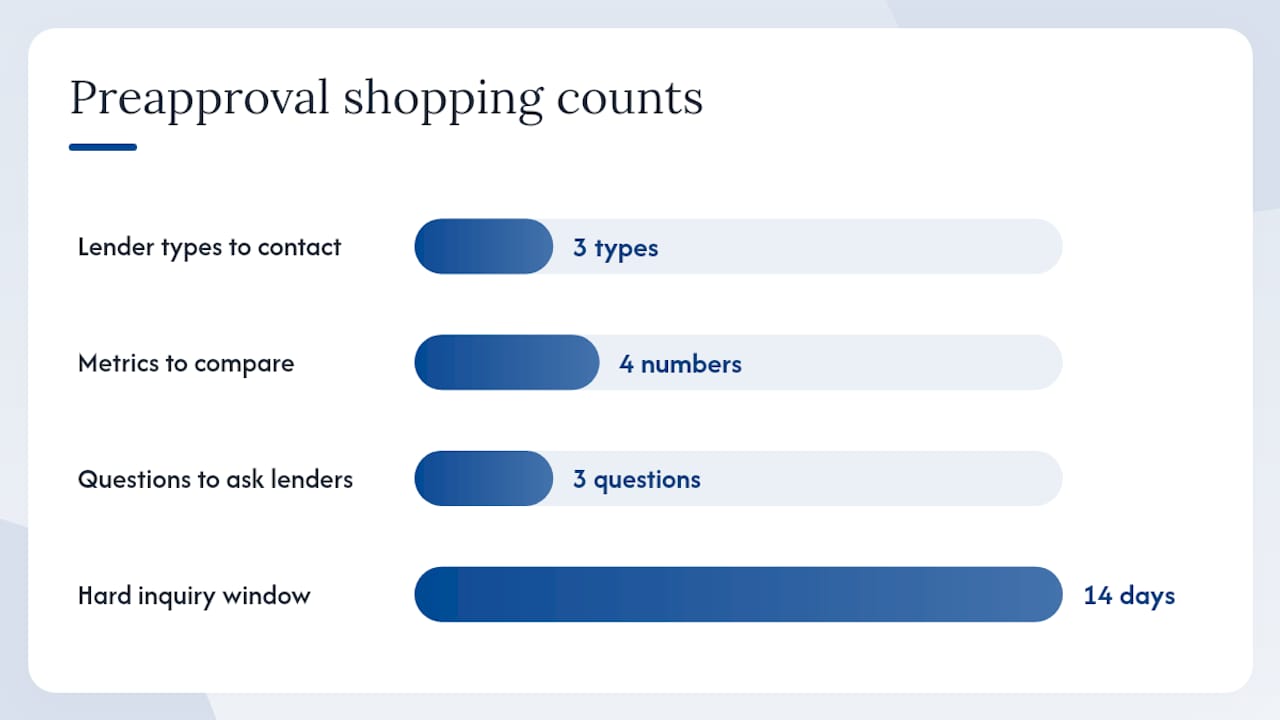
- Get preapproval offers from at least three lender types: a bank where you have an existing relationship, a credit union (which often offers relationship-based pricing), and an online lender. Credit unions frequently underwrite differently than banks and may offer lower rates to members with modest scores.
- Compare written offers on four numbers: APR, amount financed, total finance charge, and total of payments. Monthly payment alone is not a fair comparison because it changes with term length.
- Submit all applications within a 14-day window. Most FICO scoring models treat multiple auto-loan hard inquiries within that window as a single inquiry, protecting your score during rate shopping. Confirm this window with each lender before applying.
- Bring your best preapproval offer to the dealer. Dealer financing can be competitive, but it can also include a dealer reserve markup on top of the lender's rate. Ask the finance manager for the buy rate (the lender's actual rate before markup) in writing.
Questions to ask every lender before signing:
- Which credit score model and which bureau will you pull?
- Are any add-on products (GAP insurance, extended warranty) financed into the loan amount?
- What is the total finance charge over the full term?
Pro Tip: Compare APR to APR, not APR to monthly payment. A dealer who quotes a lower monthly payment by extending the term from 60 to 72 months may be offering a worse deal overall. Loanyzer's APR benchmark guidance recommends controlling for the same term and amount financed when evaluating competing offers.
A practical note on working with buyers across the credit spectrum
Working alongside buyers at different credit stages, one pattern stands out: the borrowers who get the best outcomes are the ones who arrive with a preapproval in hand and a clear sense of their own numbers. They know their score, their DTI, and their realistic down payment. That preparation shifts the entire conversation from "what can I afford monthly" to "what is this loan actually costing me."
At Autovendorsfl, the team works with buyers across a wide range of credit profiles, helping them understand how their financing options connect to the specific vehicle they want. Whether that means walking through preapproval paperwork, explaining how a trade-in affects LTV, or helping a buyer weigh the cost of waiting to improve their score versus buying now, the goal is always a transparent comparison.
Autovendorsfl can help you connect financing to the right vehicle
Choosing the right car and the right loan are decisions that work best together, not separately. At Autovendorsfl in Fort Lauderdale, the team helps buyers understand how their credit profile connects to their financing options before they commit to a vehicle. Whether you're working through preapproval paperwork, evaluating how a trade-in affects your loan-to-value ratio, or simply trying to understand what a written APR offer actually means, the dealership's hands-on approach gives you a clear picture rather than a confusing stack of numbers.
Autovendorsfl specializes in quality used and luxury vehicles, and the financing assistance offered is designed to match the right buyer to the right terms, not just the right car. Final loan terms are determined by third-party lenders based on your individual credit profile and underwriting criteria. Autovendorsfl does not guarantee specific APRs.
Visit Autovendorsfl to browse current inventory or reach out directly for personalized financing assistance.
Sources
The figures and guidance in this article draw from the following sources. Because market rates change, check current APR tables before applying.
- What Is a Good Credit Score for an Auto Loan? — Experian
- Average auto loan interest rates by credit score — Bankrate
- Auto loan rates by credit score in 2026: How to read APR benchmarks — Loanyzer
- Why would I need a co-signer for an auto loan? — CFPB
This article is general information, not a substitute for advice from a qualified financial advisor. Consult a qualified financial professional about your own circumstances before acting on anything here.