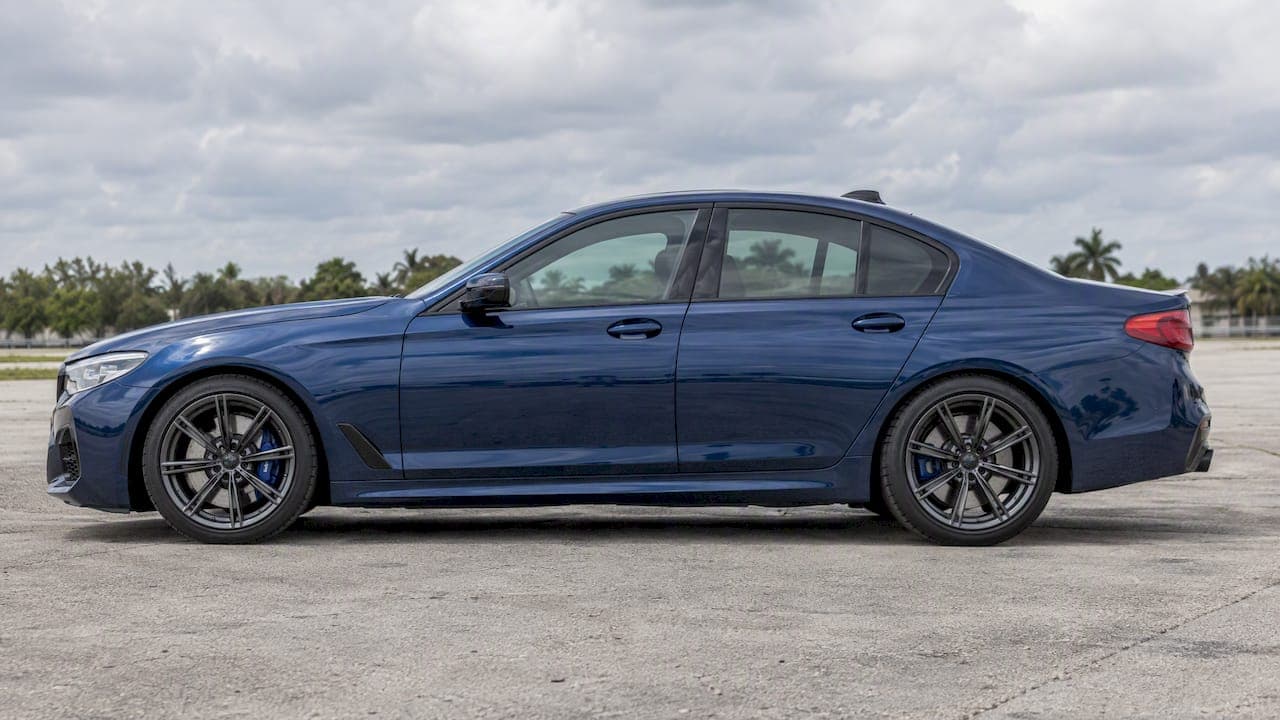
For most drivers, a square setup is the better choice: the same wheel and tire size on all four corners, which lets you rotate tires, spread wear evenly and keep costs predictable. A staggered setup, with wider tires at the rear, earns its place mainly on high-powered rear-wheel-drive performance cars, where the extra rubber helps put power down. If you drive an all-wheel-drive or front-wheel-drive car, or you simply commute and run errands, square is almost always the sensible answer.
This guide explains how each setup works, what it does to handling, tire life and budget, and how to read the tire sizes on a used luxury car before you buy it.
TL;DR
- Square means identical wheels and tires at all four corners. It allows front-to-rear rotation, wears predictably and suits AWD, FWD and daily driving.
- Staggered means wider wheels and tires on the rear axle. It adds rear grip and a sportier stance on powerful RWD cars, but you cannot rotate front to rear.
- Expect rear tires on a staggered car to wear out faster than the fronts, so budget for replacing them in pairs by axle.
- On AWD cars, tire size and tread depth must stay closely matched, or the drivetrain can pay for it.
- Buying used? Read the tire sizes on the car, check the owner's manual, and price a full replacement before you sign.
Table of Contents
- What square and staggered actually mean
- How each setup changes the way a car drives
- Rotation and wear: where the money goes
- Square vs. staggered at a glance
- What about AWD cars?
- Quirks of staggered cars many buyers miss
- Which setup suits which driver
- Our perspective: read the tires before you read the price
- Shopping for a used car with the right setup
- Frequently asked questions
- Sources
What square and staggered actually mean
A square fitment is one where all four wheels share the same diameter, width and offset, so all four tires are the same size. That is how the vast majority of cars leave the factory.
A staggered setup runs different sizes front and rear. Typically the wider wheels and tires sit on the driven axle, which on most staggered cars means the rear. A common illustration from a national tire retailer is 245-width tires up front and 275-width tires in back. Some cars also stagger wheel diameter, though that is less common on street cars.
The word to remember is stagger: the difference between front and rear. It can be a width difference, a diameter difference or both. A car with 18-inch wheels all around is square even if you change the brand, as long as every corner matches.
How each setup changes the way a car drives
Traction and acceleration
The case for staggered is simple. On a rear-wheel-drive car the rear tires do two jobs at once: they deliver the engine's power and they carry cornering loads. Staggered setups are engineered to add traction for RWD vehicles when accelerating and exiting corners. If your car makes serious power, a wider rear contact patch gives it more to work with.
Square setups, by contrast, offer neutral, balanced handling and suit FWD, AWD and daily-driving cars. Nothing about the car's balance is being pushed toward the front or the rear.
Balance and steering feel
Staggered is not a free upgrade. Wider rear tires can shift a car's balance toward understeer, where the nose pushes wide in a corner, especially if the setup isn't matched to the car's original chassis design. Enthusiast forums argue about this endlessly, and the honest answer is that it depends on the car, the alignment and the tires. A setup engineered by the manufacturer for a specific model is a different thing from a stagger someone added to a car that left the factory square.
Wet roads
Wider tires have more surface to clear water from. Wider rear tires can increase susceptibility to hydroplaning in wet or snowy conditions compared with a square setup. If you live somewhere with heavy afternoon downpours, which describes South Florida for much of the year, tread pattern and tire condition matter more on a staggered car, not less.
Rotation and wear: where the money goes
This is the part many buyers underestimate. On a square car you can rotate tires front to rear on a regular schedule so that all four wear at a similar rate. On a staggered car the front tires cannot swap with the rears because they are different sizes. Some performance tire experts note that owners often underestimate the long-term cost of losing front-to-rear rotation, since the rear tires then get replaced much more often than the fronts.
How much more often? One fitment guide says staggered rear tires on RWD performance cars can wear 1.5 to 2 times faster than the fronts, which means replacing them by axle pair on an uneven schedule. A square set tends to wear out together, so you replace all four in one visit.
Here is a simple worked example using round, made-up numbers to show the pattern, not real prices. Say the fronts last 30,000 miles and the rears last 15,000 on a staggered car. Over 60,000 miles you buy two sets of fronts' worth of tires... no: you buy two front tires twice and two rear tires four times. On a square car that rotates well, all four might last around 25,000 to 30,000 miles, and you buy four tires about twice. The staggered owner makes more shop visits, buys more tires overall and pays for rear tires that are usually the more expensive, wider size.

Your own numbers will differ with driving style, alignment, tire compound and horsepower. The point is the shape of the cost: uneven, front-loaded on the rear axle and harder to plan.
Square vs. staggered at a glance
| Square | Staggered | |
|---|---|---|
| Tire sizes | Same at all four corners | Wider (sometimes larger) at the rear |
| Front-to-rear rotation | Yes | No |
| Wear pattern | Even, predictable | Rears usually wear faster |
| Best suited to | AWD, FWD, daily drivers, mixed weather | High-power RWD performance cars |
| Handling character | Neutral, balanced | More rear grip, can lean toward understeer |
| Wet and snowy conditions | Generally more forgiving | Wider rears can raise hydroplaning risk |
| Replacement | Often all four at once | Usually by axle pair, rears sooner |
| Look | Uniform | Aggressive, filled-out rear |
What about AWD cars?
If your car is all-wheel drive, square is not just a preference, it is close to a requirement. AWD and 4WD systems use differentials or couplings that tolerate brief differences in wheel speed in corners, but they are not designed for a permanent difference in rolling circumference between the axles.
Manufacturers set tight limits. Tire Rack's guidance on AWD is to keep all four tires within 1/4 inch in circumference or 2/32-inch in tread depth. The same page reports that Porsche recommends replacing both tires on an axle when tread depths differ by more than 30%, and that Audi specifies rolling radii must stay identical or within a 4/32-inch tread difference. Where one new tire has to join a worn set, shaving the new tire to match can sometimes be an alternative to replacing all four, which is a conversation for a qualified tire shop and your owner's manual.
We cover how the major luxury AWD systems differ in our breakdown of Quattro and 4Matic variants. The tire rule applies across them: matched sizes, matched wear.

Keeping wear matched
Whatever you drive, tire condition does more for safety and drivetrain health than a spec sheet. Check tread depth and pressures monthly, rotate on schedule where your setup allows it, and keep rubber and wheels clean enough to spot cuts, bulges and uneven wear early. A good tire care and dressing guide can help you choose finishing products, though note it is written for UK readers, so check any product is sold and suitable where you live. Dressing makes tires look good. It does not replace measuring tread.
Quirks of staggered cars many buyers miss
Staggered fitments come with a few extras worth knowing before you own one.
- Run-flat tires. Staggered setups often use run-flat tires, and such cars may have no spare. Switching to non-run-flat replacements can mean adjusting or monitoring the tire pressure monitoring system (TPMS), so ask the tire shop about it before you change.
- Fewer tire choices. Specific widths and diameters at the rear are offered by fewer models than common square sizes, which narrows your options and can limit shopping around on price.
- Mixing is risky. Putting the "wrong" size on one axle changes how the car behaves. Stay with the sizes in the owner's manual or the placard unless a professional signs off on a change.
- Offsets matter on square too. Even on a square setup, offsets should not be mismatched when you change wheels, or you can create fitment and handling problems.
Which setup suits which driver
The daily commuter or family driver
Go square. You get simpler maintenance, a more forgiving car in a downpour and a tire bill you can plan around. If you are shopping for a family vehicle, our look at what to know about pre-owned family SUVs covers the wider ownership picture, and tires are a part of it.
The AWD luxury owner
Square, matched, and replaced as a set or shaved to specification. This is the setup the drivetrain expects.
The performance RWD enthusiast
Staggered can make sense if the car was designed for it, you enjoy the stance and the grip, and you accept the replacement pattern. One forum summary of the debate boils down to this: lots of horsepower on a rear-wheel-drive car generally favors staggered, while an AWD car favors square. Treat that as a rule of thumb, not a guarantee, and weigh it against your real driving.
The track-day driver
Square has real fans here because of convenience and rotation. Some track drivers prefer to swap tires around to manage wear, which a stagger rules out. Your car, your tires and your instructor's advice should decide.
Our perspective: read the tires before you read the price
We curate used luxury vehicles in Fort Lauderdale, and when a buyer asks for a particular model, tire fitment is one of the things we encourage them to look at early. A staggered set on a rear-wheel-drive sport sedan or coupe is part of what the car is meant to be. It also means the next set of tires is not a routine four-corner purchase.
Our advice for buyers is practical:
- Find the sizes. Look at the sidewall of each tire and compare front and rear. If they differ, the car is staggered.
- Check the manual or door-jamb placard. Confirm the size is what the manufacturer specified for that trim.
- Measure the tread. Uneven wear between axles on an AWD car deserves a question before you buy.
- Price the next set. Ask a tire shop for a quote on the rears and fronts separately. Then decide whether the car's character is worth that routine.
- Match the setup to the life you lead. A weekend car and a school-run SUV do not need the same tires.
If you tell us how you drive, we can point you toward vehicles that fit, whether that is a balanced AWD luxury sedan or a rear-drive car you will enjoy on a clear Sunday. Air-suspension cars have their own upkeep too, and we explain it in our guide to air suspension maintenance.
— Allen
Shopping for a used car with the right setup
Tire fitment is one of many details that separate a car that suits you from one that merely looks good in photos. If you are browsing, start with the SUV inventory for square, family-friendly choices or the sedan listings if you prefer a sportier feel. Use our Car Finder if you have a specific make, drivetrain or style in mind and want help locating it. We also take trade-ins and offer financing options, so you can look at the whole cost of owning the car, tires included, before you decide.
Frequently asked questions
What's better, square or staggered?
For most people, square. It allows front-to-rear rotation, wears evenly and is usually cheaper to maintain over time. Staggered is better only when a high-powered rear-wheel-drive car was designed for it and you value rear grip and the look more than convenience.
What are the downsides of staggered tires?
You cannot rotate tires front to rear, the rears generally wear faster and are replaced more often, and replacement is usually done in axle pairs. Wider rears can also raise the risk of hydroplaning in wet or snowy conditions, and some staggered cars rely on run-flat tires that bring TPMS considerations.
What is the point of staggered tires?
The point is rear traction. Wider tires on the driven rear axle help a powerful rear-wheel-drive car accelerate and exit corners with more grip. Many people also choose the look, with a fuller, more aggressive rear stance.
Is staggered or square better for handling?
It depends on the car. Square gives neutral, balanced handling and suits FWD and AWD vehicles. Staggered can add rear grip on a high-horsepower RWD car but may lean toward understeer if it is not matched to the chassis, so the best handling comes from the setup the manufacturer engineered for your model.
Can I switch from staggered to square?
Sometimes, but not always. It usually means changing wheels as well as tires, and it must preserve correct offset, clearance and the overall rolling diameter. Ask a qualified wheel and tire shop and check your owner's manual first, especially on AWD cars where mismatched sizes can harm the drivetrain.
Sources
- Staggered or Square: The Pros and Cons of Running Different Sized Tires Front and Rear, DrivingLine
- Tech Convo: Square vs. Staggered Wheel Setups, Apex Wheels
- Staggered Fitment Pros and Cons, Discount Tire
- Square vs Staggered Tire Setup: Which One Is Right for You?, Tire Advise
- Staggered tire fitment explained, TireFitLab
- Can Tires Be Shaved To Match Tread Depths on AWD and 4WD Vehicles?, Tire Rack