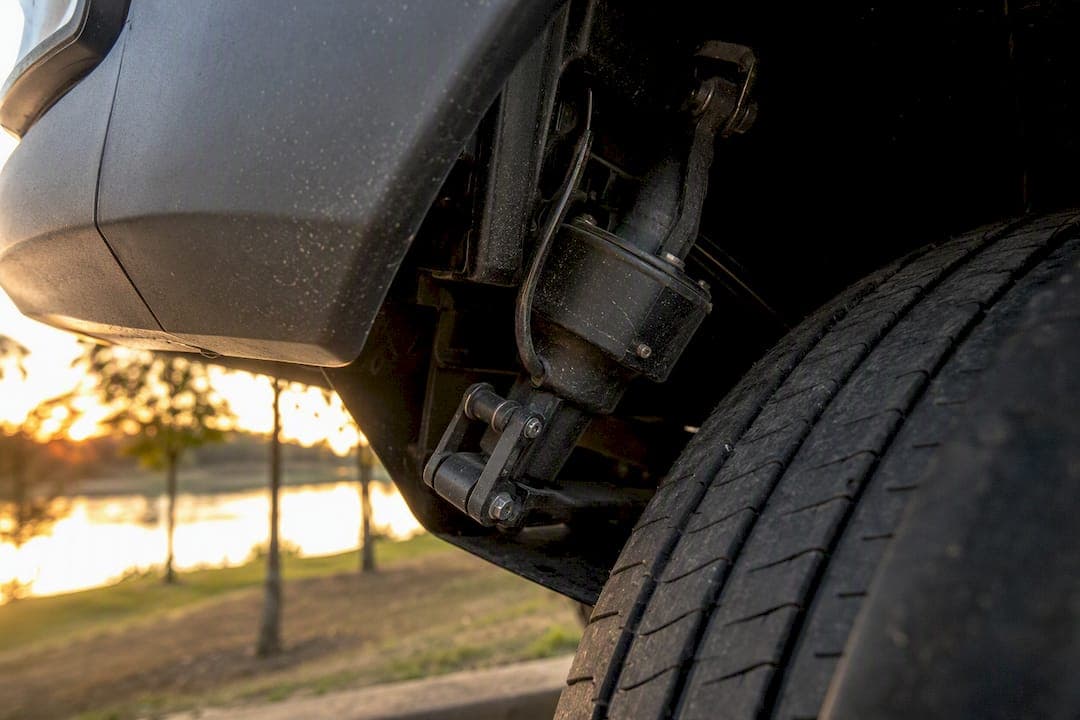
If you're shopping for a used Range Rover, target a 2019 to 2021 L405 with documented service history and avoid pre-2015 examples with unresolved air suspension or coolant pipe repairs. The 2018 facelift matured the L405's electronics and powertrain options, and by 2019 most of the early recall issues had been engineered out. Earlier models can still be good vehicles, but they demand a much higher tolerance for repair bills and a much more thorough inspection.
Two things drive this recommendation: reliability and total cost of ownership. Range Rovers built before the 2018 refresh carry a documented pattern of air suspension failures, coolant crossover pipe leaks, and transmission shudder that specialist mechanics still see regularly. Buying past that risk window, without giving up modern features, is the whole game.
Before you go further, take these three steps:
- Run a VIN check through the National Highway Traffic Safety Administration's recall database and a vehicle history service to confirm accident and recall records.
- Book a specialist pre-purchase inspection (PPI) with a Land Rover technician, not a generalist mechanic.
- Ask for service records specifically showing coolant crossover pipe and air suspension work, since these are the two most expensive systems to gamble on.
Key Takeaways
Buying a used Range Rover successfully depends on targeting the 2019 to 2021 L405 window and verifying air suspension, coolant, and transmission history before you sign anything.
| Point | Details |
|---|---|
| Target the right years | Focus on 2019 to 2021 L405 models for the best balance of features and lower mechanical risk. |
| Avoid pre-2018 without proof | Earlier L405 and L322 models need documented suspension and cooling repairs to be worth the risk. |
| Budget for known failure points | Set aside funds for air suspension, coolant crossover pipes, and transmission work regardless of generation. |
| Choose engines by priority | Pick SC380 V6 or Ingenium I6 for balanced ownership; reserve V8 for performance buyers who accept higher costs. |
| Get vetted help | Autovendorsfl pre-inspects inventory and offers personalized search, trade-in, and financing support for buyers who want documented, lower-risk options. |
Table of Contents
- Which Used Range Rover Fits Your Budget And Use Case?
- What Changed Across Three Generations Of Range Rover?
- What Breaks On A Used Range Rover, And What Does It Cost?
- Which Engine Should You Actually Buy?
- How Much Should You Budget To Buy And Own One?
- What Should A Pre-Purchase Inspection Cover?
- How Do You Lower Your Risk Before You Buy?
- What's The Bottom Line On Buying A Used Range Rover?
- How Autovendorsfl Helps You Buy With Confidence
- Sources
Which Used Range Rover Fits Your Budget And Use Case?
Not every buyer needs the same generation. A daily commuter with a tight service budget has different priorities than someone chasing V8 performance or the latest cabin tech. Here's how the three generations stack up against real-world use cases.
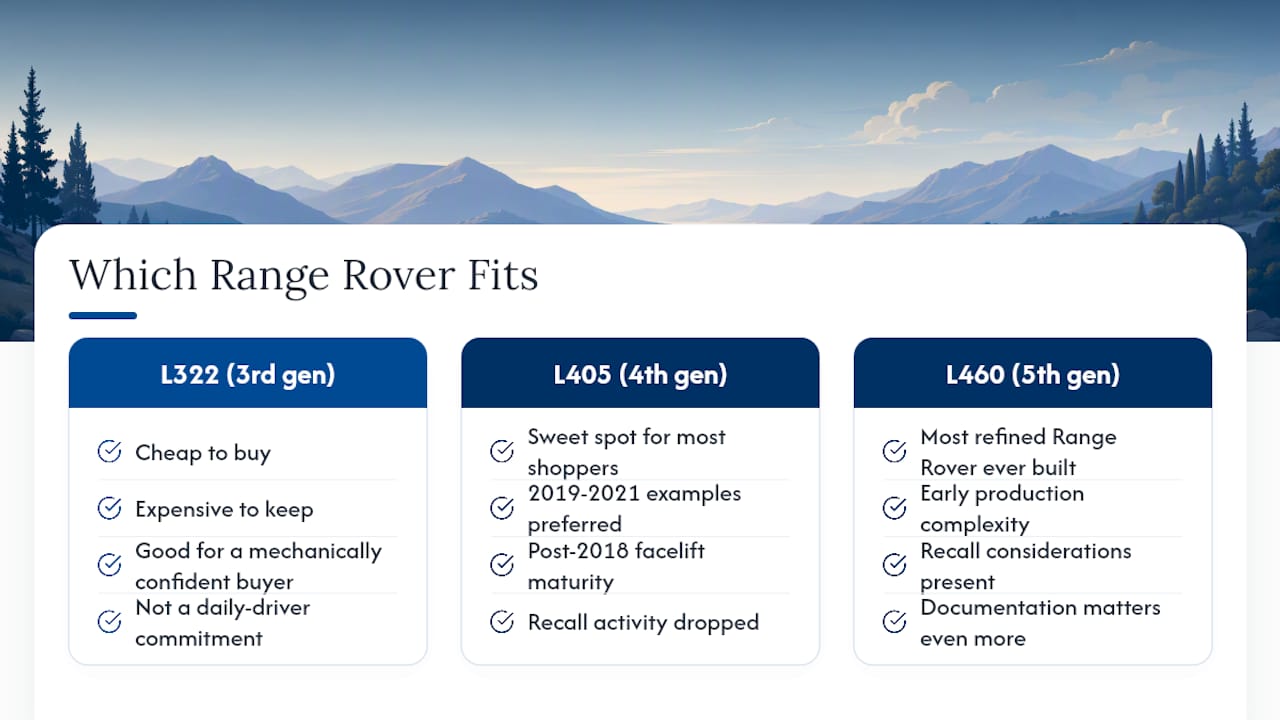
L322 (third gen): cheap to buy, expensive to keep. Good for a mechanically confident buyer who wants a project, not a daily-driver commitment.
L405 (fourth gen): the sweet spot for most shoppers, especially 2019 to 2021 examples where the 2018 facelift changes matured and recall activity dropped.
L460 (fifth gen): the most refined Range Rover ever built, but early production complexity and recall considerations mean documentation matters even more than usual.
What Changed Across Three Generations Of Range Rover?
Understanding what actually changed under the skin explains why some years carry more risk than others. This isn't cosmetic history. It's the difference between a suspension system that's been refined for a decade and one still working out its bugs.
Third generation, L322 (2002–2012): built on a steel platform with an aluminum body, the L322 introduced full-time air suspension as standard and BMW-sourced V8 engines in early years before switching to Jaguar-derived units. It's the last Range Rover generation without today's software-dependent complexity, which is both its charm and its ceiling.
Fourth generation, L405 (2012–2022): this is where things get interesting. The L405 switched to a full aluminum monocoque, cutting weight substantially and improving handling. It also introduced far more sophisticated electronics, adaptive suspension logic, and eventually plug-in hybrid technology. That sophistication is exactly why generation-by-generation guides note the L405 sits between modern amenities and higher complexity compared to older, simpler models.
Fifth generation, L460 (2021–present): the current car brings a stiffer platform, more advanced driver-assist software, and expanded electrification, including plug-in hybrid variants with real electric-only range. It's the most technologically dense Range Rover built, which raises the stakes on buying a documented, well-maintained example.
A few production milestones matter more than others when you're shopping:
- 2013: L405 launch year, carrying the highest concentration of early electrical and suspension teething issues.
- 2018: major L405 facelift, bringing revised suspension calibration and improved reliability.
- 2019–2021: the mature, lower-risk L405 window most buyers should target.
- 2022: L460 launch, introducing new software architecture and expanded hybrid options.
What Breaks On A Used Range Rover, And What Does It Cost?
Every Range Rover generation has predictable failure points, and knowing them by system saves you from being blindsided at the mechanic's shop.
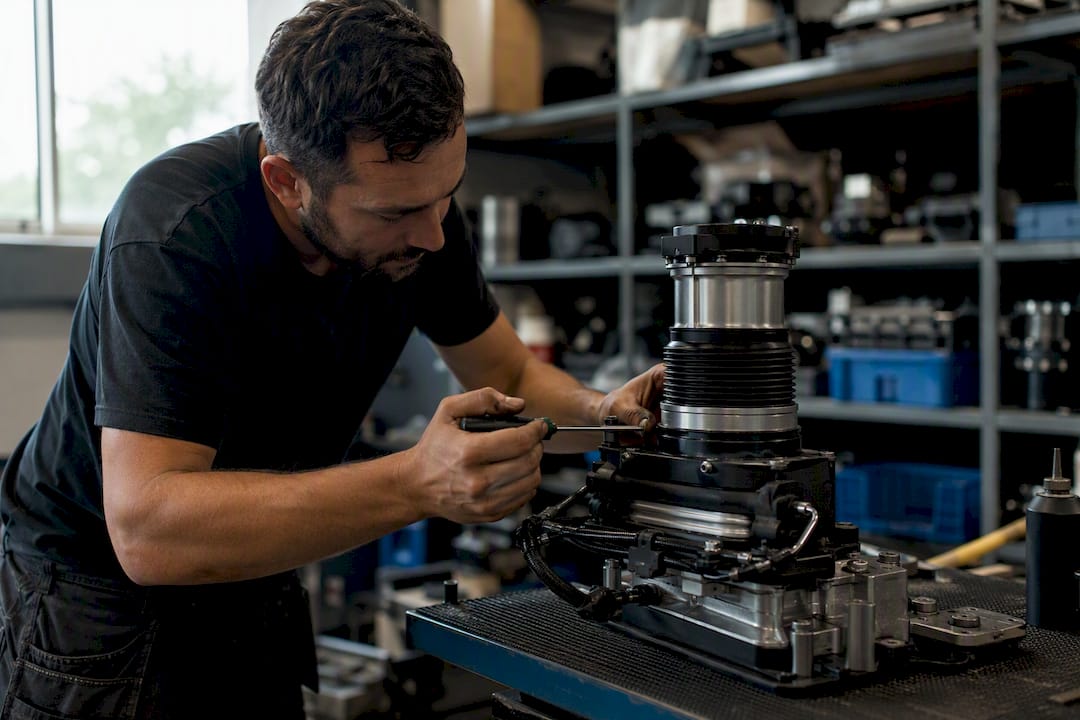
Air suspension. This is the single most common complaint across every generation. Compressor failures, air strut leaks, and height-sensor faults show up as a car that sags on one corner overnight or rides noticeably lower than it should. Replacement of a full air suspension system on an L405 can run into several thousand dollars if multiple struts and the compressor need attention at once.
Cooling system. L405 models are known for coolant crossover pipe failures, where the plastic pipe running beneath the intake manifold degrades and leaks. Left unaddressed, this can lead to overheating and, in worse cases, engine damage. Many owners proactively replace these with aluminum aftermarket pipes, and confirming this repair was done is one of the highest-value questions you can ask a seller.
Transmission. ZF eight-speed automatics, used across V6 and V8 L405 models, can develop a shudder under light acceleration, often tied to torque converter wear or software calibration. A transmission that hesitates, clunks into gear, or shudders between 1,500 and 2,500 RPM deserves a second opinion before you buy.
Electronics. Infotainment freezes, sensor faults, and dashboard warning lights are common complaints across reliability-focused used reviews, particularly on early L405 and early L460 examples still working through software revisions.
Pro Tip: Ask the seller to start the car cold, from a full stop, with you standing outside the vehicle. Air suspension height differences and exhaust smoke are far easier to spot before the engine warms up and self-corrects.
Red flags your test drive or PPI should catch: a car that sits unevenly after sitting overnight, active diagnostic trouble codes, delayed or rough transmission shifts, and any sign of coolant loss on the ground or on the underbody shield.
Which Engine Should You Actually Buy?
Choosing the wrong engine for your budget causes more used Range Rover regret than any other single decision. Here's how the three main options actually compare in practice.
The supercharged V8 delivers the performance and exhaust note people associate with the Range Rover name, but it comes with the highest maintenance burden. Earlier V8s used timing-chain guide designs that showed wear over time, and buyers considering a V8 should verify whether the guides have been updated or documented for service. It's the right choice if you want performance and accept higher running costs as the price of admission.
The SC380 supercharged V6 (2016–2019) strikes the most balanced profile of the three. It has less complexity than the V8, adequate power for most drivers, and a shorter list of known chronic issues, making it a strong middle-ground pick.
The Ingenium P400 inline-six (2020 onward) is the newest and generally lowest-risk option, benefiting from a cleaner design and fewer inherited problems from older platforms. For most buyers prioritizing reliability, this is the engine to seek out.
Plug-in hybrid variants add electric-only range but require a real charging routine to see any benefit. They make sense for buyers with home charging access and short commutes, less sense for anyone doing long highway stretches where the hybrid system adds weight without payoff.
- V8: best for performance buyers who accept higher running costs.
- SC380 V6: best balanced choice for most used buyers.
- Ingenium I6: best for reliability-focused buyers on newer models.
- PHEV: best only if home charging is realistic for your routine.
How Much Should You Budget To Buy And Own One?
Price expectations shift dramatically by generation and condition, and wide used-market price spreads mean two Range Rovers from the same model year can differ by tens of thousands of dollars based on mileage and documentation alone.
| Ownership item | Typical annual range | Notes |
|---|---|---|
| Routine service | $1,800–$2,500 | Higher for V8 models; lower for Ingenium I6 |
| Tires | $1,200–$1,800 | Larger wheel packages cost more to replace |
| Insurance | $1,800–$3,500 | Varies significantly by driver profile and location |
| Unscheduled repairs | $1,500–$3,500 | Mileage and prior documentation heavily affect this range |
A low-mileage, fully documented L405 will always cost more upfront than a higher-mileage example with a thin service file, and that premium is almost always worth paying. The biggest single-ticket repairs you'll encounter are air suspension component replacement, drivetrain work on the transmission, and major engine repairs tied to cooling system neglect.
- Expect entry-level L322 pricing to reflect years of deferred maintenance risk baked into the low sticker price.
- Expect L405 pricing to climb steeply for 2019 to 2021 examples with under 60,000 miles.
- Expect L460 pricing to stay high given its recent production window, even with moderate mileage.
What Should A Pre-Purchase Inspection Cover?
A proper PPI is non-negotiable on any used Range Rover, and it needs to go well beyond a generic mechanic's once-over.
- Air suspension diagnostics. Have the technician run a full height and compressor cycle test, not just a visual check.
- Coolant pipe inspection. Confirm whether the crossover pipe has been replaced, and if not, budget for it soon.
- Transmission behavior scan. Pull fault codes and drive the vehicle through a full gear cycle, watching for shudder or delayed engagement.
- Full diagnostic scan. Check for stored codes across every module, not just the engine.
- Cold start and highway test. Start the car cold, then run it on the highway to confirm smooth power delivery and no overheating trends.
Beyond the mechanical checklist, demand paperwork: full service history, itemized receipts for major repairs, recall completion records, and OEM parts invoices for anything replaced. A structured luxury vehicle inspection checklist helps make sure nothing gets missed during the process, and a proper test-drive routine catches issues a static inspection alone won't reveal.
How Do You Lower Your Risk Before You Buy?
Dealer certified pre-owned (CPO) programs typically offer the strongest built-in protection, since they usually require a multi-point inspection and carry a manufacturer-backed warranty. Independent sellers can offer better prices but push more inspection responsibility onto you.
Third-party extended warranties can soften the financial blow of a major repair, though coverage terms vary widely and often exclude the exact systems, like air suspension, that fail most often. Buying from a specialist dealer with documented inspection processes generally beats an auction purchase, where you rarely get a real pre-sale inspection window.
- Ask for an escrow arrangement on private sales above a few thousand dollars.
- Require documented repairs, especially coolant and suspension work, before finalizing a deal.
- Use inspection findings as leverage; a car with a pending air suspension repair should be priced accordingly.
Pro Tip: If a seller resists a specialist PPI, treat that as information. A confident seller with clean history welcomes independent verification.
What's The Bottom Line On Buying A Used Range Rover?
Getting this right comes down to five things you can act on today.
- Shortlist 2019 to 2021 L405 models first, then widen your search only if budget requires it.
- Never skip a specialist PPI covering air suspension, coolant pipes, and transmission behavior.
- Walk away from any seller who can't produce service records for those three systems.
- Negotiate based on documented findings, not guesswork, and put repair requirements in writing.
- Once you've narrowed your shortlist, get a specialist inspection scheduled before you make an offer.
An Experienced Buyer's Take On Range Rover Ownership
Satisfied owners share one trait: they went in expecting a maintenance relationship, not a maintenance-free luxury experience. Buyers who regret the purchase usually skipped the PPI or bought on emotion, chasing the badge instead of the paper trail. Treat the service history as seriously as the leather and the tech screen, because it is what actually protects your investment.
How Autovendorsfl Helps You Buy With Confidence
Finding a genuinely well-documented used Range Rover takes hours of cross-referencing service records, recall history, and inspection reports, most private sellers simply can't provide that level of transparency. Autovendorsfl curates its luxury inventory with that exact gap in mind, pairing specialist pre-purchase inspection standards with full service documentation before a vehicle ever reaches the lot.
Every vehicle passes through a vetting process built around the same red flags this guide covers: air suspension performance, coolant system condition, and transmission behavior. Autovendorsfl also offers personalized vehicle-finding assistance, so if the right L405 or L460 isn't currently on the lot, the team can search on your behalf, along with trade-in valuation and financing options to simplify the rest of the purchase. If you're ready to stop gambling on unknown history, request a curated Range Rover search and let a documented, pre-inspected example come to you.
Sources
- Used Land Rover Range Rover L405 (2013-2021): Buyer's Guide | CarScout
- Used Land Rover Range Rover 2013-2022 review | What Car?
- Used Range Rover (Mk5, 2021-date) buyer’s guide: top of the luxury SUV list | Auto Express
- Land Rover Range Rover Buying Guide: Cost, Reliability, and the Best Years to Buy - CarGurus
- Range Rover Buyer's Guide, Price Guide and What to Look For