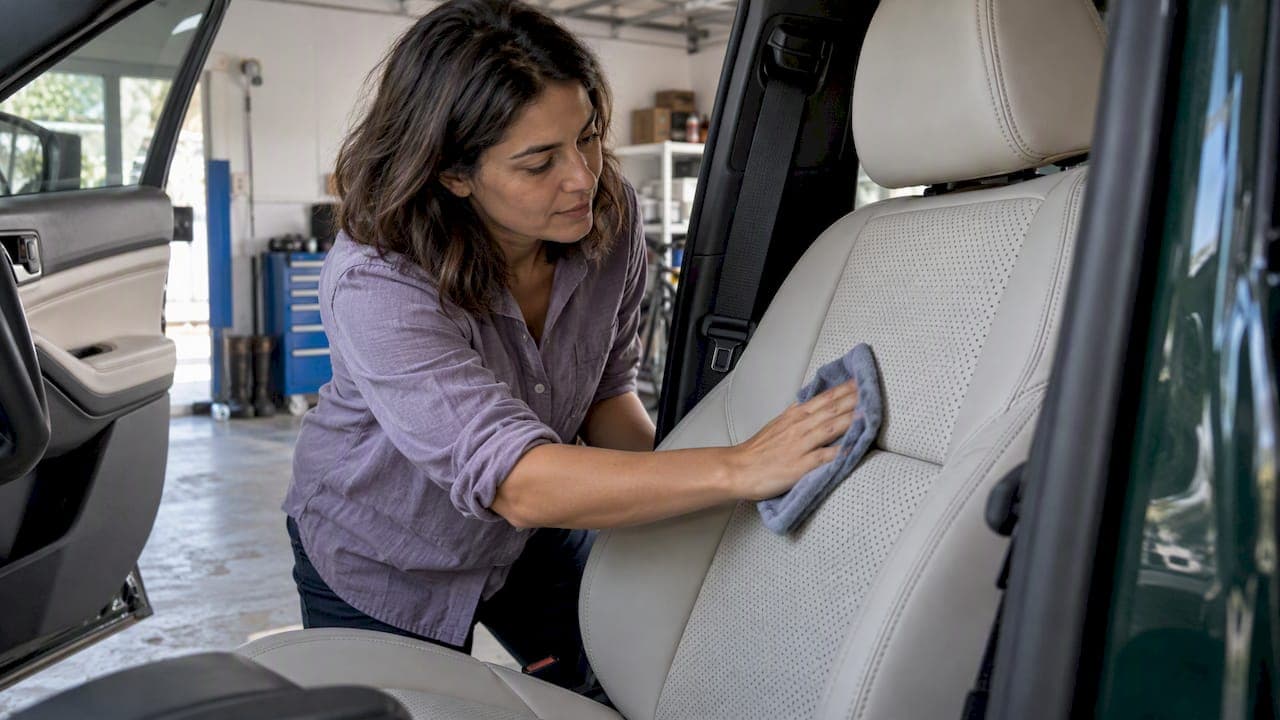
To care for ventilated seats, vacuum the perforated surface first, then clean with a barely damp microfiber cloth and a cleaner made for automotive leather. Apply the product to the cloth, never to the seat. Skip solvents, steam and soaking, and keep conditioner to a thin film so the holes stay open. That is the whole method. The rest of this guide explains why each step matters, what to use, and how to keep cooled seats comfortable for years.
TL;DR
- Vacuum first, with a soft brush attachment, so wet cleaning does not push grit deeper into the perforations.
- Put cleaner on a microfiber cloth, not on the seat. Liquid sprayed onto perforated leather can run into the holes.
- Avoid organic solvents, steam, abrasive tools and heavy, greasy conditioners. Some automakers say outright that solvents can damage seat-ventilation parts.
- Condition lightly, buff off the excess, and check your owner's manual for the products your maker approves.
- Do a quick vacuum every couple of weeks and a fuller clean every few months, more often in humid South Florida.
Table of Contents
- Why ventilated seats need a different kind of care
- What to check before you clean anything
- Tools that work, and tools that do not
- Step-by-step: how to clean ventilated leather seats
- What not to put on a ventilated seat
- Protecting the leather after cleaning without clogging the holes
- A care schedule that fits real life
- When the problem is a smell, not a stain
- Our perspective: care starts before you buy
- Looking for a car with ventilated seats?
- Checking the seats on a used car
- FAQ
- Sources
Why ventilated seats need a different kind of care
A ventilated (or cooled) seat pulls or pushes air through small holes in the seat surface. On a leather seat, those perforations are the feature you pay for on a hot day. They are also where crumbs, dust, sunscreen, lotion and sweat settle.
Two things can go wrong. If the holes fill with dirt or product, airflow drops and the seat feels less cool. If the seat gets too wet, moisture can sit beneath the perforations. Dr. Beasley's detailing guide explains that excess moisture can become trapped under the holes and that too much conditioner can fill and block them, restricting airflow.
So the goal is simple: remove what does not belong, add as little as possible, and never flood the surface. Everything below follows from that.
What to check before you clean anything
Start with the owner's manual. Automakers know their leather coatings and their ventilation hardware, and the guidance differs by brand. Capital One's guide to perforated leather advises checking the manual for product-specific recommendations and choosing cleaners designed for automotive leather rather than unspecified household sprays.
Then identify what you actually have:
- Perforated leather with ventilation: the focus of this guide.
- Perforated leather with heating only: the same gentle approach applies.
- Cloth or fabric ventilated inserts: follow the manual, and use less liquid still.
- Synthetic leather: often looks like leather but can be treated differently, so confirm in the manual.
Finally, test any new product on a hidden spot, such as the lower side of the seat base, and wait for it to dry before going further.
Tools that work, and tools that do not
You do not need a large kit. A short list covers nearly everything:
- A vacuum with a soft brush attachment.
- A soft-bristled brush or a clean toothbrush. Capital One suggests a clean toothbrush or soft brush to loosen debris, and a soft-bristle brush or bamboo cleaning pad to work in leather cleaner.
- Several clean microfiber cloths. Polestar's manual specifically mentions a clean, neutral-colored cloth, which avoids dye transfer onto light leather.
- A leather cleaner made for automotive use.
- A non-greasy leather conditioner.
What to leave in the garage: stiff brushes, sharp or abrasive tools, steam cleaners and anything that scrapes. Polestar's leather care instructions say not to scrape or rub dirty upholstery, use sharp or abrasive tools, or use a steam cleaner on leather. A Toyota service bulletin hosted by NHTSA adds that brushes used aggressively, sanders, steel wool, and cleaners containing harsh solvents or propellants can damage leather's protective coating.
The toothpick trick that circulates in car forums is tempting for stubborn holes. Treat it with caution: anything sharp risks tearing the leather around the edge of a perforation. If you use a wooden skewer or similar tool at all, wrap it in a bit of cloth and never force it.
Step-by-step: how to clean ventilated leather seats
1. Vacuum thoroughly
Go over the whole seat, including seams and the edges where the cushion meets the backrest. Capital One recommends vacuuming first to remove sand and dust, because wet cleaning can otherwise push that debris further into the perforations. Hold a brush attachment lightly against the surface and move slowly over the holes so the suction does the work.

2. Loosen what is stuck
If you can see packed dirt, use a clean toothbrush or soft-bristled brush with light pressure. Brush gently, then vacuum again. Resist the urge to dig. Loose debris lifts with suction; compacted debris usually needs a second pass after the cleaner has softened it.
3. Apply cleaner to the cloth
Dr. Beasley's guide recommends spraying a pH-balanced leather cleaner onto a microfiber towel, not onto the perforated leather. Toyota's bulletin says the same in plain terms: apply cleaners to the cloth rather than the seat. The cloth should feel lightly damp, never wet.
4. Wipe in gentle circles
Polestar describes vacuuming or dusting loose dirt, then using a clean cloth lightly dampened with a cleaning agent and cleaning with gentle circular motions. Work one section at a time, such as the seat bolster, then the center panel, then the backrest. Flip the cloth as it picks up grime.
5. Remove residue
Residue is what quietly clogs holes over time. Toyota's bulletin calls for wiping away leftover product, and Dr. Beasley's suggests buffing excess off with the dry side of the towel. A second cloth dampened with clean water, wrung out well, then a dry one, handles this.
6. Let it dry naturally
The Buick LaCrosse owner's manual, reproduced on a manual aggregator, warns that soaking or saturating leather, especially perforated leather, may cause permanent damage, and says to wipe away excess moisture and let the seat dry naturally. Skip the hair dryer and the heat gun. Park in the shade with the doors open if you can.
What not to put on a ventilated seat
This is where most damage happens, so it is worth being specific.
| Avoid | Why |
|---|---|
| Organic solvents | Mazda's manual for its seat ventilation says they may damage the seat surface and the seat-ventilation parts. |
| Steam cleaners and heat | Polestar advises against steam on leather. |
| Harsh or propellant-based cleaners | Toyota's bulletin says they can damage the leather's protective coating. |
| Saturating the seat | Moisture can sit under the perforations. |
| Heavy, greasy conditioners | They can fill the holes and cut airflow. |
| Bleach-containing soaps | Speed Clean's guide warns against bleach-containing dish soaps and harsh cleaners. |
Mazda's wording is worth noticing. It is not only a cosmetic concern. The chemistry you choose can affect the ventilation hardware itself.
Can you use Dawn dish soap?
It is the question people ask most after "how do I get the dirt out." None of the automaker material we reviewed names Dawn. Toyota's bulletin recommends clean water or a mild detergent on a microfiber cloth, with a baby-soap solution for spot cleaning, followed by wiping away residue. Speed Clean describes mild soap and water as a possible fallback: a couple of drops of gentle liquid hand or dish soap per cup of lukewarm water, applied to a microfiber towel, not the seat. It then calls for removing soap residue with clean water and patting dry with a fresh cloth.
Our view: a purpose-made automotive leather cleaner is the easier choice, because it is formulated for the finish on your seat. If you do reach for mild soap in a pinch, use very little, keep the cloth barely damp, and rinse the residue thoroughly.

Protecting the leather after cleaning without clogging the holes
Clean leather benefits from a light conditioner, but this is the step that most often goes wrong on perforated seats.
Dr. Beasley's guide suggests this approach:
- Use a small amount of a non-greasy conditioner.
- Start on adjacent non-perforated leather, such as the side bolsters or headrest.
- Apply only a thin film across perforated areas.
- Buff away any excess.
A good rule: if you can see product sitting in or around the holes, there is too much. Wipe it back with a dry microfiber cloth. Also read your manual before choosing a product. The Buick manual, for example, advises against silicone- or wax-based cleaners, a reminder that some finishes dislike certain additives.
Between cleanings, a few habits keep leather in better shape:
- Wipe spills at once with a dry cloth, then a lightly damp one.
- Use a windshield sunshade in the Florida sun to reduce heat on the seat surface.
- Let sunscreen and lotion absorb into your skin before you sit down.
- Brush off sand and beach debris before it gets ground in.
A care schedule that fits real life
No manual we read sets a universal frequency, so use this as a practical starting point and adjust to how you drive.
| Frequency | Task |
|---|---|
| Every 1 to 2 weeks | Quick vacuum of seat surfaces and seams |
| Monthly | Wipe down with a barely damp microfiber cloth |
| Every 3 to 4 months | Full clean with leather cleaner, light conditioning |
| As needed | Spot-clean spills immediately |
If you live near the coast, ride with kids or pets, or commute in humid weather, lean toward the shorter end of each range.
When the problem is a smell, not a stain
A musty smell when the ventilation runs sends many owners straight to scrubbing the seat. Sometimes the cause really is spilled drink or sweat in the cushion, and a careful clean with a lightly damp cloth will help. But if the odor shows up mainly when you run the climate system, the cabin air side is worth a look too. This guide to fixing a musty A/C smell covers the common causes and what to do about them, which helps you tell a seat problem from an air-system one.
If you have spilled something large into the seat, do not pour water on it to dilute it. Blot, let it dry naturally, and consult the manual or a professional detailer before going further.
Our perspective: care starts before you buy
Most ventilated seat trouble we hear about is not a failure of the seat. It is a habit: a spray bottle aimed straight at the perforations, a greasy conditioner rubbed in too thick, or a deep clean skipped for a year.
At Auto Vendors Inc in Fort Lauderdale, we curate used luxury and premium vehicles with attention to craftsmanship, and we pay attention to how the interior has been looked after, because it tells you a lot about how the whole car has lived. A seat with clear holes, supple leather and no lingering odor is a good sign. Cooled seats are part of what makes a luxury cabin feel considered, and we want buyers to enjoy them for the long haul.
That is why we pair a hands-on approach with personalized vehicle finding. If cooled seats are on your must-have list, tell us, and we help you search for the makes and models that offer them. Leather type matters too, and we explain the differences in our guide to Nappa versus Merino leather, so you know what you will be maintaining.
Allen
Looking for a car with ventilated seats?
If cooled seats are non-negotiable in a Florida summer, we can help you find them. Auto Vendors Inc offers a selection of used luxury and premium vehicles, with trade-in valuation and financing options available. Browse by make, model, body style and price in our used vehicle inventory, or look specifically at our SUVs for sale if your family needs space as well as comfort.
Prefer to hand off the search? Our Car Finder service lets you describe what you want, including features like ventilated seats, and we help you track down the right match. If you are weighing how a personal shopper works, our personal shopper guide explains the process.
Checking the seats on a used car
When you test drive a car with cooled seats, add a few quick checks to your routine:
- Run the ventilation on each setting and feel for steady airflow across the whole seat, not just in one patch.
- Listen for the seat fan. A steady, quiet hum is normal; rattling or grinding deserves a question.
- Look closely at the perforations in good light for packed dirt, dried residue or a sticky look.
- Check the leather around the holes for cracking or tearing, especially on the driver's bolster.
- Smell the seat with the fans running.
Our luxury SUV test drive checklist covers the rest of the car, from the infotainment to the ride.
FAQ
Can I use a toothpick to clean ventilated seat holes?
It is better to avoid it. Vacuuming with a soft brush attachment and a gentle pass with a clean toothbrush remove most debris without risking the leather edge. If you must use a pointed tool, wrap it in cloth and never force it, since Polestar and Toyota both warn against sharp or abrasive tools on leather.
Is it safe to spray cleaner directly onto perforated leather?
No. Apply the cleaner to a microfiber cloth and wipe the seat with it. Spraying directly can send liquid into the holes, where moisture can become trapped beneath the perforations, as Dr. Beasley's guide explains.
How do I condition perforated leather without blocking the holes?
Use a small amount of a non-greasy conditioner, start on the smooth leather beside the perforated panels, and apply just a thin film. Buff off any excess with a dry microfiber cloth. If product is visible in the holes, you used too much.
Can I use dish soap on ventilated leather seats?
Automaker guidance we reviewed does not name dish soap. Toyota's bulletin recommends clean water or a mild detergent applied to a cloth. A purpose-made automotive leather cleaner is the safer choice, and your owner's manual has the final word for your car.
Sources
- Seat Ventilation, Mazda CX-5 owner's manual (2026)
- Cleaning leather, Polestar 4 manual (2026)
- Leather and Synthetic Leather Care Best Practices, Toyota bulletin hosted by NHTSA
- How to Clean Leather Seats with Holes, Dr. Beasley's
- How to Clean Perforated Leather Car Seats, Capital One
- How to Clean Perforated Leather Seats, Speed Clean
- Buick LaCrosse 2016 owner's manual, page 320