
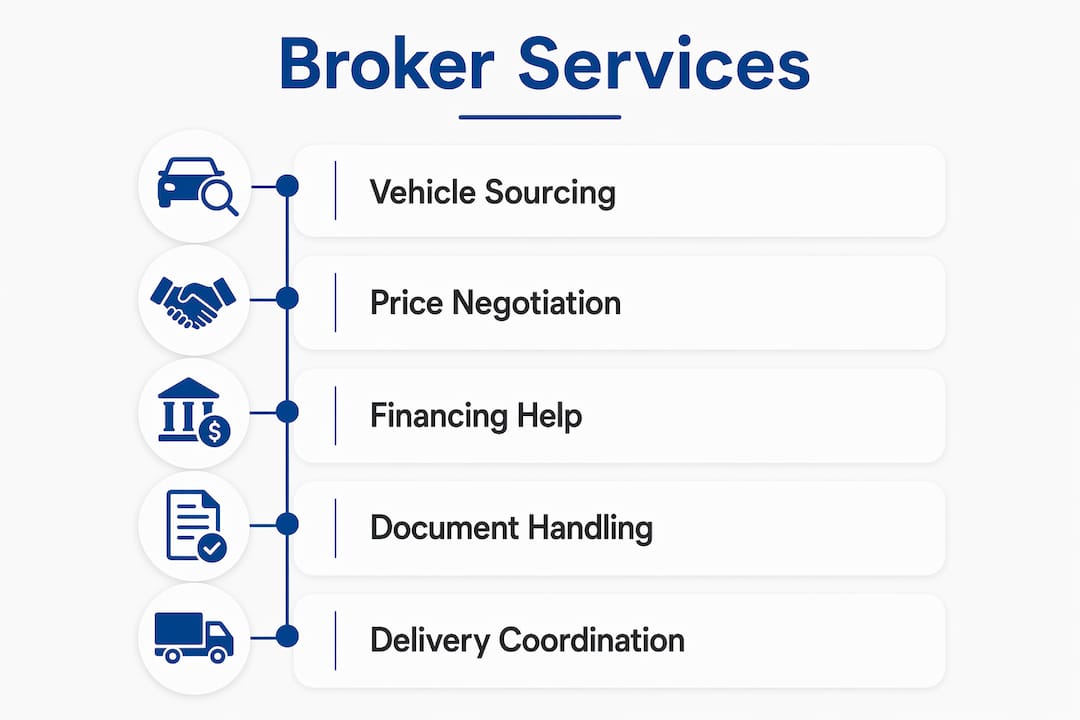
An automotive broker is a licensed professional who represents the buyer, not the dealership, throughout the entire vehicle purchase or lease process. The industry term is "auto broker" or "automotive purchasing agent," and the role covers vehicle sourcing, price negotiation, financing coordination, paperwork management, and delivery. Brokers act as fiduciary representatives, meaning their legal and professional obligation runs to the buyer's interests. Working with one saves over 14 hours per transaction while reducing the stress of dealership negotiations. Autovendorsfl offers this kind of personalized, buyer-first assistance to clients seeking quality vehicles in the Fort Lauderdale market.
What does an automotive broker do, step by step?
The auto broker process follows a defined sequence that keeps the buyer in control without requiring them to set foot in a dealership. Personalized consultation is the starting point, where the broker gathers details about the buyer's preferred make, model, trim, budget, and timeline. That information shapes every decision that follows.
Here is how the process typically unfolds:
- Consultation. The broker interviews the buyer to document needs, budget constraints, and timing. This step prevents wasted effort on vehicles that do not fit.
- Market search. The broker taps dealer networks, wholesale contacts, and auction access to locate matching vehicles. This reach extends far beyond what a retail buyer can access independently.
- Negotiation. The broker uses knowledge of invoice pricing and holdbacks to shift negotiating leverage toward the buyer. Dealers grant better terms to brokers who bring repeat volume business.
- Deal presentation. The broker presents a full deal breakdown, including price, fees, and financing terms, for the buyer's approval before anything is signed.
- Financing and paperwork. The broker coordinates loan or lease documentation, often securing better rates than a buyer would find independently.
- Delivery. The broker arranges vehicle delivery, and most clients never visit a dealership at all.
Pro Tip: Ask your broker for a written deal breakdown before signing anything. A legitimate broker will always provide full transparency on price, fees, and financing terms.
The sequence above applies to both new and used vehicles, though used car transactions add complexity around condition evaluation and auction sourcing.

What services do automotive brokers offer beyond price negotiation?
Automotive broker services extend well beyond getting a lower sticker price. Brokers provide a full suite of buyer protections that most retail buyers never access on their own.
- Vehicle sourcing. Brokers search dealer inventories, private networks, and wholesale auctions to find the exact vehicle the buyer wants, including rare trims and colors.
- Pre-purchase inspections. For used vehicles, brokers arrange independent mechanical inspections before the buyer commits. This step catches hidden problems that condition reports miss.
- Lease deal structuring. Brokers optimize lease variables like money factor and residual value, which most buyers overlook entirely. A poorly structured lease can cost thousands more over its term.
- F&I protection. Finance and insurance offices at dealerships are profit centers. Brokers shield clients from hidden costs such as unnecessary add-ons and inflated finance rate markups.
- Trade-in management. Brokers handle trade-in valuation and negotiation separately from the purchase price, preventing dealers from blending the two to obscure real savings.
- Remote buying coordination. Buyers who want a fully remote purchase process rely on brokers to manage every step without requiring in-person visits.
Pro Tip: For lease deals specifically, always ask your broker to disclose the money factor and residual percentage. Those two numbers determine your actual monthly cost more than the capitalized price does.
Broker fees reflect this scope of work. New car broker fees typically range from $300 to $1,000, while used car broker fees range from $1,000 to $2,500. The savings from expert negotiation and avoided hidden costs frequently exceed the fee paid.
| Service category | What the broker handles |
|---|---|
| Vehicle sourcing | Dealer networks, wholesale contacts, auction access |
| Price negotiation | Invoice pricing, holdbacks, volume discounts |
| Lease structuring | Money factor, residual value, cap cost reduction |
| Financing | Loan sourcing, rate comparison, documentation |
| Delivery | Logistics coordination, often without dealership visit |
How does an automotive broker differ from a dealer or referral platform?
The core distinction is who the professional represents. A dealer's salesperson works for the dealership and is paid to maximize the store's profit on every transaction. An auto broker represents the buyer and is paid by the buyer, creating a fundamentally different incentive structure.
Dealers own their inventory and need to move it. That ownership creates pressure to sell specific units at specific margins. Brokers own no inventory, so they have no financial reason to push one vehicle over another. Their only obligation is finding the best match for the buyer's stated needs and budget.
Referral platforms occupy a third category. Services that connect buyers to participating dealers provide a pre-negotiated price, but they do not represent buyers through the full transaction. Trade-ins, financing, and F&I product decisions remain entirely in the buyer's hands once they arrive at the dealership. That gap is where most of the cost and stress in a car purchase actually lives.
Licensed brokers fill that gap. They manage the complete transaction and carry fiduciary responsibility for the buyer's outcome. That legal accountability is absent from both dealer salespeople and referral platforms. Buyers researching stress-free car buying consistently report that full-service broker representation produces the most satisfying outcomes.
Who benefits most from using an automotive broker?
Certain buyers gain the most measurable value from broker services. Recognizing whether you fall into one of these categories helps clarify whether the fee is worth it.
- Time-constrained buyers. Professionals who cannot spend weekends visiting dealerships benefit immediately. Brokers handle all research, calls, and negotiations on the buyer's schedule.
- Luxury and collector vehicle buyers. Rare trims, limited production models, and high-value vehicles require access to networks that retail buyers cannot reach. Autovendorsfl specializes in exactly this segment, sourcing premium vehicles for clients who expect both quality and discretion.
- Lease shoppers. Lease transactions involve more variables than cash or financed purchases. A broker who understands money factor optimization can save a buyer thousands over a three-year term without changing the vehicle at all.
- Remote buyers. The growth of remote vehicle purchasing has increased broker demand significantly. Buyers relocating, purchasing across state lines, or simply preferring digital transactions rely on brokers to manage logistics end to end.
- First-time buyers or those with limited negotiating experience. Dealership finance offices are staffed by trained professionals. A broker levels that playing field immediately.
- Used car buyers seeking auction-sourced vehicles. Brokers access dealer-only auctions like Manheim and ADESA to source vehicles at wholesale prices. That access is not available to the public.
The practical result is a car buying process that is faster, less stressful, and often less expensive than going it alone.
Key Takeaways
An automotive broker is a licensed buyer's representative who manages vehicle sourcing, negotiation, financing, and delivery, saving buyers time, money, and stress across the full transaction.
| Point | Details |
|---|---|
| Brokers represent buyers, not dealers | Their fiduciary duty runs to the buyer, creating a fundamentally different incentive than a dealer salesperson. |
| Full transaction management | Brokers handle sourcing, negotiation, financing, paperwork, and delivery, often without a dealership visit. |
| Fee structure is transparent | New car fees run $300–$1,000; used car fees run $1,000–$2,500, typically offset by negotiated savings. |
| Lease deals require broker expertise | Money factor and residual value optimization can save thousands over a lease term. |
| Referral platforms are not brokers | They connect buyers to dealers but provide no fiduciary representation or full transaction management. |
Why I think most buyers underestimate what a broker actually does
Most people assume an auto broker is just a negotiator who gets a slightly better price. That framing misses the real value entirely. The price is almost the least important thing a good broker does.
What actually matters is deal structure. A buyer who focuses only on the sticker price can still lose thousands in a lease through a poor money factor, or in a financed deal through a marked-up interest rate. Dealers are trained to give ground on price while recovering margin elsewhere. A broker who understands the full transaction prevents that from happening at every stage.
The other underestimated factor is access. Used car brokers who work Manheim and ADESA auctions are buying at wholesale prices that retail buyers simply cannot reach. That gap between wholesale and retail is where real savings live, and it has nothing to do with negotiating skill.
The growth in remote buying has also changed what buyers expect. Clients no longer want to spend a Saturday at a dealership. They want a professional to handle the process and deliver a vehicle to their door. That expectation is reasonable, and brokers are the only service category built to meet it fully.
My honest view is that broker fees are underpriced relative to the value delivered, particularly on luxury and lease transactions. If you are spending $60,000 or more on a vehicle, paying $800 for someone whose sole job is protecting your interests is not a cost. It is insurance.
— Allen
How Autovendorsfl helps buyers find the right vehicle
Autovendorsfl brings the same buyer-first philosophy to every vehicle search in the Fort Lauderdale market. The team specializes in sourcing premium and luxury vehicles, handling the search, negotiation, and paperwork so clients can focus on what matters.
Whether you are looking for a specific luxury model or want expert guidance on a used vehicle purchase, Autovendorsfl provides personalized assistance from consultation through delivery. The process is transparent, the fees are clear, and the goal is always the buyer's best outcome. Clients searching for quality trucks can browse the current pickup selection in Fort Lauderdale to see the kind of curated inventory Autovendorsfl maintains. Reach out directly to start a conversation about your next vehicle.
FAQ
What does an automotive broker do for a car buyer?
An automotive broker represents the buyer throughout the entire vehicle purchase or lease process, handling sourcing, negotiation, financing, paperwork, and delivery. Most clients never visit a dealership at all.
How much does an automotive broker charge?
New car broker fees typically range from $300 to $1,000, and used car broker fees range from $1,000 to $2,500. Savings from expert negotiation and avoided hidden costs frequently offset the fee.
Is an automotive broker the same as a referral platform?
No. Referral platforms connect buyers to dealers at a pre-negotiated price but provide no fiduciary representation. A licensed broker manages the full transaction, including financing and F&I decisions, on the buyer's behalf.
Who benefits most from hiring an automotive broker?
Buyers with limited time, those seeking luxury or rare vehicles, lease shoppers, and remote buyers gain the most value. Brokers also protect inexperienced buyers from costly dealership finance office tactics.
Can an automotive broker help with used car purchases?
Yes. Used car brokers access dealer-only auctions like Manheim and ADESA to source vehicles at wholesale prices and arrange independent inspections to verify condition before purchase.