
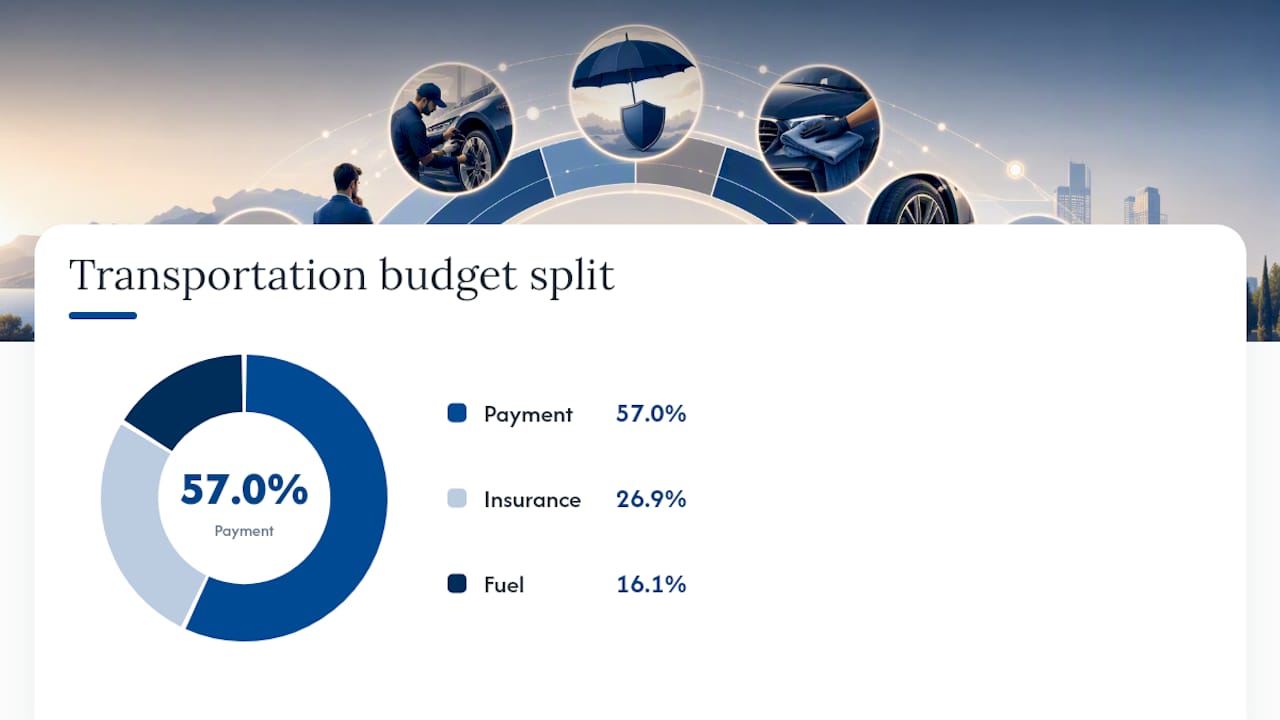
Target a purchase price between $45,000 and $65,000 for your first luxury car if you earn between $90,000 and $130,000 a year, and lean toward certified pre-owned to protect your monthly numbers. Two rules should drive every dollar figure that follows: keep the car payment at or below 10% of your take-home pay, and keep total transportation costs, meaning payment plus insurance, fuel, and maintenance, at or below 15%.
If those thresholds break under your preferred model, you have two honest paths forward: a loaded mainstream trim (think a top-spec Toyota or Honda) or a lower-trim luxury model bought certified pre-owned. Both get you closer to the experience without the financial strain.
- Entry-level luxury (new): roughly $40,000 to $50,000 before options
- Entry-level luxury (used or CPO): roughly $28,000 to $40,000
- Payment rule: monthly payment ≤ 10% of take-home pay
- Total transport rule: payment + insurance + fuel + maintenance ≤ 15% of take-home pay
Quick math: on $100,000 in gross income, roughly $6,900 in monthly take-home pay after taxes puts your payment ceiling near $690 and your total transportation ceiling near $1,035.
Key Takeaways
| Point | Details |
|---|---|
| Apply the two numeric rules | Keep payment at or below 10% of take-home pay and total transport costs at or below 15%. |
| Have a fallback ready | If those limits are exceeded, consider a loaded mainstream model or a lower-trim CPO luxury vehicle. |
| Match buying approach to budget | New fits higher incomes tolerant of depreciation; CPO fits most first-time buyers; late-model used maximizes value. |
| Calculate total cost, not sticker price | Insurance, maintenance, fuel, and fees can nearly double a vehicle's five-year cost. |
| Work with a curated dealer | Autovendorsfl offers pre-inspected CPO inventory, financing help, and trade-in valuation to reduce first-time buyer risk. |
Table of Contents
- What Total Cost of Ownership Includes
- How to Calculate Your Real Monthly Budget
- New, Used, or Certified Pre-Owned: Which Fits Your Budget?
- Real Price Ranges and Three Buyer Scenarios
- Your Pre-Signing Checklist
- How a Specialized Luxury Dealer Reduces Your Risk
- Why Luxury Insurance Runs Higher (and How to Manage It)
- Preparing for Higher Repair and Maintenance Costs
- Comparing Dealership Financing Against Banks and Credit Unions
- Leasing Versus Buying Your First Luxury Car
- Resale Value and Depreciation in Your Budget Planning
- A Dealership's View: What First-Time Luxury Buyers Get Wrong
- How Autovendorsfl Helps First-Time Luxury Buyers
- Sources
What Total Cost of Ownership Includes
The sticker price is the smallest number you'll deal with over five years. First-time luxury buyers routinely underestimate how much insurance, maintenance, and fees stack on top of the loan, and that gap is where budgets quietly fail.
Insurance tends to run higher on luxury models because parts and labor cost more to replace and repair. Maintenance follows the same pattern. Fuel or charging costs vary by model, but performance-oriented luxury trims often demand premium fuel. Registration and taxes generally scale with the vehicle's value, so higher-priced cars cost more to title. Dealer fees and documentation charges add further costs, as do optional add-ons like extended warranties or paint protection packages that dealerships pitch at signing.
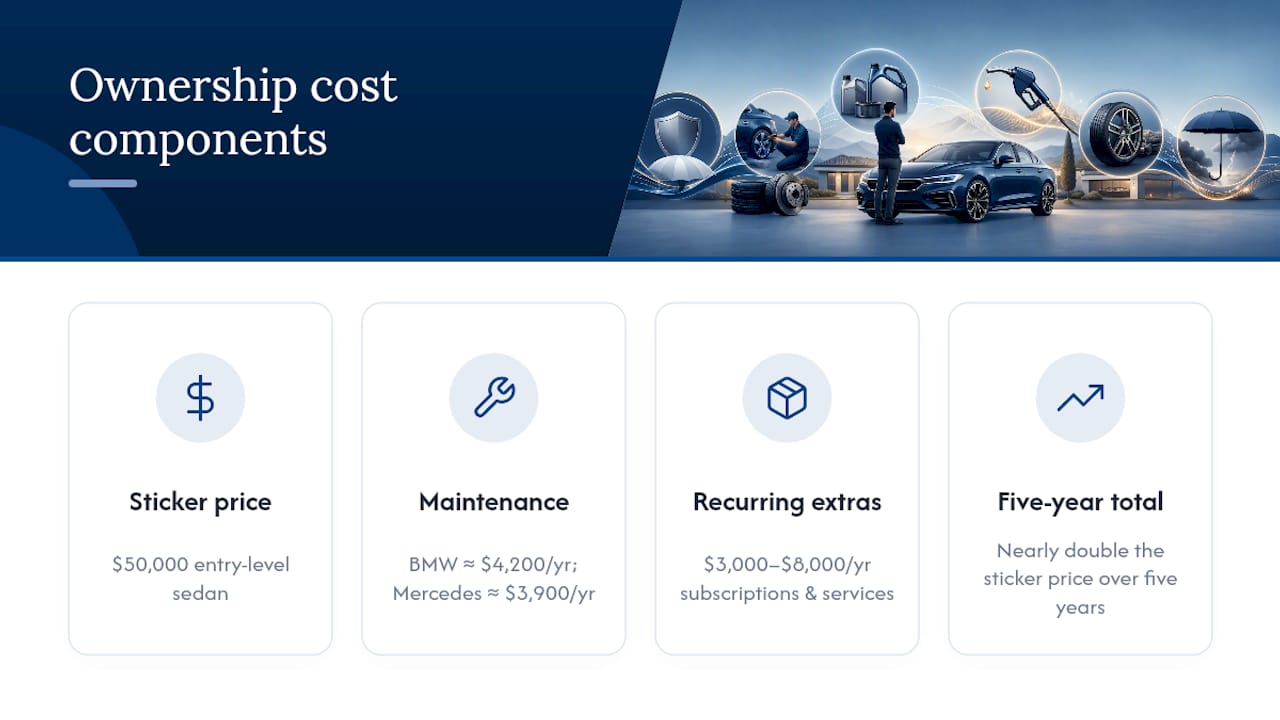
Annual maintenance and repair costs for luxury brands run noticeably higher than mainstream vehicles. BMW ownership averages around $4,200 a year in upkeep, while Mercedes-Benz owners see roughly $3,900 annually. Add hidden recurring costs, subscription services for navigation or connectivity features, concierge programs, and similar extras, and many owners find another $3,000 to $8,000 tacked onto their yearly total.
Here's what a realistic five-year picture looks like for a $50,000 entry-level luxury sedan:
That $50,000 car costs substantially more once you factor in five years of ownership, nearly double the sticker price when including all ownership expenses.
How to Calculate Your Real Monthly Budget
Start with your monthly take-home pay, the number that actually lands in your account after taxes and deductions. Multiply that figure by 0.10 to get your maximum car payment, and by 0.15 to get your total transportation ceiling.
- Find your monthly take-home pay. Pull it from a recent pay stub rather than estimating from your salary.
- Apply the 10% rule. Multiply take-home pay by 0.10 to find your payment cap.
- Apply the 15% rule. Multiply take-home pay by 0.15 to find your total transportation cap, which includes payment, insurance, fuel, and maintenance.
- Get insurance quotes early. Insurance costs shift the math considerably on luxury models, so run quotes before you fall in love with a specific trim.
- Reverse-engineer your purchase price. Use your payment cap, a target APR, and a loan term (typically 60 to 72 months) to calculate the maximum loan amount you can support, then add your down payment.
Say your take-home pay is $6,200 a month. Your payment cap lands at an affordable level, and your total transport cap sits higher to cover other costs. Based on typical loan terms and down payment, your payment supports a loan amount that puts your realistic purchase price near a moderate luxury vehicle price range. If insurance quotes come back at $250 a month and fuel runs $150, you have $530 left for the payment itself, tightening that number further.
Pro Tip: A longer loan term lowers your monthly payment, but it also stretches out interest costs and raises your risk of owing more than the car is worth if you need to sell or trade in early. Stick to 60 months unless the math genuinely doesn't work at 72.
New, Used, or Certified Pre-Owned: Which Fits Your Budget?
Buying new gets you the newest technology, a full factory warranty, and zero unknown history, but you absorb the steepest depreciation hit in the industry. Consumer Reports notes that new luxury cars commonly lose a significant chunk of their value in the first two to three years, meaning you're financing a car that's worth considerably less than what you paid almost immediately.
Buying used shifts that math in your favor. Someone else absorbed the early depreciation, so your purchase price drops substantially while the car often still has years of useful life left. The tradeoff is risk: you're inheriting an unknown maintenance history unless you verify it carefully.
Certified pre-owned splits the difference, and it's often the smartest entry point for a first-time luxury buyer. CPO programs pair a lower purchase price with manufacturer-backed warranty coverage and a multi-point inspection, giving you most of the peace of mind of buying new at a meaningfully lower cost.
- Choose new if you can absorb 30% or more in early depreciation and genuinely need the latest safety and tech features.
- Choose CPO if you want warranty protection and inspection assurance without paying full retail.
- Choose late-model used if maximizing value matters more than warranty coverage, and you're comfortable arranging your own inspection.
Real Price Ranges and Three Buyer Scenarios
Purchase-price bands vary enormously depending on how "luxury" you define it, and where you fall matters more than which badge you're chasing.
| Tier | New price range | Used/CPO price range |
|---|---|---|
| Entry-level luxury | $40,000 to $50,000 | $28,000 to $40,000 |
| Mid-luxury | $45,000 to $65,000 | $38,000 to $48,000 |
| High-luxury | $70,000 and above | $45,000 to $65,000 |
MoneyLion's analysis of income needed nationwide found buyers typically need well over $200,000 in annual income to comfortably afford many new luxury models without straining their budget, a number that surprises most first-time shoppers who assume six figures alone is enough.
Scenario 1: The first-time luxury buyer ($75,000 income). Target a CPO Acura TLX or Genesis G70 in the $30,000 to $35,000 range. Estimated annual ownership cost: $8,000 to $9,500.
Scenario 2: The aspirational mid-career buyer ($120,000 income). Target a used or CPO BMW 3 Series, Mercedes-Benz C-Class, or Audi A4 in the $38,000 to $48,000 range. Estimated annual ownership cost: $9,500 to $12,000.
Scenario 3: The high-income buyer with fewer constraints ($220,000-plus income). A new Lexus ES, Tesla Model 3, or loaded BMW 3 Series in the $45,000 to $60,000 range fits comfortably. Estimated annual ownership cost: $11,000 to $14,000.
Lexus consistently posts some of the lowest maintenance costs in the luxury segment, while Tesla owners trade traditional maintenance for tire wear and occasional service center visits tied to software or drivetrain components.
Your Pre-Signing Checklist
Complete these steps in order, and don't let dealership momentum push you past any of them.
- Schedule a pre-purchase inspection on any used or CPO vehicle before you commit. An independent mechanical inspection catches issues that a clean CarFax report won't.
- Request full service records and verify them against the vehicle's mileage and age.
- Get insurance quotes from at least three carriers before you sign anything, since luxury premiums vary widely by model.
- Get pre-approved for financing through a bank or credit union so you know your real rate before you walk onto a lot.
- Negotiate the purchase price, not the monthly payment. Dealers can stretch a term to hit any payment target you name, which hides the true cost.
- Confirm every rolled-in fee before signing, including documentation charges, add-on packages, and extended warranty costs.
- Verify CPO terms directly, including what the warranty covers and for how long.
Pro Tip: Ask the inspector specifically about brake wear, suspension components, and any electrical or infotainment glitches. These are the systems that generate the most expensive luxury repair bills once the factory warranty runs out.
How a Specialized Luxury Dealer Reduces Your Risk
A dealership that focuses on luxury and premium inventory brings a few advantages a private sale simply can't match. Curated sourcing means the vehicles on the lot have already passed a baseline of scrutiny before you ever see them.
- Pre-inspection and transparent history reporting eliminate the guesswork of buying from an individual seller.
- CPO sourcing gives you access to warranty-backed vehicles across multiple brands in one place.
- Financing facilitation lets you compare terms without visiting three separate banks.
- Trade-in valuation streamlines what would otherwise be a separate, time-consuming sale.
The tradeoff is real: dealership pricing sometimes runs slightly higher than a private-party sale, and dealer fees add a modest cost on top. For a first-time luxury buyer, the inspection assurance and financing convenience usually outweigh that gap, especially since a bad private-sale purchase can cost far more in repairs than the savings were worth.
Why Luxury Insurance Runs Higher (and How to Manage It)
Luxury vehicles cost more to insure because their parts, sensors, and labor rates cost more across the board. A cracked windshield with embedded cameras or a damaged bumper with parking sensors can run into the thousands, and insurers price that risk into your premium from day one.
You can manage that cost without giving up the car you want. Raising your deductible lowers your monthly premium, though it raises what you pay out of pocket in a claim. Bundling auto insurance with a homeowner's or renter's policy often unlocks a discount many first-time buyers never ask about. Some insurers also offer usage-based programs that track driving habits and reward lower-mileage or safer drivers with reduced rates, which can matter if you're not putting heavy miles on the car.
Getting quotes before you shop, not after, gives you real numbers to weigh against the 15% total-transportation rule instead of a guess.
Preparing for Higher Repair and Maintenance Costs
Luxury brands use specialized parts, proprietary diagnostic tools, and often require dealership or brand-certified technicians for major repairs, all of which push labor and parts costs above what a mainstream vehicle demands. Once the factory warranty expires, that gap becomes real money out of your pocket.
Build a maintenance reserve into your monthly budget rather than treating repairs as a surprise. Setting aside $150 to $300 a month in a separate account covers most routine service and softens the blow of a larger repair bill. CPO vehicles help here directly, since their extended warranty coverage absorbs many of the repairs that would otherwise land on you in years three through six.
Comparing Dealership Financing Against Banks and Credit Unions
Dealership financing offers convenience: one visit, one signature, and sometimes promotional rates on new vehicles that beat what a bank can offer. But those promotional rates typically apply only to specific models or credit tiers, so read the fine print before assuming you qualify.
Banks and credit unions often provide more competitive rates for buyers with strong credit, and walking in with pre-approval gives you a real number to compare against whatever the dealership proposes. Getting pre-approved before you shop also gives you leverage at the negotiating table, since the dealer knows you have a fallback option if their offer doesn't beat it.
Credit score matters enormously here. A difference of even 50 points can shift your APR by a full percentage point or more, which on a $40,000 loan translates to real monthly dollars over a five or six year term.
Leasing Versus Buying Your First Luxury Car
Leasing lowers your monthly payment because you're only financing the vehicle's depreciation over the lease term, not its full value. That makes leasing attractive if you want a new luxury model every few years and don't want to think about resale.
Buying makes more sense if you plan to keep the car past the warranty period or want to build equity rather than hand the vehicle back at lease-end. Buying also avoids mileage penalties and wear-and-tear charges that can surprise lease returners.
For a first-time luxury buyer working within a tight budget, buying used or CPO usually wins on total cost, since a lease's lower payment often gets offset by the fact that you own nothing at the end of the term.
Resale Value and Depreciation in Your Budget Planning
Depreciation rate should factor into your purchase decision as much as sticker price. Some luxury brands hold value noticeably better than others, and choosing a model with strong resale expectations protects you if you need to sell or trade in earlier than planned.
A car that depreciates slowly gives you more flexibility down the road, whether that means trading up, selling privately, or simply having a stronger equity position if you ever face negative equity concerns on a future trade-in.
A Dealership's View: What First-Time Luxury Buyers Get Wrong
The most common mistake first-time luxury buyers make is fixating on the monthly payment and ignoring everything else. A dealer can hit almost any payment target by stretching the loan term, but that doesn't make the car affordable. It just moves the cost further down the road.
The second mistake is skipping the pre-purchase inspection on a used or CPO vehicle because the car "looks perfect" on the lot. Cosmetic condition tells you almost nothing about brake wear, suspension health, or electrical systems, and those are exactly the repairs that get expensive once a warranty expires.
The third mistake is underestimating insurance and maintenance before signing anything. Buyers routinely calculate what they can afford based on the loan alone, then get blindsided by a $250 monthly insurance quote that blows past their 15% total-transportation ceiling.
What actually works is straightforward: get pre-approved before you shop, set a hard monthly cap tied to the 10% and 15% rules, insist on service records or a CPO designation, and shop insurance before you fall in love with a specific trim.
Pro Tip: The best time to negotiate is at the end of a sales month or quarter, when dealers are often more motivated to move inventory. If you have cash available for a larger down payment, using it strategically to reduce your loan amount, rather than spending it all on your down payment, often does more for your long-term affordability than stretching for a higher trim.
How Autovendorsfl Helps First-Time Luxury Buyers
Autovendorsfl is built around the same budget-first approach this article just walked through. Rather than pushing you toward the highest sticker price on the lot, the dealership focuses on matching your actual numbers, your take-home pay, your target monthly cap, and your ownership tolerance, with a curated inventory of quality used and certified pre-owned luxury vehicles.

Every vehicle goes through pre-inspection and transparent history verification before it reaches the lot, so you're not left guessing about service records the way you would with a private-party sale. The team also facilitates financing comparisons and handles trade-in valuation directly, which saves you the separate trips to a bank and a used-car lot that most first-time buyers assume they need to make.
If you're ready to turn your budget numbers into an actual shortlist of models, request a personalized vehicle match and let the team help you find a CPO or used luxury vehicle that fits both your payment cap and your ownership expectations.
Sources
Run your own numbers against a few trusted references before committing to any purchase price. Experian's car affordability calculator lets you plug in your actual income to confirm your payment and total-transport caps, while MoneyLion's state-by-state salary study shows how income requirements shift depending on where you live and which luxury segment you're targeting.
For ownership cost reality checks, CarCostBreakdown's luxury maintenance estimates break down brand-specific repair costs, and Consumer Reports' luxury buying guide offers useful depreciation context for new versus used decisions. Before you sign anything, get quotes from at least three insurance carriers and compare a bank or credit union rate against whatever the dealership proposes, since that comparison alone can shift your realistic budget by hundreds of dollars a month.
This article is general information, not a substitute for advice from a qualified financial advisor. Consult a qualified financial professional about your own circumstances before acting on anything here.
- Car Affordability Calculator: How Much Car Can I Afford?
- This Is the Salary You Need To Afford a Luxury Car in Every State in 2026
- Luxury Cars $50K–200K — Hidden Costs & True Ownership 2026
- Buying a luxury car — Consumer Reports