
Yes, putting a deposit down to hold a car is a normal and common practice, but it's only safe when the terms are in writing. Before you hand over any money, get a signed document listing the VIN, the deposit amount, an exact expiration date, and clear refund terms. If a dealer breaks that agreement, you're entitled at minimum to your money back.
TL;DR:
- Most car holding deposits range from $500 to $1,000 for used cars, with longer hold periods of 24 to 72 hours; special orders may extend to about a week.
- The refundability of a deposit depends on the signed agreement and state laws, with terms like nonrefundable or liquidated damages clauses requiring careful review.
- Always document the VIN, car details, deposit amount, expiration date, and refund terms in writing before paying any deposit, and negotiate contingencies for inspections and financing.
- If a dealer breaches the hold by selling the car, you are generally entitled to a full refund, and escalating via written demand, state agencies, or small claims court is advisable.
- A documented, written hold process reduces disputes and ensures proof of agreement, making it the safest way to reserve a vehicle without risking loss or misunderstandings.
Table of Contents
- What a Car Hold with Deposit Actually Means
- Typical Deposit Amounts and How Long a Hold Lasts
- Refund Rules, Contract Language, and How State Law Protects You
- The Pre-Purchase Checklist: Documenting Your Deposit Before You Pay
- What to Do If the Dealer Keeps Your Deposit or Sells the Car
- How Auto Vendors Inc Documents Every Hold We Take
- An Editorial Take on When a Deposit Is Actually Worth the Risk
- Reserve Your Next Vehicle the Right Way with Autovendorsfl
- Sources
- FAQ
What a Car Hold with Deposit Actually Means
A holding deposit is a small payment that takes a specific car off the market for a set window of time while you finish inspections, financing, or paperwork. It's different from a down payment, which is money applied directly toward the purchase price once you sign a full purchase agreement. It's also different from a factory-order reservation fee, which secures a build slot for a car that doesn't exist on the lot yet, and from earnest money, a term more common in real estate but occasionally borrowed by dealers to describe the same holding concept.
The line between a "hold" and a binding sale matters more than most buyers realize. A holding deposit typically keeps you in a pre-contract stage. You haven't agreed to buy the car. You've agreed to have first right to buy it before anyone else, for a limited time, usually with the right to walk away and get your money back if you decide against it. A purchase deposit, by contrast, often accompanies a signed purchase agreement or retail installment contract, which can make the deposit part of a binding deal with real consequences if you back out. According to LegalClarity's breakdown of holding deposits, there's no federal rule that forces a dealer to make any deposit refundable. Everything depends on the paper you sign.
Whether the money gets applied to your purchase price also varies by dealer policy:
- Some dealers credit the full holding deposit toward the sale price if you complete the purchase.
- Others treat it as a separate administrative fee that disappears into the transaction regardless of outcome.
- A few structure it as pure earnest money that's refunded once financing closes, then handled as a new payment at closing.
Ask which of these applies before you pay anything. The receipt should say so explicitly, not leave it implied.
Typical Deposit Amounts and How Long a Hold Lasts
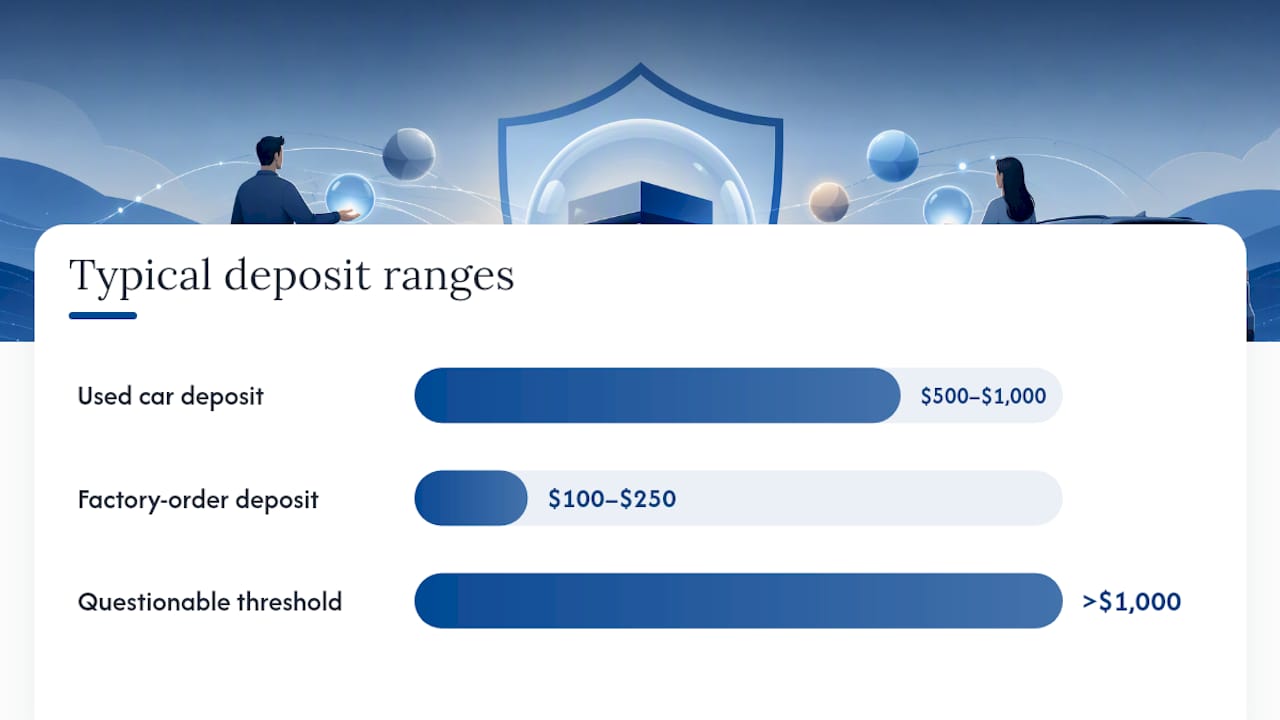
Most dealers ask for $500 to $1,000 to hold a used car off the lot, though the exact number tracks the car's price and demand. A factory-order reservation, where you're securing a build slot rather than a physical vehicle, usually runs cheaper, often somewhere between $100 and $250, since the dealer isn't losing a sale to another walk-in buyer.
Hold periods follow a similar logic. Most dealership holds run 24 to 72 hours for cars already sitting on the lot, long enough to arrange financing or get an independent inspection scheduled, but short enough that the dealer isn't losing other potential buyers indefinitely. Special orders or factory shipments can stretch that window to about a week, since the car genuinely isn't going anywhere else in the meantime.
A few things push those numbers up or down:
- Vehicle scarcity. A rare trim or a high-demand luxury model gives you less negotiating room on both deposit size and hold length, since the dealer has other buyers waiting.
- Sales channel. Private-party sales tend to have more flexible, informally negotiated terms than dealership transactions, which usually run through standardized paperwork.
- Season and inventory turnover. A car that's been sitting for weeks gives you more leverage to ask for a longer hold or a smaller deposit than one that just arrived.
If a dealer asks for a deposit well above $1,000 on an ordinary used car, that's worth questioning rather than assuming it's standard.
Refund Rules, Contract Language, and How State Law Protects You
The single word "nonrefundable" printed on a receipt doesn't automatically settle the matter. Refundability comes down to three layers stacked on top of each other: what the contract says, what your state's consumer protection laws allow, and whether the dealer actually held up their end of the deal.
Watch for these terms when you read a hold agreement:
- "Nonrefundable" means exactly what it sounds like on paper, but it's only enforceable if the underlying agreement is otherwise fair and the dealer didn't breach it first.
- Liquidated damages clauses set a specific dollar amount the seller keeps if you back out, meant to estimate the seller's actual loss rather than punish you.
- Forfeiture clauses are broader, sometimes vaguer language allowing the dealer to keep the whole deposit for almost any reason you don't complete the purchase.
Contract law generally doesn't let a seller keep a deposit that functions as a penalty rather than a reasonable estimate of loss. Under the Uniform Commercial Code's default rules, when there's no valid liquidated-damages clause, a seller's retention on a canceled sale is typically capped at 20% of the contract price or $500, whichever is smaller. Courts frequently look at whether a forfeiture clause is reasonable, or whether it's really just a penalty dressed up in contract language, and they can strike down provisions that look punitive.
State law adds another layer that varies more than most buyers expect. Some states require dealers to disclose deposit terms clearly before accepting payment, and a handful give consumers explicit cancellation rights within a short window after signing. Others default to whatever the UCC allows and leave it largely up to the written contract. This state-by-state patchwork is exactly why the paperwork you sign matters more than any general rule of thumb you've heard from a friend or a forum post.
Pro Tip: Ask the salesperson to write "refundable if buyer cancels within [X hours/days]" directly into the receipt, in their own handwriting or on the printed form, rather than accepting a verbal promise. A signed document beats a friendly assurance every time a dispute actually happens.
The Pre-Purchase Checklist: Documenting Your Deposit Before You Pay
Treat every deposit like a small contract, because that's exactly what it is. Here's the sequence to follow at the dealership or in a private sale, before any money changes hands.
- Get the full VIN in writing. Not the last six digits, not "the blue Accord on the lot." The complete 17-character VIN tied to that exact car, written on the receipt itself.
- Confirm year, make, model, and trim on the same document. This closes any loophole where a dealer swaps the car you thought you were holding for a similar one.
- Nail down the deposit amount and payment method. Write the dollar figure and specify whether it was paid by credit card, debit card, check, or cash.
- Set an exact expiration date and time, not a vague window. "Held until Friday" is weaker than "Held until 5:00 PM on Friday, March 13, 2026."
- Spell out refund terms in plain language. State whether the deposit is fully refundable, partially refundable, or nonrefundable, and under what specific conditions each applies.
- Negotiate an inspection contingency. This lets you walk away with a full refund if an independent mechanic finds a problem the dealer didn't disclose. Ask what documentation counts as proof, typically a written inspection report.
- Negotiate a financing contingency. This protects your deposit if your loan falls through for reasons outside your control. Lenders' denial letters are the standard proof dealers accept.
- Get signatures from both parties. A receipt with only your signature, or only the salesperson's initials, is weaker evidence than one both sides signed.
On payment method, a credit card gives you a dispute mechanism cash simply doesn't have. If a dealer refuses to honor a legitimate refund, you can file a chargeback with your card issuer and let them investigate, which is a meaningfully faster path than small-claims court. Cash deposits leave you with nothing but a signed receipt and your word against theirs if things go sideways. If cash is genuinely unavoidable, insist on a detailed, signed receipt and consider photographing the exchange or having a witness present.
Once you've got the signed paperwork, don't just fold it into a glove compartment and forget about it:
- Photograph or scan the signed receipt and the VIN plate the same day, before you leave the lot.
- Email yourself and the dealer a copy of the signed document so there's a timestamped record on both sides.
- Set a calendar reminder for 24 hours before the hold expires, so you're not scrambling on the deadline itself.
- Keep every text, email, and voicemail related to the hold in one folder, since scattered communication is hard to reconstruct later.
Pro Tip: A quick pre-owned inspection checklist run during your hold window turns your inspection contingency from a formality into a genuinely useful safeguard. Schedule the inspection the same day you sign the hold, not two days before it expires.
What to Do If the Dealer Keeps Your Deposit or Sells the Car
If a dealer sells a car out from under a valid, signed hold, that's a breach on their part, and you're entitled at minimum to your full deposit back. Start with a written demand letter or email, not a phone call, since phone calls leave no paper trail. State the facts plainly: the VIN, the hold dates, the amount paid, and the specific refund you're owed under the signed agreement.
If a written demand doesn't get a response within a reasonable window, usually a few business days, escalate through a few practical channels:
- Your state attorney general's consumer protection division can investigate patterns of dealer misconduct, though individual case resolution isn't guaranteed.
- Your state's motor vehicle regulator or dealer licensing board has direct authority over dealer conduct and can act on repeated violations.
- The Better Business Bureau won't force a refund, but a documented complaint creates a public record other buyers can see, and dealers often respond to protect their rating.
- Small-claims court is often the most direct remedy for a deposit dispute in the $500 to $1,000 range, since claim limits in most states comfortably cover that amount and filing fees are low. Bring your signed receipt, payment proof, and any written communication as evidence.
It's worth separating two very different situations here. A dealer selling the car during a valid hold is a dealer breach, and refund remedies apply cleanly. A buyer missing a financing deadline or simply changing their mind is a buyer breach, and depending on the contract's liquidated-damages language, the dealer may be within their rights to keep some or all of the deposit. Knowing which side of that line you're on before you escalate saves you time and, often, a frustrating phone call.
How Auto Vendors Inc Documents Every Hold We Take
We build our reservation process around the same protections this article walks through, because disputes almost always trace back to vague paperwork rather than bad faith. Every hold we accept comes with a receipt tied to a specific VIN, a clearly stated expiration date and time, and refund terms spelled out in plain language before any payment changes hands.
Buyers working with us get:
- A documented online reservation process that generates a written record automatically, rather than relying on a handshake at the counter.
- Appointment-only test drives that keep the vehicle's status and hold window unambiguous while you evaluate it.
- Coordination on inspections and financing timelines, so contingencies you negotiate actually have room to play out before a hold expires.
This structure exists to cut down disputes before they start, not to slow buyers down. A clear hold document means fewer misunderstandings and faster movement once you decide to buy.
An Editorial Take on When a Deposit Is Actually Worth the Risk
Not every car is worth a deposit, and the instinct to hold everything you like is how buyers end up frustrated. A small refundable hold makes sense on a genuinely scarce listing, a rare trim, a well-priced car that's clearly going to move fast, something where the alternative is losing it to the next walk-in buyer. On an ordinary used sedan with three similar listings a mile away, a deposit mostly just ties up your money for no real benefit.
Where I disagree with a lot of casual advice floating around forums: the negotiation happens at signing, not after. Once you've handed over cash and walked out with a vague verbal promise, your leverage is essentially gone. Ask for the short refundable window, get the dealer's signature on a real hold form, and put contingency language in writing before you pay anything. And if a hold is about to lapse, call the dealer that day. Silence after a deadline passes is far worse for you than an awkward phone call before it does.
— Allen
Reserve Your Next Vehicle the Right Way with Autovendorsfl
Autovendorsfl gives you what a lot of casual "cash deposit, verbal promise" arrangements can't: a documented hold tied to a specific VIN, with expiration and refund terms in writing from the start. That's the practical difference between hoping a dealer remembers what was agreed and having proof of it.
Reservations through the dealership generally include clear paperwork, appointment-only test drives to maintain accurate vehicle availability, and coordination on financing and inspections to help contingencies have time to work. If you're weighing repairs or condition issues that show up on a vehicle history report, a resource like Auto Glass Kings' guide to common repair mistakes is worth a look before you finalize anything. When you've found the right vehicle in our inventory, visit Auto Vendors Inc to start a documented reservation or ask our team any questions about hold terms before you commit a single dollar.
Sources
- Can You Put a Deposit on a Car to Hold It? What to Know - LegalClarity
- What to know before putting down a deposit for a used car
- How to Reserve a Car at a Dealership | Chase
- Can the dealership keep your deposit? — Motor1 analysis
FAQ
How long will a car dealer hold a car with a deposit?
Most dealerships hold a lot car for 24 to 72 hours, while special orders or factory shipments can extend the hold to a week or more depending on production timing.
Can you put a deposit on a vehicle to hold it?
Yes, most dealers and private sellers accept a holding deposit, but the terms, amount, and refund policy vary by seller since no federal rule sets a standard.
Do I lose my deposit if I don't buy the car?
It depends on your written agreement and state law; if the receipt says "nonrefundable" and that language holds up under state consumer protection rules, you may lose it, but many contracts allow a partial or full refund under specific conditions like a failed inspection contingency.
What is the $3,000 rule for cars?
There's no universal legal standard for a specific dollar amount for car deposits; buyers should rely on the written contract terms and their state's consumer protection rules instead of unverified numeric rules of thumb.
Is a car deposit the same as a down payment?
No, a holding deposit typically reserves the car temporarily without committing you to buy, while a down payment is money applied toward the purchase price under a signed purchase agreement.