
A coupe trades rear-seat room and cargo access for style and a sportier driving feel; a sedan trades some of that flash for practicality, especially in the back seat and trunk. If you carry passengers or gear regularly, a sedan usually serves you better. If you drive mostly solo or in pairs and want a car that looks and feels like a statement, a coupe earns its keep.
TL;DR:
- Sedans typically offer easier rear access, larger trunks, and more rear headroom, making them better for families or frequent passengers.
- Coupes often have narrower doors, smaller trunk openings, and less rear headroom, which can make daily tasks like buckling children or loading cargo more difficult.
- The performance difference between coupe and sedan models sharing the same platform is usually minimal, with tuning and structural choices having a bigger impact than body style.
- Insurance premiums for coupes tend to be higher due to riskier driver profiles and increased theft or claim rates, especially for niche or sporty models.
- The defining factors are door count and trunk design; checking rear headroom and trunk access during a test drive helps confirm if a body style suits daily needs.
Table of Contents
- What Defines a Sedan and What Defines a Coupe Today
- Practical Differences That Matter Day to Day
- Driving Feel and Performance: What Actually Changes
- Ownership Costs and Insurance: What to Check Before You Buy
- How Modern Models Blur the Lines
- Decision Checklist: How to Choose Between a Coupe and a Sedan
- What Buyers Get Wrong About Coupes and Sedans
- Find Your Ideal Coupe or Sedan at Autovendorsfl
- Sources
- FAQ
What Defines a Sedan and What Defines a Coupe Today
Traditionally, a sedan means four doors, a fixed roof, and a "three box" layout: engine bay, cabin, and trunk as separate volumes. A coupe means two doors, a lower roofline, and often a shorter body with the trunk blended more closely into the rear profile. That was the rule for decades, and it still holds for plenty of models on the road.
It stopped being the whole story once marketing got involved. Automakers now sell "four-door coupes," sportback variants, and fastback sedans that borrow a coupe's sloped roofline while keeping four full-size doors. Industry writers have pointed out that this blur is deliberate: brands want to sell higher trim levels with coupe styling paired with sedan practicality, and calling a four-door car a "coupe" makes it feel more special without sacrificing usability.
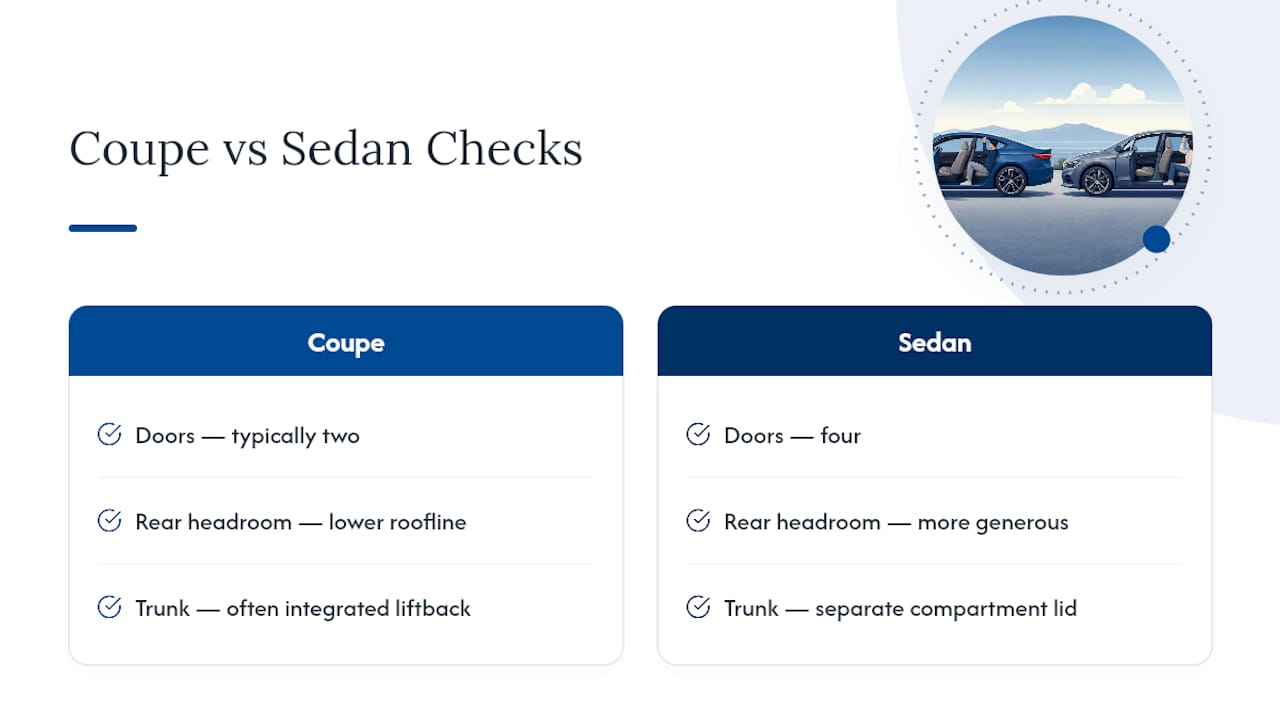
The fix is simple. Ignore the badge and check three measurable things: door count, rear headroom, and whether the trunk opens separately from the cabin or lifts as one piece with the glass.
Practical Differences That Matter Day to Day
This is where the coupe vs sedan comparison stops being theoretical and starts affecting your actual week. Sedans generally deliver easier rear access, more usable trunk openings, and better rear headroom than coupes, because the longer body and upright roofline give designers room to work with in the back seat.
A few concrete contrasts worth weighing before you sign anything:
- Child seats and boosters: narrower rear doors on a coupe make buckling a squirming toddler harder every single time, not just occasionally.
- Third-row guests: friends riding in back of a coupe deal with a tighter door opening and less headroom sliding in.
- Grocery runs and luggage: coupe trunk openings tend to be smaller even when total volume is close to a sedan's.
- Frequency compounds the problem: if you open those rear doors twice a day for a commute carpool, the coupe's design costs you time and patience.
None of this makes a coupe impractical for every buyer. It just means the trade-off shows up in small, repeated moments rather than one big dealbreaker.
Driving Feel and Performance: What Actually Changes
Manufacturers frequently tune coupe variants with stiffer springs, quicker steering ratios, and sometimes a lower ride height than the sedan sharing its platform. Losing two doors also removes some structure, and engineers often compensate with extra bracing that can make the shell feel tighter over rough pavement.
Here's the part buyers miss: when a coupe and sedan share a platform, the real-world performance gap is often modest. Tuning and structural choices matter more than door count, and a well-sorted performance sedan can out-handle a soft-tuned coupe from the same lineup. If driving engagement is your priority, look at the specific trim and suspension setup, not the body style label. A four-door sport sedan with the right chassis tune will out-corner a coupe that was never built for performance in the first place. For a taste of what dedicated coupe performance tuning looks like at the high end, models like the Mercedes GT53 show how far manufacturers push chassis stiffness and power delivery when style and speed are both the point.
Ownership Costs and Insurance: What to Check Before You Buy
Insurance is where the coupe vs sedan decision gets financial teeth. Insurers tend to price coupes higher than comparable sedans, largely because of driver demographics and theft or claim history tied to the body style.
By the numbers: Coupes routinely carry higher premiums than similarly priced sedans, a pattern Car and Driver's insurance analysis attributes to riskier driver profiles and elevated theft and claim rates associated with typical coupe ownership.
Buyer age and driving record can swing that cost more than the body style alone does, so a clean-record buyer in their forties may not see much gap at all. The smartest move is to get a quote on the exact model and trim before you fall in love with it. Resale also varies by model rather than by body type. A well-known sedan nameplate often holds value better than a niche coupe, simply because more buyers shop for it. Our breakdown of luxury insurance costs walks through what drives premiums up and what you can actually control.
How Modern Models Blur the Lines
Four-door coupes, fastbacks, and coupe-styled SUVs make the coupe vs sedan comparison messier every model year. Some "sedans" are technically hatchbacks in disguise, meaning the trunk lid integrates with the rear glass instead of opening as a separate panel. That single detail changes how you load a stroller or a set of golf clubs.
Judge a four-door coupe by asking whether it was built style-first or practicality-first. Check rear headroom against a standard sedan in the same class, and check whether the trunk opening is a small hatch or a full-width panel. A car marketed as sporty can still swallow a week of groceries if the engineers didn't sacrifice cargo access for looks. When in doubt, sit in the back seat yourself before you decide the label tells you anything useful.

Decision Checklist: How to Choose Between a Coupe and a Sedan
Work through this before you commit to either body style:
- Count your regular passengers. If you routinely carry more than one adult in back, weight your decision toward a sedan.
- Total your cargo needs. Strollers, sports gear, and luggage for trips all point toward the bigger trunk opening a sedan usually offers.
- Check your parking and garage fit. Coupes are sometimes shorter but lower, which matters for tight garage clearances.
- Rate your insurance sensitivity. If premium cost is a major factor, get quotes on both body styles in your target trim before shopping further.
- Test-drive with intent. Load the back seat with a passenger your actual size, then try buckling a child seat or sliding cargo into the trunk.
Pro Tip: Ask the dealer to open the trunk fully and load something bulky, like a duffel bag or a case of water, before you leave the lot. Photos and spec sheets never show you how narrow a coupe's trunk opening really is.
Before you sign anything, compare insurance quotes on the specific trim, measure rear-seat legroom against your tallest regular passenger, and request a hands-on trunk demonstration. Our guide to car selection criteria for families covers additional buying factors worth weighing alongside body style.
What Buyers Get Wrong About Coupes and Sedans
Most buyers walk in assuming the body style tells them everything they need to know, and that assumption costs them time on the lot. I've watched shoppers fall for a sleek coupe roofline and skip the fifteen seconds it takes to sit in the back seat, only to realize during the test drive that their teenager can barely fit behind them.
The buyers who make the smartest calls run a simple test: can they live with the rear-seat and trunk access every single day, not just on the drive home? That question ends most indecision faster than any spec sheet. Side-by-side test drives at a dealership, where you can move from a coupe to its sedan sibling in the same lot visit, expose these differences far better than browsing photos online.
Some dealerships regularly see buyers change their minds after sitting in both body styles back to back. Trust what your body tells you in the seat over what the marketing copy tells you on the window sticker.
— Allen
Find Your Ideal Coupe or Sedan at Autovendorsfl
A good dealership experience gives you something a spec sheet and a search filter cannot: the chance to sit in a coupe and its sedan sibling on the same lot visit and feel the difference for yourself. Some curated selections of premium and luxury vehicles span both body styles, and teams can help you weigh the trade-offs against your actual driving habits, not a marketing label.

Here's what that looks like in practice:
- Personalized vehicle finding services can help you navigate listings and body style differences.
- On-lot comparisons and test drives allow checking rear headroom and trunk access before deciding.
- Trade-in valuation and financing coordination can simplify the buying process. If you're still weighing cash against financing, consulting with the sales team may help.
Browse current inventory like our Honda Civic listings to see how body style and trim options play out in real listings, or reach out to start a personalized search built around how you actually drive.
Sources
- Sedan vs Coupe explanation and examples
- Coupe vs Sedan: Which Body Style Is Right for You in 2026?
- Sedan vs. Coupe: How Different Are They?
FAQ
Is Every Two-Door Car a Coupe?
Not necessarily. Some two-door cars are technically hatchbacks or fastbacks where the trunk lid integrates with the rear glass, which changes cargo access even though the body looks coupe-like.
What Are the Disadvantages of a Coupe?
Coupes typically offer less rear headroom, narrower door openings that make child seats and rear passengers harder to manage, and often higher insurance premiums than a comparable sedan.
Is a Coupe the Same as a Sedan?
No. A coupe traditionally has two doors and a sportier roofline, while a sedan has four doors and a three-box layout with more rear-seat and trunk practicality, though modern "four-door coupe" models blur that line.
What Qualifies a Car as a Coupe?
There's no single universal rule, but a coupe traditionally means two doors and a lower, sportier roofline. Since labels vary by automaker, checking rear headroom and door count yourself is more reliable than trusting the name on the trim badge.