
Pay cash if it won't drain your emergency fund and the loan's APR would exceed what you'd earn keeping that money invested; finance if a 0% or low-APR offer beats your realistic returns, or if paying cash would leave you without a safety cushion. The exceptions that flip the math: manufacturer rebates tied to financing, promotional APR deals, and thin savings. The numbers and a step-by-step checklist below make the choice concrete.
TL;DR:
- Financing is generally more expensive than paying cash due to interest costs, especially over longer loan terms like 60 or 72 months.
- A 0% APR promotion can make financing cheaper than paying cash if a moderate investment return exceeds the loan's effective interest rate.
- Preapproval from banks, credit unions, or online lenders strengthens your negotiating position and helps you compare total loan costs accurately.
- Paying cash is advisable only if it leaves at least three months of expenses in your emergency fund and your investment returns are lower than the loan's APR.
- Combining a sizable down payment with a shorter loan term often balances interest savings and liquidity needs better than an all-cash or fully financed approach.
Table of Contents
- Cash vs Financing a Car: Weighing the Real Tradeoffs
- How Much Does Financing Actually Cost You?
- Where Should You Get Your Car Loan?
- How Do You Decide: Cash or Financing?
- How Do You Protect Your Negotiating Leverage?
- How Autovendorsfl Helps You Run the Numbers
- Get Help Running Your Numbers Before You Buy
- What Auto Financing Really Means for You
- Sources
Cash vs Financing a Car: Weighing the Real Tradeoffs
Every dollar decision on a vehicle purchase comes down to two competing priorities: minimizing total cost and preserving flexibility. Cash wins on cost. Financing wins on flexibility. Which one wins for you depends on your savings cushion, the loan terms available, and whether you can put idle cash to better use elsewhere.
Paying cash eliminates interest entirely and removes any risk of repossession, since there's no lender holding a lien on the title. It also simplifies the purchase. No paperwork with a lender, no monthly obligation, no insurance mandates beyond your state's minimum. The downside is liquidity. A $30,000 vehicle purchase that empties your savings account leaves you exposed if your transmission fails or you lose income six months later.
Financing keeps that cash working for you, whether that means sitting in an emergency fund or invested for growth. It can also unlock manufacturer incentives that only apply to financed deals, and Experian notes that paying cash, while it avoids interest and repossession risk, can cost you those rebates and reduce your available savings. The tradeoff: you pay interest over the loan term, and lenders typically require full coverage insurance, which raises your monthly cost beyond just the loan payment.
Financing is far more common than cash purchases. As of Q3 2025, roughly a majority of new-car purchases and a significant share of used-car purchases were financed, which tells you most buyers are choosing liquidity over a zero-interest outcome, even when they could afford to pay outright.
How Much Does Financing Actually Cost You?
Numbers settle this argument faster than opinions. Take a $30,000 used vehicle financed at a 60-month term.
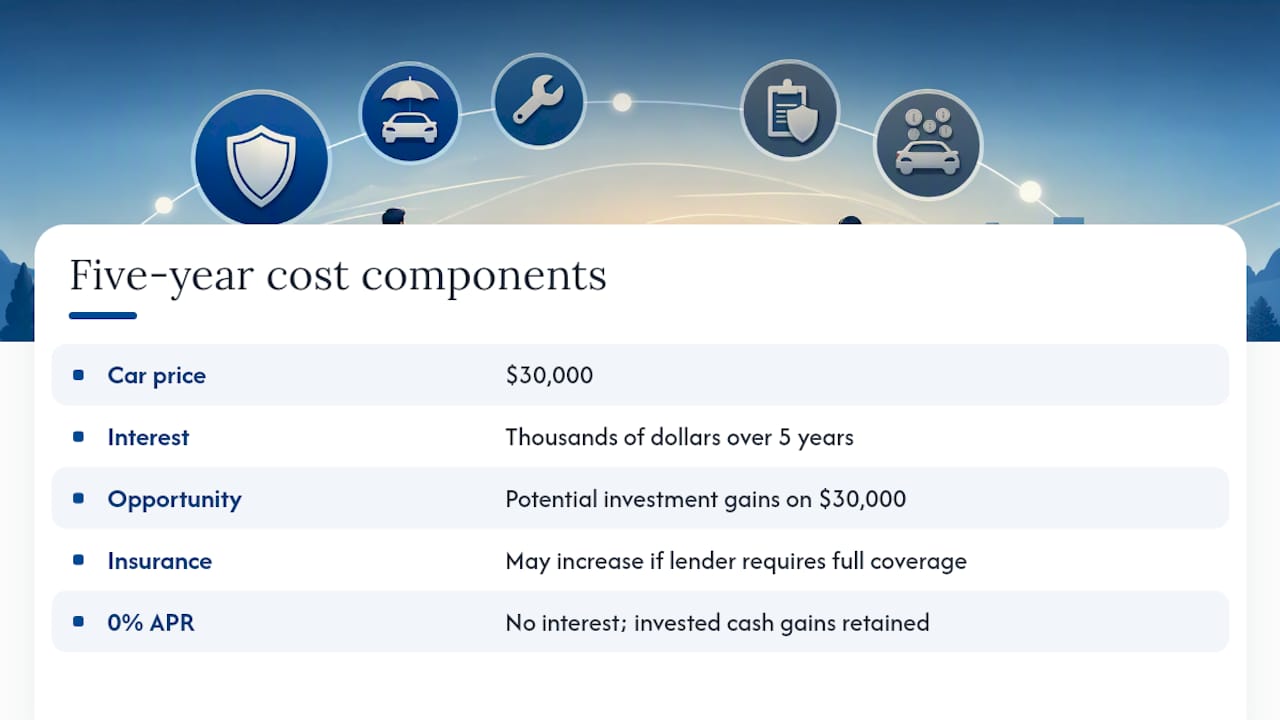
At a typical APR for used-car loans, you'd pay thousands of dollars in interest over five years. That's the baseline cost of financing instead of paying cash.
Now run the opportunity-cost side. If you paid cash instead of financing, that $30,000 stays invested. If it earns a moderate annual return in a high-yield savings account or conservative investment, five years of compounding can generate a substantial gain. myFICO's calculator guidance makes this exact point: if the after-tax cost of borrowing is lower than the return on invested cash, financing can come out ahead even when you could pay cash outright.
The math tilts hard toward financing when a 0% APR promotion is on the table. In that scenario, there's no interest to offset, so any return on your invested cash is pure upside. Investopedia points out that rebates tied to financing can also change the math, since some manufacturers only apply cash-back incentives to financed deals, not cash purchases.
Don't forget the variables that shift these numbers: sales tax, title fees, and destination charges apply regardless of payment method, but insurance costs rise if a lender requires full coverage you wouldn't otherwise carry.
Where Should You Get Your Car Loan?
Financing routes aren't identical, and picking the wrong one costs you real money over the loan term. You have three basic paths: banks, credit unions, online lenders, or financing arranged directly through the dealership.
- Credit unions and banks often offer lower APRs than dealer financing, especially for buyers with strong credit, and credit union auto loans tend to carry fewer add-on fees.
- Online lenders move fast and let you compare multiple offers without visiting a branch, which is useful if you want rate shopping across several lenders before you ever step onto a lot.
- Dealer-arranged financing can be competitive, particularly with manufacturer-subsidized rates, but it can also carry a markup over the wholesale rate the dealer receives from its lending partner. Understanding how dealer-arranged financing works helps you spot that markup before signing.
Getting preapproved before you shop changes your negotiating position entirely. The FTC recommends comparing APR, loan term, and total cost rather than fixating on the monthly payment alone, since a lower payment stretched over a longer term often costs more overall. Preapproval also gives you a firm number to negotiate against if the dealer tries to beat your outside offer.
When comparing offers, look past the headline APR. Check for origination fees, prepayment penalties, and the exact loan term in months. A 72-month loan lowers your payment but adds years of interest compared to a 48-month term at the same rate.
Pro Tip: Ask every lender for the total finance charge in dollars, not just the APR. Two loans with similar rates can carry very different total costs depending on fees baked into the contract.
How Do You Decide: Cash or Financing?
Run through this sequence before you commit to either path.
- Check your emergency fund first. If paying cash would leave you with less than three months of expenses in savings, lean toward financing regardless of the APR.
- Compare the loan's APR to your realistic after-tax return on the same money if left invested or saved. If the APR is lower, financing likely wins.
- Confirm the out-the-door price, including tax, title, and fees, before factoring in payment method at all.
- Get an insurance quote for the specific vehicle, since financed vehicles usually require full coverage that a cash purchase might not.
- Ask the lender directly: What's the APR? What's the total finance charge? Is there a prepayment penalty? Are there dealer incentives only available with financing?
Watch for red flags if offers vary widely between lenders. A gap larger than a point or two in APR for the same credit profile often signals a dealer markup rather than a true market rate.
The simplest rule-of-thumb: pay cash if you're comfortable after preserving your emergency fund and the loan APR exceeds what you'd realistically earn elsewhere. Finance if the APR is meaningfully lower than your opportunity cost, or if liquidity matters more to you than saving on interest.

Pro Tip: If your emergency fund and loan comparison land in a toss-up, a larger down payment with a shorter loan term often splits the difference. You limit total interest while keeping some cash on hand.
How Do You Protect Your Negotiating Leverage?
Timing matters more than most buyers realize. Negotiate the vehicle's price to a final, out-the-door number before you tell the dealer how you're paying. KBB's guidance is clear on this: revealing cash upfront can actually cost you leverage, since some dealers make more margin on financed deals through lender incentives.
- Keep financing "on the table" during negotiations, even if you plan to pay cash, since dealers sometimes offer better pricing when a finance option is still open.
- For large purchases, expect the dealer to require a cashier's check or wire transfer rather than physical cash. Experian confirms this is standard practice for safety and anti-money-laundering reasons.
- Confirm accepted payment methods, required identification, and any daily transaction limits with the dealer before you arrive.
- Ask whether any advertised rebates or incentives require financing, since some do.
How Autovendorsfl Helps You Run the Numbers
Autovendorsfl works through these scenarios directly with buyers, running cash-versus-financing comparisons against real inventory rather than generic estimates. That means checking your emergency fund status, comparing available APRs, and arranging secure payment methods once you've decided. Our personalized vehicle finding assistance pairs with a curated inventory of quality and luxury models, so the math you run applies to the actual car you want. For deeper explanations of loan structures and preapproval strategy, our blog resources cover auto loan structures in more detail.
Get Help Running Your Numbers Before You Buy
Deciding between cash and financing gets a lot easier when someone runs the actual numbers against a real vehicle instead of a hypothetical one. Autovendorsfl offers a free consultation to compare your cash and financing scenarios side by side, using current APR offers and the specific vehicle you're considering from our inventory.
Our team helps with preapproval, arranges secure payment methods like cashier's checks or wire transfers, and handles trade-in valuations if you're rolling equity from a current vehicle into your next purchase. If you're weighing a pre-approval strategy for luxury financing, our finance team can walk you through it before you set foot on the lot. Reach out through our inventory search page to schedule a consultation and get a firm out-the-door price on the vehicle you have in mind.
What Auto Financing Really Means for You
Cash purchases can be right, and so can financing. The industry-standard framing financial advisors use is minimizing total cost versus preserving flexibility, and most articles stop there, as if it's a purely personal preference. It isn't. The math has a right answer for your specific situation, and it changes month to month as APRs and savings yields move.
What gets underestimated is how often the "optimal" choice is neither pure cash nor pure financing, but a blend: a substantial down payment paired with a shorter loan term. That approach caps your interest exposure while keeping a real cushion in savings, and it's a more honest reflection of how most people actually manage risk than the all-or-nothing framing you'll find in most comparisons.
The other blind spot: buyers fixate on the interest rate and forget that financing often triggers a full-coverage insurance requirement they wouldn't otherwise carry. That's a real monthly cost, and it belongs in the same spreadsheet as the loan payment, not treated as a separate line item you deal with later. Run both numbers before you decide, not after.
— Allen
This article is general information, not a substitute for advice from a qualified financial advisor. Consult a qualified financial professional about your own circumstances before acting on anything here.
Sources
- Financing or leasing a car | Consumer FTC
- Should I finance or pay cash for a car? — Experian
- Vehicle financing vs paying cash calculator — myFICO