
Positive trade equity is the gap between what your car is worth and what you still owe on it. Say your trade is worth more than your loan payoff. The difference is yours to use. You can apply it as a down payment to shrink your new loan, take it as a check if you're not buying, or let it lower the taxable price of your next vehicle in states that tax net purchase price.
TL;DR:
- A positive trade-in equity occurs when your car’s value exceeds your remaining loan balance, giving you cash that can be used as a down payment, cash back, or to lower tax liabilities.
- Knowing your exact payoff amount through a 10-day quote and obtaining written dealer offers before visiting can prevent surprises and strengthen your negotiation position.
- Preparing your vehicle with detailed maintenance records, cosmetic repairs, and thorough cleaning increases your trade-in value and reduces appraisal risks.
- Separating trade-in negotiations from new vehicle pricing avoids dealer tactics that inflate the overall deal and dilute your equity.
- Applying your positive equity as a down payment usually results in better loan terms and lower interest rates, especially if timed during the middle of your loan term or before significant depreciation.
Table of Contents
- What Is Trade In Positive Equity and How Do Dealers Apply It?
- How Do You Calculate Your Positive Equity Before Visiting Dealers?
- What Tactics Protect and Increase Your Trade-In Equity?
- Paperwork Checklist: Confirming Your Payoff and Credit
- How Trade-Ins Affect Sales Tax and Your Options for Using Equity
- One-Page Checklist to Bring to the Dealership
- Common Pitfalls and Fees That Eat Into Your Equity
- How Positive Equity Changes Your New Loan Terms
- When Is the Right Time to Trade In a Car With Positive Equity?
- Market Value vs. Payoff: Which Number Actually Matters?
- Strategies to Maximize Your Equity Before You Trade
- Why Auto Vendors Inc Recommends These Steps
- Get a Written Trade-In Offer Before You Decide Anything
- Sources
- FAQ
What Is Trade In Positive Equity and How Do Dealers Apply It?
Trade equity is simply your vehicle's trade-in value minus your remaining loan balance, and when that number is positive, it becomes cash you control in the deal. Phroogal's glossary uses a clean example: a car worth $15,000 with a $12,000 payoff nets $3,000 in positive equity. If you own your vehicle outright, the entire appraisal figure becomes equity to use however you want.
Dealers typically set trade-in value using a mix of wholesale auction data, valuation guides like Black Book or NADA, and a physical inspection covering mileage, condition, and accident history. Once you agree on a number, the transaction flow generally runs in this order:
- Dealer appraises your trade and proposes a value.
- Dealer contacts your lender for the exact loan payoff.
- The payoff is subtracted from the trade value.
- Any surplus, your positive equity, gets applied to the new deal or paid to you directly.
Here's the part most buyers miss: a dealer generous on trade-in value can quietly claw it back by raising the price of the new car or padding the interest rate. That's why how luxury vehicle trade-in appraisal works matters as much as the appraisal number itself. Treat every figure in the deal as separate and negotiable, not as one bundled monthly payment.
How Do You Calculate Your Positive Equity Before Visiting Dealers?
Knowing your real equity number before you set foot on a lot puts you in control of the negotiation instead of reacting to whatever the finance manager quotes you. Follow these steps:
- Call your lender and request a 10-day payoff quote, not your last statement balance.
- Get at least one written offer from a dealer, ideally one who specializes in your vehicle type.
- Pull a free online estimate (Kelley Blue Book or a similar tool) as a sanity check, not gospel.
- Subtract your 10-day payoff from the written trade offer to get your usable equity.
A quick example: your written offer is higher than your 10-day payoff, and the difference is your usable equity. That figure changes fast if your car carries a salvage title, needs tires, or has an outstanding recall repair, so factor those in before you get attached to a number.
Pro Tip: A 10-day payoff includes interest that accrues during the lender's processing window, so it's almost always higher than your monthly statement balance. Using the statement number instead can leave you short by a few hundred dollars after the dealer sends payment.
For a full walkthrough on requesting this quote, U.S. owners can review this payoff guide before calling their lender.
What Tactics Protect and Increase Your Trade-In Equity?
A little preparation before appraisal day routinely adds hundreds of dollars to your offer, and a little discipline at the negotiating table keeps that money from disappearing into someone else's column.
Before you arrive:
- Gather service records. Documented maintenance and small mechanical repairs consistently improve how appraisers judge condition.
- Wash, detail, and photograph the car, inside and out, including the undercarriage if it's clean.
- Fix cheap cosmetic issues (a cracked taillight, a missing floor mat) that cost little but signal neglect to an appraiser.
- A pre-purchase style inspection, similar to what buyers get on a used car pre-purchase inspection, can also flag issues worth fixing before appraisal.
At the dealership: negotiate the price of the new vehicle to a firm number first, completely separate from any trade-in discussion. Only after that number is locked in should you present your trade for appraisal. Negotiating this way prevents a dealer from quietly inflating the sale price to offset a strong trade offer. For more scripts and phrasing, this guide to negotiating a used luxury car breaks down how to hold your ground.
A private sale usually nets a higher gross price than a dealer trade, since you're cutting out the dealer's resale margin. But the trade-in route wins on convenience and, in most states, on tax savings, which often closes the gap entirely.
Paperwork Checklist: Confirming Your Payoff and Credit
The two documents that matter most here are the 10-day payoff quote and the itemized buyer's order. The payoff quote is the number your dealer sends to your lender; comparing it against your monthly statement shows you exactly how much interest accrues during processing, which is the gap that causes most post-sale surprises.
Your buyer's order should show:
- Trade-in value listed as its own line item, separate from the new vehicle's price.
- The exact payoff amount sent to your lender.
- Positive equity applied, whether as a down payment credit or a check issued to you.
- A limited power of attorney authorizing the dealer to handle your old title, if your state requires it.
Federal rules under the FTC's CARS framework require dealers to disclose clearly when a monthly payment quote assumes a trade-in value, so an itemized order isn't just good practice. It's your paper trail if a number doesn't match what was promised. Confirm with your old lender within a week or two that the payoff posted; if it hasn't, follow up immediately rather than assuming the check is in the mail.
How Trade-Ins Affect Sales Tax and Your Options for Using Equity
Many states calculate sales tax on the price of your new vehicle after subtracting your trade-in credit, not on the full sticker price. That means applying equity as a trade-in credit can lower your tax bill in a way that taking cash outright cannot, since a cash-out payment gets taxed as ordinary income on the deal rather than netted against the purchase price.
State rules vary widely on this, so check specifics through a state-by-state trade-in tax guide before assuming your state offers the same treatment as your neighbor's.
Beyond the tax question, you have three practical paths for your equity:
- Apply it entirely as a down payment to shrink your new loan principal.
- Split it: part down payment, part cash back at closing.
- Take the full amount as a dealer check if you're not buying immediately.
One-Page Checklist to Bring to the Dealership
Print this or save it to your phone before your appointment:
- Your 10-day payoff quote, printed or emailed from your lender.
- Service records and any recent repair receipts.
- Driver's license and current vehicle registration.
- Lien information (lender name, account number, payoff address).
- A written offer from at least one other source for comparison.
Watch for two red flags during the appraisal: a salesperson who only wants to talk monthly payment instead of itemized numbers, and any refusal to put the trade-in value and payoff amount in writing before you sign. Both are signs your equity might get absorbed into the deal instead of credited to you. Before you leave, ask to see confirmation that the payoff was sent to your old lender and that any surplus appears as a specific line on your buyer's order.
Common Pitfalls and Fees That Eat Into Your Equity
Doc fees, title transfer fees, and registration costs get subtracted from your deal somewhere, and if you're not watching closely, they get quietly folded into your trade-in credit instead of your cash due at signing. Ask for a full fee breakdown before agreeing to any number.
Prepayment penalties on your old loan are another hidden cost. They're rare on newer auto loans but still show up occasionally, and they reduce your usable equity dollar for dollar. Confirm with your lender whether one applies before you calculate your net figure.
Salvage titles, branded titles, and undisclosed accident history can also collapse an equity estimate fast. An appraiser who spots frame damage or a rebuilt title mid-inspection will often cut the offer well below what an online estimator suggested, since those tools rarely account for title history.
Finally, watch for dealers who negotiate purchase price and trade-in value as one combined number. This is the single most common way equity gets diluted. If a salesperson keeps steering the conversation back to "what payment works for you," that's a cue to pause and ask for the trade-in value and vehicle price in writing, separately, before continuing.
How Positive Equity Changes Your New Loan Terms
Applying positive equity as a down payment does more than just lower your out-of-pocket cost at signing. It reduces your loan-to-value ratio on the new vehicle, which lenders weigh heavily when setting your interest rate. A lower loan-to-value ratio often qualifies you for a better rate tier, particularly if your credit sits in a borderline range between two pricing brackets.
A larger effective down payment also shortens the gap between what you owe and what the car is worth from day one, which matters if you're financing a vehicle that depreciates quickly. It lowers your risk of sliding into negative equity again if you need to trade before the loan is paid down. If you're curious how that scenario plays out, this breakdown of negative equity in auto trades covers what happens when the math runs the other direction.
Equity applied as cash back, rather than a down payment, doesn't touch your loan terms at all. It's simply money in hand, taxed and disbursed separately from the new purchase. If your goal is the lowest possible monthly payment or the shortest loan term, directing equity into the down payment is almost always the stronger move over taking a check and financing the full purchase price.
When Is the Right Time to Trade In a Car With Positive Equity?
Timing matters more than most owners realize. Positive equity tends to peak somewhere in the middle of a loan term, after enough payments have chipped away at the balance but before depreciation catches up to what you owe. Waiting too long to trade, especially past the 60,000 to 70,000-mile range on many vehicles, often means your car's market value is dropping faster than your remaining balance.
Seasonal demand shifts also affect what you can extract from a trade. Convertibles and SUVs typically command stronger trade offers in spring and early summer, while trucks and all wheel drive vehicles see demand spikes heading into fall and winter in colder states. If your equity position is already solid, timing the trade around seasonal demand for your specific vehicle type can add meaningfully to the offer.
The other trigger worth watching is your loan's interest structure. Early in a loan, payments are weighted heavily toward interest, so equity builds slowly. Once you're past the halfway point, principal reduction accelerates and equity often grows faster than people expect. Running your numbers, current market value against current payoff, every few months rather than waiting for a "someday" trade-in date helps you catch the window while it's open.
Market Value vs. Payoff: Which Number Actually Matters?
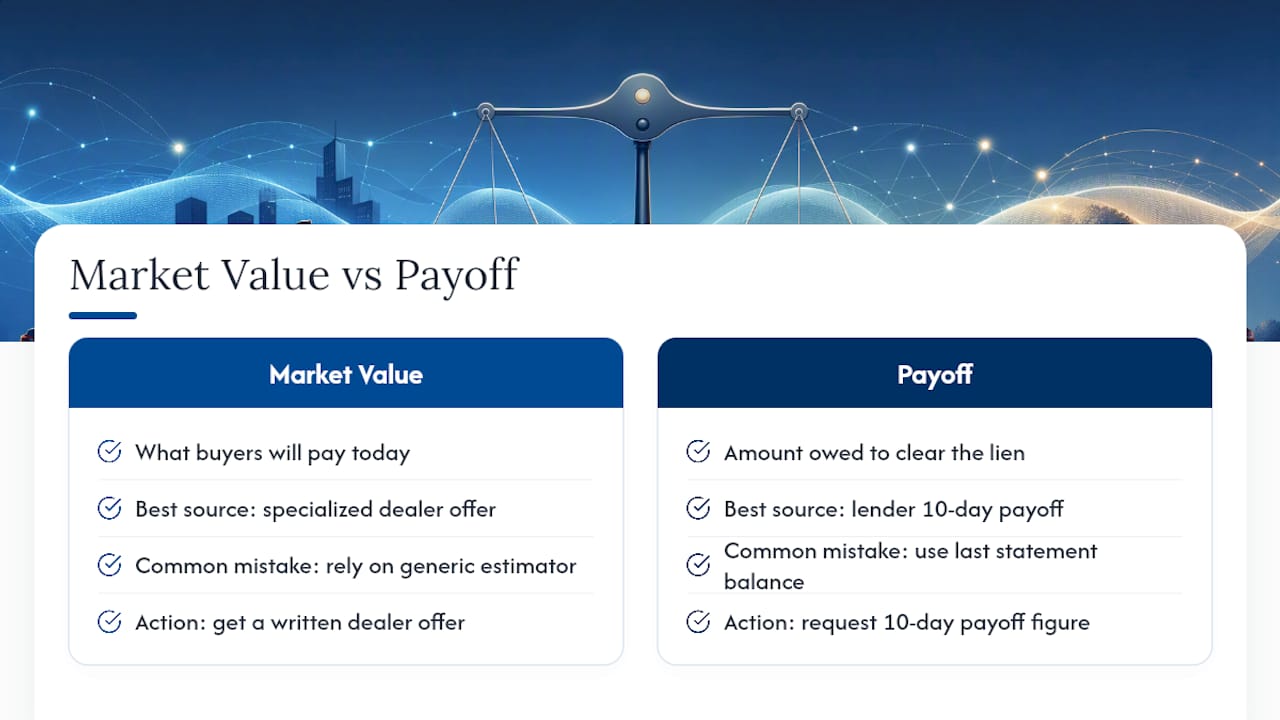
Two numbers drive every trade-in decision, and confusing them is one of the most expensive mistakes a seller can make. Market value is what your car is actually worth to a buyer today. Payoff is what you owe your lender to release the lien. Positive equity only exists when market value exceeds payoff, and the size of that gap determines your real negotiating leverage.
Estimating market value starts with an online tool, but treat that number as a starting point, not a conclusion. A written offer from a dealer who specializes in your vehicle type tends to reflect real demand more accurately than a generic estimator, since specialized dealers know how specific trims, mileage bands, and options move in their local market.
Your payoff number requires more precision than most owners expect. A monthly statement balance is not your payoff; it's your balance as of your last billing cycle, and interest keeps accruing daily after that. Requesting the 10-day payoff figure from your lender gives you the exact amount needed to clear the lien on a specific future date, which is the only number a dealer should be using to calculate your equity. Comparing a stale statement balance against a fresh market estimate is how sellers end up disappointed on delivery day when the numbers don't match what they expected.
Strategies to Maximize Your Equity Before You Trade
A few weeks of preparation before you ever sit down with a dealer can shift your equity position by hundreds of dollars, sometimes more on higher value vehicles.
Start with condition. Minor cosmetic repairs, a thorough detail, and fresh tires if yours are worn all move the needle on appraisal because they change how an inspector scores your car in the first ninety seconds of looking at it. Service records matter just as much; a folder of maintenance receipts tells an appraiser your car has been cared for, which reduces their perceived risk and often shows up directly in the offer.

Timing your loan payoff also plays a role. If you're close to a milestone where your balance drops below a round number, waiting a payment cycle or two before trading can meaningfully widen your equity gap, especially on loans with steep early interest.
Shopping your trade to more than one buyer, whether that's multiple dealers or a private sale comparison, gives you leverage even if you ultimately trade in. Knowing your car's private-party ceiling lets you recognize a fair dealer offer instantly instead of guessing. And always separate your trade negotiation from your purchase negotiation; bundling them is the single easiest way for a dealer to quietly recover margin from the equity you worked to build.
Why Auto Vendors Inc Recommends These Steps
Working through hundreds of trade-in appraisals over the years, I've noticed the same pattern again and again: sellers who separate their numbers, purchase price, trade value, and payoff, walk away with meaningfully more than sellers who negotiate on monthly payment alone. That's not a coincidence. It's how the math works when every figure is visible instead of bundled.
Some dealers provide written trade appraisals and handle lender payoff directly, so nothing gets buried in a combined number. If you're weighing negative equity against a trade, our negative equity guide covers that scenario too.
— Allen
Get a Written Trade-In Offer Before You Decide Anything
Some dealers offer a written trade-in appraisal with your equity itemized before you commit to anything, so you know your exact number instead of guessing at a monthly payment. That transparency is the whole point of an approach where a Car Finder service does the legwork of matching your equity to the right replacement vehicle instead of pushing whatever's on the lot.
Some dealers handle lender payoff directly and apply your positive equity where you want it, down payment, cash back, or a price reduction, with every figure documented on your buyer's order. If you're ready to see your real number, start with our Car Finder tool to browse curated inventory, or head straight to our current vehicles for sale if you already know what you're after. Sedan shoppers can browse our sedan inventory directly, and SUV buyers can do the same on our SUV inventory page. Request your written appraisal today and see exactly what your equity is worth.
This article is general information, not a substitute for advice from a qualified financial advisor. Consult a qualified financial professional about your own circumstances before acting on anything here.
Sources
- Trade Equity Definition & Meaning | Phroogal Financial Glossary
- What is a 10-day pay-off | OneMain Financial
- Trading a Financed Car: How Loans & Equity Impact Your Deal - Car Mechan
FAQ
Can I Get Cash Instead of Applying Equity to a New Car?
Yes. If your trade-in value exceeds your loan payoff and you're not buying a replacement vehicle, the dealer can issue you a check for the surplus. Confirm this in writing on your buyer's order before signing anything.
Is a Private Sale Better Than Trading In for Equity?
A private sale usually brings a higher gross price since there's no dealer margin built in, but a trade-in often wins on convenience and tax savings in states that tax the net purchase price after trade-in credit. Run both numbers before deciding, since the gap is sometimes smaller than expected.
How Long Does It Take for My Loan Payoff to Clear?
Most lenders process a dealer's payoff within one to two weeks of receiving payment, though a 10-day payoff quote is specifically calculated to stay accurate through that window. Follow up with your old lender if you don't see confirmation within two weeks.
Does Auto Vendors Inc Provide Written Trade-In Appraisals?
Yes, Auto Vendors Inc provides written trade-in appraisals with your equity itemized separately from the new vehicle's price. You can request one through our Car Finder service.
What Documents Do I Need to Bring to Trade In My Car?
Bring your 10-day payoff quote, vehicle registration, driver's license, and any service records you have. Lien information, including your lender's name and account number, speeds up the payoff process significantly.