
Yes, you can trade in or sell a car that still has a lien on the title. Dealerships handle this routinely. Your first move is to request a formal 10-day payoff quote from your lender and pull a trade-in valuation, so you know whether you're sitting on positive or negative equity. That single number determines your next step: apply the equity to your new purchase, cover a shortfall, or roll it forward. Bring the payoff quote and your paperwork so nothing stalls at the desk.
TL;DR:
- Confirm your 10-day payoff quote before visiting the dealer to verify the exact amount owed and avoid surprises during transactions.
- Keep making scheduled payments until the lender confirms the payoff has been processed and request written proof of completion.
- Calculate your equity by subtracting the payoff amount from your vehicle’s trade-in value, then use this figure to negotiated or determine your next move.
- In cases of negative equity, consider paying the shortfall out of pocket or selling privately to potentially recover more than trading in at a dealership.
- Proper documentation, including payoff letters, registration, and lien release letters, is essential to facilitate a smooth trade-in process and timely title transfer.
Table of Contents
- How Dealers Handle a Trade-In With a Lien
- Getting a Payoff Quote and Calculating Your Equity
- What Happens When Your Trade-In Has Positive Equity
- Owing More Than the Car Is Worth: Three Paths Forward
- Documents to Bring Before You Trade In or Sell
- How Long Payoff and Title Transfer Actually Take
- How Autovendorsfl Manages Lien Payoffs for Trade-Ins
- Why the "Just Trust the Dealer" Advice Falls Short
- Get a Lien Trade-In Appraisal From Autovendorsfl
- Where to Verify These Details Yourself
- Sources
How Dealers Handle a Trade-In With a Lien
Once you tell a dealership your vehicle has an outstanding loan, the process moves into a routine back office task. The finance manager contacts your lender directly, confirms the exact payoff figure, and often asks you to sign a limited power of attorney so the dealership can finish title paperwork on your behalf. This document does not hand over ownership. It authorizes the dealer to handle the narrow task of transferring title once the lien is cleared.
Payment to your lender typically moves by electronic transfer or certified check, and how fast that happens depends heavily on your state's title system. Some states run electronic lien and title systems that clear a payoff almost instantly. Others still rely on mailed paper titles, which stretches the timeline considerably.
Here's what matters most during that window:
- You remain legally responsible for the loan until your lender confirms the payoff, so keep making scheduled payments until you have written proof otherwise.
- Ask the dealer for a copy of the payment confirmation, including the method used, before you leave the lot.
- If you have negative equity, confirm in writing whether the dealership is paying the shortfall directly or rolling it into your new loan.
Pro Tip: Call your lender about a week after the trade to confirm the account shows as paid in full. Dealers occasionally submit payment late, and you don't want a missed payment showing up on your credit report over a paperwork delay.
Getting a Payoff Quote and Calculating Your Equity
Your loan statement balance and your actual payoff amount are rarely the same number. A payoff quote accounts for daily interest accrual and sometimes a small administrative fee, and it's only guaranteed for a set window, usually 10 days. Requesting one is simple:
- Call your lender or log into your loan servicing account and ask specifically for a "10-day payoff quote," not just your current balance.
- Get the payoff amount in writing, including the exact expiration date.
- Pull a trade-in estimate from KBB, Edmunds, or NADA Guides using your vehicle's real mileage and condition, not the best-case scenario.
- Subtract the payoff amount from the trade-in value to find your equity position.
Say your car appraises at $18,000 and your payoff quote reads $15,500. You're carrying $2,500 in positive equity. Flip those numbers, and you owe $2,500 more than the car is worth, which changes your entire negotiating strategy. Bring both documents to the dealership. A printed valuation and a current payoff letter give you leverage and prevent the finance office from lowballing either figure.
What Happens When Your Trade-In Has Positive Equity
Positive equity becomes real money you can put toward your next vehicle. Once the dealer pays off your existing lien, the leftover amount typically applies as a down payment on your new purchase, or you can request it as a check.
Most states only charge sales tax on the difference between your new vehicle's price and your trade-in value, which is one of the more overlooked reasons trading in beats a private sale for buyers replacing their vehicle right away, according to FTC guidance on trade-ins. A few states tax the full purchase price regardless of trade-in value, so it's worth checking your state's trade-in tax rules before assuming the savings apply to you.
- Insist your equity amount is itemized as its own line on the sales contract, not folded into a vague "discount."
- If your equity is substantial and you're not buying immediately, a private sale might net you more cash than a dealer trade-in would.
- Double check that any manufacturer rebate is applied separately from your trade-in credit.
Owing More Than the Car Is Worth: Three Paths Forward
Negative equity isn't rare, and it isn't a dead end either. You generally have three realistic options, each with different costs.
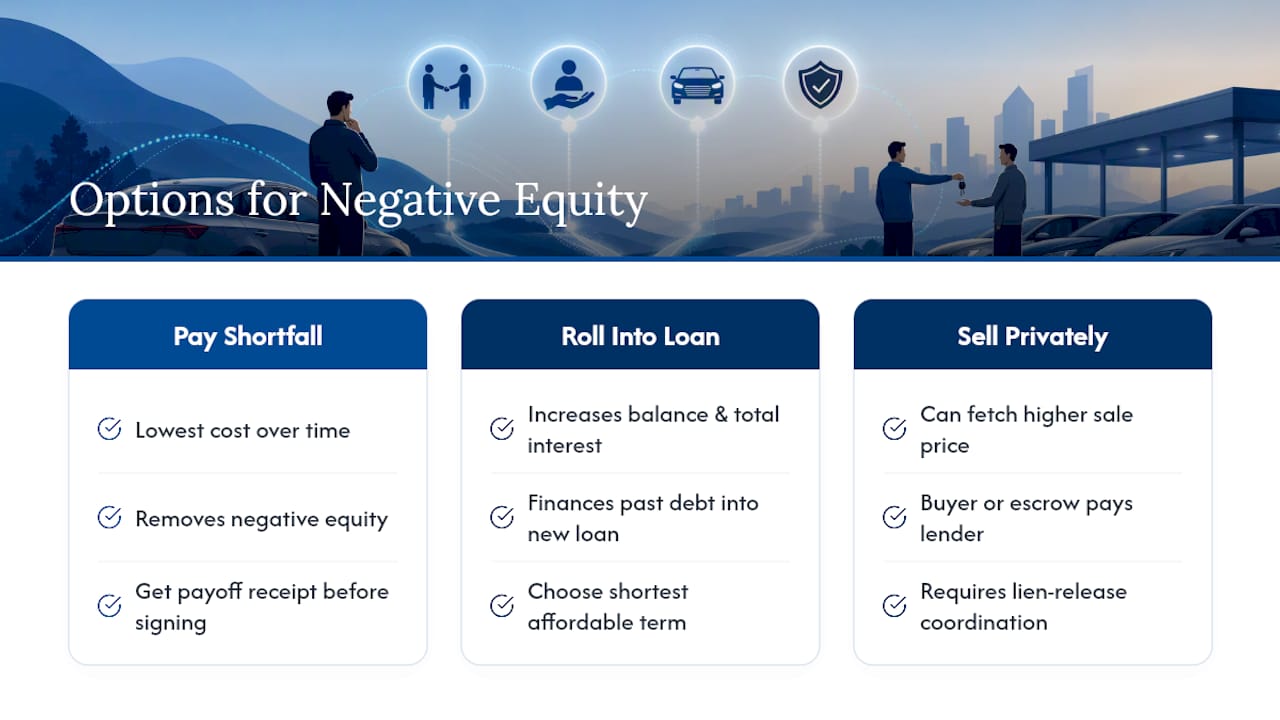
Pay the shortfall out of pocket. This is usually the cheapest route over time because you're not financing yesterday's debt into tomorrow's loan. Get a receipt showing the payoff was applied in full before you sign anything new.
Roll the difference into your new auto loan. Dealers do this constantly, but it stretches your loan balance and total interest paid, according to a CFPB data spotlight on negative equity. If you can't avoid this path, choose the shortest loan term you can afford and put down as much cash as possible to limit the damage. Our breakdown on negative equity in auto trades walks through the math in more detail.
Sell privately instead. A private buyer can pay your lender directly, or you can use an escrow service, which sometimes yields a higher sale price than a dealer trade-in offer. It also requires more coordination on your end, since you're managing the lien release yourself rather than handing that job to a finance office.
Pro Tip: If your loan carries a high interest rate and you have a few months before you plan to trade, look into refinancing or making extra principal payments first. Shrinking the payoff amount even slightly can flip you from negative to positive equity by the time you're ready to sell.

Documents to Bring Before You Trade In or Sell
Showing up prepared is the difference between a same-day trade and a week of phone tag. Gather these before you leave the house:
- Your 10-day payoff letter, including your lender's phone number and mailing address.
- Your current vehicle registration, and the title itself if you already hold it.
- A government-issued photo ID.
- Your loan account number.
- Any lien release letter you've already received, even a partial one.
If your title is electronic or still sitting with your lender, bring their contact information so the dealer's title clerk can verify the lien status directly through the state system. And if a dealer asks you to sign a limited power of attorney, understand that it's a narrow, standard authorization letting them complete title transfer paperwork on your behalf, nothing broader. A lien release letter can sometimes stand in for a missing paper title, letting the trade proceed while the state processes the official record.
How Long Payoff and Title Transfer Actually Take
Timing depends almost entirely on your state's title system. States running electronic lien and title programs can often confirm a lien release within days. States that still issue paper titles by mail can take two to six weeks for a clean title to arrive after the lender processes your payoff.
Verify the payoff actually went through rather than assuming it did:
- Call your lender a week or two after the trade and confirm the account shows a zero balance and is closed.
- Request written payoff confirmation from the dealer, including the payment method and date.
- Check your state's title record system online if one is available.
If payoff is delayed past your state's typical window, keep making any scheduled payments and request written proof of payment from the dealer. Dealerships that facilitate lien payoffs remain common and generally reliable, but if a dealer stalls or won't provide documentation, filing a complaint with the CFPB or FTC is a legitimate last resort.
How Autovendorsfl Manages Lien Payoffs for Trade-Ins
When you bring a financed vehicle to Autovendorsfl, our title team follows a structured process rather than treating your payoff as an afterthought. We contact your lender to confirm the exact 10-day payoff figure, coordinate the certified payment, and keep you informed at each stage rather than leaving you guessing.
- We request and document your payoff quote before finalizing your trade-in appraisal, so there are no last-minute surprises.
- Our title clerks track lender confirmation and provide written proof once your account is closed.
- We flag any negative equity clearly and walk you through your options rather than defaulting to rolling it into a new contract.
- Overpayments or refunds from your prior lender are tracked until they're resolved.
That level of follow-through matters most during the week or two after your trade, when most confusion about lien payoffs actually happens.
Why the "Just Trust the Dealer" Advice Falls Short
Most guidance on trading in a financed car stops at "the dealer will handle it," and that's technically true but incomplete. The real risk isn't whether a dealership can process a lien payoff. It's whether you verify that they did. A dealer submitting a certified check is not the same as your lender marking the account closed, and the gap between those two events is where problems surface, usually a missed payment notation or a lingering account that never got reported paid.

The equity math gets treated as an afterthought too. Buyers fixate on the trade-in number a dealer offers without first knowing their own payoff figure, which puts them at a negotiating disadvantage before the conversation even starts.
My honest read: get your 10-day payoff quote before you set foot on a lot, not after. Treat the written payoff confirmation as mandatory, not optional. And if you're carrying negative equity, decide your approach before you're sitting across from a finance manager, because that's the worst possible moment to make that decision under pressure.
— Allen
Get a Lien Trade-In Appraisal From Autovendorsfl
Autovendorsfl is the direct alternative to guessing your way through a private sale or navigating a lien payoff alone. We handle the lender communication, the title paperwork, and the payoff coordination in house, so you're not stuck chasing confirmations after the fact.
Bring your 10-day payoff quote and current registration, and our team will provide a no-obligation trade-in appraisal on the spot, factoring in your existing loan balance from the start. If you're shopping for a luxury or premium vehicle, we'll also apply our personalized vehicle-finding service to match you with something that fits once your trade is squared away. Any fees or timeline specifics tied to your payoff will be laid out clearly before you sign anything, so there are no surprises at closing. Reach out through our trade-in appraisal page to schedule a visit or start the process online.
Where to Verify These Details Yourself
- The CFPB's guide on trading in unpaid vehicles covers payoff timing and equity comparisons.
- The FTC's page on trade-ins and negative equity explains shortfall handling and disclosure protections.
- KBB, Edmunds, and NADA Guides remain the standard tools for pulling a realistic trade-in valuation before you negotiate.
Sources
- Should I trade in my car if it’s not paid off? | CFPB
- Auto trade-ins and negative equity: When you owe more than your car is worth | FTC
- Yes, you can sell a car with a lien — here’s how | Bankrate