
What a vehicle provenance report means and its core components
A vehicle provenance report is a comprehensive, chronological record of a car's entire life, from its original manufacture through every ownership transfer, restoration, and documented event up to the present day. Think of it as a biography for a vehicle, one that answers not just "is this car legally clean?" but "is this car genuinely what the seller claims it is?"
Where a basic title check tells you a car's current legal status, a provenance report tells you its full story. The distinction matters most when authenticity and long-term value are on the line.
A complete provenance report typically covers:
- Ownership history: Every registered keeper, with dates, regions, and transfer circumstances
- Maintenance and service records: Scheduled work, specialist invoices, and documented repairs
- Authenticity evidence: Matching VIN and engine numbers, factory build sheets, original keys, and window stickers
- Restoration documentation: What was changed, by whom, and when
- Legal and financial status: Outstanding finance, theft flags, insurance write-offs, and branded title history
- Incident and accident history: Reported collisions and damage beyond what basic databases capture
Together, these elements establish a verifiable chain of custody that supports both buyer confidence and accurate valuation.

Why vehicle provenance matters in the US market today
Provenance functions as a price multiplier. A vehicle with a clean, verifiable history reduces buyer risk and supports a higher asking price, while a car with gaps in its story often sells at a discount, regardless of how it looks in photos. For collector car buyers, provenance transforms a vehicle from a used asset into a documented investment.
The US government recognizes the consumer protection value of documented vehicle histories. The National Motor Vehicle Title Information System (NMVTIS), administered under US Department of Justice guidelines, is the only publicly available system in the United States to which all insurance carriers, auto recyclers, junk yards, and salvage yards are required by federal law to report. It captures branded titles, salvage designations, and odometer readings, giving buyers a federally backed baseline for fraud prevention.
Pro Tip: Before negotiating price on any used vehicle, pull an NMVTIS report first. A branded title, even one that was "washed" through a retitling in another state, often appears in the federal database when it would not show on a private database alone.
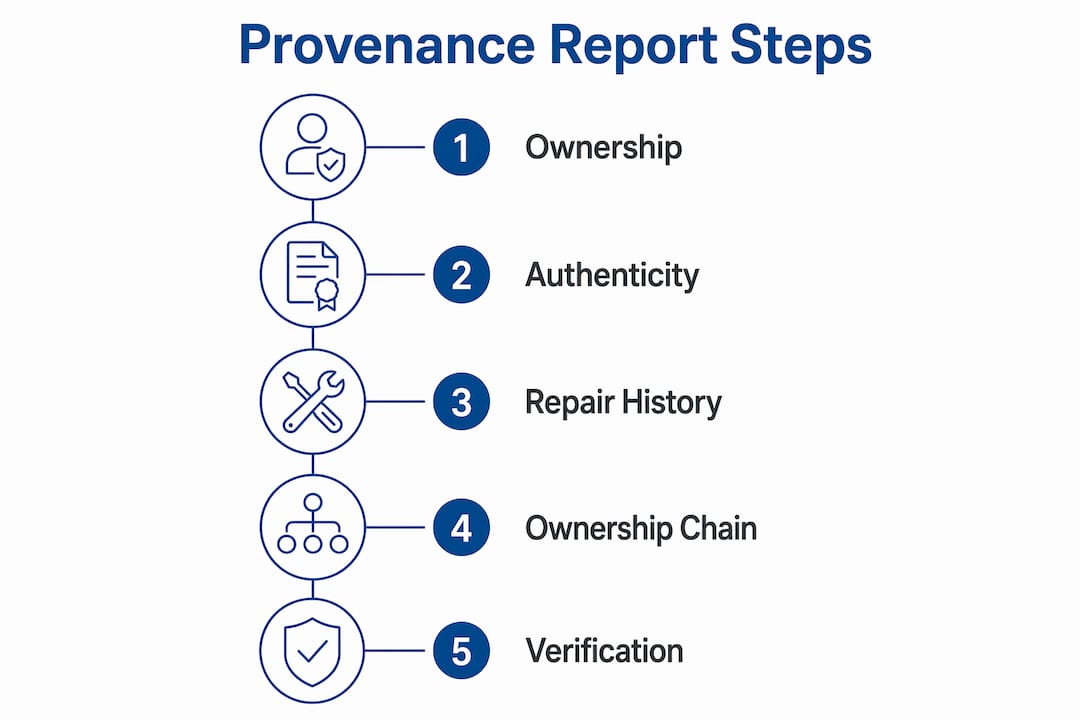
Buyer demand for documented histories has grown alongside the luxury and collector car market. Authenticity via provenance attracts discerning buyers and supports higher resale value, particularly in segments where originality is a core part of the vehicle's appeal.
Key elements found in vehicle provenance reports
A provenance report goes deeper than a standard vehicle history report in several specific ways. Understanding each category helps you read the document critically rather than just scanning for red flags.
| Category | What it covers |
|---|---|
| Ownership chain | Every registered keeper, transfer dates, and geographic history |
| Service and maintenance | Dated invoices, mileage at service, shop or specialist details |
| Authenticity markers | Matching numbers, factory paperwork, original components |
| Restoration records | Parts replaced, bodywork performed, paint history |
| Legal and financial status | Outstanding finance, theft reports, write-off or salvage brands |
| Incident history | Reported accidents, damage assessments, repair quality notes |
Ownership history with dates and regions is particularly telling. A car that changed hands four times in two years, or one that spent time in a flood-prone region, raises questions a seller's verbal assurances cannot answer.
Authenticity evidence, including "matching numbers" confirmation, matters most in the collector segment. As vintage car researchers note, provenance research traces ownership and location from a vehicle's creation to the present, using bills of sale, titles, auction catalogs, and even personal photographs from prior owners.
One limitation worth knowing: provenance reports may lack minor repair records and can reflect database update delays. A car repaired last month may not yet appear in any report.
How to verify and interpret vehicle provenance effectively
Cross-referencing documents is the first step. Ownership dates on the title should align with service records. Mileage figures across invoices, MOT equivalents, and registration documents should form a consistent progression. Any gap or contradiction deserves a direct question to the seller.
Pro Tip: Ask for primary sources, not just database printouts. Owner photographs, handwritten service notes, and specialist invoices are harder to fabricate than a digital summary and carry more weight with professional appraisers.
Physical inspection remains non-negotiable. Neither a provenance report nor a vehicle history report substitutes for a pre-purchase inspection by a qualified mechanic. Reports capture documented events; a mechanic assesses current mechanical condition, wear, and hidden damage that no database records.
A few specific things to watch for when reviewing a provenance report:
- Gaps in service history that coincide with high-mileage periods
- Ownership transfers that lack supporting documentation
- Restoration claims without corresponding invoices or photos
- Inconsistencies between the VIN on the report and the physical chassis plate
Expert collectors often prioritize primary research, including owner testimonies and original photographs, over secondary database summaries when validating authenticity. For guidance on inspecting a pre-owned luxury vehicle, combining document review with a hands-on physical check is the standard approach among experienced buyers.
How provenance reports and vehicle history reports differ
These two document types answer fundamentally different questions, and confusing them leads buyers to either overpay for false confidence or miss critical authenticity issues.
A vehicle history report focuses on present legal and financial status. It captures ownership records, accident history, service snapshots, and title status, but it is a point-in-time snapshot. Reports only show the latest event submitted to reporting companies, meaning a vehicle could be wrecked, repaired, and resold before the incident appears in any database.
A provenance report provides the longitudinal record. It answers whether the car is what the seller says it is, not just whether it is currently free of liens.
Key distinctions:
- History reports verify legal and financial cleanliness at a moment in time
- Provenance reports establish authenticity, chain of custody, and the full ownership narrative
- Both miss unreported incidents, DIY repairs, and minor damage below reporting thresholds
- Neither replaces a physical inspection for current mechanical condition
For everyday used car purchases, a history report often suffices. For luxury vehicles, classics, or any car where originality affects value, provenance documentation is what separates a confident purchase from a costly assumption. Learn more about how vehicle pedigree affects pricing in the luxury segment.
Expert insights from Autovendorsfl on provenance in luxury vehicle purchases
Autovendorsfl, based in Fort Lauderdale, has built its reputation on curating premium and luxury vehicles with documented histories. The team's perspective on provenance reflects years of hands-on experience in a market where authenticity directly determines value.
Provenance is not a formality for luxury and collector vehicles. It is the foundation of the purchase decision. When a buyer can trace every keeper, every service visit, and every restoration with supporting paperwork, they are not just buying a car. They are buying certainty. That certainty protects their investment at resale and makes ownership genuinely satisfying rather than a source of ongoing doubt. At Autovendorsfl, we integrate provenance review into every acquisition because our buyers deserve to know exactly what they are getting.
This approach reflects a broader truth in the collector and luxury market: provenance increases buyer confidence and reduces risk by providing a verified story behind a vehicle's ownership and care. For buyers exploring exotic car provenance, the documentation standard is even higher, with factory build sheets, concours records, and specialist histories all contributing to the final valuation.
The origin of "provenance" and how it applies to vehicles
The word "provenance" comes from the French provenir, meaning "to come from." Art historians and museum curators used it for centuries to describe the documented chain of ownership for a painting or artifact, establishing both authenticity and legal title. The automotive world borrowed the concept directly.
Applied to vehicles, provenance means a verifiable, chronological story emphasizing authenticity and chain of custody. Vintage car researchers describe it as tracing a car backward from the present to its creation, closing gaps in ownership and condition along the way. The goal is not a perfect paper trail, which rarely exists for older vehicles, but a consistent, credible record that holds up under scrutiny.
Gaps in provenance do not automatically signal a problematic past. Professional appraisers distinguish between missing data, which is common in older vehicles, and suspicious inconsistencies, which suggest concealment. A car with three well-documented owners and one undocumented decade is a different risk profile than a car whose mileage figures contradict each other across multiple records.
Key Takeaways
A vehicle provenance report establishes authenticity and chain of custody, going well beyond what a standard history report captures, and is especially critical for luxury and collector vehicle purchases.
| Point | Details |
|---|---|
| Provenance vs. history reports | Provenance documents authenticity and full ownership narrative; history reports verify current legal and financial status. |
| NMVTIS as a baseline | The federally mandated NMVTIS system captures branded titles and salvage records that private databases may miss. |
| Primary sources carry more weight | Owner photos, handwritten invoices, and specialist records are harder to fabricate than database summaries. |
| Physical inspection is still required | No report, provenance or history, replaces a qualified mechanic's pre-purchase inspection of current condition. |
| Gaps are not automatic red flags | Missing documentation is common; appraisers look for inconsistencies, not just absences, when assessing risk. |