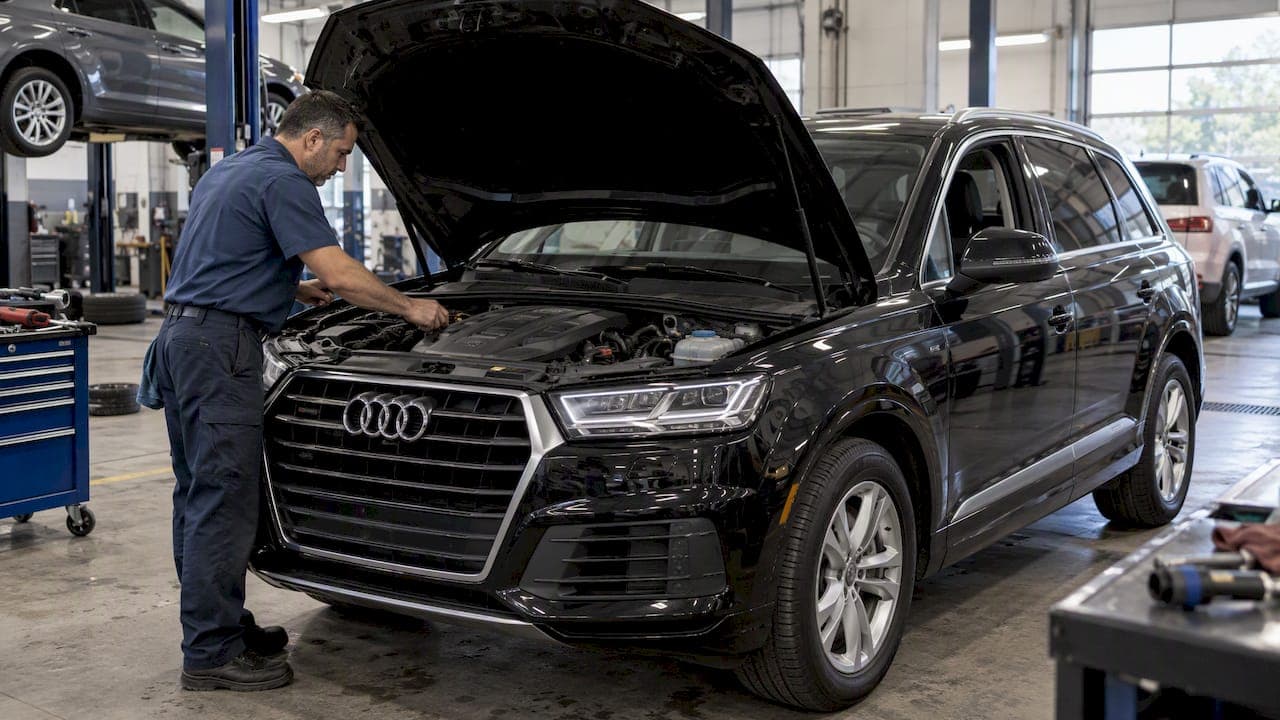
Short verdict: the Audi Q7 is a capable, well-engineered luxury SUV, but its real-world reliability is mixed. Ownership costs run higher than average, and several expensive failure modes tend to surface after roughly 50,000 miles, particularly in the air suspension, electronics, and engine. Maintenance discipline and model-year choice make the biggest difference in how that risk plays out.
TL;DR:
- RepairPal estimates annual repairs at $1,185, while air suspension, engine, and electronic problems become more common between 50,000 and 80,000 miles.
- Treat 2017 cautiously, and compare 2018 with later years; complete service records and resolved recalls offer better evidence than model year alone.
- Before buying, cycle the air suspension through its ride settings, check for sagging, and scan diagnostic codes; compressor and strut repairs can cost several thousand dollars.
- Rotate tires every 6,000 miles and keep tread depth even across all four, because mismatched tires can strain the quattro center differential.
- Check the specific VIN for open rearview camera software or airbag recalls, since exposure varies by production date and not every Q7 is affected.
Table of Contents
- Audi Q7 Reliability by the Numbers: RepairPal, Consumer Reports, and iSeeCars
- Common Q7 Problems by System and What Repairs Really Cost
- Which Audi Q7 Years to Avoid and Which Ones to Trust
- Audi Q7 Maintenance Costs: What to Budget and When
- Pre-Purchase Inspection Checklist for a Used Audi Q7
- How We Approach Inspecting a Used Luxury SUV Like the Q7
- Car Finder and Inspected Luxury SUV Inventory
- FAQ
- Sources
Audi Q7 Reliability by the Numbers: RepairPal, Consumer Reports, and iSeeCars
Three independent data sources tell a consistent story: the Q7 is a mid-pack performer with above-average repair costs. RepairPal rates the Audi Q7 2.5 out of 5 for reliability, with an average annual repair cost of $1,185 and close to one unscheduled repair visit per year. That rating places the Q7 behind many mainstream midsize SUVs, though not unusually far behind other European luxury models.
RepairPal puts the Audi Q7's average annual repair cost at $1,185, a figure that reflects both routine upkeep and the unscheduled fixes that show up as the SUV ages.
Longevity data paints a similar picture. iSeeCars' survival-model analysis estimates the average Q7 lifespan at about 124,120 miles, or roughly 9.3 years of typical use. That is a reasonable number for a luxury SUV, though it trails the mileage ceilings common among Japanese and domestic competitors.
Consumer Reports' owner-survey data breaks trouble spots into categories rather than a single score, and the Q7's recurring weak points cluster in a few predictable areas:
- Suspension and steering components show up repeatedly in owner-reported trouble spots.
- Electrical accessories, including infotainment and sensor-related systems, are a frequent complaint category.
- Brakes appear often enough to warrant attention during routine service.
- Fuel system and emissions-related issues round out the list of recurring categories.
Recalls add another layer worth checking before buying. Consumer Reports' recall summary notes campaigns tied to rearview camera software and airbag systems on certain model years. Since recall exposure varies by VIN and production date, the sensible step is to run your specific VIN through a recall lookup before finalizing a purchase, rather than assuming your car matches a general pattern.
Common Q7 Problems by System and What Repairs Really Cost
The Q7's failure modes aren't random. They cluster around a handful of systems, and knowing where to look saves both money and frustration.
Engine issues. Oil consumption and misfires are the most frequently reported engine complaints. CarComplaints documents model-year clusters where owners reported catastrophic engine failures carrying high repair costs, with the 2017 model year standing out for both frequency and severity. Watch for blue exhaust smoke on startup, rough idle, or a check-engine light tied to misfire codes. These symptoms rarely resolve on their own and tend to worsen with mileage.

Air suspension. This is the single most expensive system to repair on a Q7 equipped with adaptive air suspension. Failure typically shows up as the vehicle sitting unevenly, a rough ride, or a dashboard warning about suspension faults. RepairPal's cost estimator lists air suspension compressor and strut replacement among the priciest repairs on the vehicle, with a full compressor-and-strut job that can cost several thousand dollars. Cycling through all ride-height modes during a test drive is the simplest way to catch a failing system before you own it.
Brakes. Squealing brakes tied to certain years appear often enough in CarComplaints' model-year breakdowns to be worth a dedicated check, particularly on 2017 models. Pad and rotor replacement on a Q7 tends to be more expensive than on a mainstream SUV due to larger components, so budget accordingly if you hear noise during braking.
Electronics and infotainment. Glitchy displays, unresponsive touch controls, and sensor warning lights that clear and reappear are common quirks. Most are software-related rather than catastrophic, but a dealership software update or module reset is often the first troubleshooting step before assuming a part needs replacement.
| System | Common symptom | Typical repair cost range |
|---|---|---|
| Air suspension (compressor/strut) | Uneven ride height, suspension warning | several thousand dollars |
| Brakes | Squealing, especially on 2017 models | Several hundred dollars per axle |
| Engine (oil consumption/misfire) | Blue smoke, rough idle, check-engine light | Ranges widely; severe cases run high |
| Electronics/infotainment | Display glitches, intermittent warnings | Often resolved with software updates |
Pro Tip: Ask for a printout of recent diagnostic trouble codes during any pre-purchase inspection. A clean printout with no recurring codes tells you more than a visual inspection ever will.
Frequency and severity of these issues both tend to climb between 50,000 and 80,000 miles, the point where factory warranties have usually expired and deferred maintenance starts catching up with the vehicle.
Which Audi Q7 Years to Avoid and Which Ones to Trust
Redesign years are where most of the Q7's reliability problems concentrate, and the 2017 model year is the clearest example. It followed a generational redesign, and CarComplaints flags 2017 as one of the worst years for owner complaints, with squealing brakes and severe engine problems appearing at a higher rate than surrounding model years.
This pattern isn't unique to Audi. New platforms tend to carry early-production bugs that get ironed out through software updates and supplier fixes over the following model years. A buying guide from CarGurus makes the same observation about redesign-year electronic and drivetrain complaints settling down in later production runs.
Based on the complaint and recall patterns across these sources, here's how the model years generally shake out:
- Years to approach with caution: 2017 and, to a lesser extent, 2018, due to concentrated complaint clusters around brakes and engine reliability.
- Years with fewer reported issues: model years following 2018 tend to benefit from accumulated software and component fixes applied after the redesign's early bugs surfaced.
- General rule: a Q7 with full service records and no outstanding recalls is a safer bet than chasing a specific model year in isolation.
Model year matters, but it's a filter, not a guarantee. A well-maintained 2017 can outlast a neglected 2019.
Audi Q7 Maintenance Costs: What to Budget and When
Running a Q7 costs more than running a mainstream midsize SUV, and the gap tends to widen with age. RepairPal's average annual repair cost of $1,185 is a useful baseline, but that figure represents an average across the ownership life, not a flat yearly number. Early ownership years typically cost less; costs climb once the vehicle passes the 50,000 to 80,000-mile range, where air suspension components, engine seals, and electronic modules start to show wear.
A few maintenance habits go a long way toward keeping costs on the lower end of that range:
- Stick to or shorten oil-change intervals rather than stretching them, since high-performance European engines are more sensitive to oil degradation than typical economy engines.
- Rotate tires every 6,000 miles and keep tread depth consistent across all four, since mismatched tires put uneven load on the quattro center differential.
- Service the transmission and differential fluids on schedule rather than treating them as lifetime-fill components.
- Replace brake fluid at the recommended interval to prevent corrosion in brake lines that can lead to pricier repairs later.
A maintenance-interval guide for European vehicles outlines similar oil-change cadence recommendations, which lines up with the preventive approach many specialists take toward reducing oil-consumption-related engine problems over time.
Pro Tip: If your Q7 is out of warranty, an independent European specialist shop can often handle routine service and diagnostics for less than dealer labor rates while still using OEM-quality parts, provided they're experienced with Audi-specific systems.
For AWD-specific service parts, a Quattro owner's parts guide is a useful reference when sourcing differential or Haldex components, and our own breakdown of quattro versus other AWD systems explains why tire matching matters more on this platform than on front-wheel-drive-based crossovers.
Pre-Purchase Inspection Checklist for a Used Audi Q7
Buying a used Q7 rewards patience. A thorough inspection catches most of the expensive problems before they become your problems.
- Pull the VIN report first. Check for open recalls, especially the rearview camera software and airbag campaigns noted in Consumer Reports' recall summary, and confirm service history through dealership or independent shop records.
- Cycle the air suspension. Start the vehicle and let it run through its ride-height adjustments. Watch for uneven settling, one corner sagging lower than the others, or a suspension warning light.
- Observe a cold start closely. Blue exhaust smoke, rough idle, or a hesitant start can point to oil consumption issues that worsen over time.
- Take it on a real road test. Listen for clunks, whines, or vibration from the drivetrain, particularly under acceleration and during tight turns.
- Check tire tread depth on all four corners. Mismatched depth suggests inconsistent rotation habits and raises the risk of drivetrain stress down the line.
- Scan for stored diagnostic codes. A shop visit for a quick scan is inexpensive insurance against buying a car with unresolved electrical gremlins.
Red flags that justify walking away or negotiating a lower price:
- Missing or incomplete service records, especially around the 50,000 to 80,000-mile window.
- Visibly uneven ride height or a suspension warning that the seller dismisses as minor.
- Heavy oil consumption between changes, confirmed by asking the seller directly about top-offs.
- Recurring warning lights that clear and return, suggesting an unresolved sensor or module fault.
A guide to buying high-mileage luxury cars walks through a similar process in more depth if you're comparing a Q7 against other luxury SUVs with higher odometer readings.
How We Approach Inspecting a Used Luxury SUV Like the Q7

A used Q7 should be treated the way this guide suggests: service history first, then a hands-on check of the systems most likely to fail. That means reviewing maintenance records for gaps, cycling the air suspension through its ride-height settings, and road-testing for the drivetrain noises that tend to show up once an SUV has logged real miles.
Personalized vehicle finding matters because a Q7 that looks clean in photos can hide a sagging suspension or a stored fault code that only surfaces under inspection. It's better to walk away from a problem vehicle than face costly surprises months later. Buyers weighing a used luxury SUV against the issues outlined above may benefit from talking through what to look for before committing.
— Allen
Car Finder and Inspected Luxury SUV Inventory
Shopping for a used Q7 or a comparable luxury SUV takes time most buyers don't have, especially once you factor in VIN checks, recall lookups, and the hands-on tests this guide describes. That's exactly where our Car Finder service earns its keep: tell us what you're looking for, and we do the legwork of matching you to a vetted vehicle instead of leaving you to sort through listings alone.
- We review service history and recall status before a vehicle reaches our lot.
- We road-test for the drivetrain and suspension symptoms covered in this guide.
- We help you compare SUV options, not just a single listing, so you can weigh trade-offs with real information.
Start with our Car Finder to get matched with an inspected SUV, or browse our current SUV inventory if you'd rather look first and talk later.
FAQ
What year to stay away from Audi Q7?
The 2017 model year draws the most owner complaints, including squealing brakes and severe engine problems, according to CarComplaints' model-year data. It followed a generational redesign, which tends to concentrate early-production issues in a single year.
Why is the Audi Q7 so cheap on the used market?
Luxury SUVs depreciate faster than mainstream models while carrying higher repair costs once out of warranty, which pushes used prices down relative to the original sticker. RepairPal's average annual repair cost of $1,185 reflects part of why buyers price in that ownership risk.
Is it worth buying a used Audi Q7?
A used Q7 can be a solid choice if you verify service history, check for open recalls, and inspect the air suspension and engine for the symptoms outlined above. Model year and maintenance history matter more than the badge alone, so a well-documented later-production Q7 is generally a safer bet than an early redesign-year example.
Which is better, the BMW X5 or the Audi Q7?
Both are capable luxury midsize SUVs with their own recurring trouble spots, and neither is clearly more reliable across every data source. The better choice usually comes down to which specific model year and service history you're looking at rather than the brand itself.
Sources
- Audi Q7 Reliability - 2026 Ratings | RepairPal
- 2027 Audi Q7 Reliability - Consumer Reports
- Audi Q7 reliability | iSeeCars
- Carcomplaints