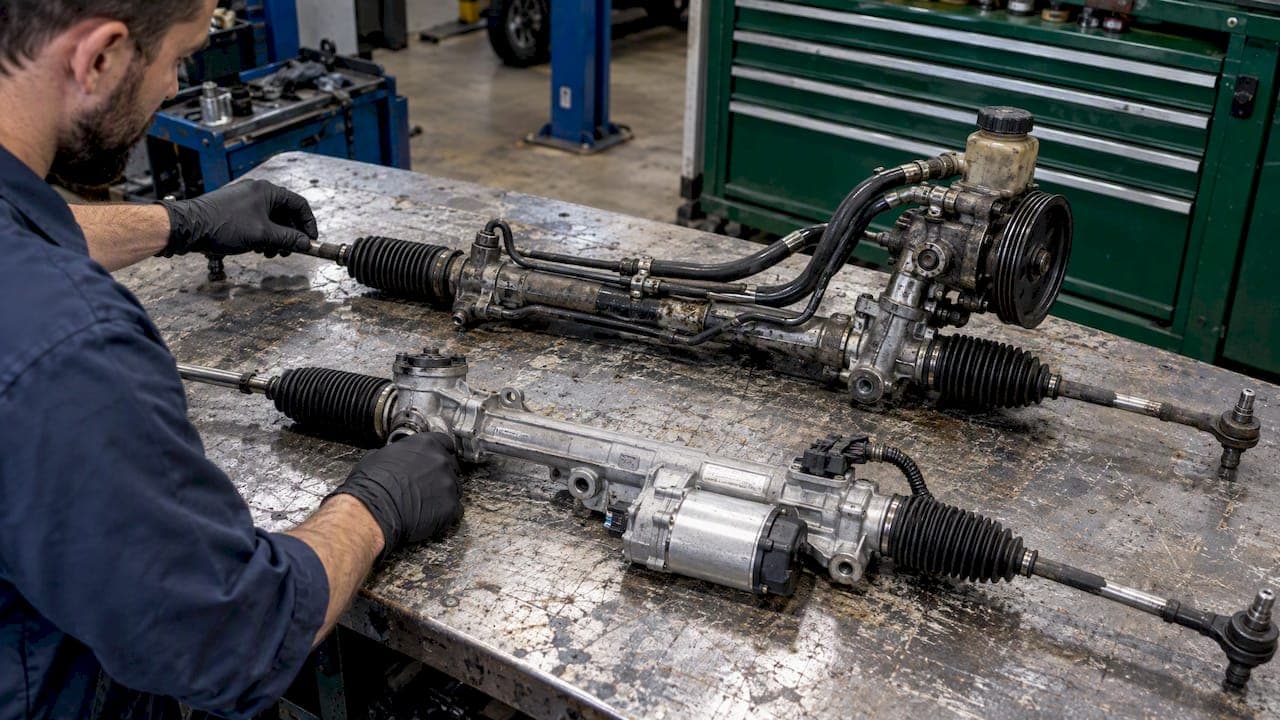
Hydraulic power steering uses an engine-driven pump and pressurized fluid to help you turn the wheel. Electric power steering (EPS) uses a sensor, a computer and an electric motor instead. Electric systems are lighter, use less energy and need almost no routine service. Hydraulic systems are often praised for richer road feel but need fluid attention and can leak. If you are shopping for a used car, the difference affects how the car drives, what it costs to keep and which safety features it can offer.
Below, we explain how each system works, where each one wins, what repairs look like, and how to check the steering on a used car before you buy.
TL;DR
- Hydraulic steering relies on an engine-driven pump and fluid. EPS replaces them with a torque sensor, control unit and electric motor.
- EPS saves energy because it works on demand. A hydraulic pump runs continuously, even when you drive straight.
- Hydraulic steering is known for feedback and feel. EPS wins on efficiency, low maintenance and compatibility with driver-assist features.
- Hydraulic fluid generally needs changing about every five years or 50,000 miles, per the owner's manual. An EPS rack replacement can cost $1,500 or more.
- On a used car, check the owner's manual, look for leaks, and test-drive at parking-lot and highway speeds.
Table of Contents
- How hydraulic power steering works
- How electric power steering works
- Electric vs. hydraulic steering at a glance
- Steering feel: where hydraulic still has a reputation
- Low-speed and high-speed behavior
- Efficiency: why the pump is the problem
- Maintenance and repair costs
- Why automakers moved to electric
- Do modern cars still have hydraulic steering?
- What to check on a used car
- Which one is right for you?
- Our perspective
- Find the right car with the right steering
- FAQ
- Sources
How hydraulic power steering works
A hydraulic system is a mechanical loop. According to the IEEE Technology Navigator, an engine-driven pump pressurizes fluid, and a valve-controlled actuator uses that pressure to assist the steering rack. When you turn the wheel, the valve directs fluid to one side of the actuator, and the pressure does much of the physical work.
The parts list tells the story: a pump, a drive belt and pulley, hoses, a fluid reservoir, and the valve and rack. Each part adds weight, and each can wear or leak. The pump is also tied to the engine, which becomes important when we get to hybrids and fully electric vehicles.
How electric power steering works
EPS removes the fluid entirely. The same IEEE overview describes a torque sensor that reads what you are doing with the wheel, an electronic control unit that decides how much help to give, and an electric motor that supplies it. The motor can sit at the steering column, at the pinion, or directly on the rack.

Those layouts differ in a meaningful way. IEEE notes that column-assist systems are lighter and simpler, while rack-assist systems provide more assist authority and better isolation, at the cost of added weight and expense. Larger and heavier vehicles tend to need the stronger arrangements.
According to Clemson's Vehicular Electronics Laboratory, EPS eliminates the hydraulic pump, hoses, fluid, drive belt and pulley, so it is generally smaller and lighter than a hydraulic setup.
Electric vs. hydraulic steering at a glance
| Factor | Hydraulic | Electric (EPS) |
|---|---|---|
| Power source | Engine-driven pump and pressurized fluid | Electric motor, torque sensor and control unit |
| Energy use | Pump draws power continuously | Draws power mainly when assistance is needed |
| Road feel | Often described as richer, more progressive feedback | Varies by tuning; software shapes the feel |
| Routine service | Fluid replacement; belts and hoses to watch | No fluid service; less routine maintenance |
| Typical repairs | Pump, belt, hoses, leaks | Sensor, motor or rack assembly |
| Driver-assist features | Poorly suited to active steering | Can steer without driver input |
| Hybrid and EV compatibility | Engine-driven pump is unsuitable | Compatible |
Steering feel: where hydraulic still has a reputation
The loudest argument in enthusiast circles is about feel. The IEEE overview describes hydraulic steering as providing strong low-speed assistance and progressive road feedback, while EPS calculates assistance in real time from driver torque and vehicle signals.
An engineering explanation comes from Road & Track, which reports McLaren engineers' view that hydraulic assistance can pass along more high-frequency road information, because the inertia of an electric motor filters some vibration before it reaches your hands.
In a 2012 BMW comparison, Car and Driver's editors preferred the electric system in seven of ten rating categories, while the hydraulic setup won the three feedback categories. That split is a fair summary of the whole debate: electric systems often do more things well, and hydraulic systems tend to talk to you more.
There is a flip side. Honda's technical research reports that EPS motor inertia, gear reduction and control programming can attenuate steering vibration more effectively than hydraulic steering in the conditions tested. Less vibration can mean a calmer wheel on rough pavement, which many daily drivers prefer.
The practical point: EPS feel is tuned in software, so two cars with electric steering can feel very different. A test drive tells you more than any spec sheet.

Low-speed and high-speed behavior
Most drivers notice the difference in a parking lot and on the interstate. Clemson says EPS provides more assistance at low speeds and less at high speeds. Firestone Complete Auto Care explains the same behavior from the driver's seat: sensors measure the torque you apply and assistance varies mainly with vehicle speed, which makes parking easier and high-speed steering more resistant.
For a busy professional in a large SUV, that low-speed lightness can matter every day. For an enthusiast, the question is whether the high-speed weighting feels natural. Both are reasons to drive the exact car, not just read about the platform.
Efficiency: why the pump is the problem
A hydraulic pump is belt-driven, so it is always turning. Kelley Blue Book's 2025 guide says hydraulic pumps run continuously, even when the vehicle travels straight, which wastes energy. Clemson makes the same point from the other side: EPS consumes little significant power when no assistance is needed, because the motor operates on demand.
How much does that save? Car and Driver says EPS draws electrical energy only when assistance is needed and improves fuel economy by a few percent compared with hydraulic assistance. A few percent is modest on any single tank, but across a decade of ownership it adds up, and across an automaker's whole fleet it helps with fuel economy targets.
Maintenance and repair costs
This is where the two systems differ most for an owner's wallet.
Hydraulic systems
Kelley Blue Book says hydraulic fluid generally needs replacement about every five years or 50,000 miles, subject to what your owner's manual says. Repairs may involve the pump, belts, hoses or leaks. J.D. Power adds that hydraulic systems have more moving parts and therefore more potential failure points.
A leak is the classic failure. Car and Driver notes that a leaking hydraulic line can cause loss of power assistance, although the vehicle remains steerable manually. It will just take a lot more effort, especially at parking speeds. If you want a closer look at the warning signs, this guide to power steering leak signs and costs covers how leaks show up and what to do next.
Electric systems
J.D. Power says electric systems generally require less maintenance because they use no hydraulic fluid. Kelley Blue Book agrees that EPS needs less routine service and no fluid service. The trade-off is that failures, when they happen, can be expensive: KBB says a rack replacement can cost $1,500 or more.
So the honest summary is this. Hydraulic costs tend to arrive in small, predictable amounts (fluid, hoses, a belt), with the occasional pump. Electric costs tend to be near zero for years, with a less common but larger bill if a major component fails.
Why automakers moved to electric
Three reasons come up again and again. Per Car and Driver, automakers shifted toward EPS because it improves fuel economy, eliminates hydraulic-fluid maintenance, and enables driver-assist features that steer without driver input.
The third reason is the biggest. Car and Driver identifies lane-keep assist, automated parking, lane changes and obstacle avoidance as functions that depend on EPS being able to steer without the driver's hands. An engineering chapter published by Springer says hydraulic steering has limited parameterization and is poorly suited to active driver-assistance functions, and that EPS has largely replaced hydraulic rack-and-pinion systems.
There is also an architecture problem. The same Springer chapter states that hydraulic pumps driven by combustion engines are unsuitable for hybrid and fully electric vehicles, while EPS is compatible with them. A car that shuts its engine off at a stoplight or has no engine at all cannot rely on an engine-driven pump.
Do modern cars still have hydraulic steering?
Mostly not in passenger cars. Springer says hydraulic rack-and-pinion systems have been almost completely replaced by EPS, though hydraulic systems remain in use in heavy trucks. Electro-hydraulic steering, which uses an electric pump rather than a belt-driven one, is still used in small-volume production. Springer describes it as able to reduce energy use and become independent of the combustion engine, but unsuitable for active steering interventions, so it is mainly a transitional or limited-volume technology.
For a used-car shopper, that means the model year matters. Older vehicles are more likely to have hydraulic steering, newer ones electric, and some generations of the same model may have switched partway. Your owner's manual and a trained technician can confirm which system a specific car has.
What to check on a used car
Kelley Blue Book advises buyers to compare steering feel, low-speed maneuverability, fuel economy, driver-assist features and maintenance needs, and to check the owner's manual for fluid requirements. Here is how to turn that into a short routine.
- Identify the system. Look in the owner's manual or ask the seller. If there is a power steering fluid reservoir under the hood, the car is hydraulic or electro-hydraulic.
- Check service history. On a hydraulic car, look for fluid changes at the interval the manual lists. On an electric car, look for any steering warning-light history or software updates.
- Inspect for leaks. With the engine off, look around the pump, hoses and rack for wet spots or residue. Note the fluid level and its condition.
- Listen and feel at parking speed. Turn the wheel lock to lock in a parking lot. Whining, groaning or notchy, uneven effort deserves a closer look.
- Drive at highway speed. The wheel should feel stable and settle on center. Note whether the weighting feels natural to you.
- Test the driver-assist features. If the car has lane-keep assist or automated parking, try them. They depend on electric steering.
- Get an inspection. An independent technician can scan for steering codes and inspect the rack, which matters given the repair cost KBB cites for an EPS rack.
If you are weighing a family SUV, the same steering questions tie into the rest of your criteria. Our family car selection guide walks through how to rank them, and if you are comparing luxury ride hardware, our piece on Mercedes air suspension leaks covers another system worth checking before you buy.
Which one is right for you?
If you want the lowest routine upkeep, electric steering is the clearer pick. No fluid, no pump belt, fewer parts to leak.
If you value feedback above everything, a hydraulic car may suit you, and it is worth driving a few to learn what you like. Some electric cars feel excellent, too, so do not rule them out on principle.
If you want modern safety tech, you will want electric steering, since features like lane-keep assist and automated parking rely on it.
If you are buying a hybrid or EV, the question answers itself: EPS is the compatible architecture.
Our perspective
We sell used and luxury vehicles in Fort Lauderdale, and steering rarely makes the top of a buyer's list until they drive two cars back to back. Then it often decides the purchase. A buyer coming out of an older sedan with a heavy, communicative wheel can find a newer car's light, quiet steering strange. A buyer coming out of a newer car can find an older one tiring in a tight parking garage.
Our advice is to treat steering as part of the whole ownership picture, not a spec. Ask what the system is, ask how it has been maintained, and drive the car the way you will actually use it: parking lots, city streets, the highway. If you are not sure what to prioritize, that is exactly what our personalized vehicle-finding help is for. We would rather you spend an extra hour on a test drive than discover a mismatch a month after you buy.
— Allen
Find the right car with the right steering
If you would like help narrowing down vehicles by how they drive, our Car Finder service is built for that. Tell us what you want, whether it is a comfortable luxury sedan, a family SUV or something more unusual, and we will help you find it. You can start with our Car Finder, or browse the full used inventory, including SUVs and sedans.

We also handle trade-in valuation and financing, so you can move from the test drive to the paperwork in one place.
FAQ
Why has hydraulic steering been phased out?
Electric steering improves fuel economy, removes fluid maintenance and enables features such as lane-keep assist and automated parking. Hydraulic pumps are also unsuitable for hybrid and fully electric vehicles. Together, those reasons pushed nearly all passenger-car makers toward EPS.
Do modern cars have hydraulic power steering?
Very few passenger cars do. Hydraulic rack-and-pinion systems have been almost completely replaced by EPS, although hydraulic steering remains in use in heavy trucks and electro-hydraulic systems appear in small-volume production. Check the owner's manual for the exact car you are considering.
Which system needs less maintenance?
Electric steering. It uses no hydraulic fluid, so there is no fluid service, and it has fewer parts that can leak or wear. Hydraulic fluid generally needs replacing about every five years or 50,000 miles, depending on the manual.
Is electric steering more expensive to fix?
It can be when a major component fails. Kelley Blue Book says an EPS rack replacement can cost $1,500 or more. Routine costs, however, are usually lower than on a hydraulic car.
Can I drive with a power steering leak?
The car stays steerable, but you lose assistance, so the wheel gets much harder to turn, especially at low speeds. Have a technician look at it promptly instead of topping up and hoping.
Sources
- Power steering, IEEE Technology Navigator
- Clemson Vehicular Electronics Laboratory: Electric Power Steering
- Honda Technical Review: Hydraulic versus Electric Power Steering Systems
- Kelley Blue Book: Power Steering Guide
- Car and Driver: Electric vs. Hydraulic Power Steering
- Car and Driver: What Is Power Steering and How Does It Work?
- Road & Track: Why Hydraulic and Electric Power Steering Feel Different
- Firestone Complete Auto Care: Hydraulic vs. Electric Power Steering
- J.D. Power: Electric vs. Hydraulic Power Steering
- Springer: Steering Systems for Passenger Cars and Commercial Vehicles