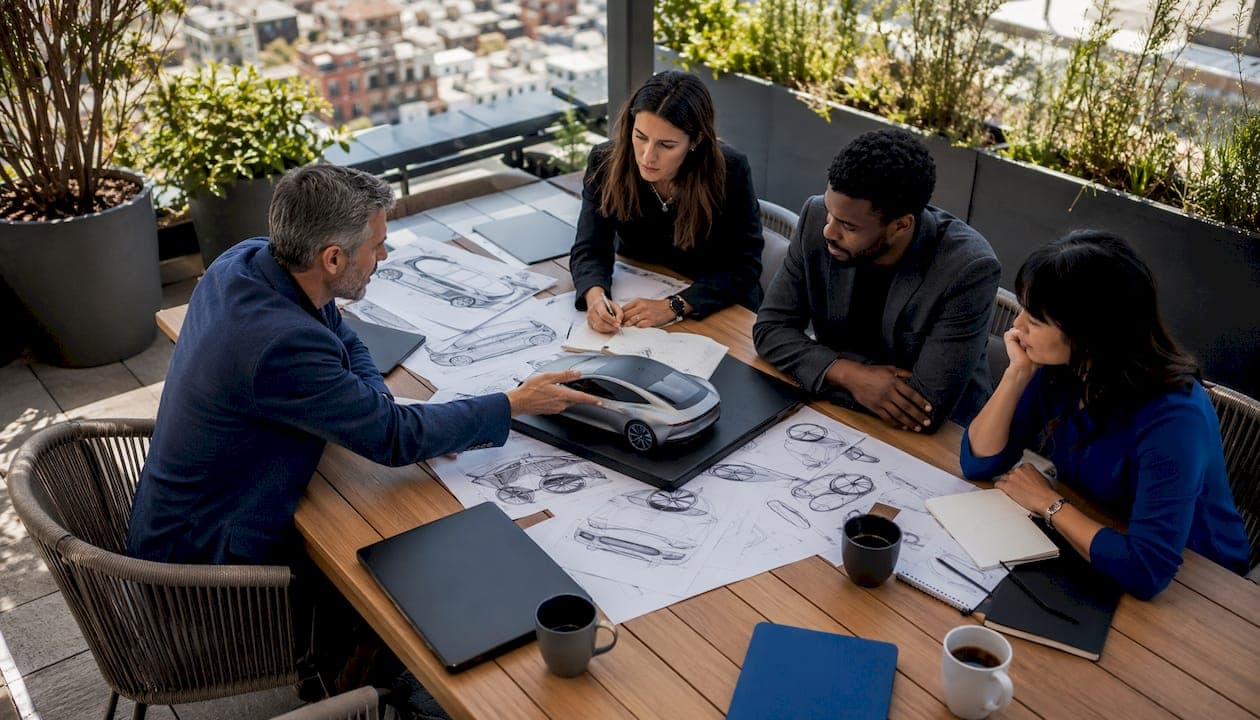
A concept car reaches production only when it clears three hard requirements: a viable business case, manufacturable engineering, and a validated production line. Most show cars never make it. The ones that do pass formal stage gates that filter out beautiful ideas that cannot be built profitably, safely, or reliably at scale.
TL;DR:
- Feasibility and business case gate: market demand, bill of materials, and capital costs reviewed first
- Engineering and prototyping gate: clay models, mule cars, and design validation prototypes built and tested
- Validation and Production Try-Out (PTO) gate: full assembly line debugged before the first saleable unit
- Start of Production (SOP): the program launches commercially
Buyer signal: If an OEM has named a production platform, confirmed a supplier chain, and announced a PTO schedule, the concept is production-intent. Vague launch windows and no platform mention are warning signs.
Table of Contents
- How concept cars reach production: the stage-by-stage pipeline
- How designers scale a show car into a buildable luxury vehicle
- The feasibility study is the gatekeeper that decides everything
- Prototyping and validation: from clay to crash test
- Manufacturing readiness: tooling, suppliers, and scaling to the line
- What realistic timelines look like for luxury programs
- What signals tell you a concept is likely to reach production
- How to judge a production luxury car that started as a concept
- Short concept-to-production stories that illustrate the real changes
- What designers and engineers say about scaling concepts
- Key Takeaways
- Why this process matters more than most buyers realize
- Autovendorsfl helps you find concept-inspired luxury vehicles worth buying
- Useful sources for further reading
How concept cars reach production: the stage-by-stage pipeline
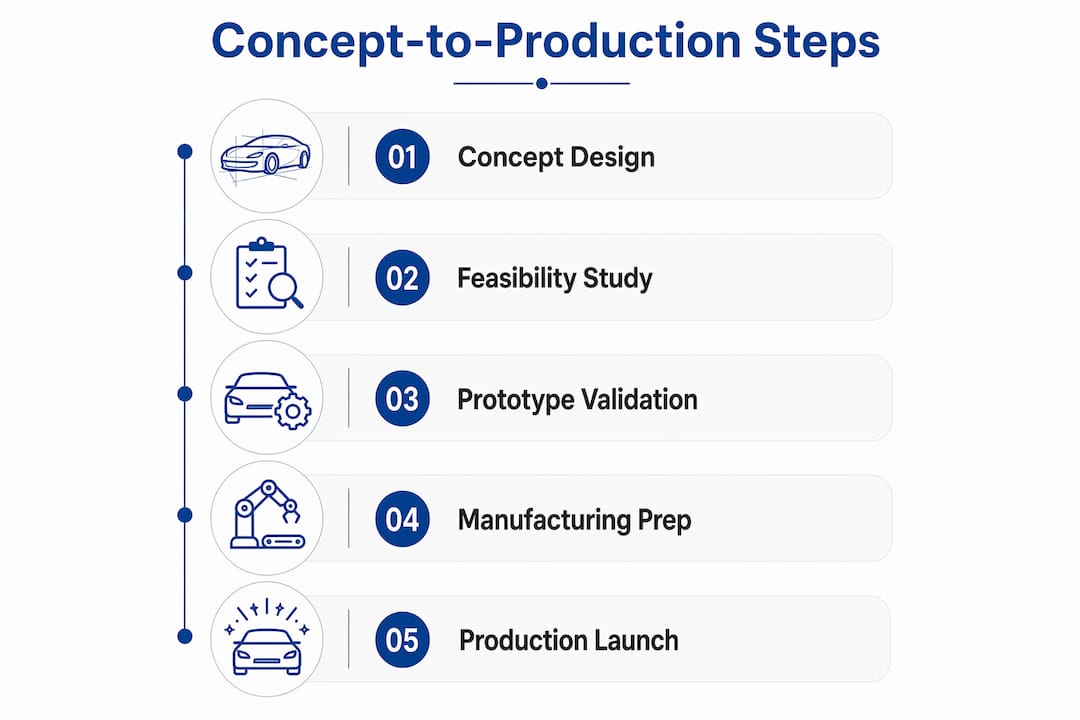
The automotive design process follows a defined sequence of stage gates, each requiring sign-off before the program advances. The standard lifecycle runs: Product Vision → Preliminary Spec → Concept Freeze → Engineering and Prototyping → Functional Confirmation → PTO → SOP.
A luxury program typically spans four to seven years from initial concept to showroom. Software-led programs can compress some phases, but physical validation still drives the calendar. Each gate has a clear deliverable: a signed business case, a frozen design package, a validated prototype, or a confirmed production line.
How designers scale a show car into a buildable luxury vehicle
Designers convert dramatic show-car gestures into manufacturable surfaces by reconciling packaging, crash safety, and aerodynamics with the original aesthetic intent. The result is always a compromise, but the best luxury programs preserve the concept's proportional identity even as specific details change.
Common changes from concept to production:
- Door apertures shrink to meet side-impact structure requirements
- Glass areas reduce once pillar reinforcement and defrost systems are packaged
- Bumper structures grow to absorb low-speed impacts per federal standards
- Lighting elements simplify when production-grade LED or laser modules replace custom show units
- Interior trim materials shift from hand-laid exotic composites to durable, cost-effective alternatives
What typically survives: overall silhouette, greenhouse proportions, and signature surface creases. What rarely survives: flush door handles with no visible mechanism, single-piece panoramic glass wrapping into the roof, and ultra-thin A-pillars.
Pro Tip: Look for production-grade hinge lines, visible service seams around the hood and trunk, and standard-width door gaps. A concept with those details already present is far closer to production than one with seamless body panels and hidden hinges.
Calty, Toyota's design arm, identifies scaling as the central challenge: converting sculpted, oversized concept forms into a pragmatic production footprint without losing the design's character. That tension is visible in every luxury vehicle that started life on a show stand.
The feasibility study is the gatekeeper that decides everything
The feasibility study is the decision pivot for any production program. If it fails, no amount of design excellence moves the project forward. It evaluates market size, target price, bill of materials (BOM), supplier capability, and regulatory scope for every intended market simultaneously.
For luxury programs, the economics are particularly demanding. Low-volume production means tooling costs are spread across fewer units, pushing per-unit cost up. Customization premiums can offset some of that, but the BOM must still support a margin that justifies the capital investment.
The financial and market metrics a program must clear:
- Projected sales volume supports tooling amortization
- Target retail price aligns with segment benchmarks and brand positioning
- BOM cost leaves adequate gross margin at target volume
- Supplier capability confirmed for specialized materials and components
- Regulatory compliance pathway identified for all target markets (EPA, NHTSA, FMVSS in the US)
When evaluating foreign market models or limited-production luxury vehicles, this feasibility gate is where most programs quietly die, long before a press release announces cancellation.
Prototyping and validation: from clay to crash test
Multiple prototype types serve distinct validation goals, and each builds on the last. Concept builds commonly involve 5–30 people and take 3–12 months for a single show prototype — a scale that underscores why a show car appearance does not equal production readiness.
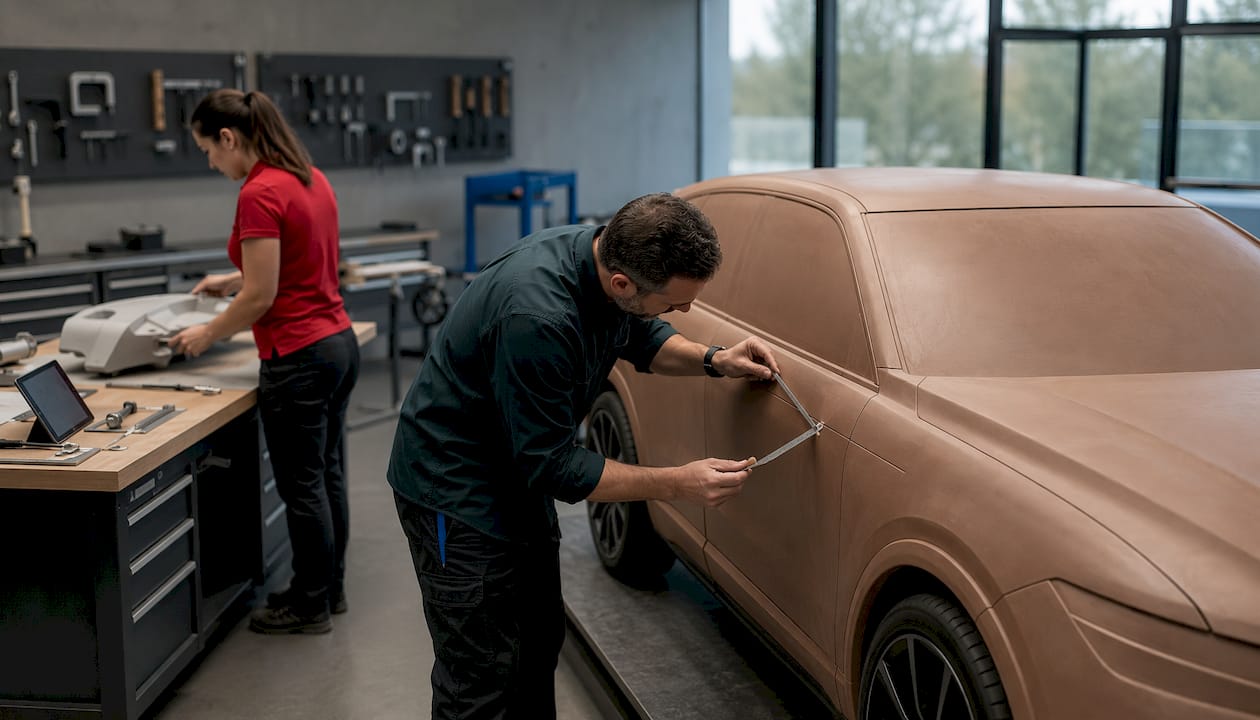
| Prototype Type | Primary Purpose | Typical Lead |
|---|---|---|
| Clay / CAS model | Surface design validation | Design studio |
| Engineering mule | Powertrain and systems packaging | Engineering |
| Design Validation (DV) prototype | Form, fit, and function confirmation | Program team |
| Durability / crash prototype | Safety and longevity testing | Safety engineering |
| PTO / pre-production unit | Assembly line and tooling debug | Manufacturing |
Production Try-Out (PTO) is the final pre-production phase, where vehicles are built on actual line tooling to catch fitment errors, robot movement conflicts, and assembly sequence problems before the first saleable unit rolls off. A program that has completed PTO is genuinely close to SOP.
Buyer checklist for early production reports: confirmed crash ratings (NHTSA or IIHS), published homologation status for the US market, durability cycle completion, and a confirmed SOP date.
Manufacturing readiness: tooling, suppliers, and scaling to the line
Production readiness depends on three things arriving together: dedicated tooling, confirmed supplier agreements, and validated assembly processes. None of the three can substitute for the others.
Major investment areas for a luxury production program:
- Stamping dies for body panels, which can take 18–24 months to design, cut, and validate
- Paint shop tuning for multi-stage finishes and specialty colors common in luxury segments
- Robotics and end-of-arm tooling calibrated for the specific body architecture
- Low-volume customization lines for bespoke interior options, personalization programs, and coach-built variants
Supplier readiness for specialized materials is a frequent bottleneck. Carbon fiber structural components, hand-stitched leather interiors, and custom aluminum castings each require supplier qualification programs that run in parallel with vehicle engineering. A delay in any one supplier can push SOP by months.
Most concept cars require an entirely separate engineering program before production can begin, because show cars are built to look extraordinary, not to be assembled repeatedly at consistent quality. The manufacturing program is, in effect, a second project layered on top of the design project.
What realistic timelines look like for luxury programs
Luxury programs typically run longer than mainstream ones. Development commonly takes four to seven years from concept to showroom, with the highest schedule risk concentrated at concept freeze and PTO.
Common causes of delay: supplier late-delivery of long-lead tooling, validation failures requiring design changes, cost overruns that trigger a BOM review, and regulatory changes in target markets. A single crash test failure that requires structural redesign can add six to twelve months to the program.
Top program threats that push timelines or cancel programs entirely:
- BOM cost exceeds target at final engineering review
- Key supplier exits the program or cannot meet quality standards
- Regulatory homologation fails in a primary market
- Executive funding pulled after a market downturn
- Validation failure too late in the program to redesign economically
What signals tell you a concept is likely to reach production
The most predictive signals are a production-intent prototype, a committed supplier chain, a realistic BOM, and confirmed executive program funding. A concept with all four is far more likely to reach SOP than one with only dramatic styling and a press release.
Signals that increase production likelihood:
- OEM names a specific production platform (shared architecture lowers tooling cost)
- Supplier partners are publicly announced
- A target price range is stated, not just implied
- Engineering details (wheelbase, powertrain specs, weight targets) are confirmed
- A production facility is named
Signals that lower the odds:
- Radical door geometries (suicide doors, gull-wings, canopy entries) with no production precedent
- No platform mention
- Specs described as "subject to change" across multiple show appearances
- No homologation timeline stated for the US market
When reading a press release or watching a reveal, listen for platform names, supplier mentions, and pricing language. Those details are not accidental. For buyers tracking limited-edition vehicles, these signals separate genuine production programs from perpetual show-circuit concepts.
How to judge a production luxury car that started as a concept
Ask production-intent questions directly. A dealer or OEM representative for a genuine production program can confirm a target launch date, SOP status, homologation steps completed, and warranty scope. Vague answers to specific questions are informative in themselves.
Specific questions worth asking:
- Has a production-intent prototype been built and tested?
- Has the BOM been published or confirmed to support the stated price?
- Where will the vehicle be built, and has that facility been confirmed?
- What is the homologation status for the US market?
- Is the warranty coverage identical to the brand's standard production vehicles?
Red flags: no PTO completed, no named supplier partners, widely variable stated specifications across appearances, nebulous pricing described as "starting from" with a range spanning six figures, and launch timing described only as "soon."
Factory test cars and pre-production units carry their own provenance considerations. Early production vehicles from a concept-derived program can be worth tracking, but only after PTO is confirmed and homologation is complete.
Short concept-to-production stories that illustrate the real changes
The gap between a show car and its production counterpart is almost always larger than press coverage suggests. Three patterns appear repeatedly in luxury concept transitions:
The proportional survivor: A concept with a long hood, short deck, and wide stance reaches production with those proportions largely intact, but the door count changes from two to four, the glass area shrinks by roughly a third, and the interior loses its single-piece carbon fiber tub in favor of a modular platform shared with a sibling model. The silhouette reads as the concept; almost nothing underneath it does.
The technology demonstrator: A concept built around a novel powertrain architecture reaches production, but the production version uses a proven platform from an existing model. The exterior design survives at roughly 70% fidelity; the powertrain that generated the headlines does not appear until a second-generation model years later.
The canceled near-miss: A concept clears design freeze and enters engineering validation, then fails the BOM review when commodity material costs rise. The program is suspended, not canceled, and resurfaces two years later with a revised interior specification and a higher target price.
The single biggest engineering compromise in each case is the same: the structure. Show cars are built once, by hand, to look perfect under lights. Production cars must survive decades of real-world use, repeated assembly, and crash tests. The structure that makes a concept buildable at scale rarely resembles the one that made it beautiful on the show stand.
What designers and engineers say about scaling concepts
Designers and engineers consistently describe the concept-to-production process as iterative tension between artistic freedom and hard manufacturing constraints. The creative vision that makes a concept memorable is precisely what makes it difficult to build.
Florence Wright describes this as a constant negotiation: concepts can use exotic materials freely, while production vehicles must be cost-effective and durable across years of ownership. Every material choice in a production luxury car reflects a decision made under that constraint.
Calty's design leads identify scaling as the central challenge: converting sculpted, oversized show surfaces into a practical production shell without losing the design's essential character. The work is not subtraction — it is translation.
For buyers, this translates into a practical signal: when a manufacturer's design team discusses a concept in engineering terms (packaging, crash structure, supplier materials) rather than purely aesthetic ones, the program is likely serious. Marketing language about "the future of luxury" with no engineering specifics is a different kind of signal entirely.
Key Takeaways
A concept car becomes a production luxury vehicle only when its business case, engineering validation, and manufacturing readiness all pass formal stage gates — typically across a four-to-seven-year program.
| Point | Details |
|---|---|
| Business case is the first filter | Feasibility studies evaluate BOM, market size, and tooling costs before any engineering commitment is made. |
| PTO confirms production readiness | Production Try-Out on actual line tooling is the final validation before the first saleable unit is built. |
| Show cars are not prototypes | Concept builds involve 5–30 people and 3–12 months; the production program is a separate, larger effort. |
| Platform mention is the strongest buyer signal | An OEM naming a shared production platform signals lower tooling cost and higher production likelihood. |
| Autovendorsfl vets production-intent evidence | Autovendorsfl sources and evaluates concept-derived luxury vehicles, helping buyers confirm SOP status and homologation before purchase. |
Why this process matters more than most buyers realize
The conventional wisdom is that a stunning concept at an auto show means a stunning production car is coming. That is rarely how it works. The concepts that generate the most excitement, the radical door geometries, the single-piece glass canopies, the hand-laid carbon fiber cabins, are almost always the ones that change most dramatically before production. The concepts that look slightly conservative on the show stand, the ones with visible door seams and production-plausible interiors, are the ones worth tracking seriously.
What buyers underestimate is how much of a luxury vehicle's character is determined not by the design team but by the manufacturing program. The feel of a door closing, the consistency of panel gaps, the way a leather surface holds up after three years — none of that comes from the concept. It comes from the PTO process, the supplier qualification program, and the assembly line validation that most buyers never hear about.
When a luxury buyer asks whether a concept-inspired model is worth waiting for, the honest answer depends entirely on whether the program has cleared its feasibility gate, named its suppliers, and completed PTO. Everything else is speculation dressed as anticipation.
Autovendorsfl helps you find concept-inspired luxury vehicles worth buying
Tracking a concept from show stand to showroom takes patience and the right questions. Autovendorsfl specializes in sourcing production luxury vehicles that meet genuinely high standards, including models that originated as concepts and have completed the full development pipeline.
The team at Autovendorsfl reviews production-intent evidence, confirms homologation and SOP status, and matches buyers with vehicles that reflect real craftsmanship rather than show-circuit promise. Whether you are looking for a specific model or want a concierge evaluation of a concept-derived program before committing, the process starts with a conversation. Contact Autovendorsfl directly at autovendorsfl.com to request a production-intent checklist review or to begin a personalized vehicle search.
Useful sources for further reading
- Automotive product development lifecycle (EV-Global): detailed stage-gate breakdown including PTO and SOP definitions
- Concept car overview (Wikipedia): background on concept car definitions, limitations, and production rates
- Calty design interview (Motor1): practitioner account of scaling challenges from a major OEM design studio
- Transforming prototypes into production vehicles (Newshub): designer perspective on material and manufacturability trade-offs
- From concept to reality: feasibility gate (Newshub): feasibility study process and its role as program gatekeeper
- Concept car prototyping with 3D printing (Formlabs): prototype team size, build times, and production separation
- What is a prototype classic car (Butter Classics): collector perspective on prototype and pre-production vehicles
- NHTSA (nhtsa.gov) and IIHS (iihs.org): primary sources for US crash test ratings and homologation requirements — consult directly when evaluating a specific production program's safety validation status