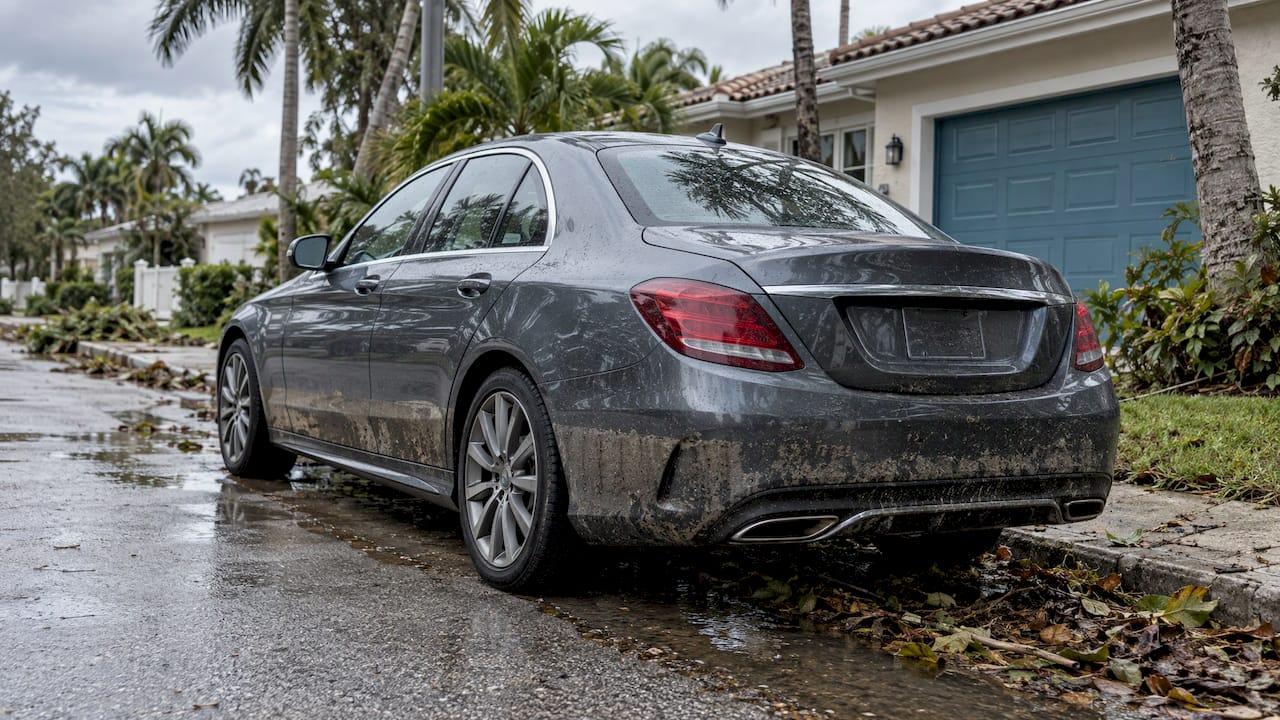
If a hurricane damaged your car in Florida, do not start it if water rose above the door opening, photograph everything, call your insurer, and have the car towed to a qualified repair facility. Then decide whether it is worth repairing or whether it is time to replace it. If you replace it, buy a car whose history you can read from the title to the VIN report, because storm season also sends flooded vehicles into the used market. We help buyers across Fort Lauderdale find that car through our Car Finder service.
TL;DR
- Never start a car that sat in floodwater. Starting it can turn repairable water damage into engine damage, and electrical shorts can cause fires.
- Photograph the car before you move it, then file a claim. Flood damage is normally handled under optional comprehensive coverage, not collision.
- In Florida, an insured car is a total loss when the insurer pays you to replace it. For an uninsured car the threshold is repair costs of 80% or more of replacement value.
- A flood brand on a Florida title is only as reliable as the reporting behind it. Cars from other states can arrive with clean titles, so check the VIN, the history and the car itself.
- When you are ready for a replacement, our team can search for it with you, handle your trade-in valuation and discuss financing.
Table of Contents
- What a hurricane does to a car
- First steps after the storm
- Does insurance cover hurricane car damage?
- Replacing the car: the settlement is a budget, not a deadline
- Why storm season changes how you shop for a used car
- Our perspective
- Let us find the replacement with you
- FAQ
- Sources
What a hurricane does to a car
Wind and debris dent panels and break glass. Water does the quieter, costlier damage. AAA explains that floodwater is a corrosive, abrasive mixture that can carry sewage, chemicals and coastal salt water. It can reach the engine, transmission, drivetrain, fuel, brake, power-steering and electrical systems. Corrosion problems can show up weeks or months after the water is gone, and repair bills can exceed the car's value.
Salt water is the worst case, and it is what Florida's storm surge brings. Kelley Blue Book reports that State Farm considers salt-water submersion more damaging than fresh water because it raises the chance of corrosion. Many insurers treat a car as a total loss if water reaches the dashboard and damages electronics, or if the car sat in water for an extended period. Progressive says minor flooding that drains quickly can often be repaired.
Modern cars make the electrical side more important. A General Motors representative told Consumer Reports that both electric and gas-powered vehicles have 12-volt systems that are subject to flood damage and can affect screens, controls and electrical components. The same article says no submerged vehicle should be driven without a comprehensive professional inspection.
First steps after the storm
Safety comes before paperwork. Work through these in order.
- Stay clear of power lines. The CDC says never to touch a fallen line and not to drive through standing water if downed lines may be in it. If a line falls across your car, stay inside, keep the ignition on if the engine stalls, warn others away and call the utility and emergency services.
- Do not start the car. AAA's post-storm guidance says not to start a vehicle if water rose above the door opening. State Farm's spokesperson told Consumer Reports that turning on a car stalled in deep water can do serious engine damage, and that water in the electrical system can cause a fire.
- Document everything. Photograph the exterior before the car is moved and the interior once the water recedes. Keep receipts for temporary repairs and lodging. AAA's advice, reported by CBS12, also covers video and keeping belongings in the record.
- Seal what is broken. Consumer Reports suggests covering cracked or broken windows with a tarp and packing tape to keep more water out.
- Call your insurer, then arrange a tow to a qualified repair facility.
A proper inspection matters even when the car looks fine. AAA says a qualified technician should check for contaminated fluids, drain and refill affected systems, and inspect, clean and dry electrical components. NHTSA, the federal vehicle safety agency, notes that damage may not be visible after the water recedes.
Electric and hybrid vehicles
If you drive an electric or hybrid car, the rules are stricter. AAA says not to drive or charge one that was exposed to flooding until a certified technician has inspected it. NHTSA warns that flooded vehicles can carry high voltage and short circuits that shock or start fires. It adds that a damaged vehicle with a lithium-ion battery should not be parked in a garage or within 50 feet of a house, structure, vehicle or combustibles, and that you should contact your dealer if you suspect battery damage. Kelley Blue Book notes that after a 2022 Florida hurricane, electric cars left in floodwater began catching fire.
An automaker's service bulletin shows how seriously the industry takes this. A 2017 Toyota bulletin filed with NHTSA warns that water and corrosion can cause abnormal heat that could lead to fire and false airbag activation. It directs that electrical components submerged in salt water, such as harnesses, connectors, ECUs and hybrid batteries, be replaced rather than reused.
Does insurance cover hurricane car damage?
Usually yes, if you carry the right coverage. Collision does not pay for flood. The Florida Office of Insurance Consumer Services says that for flood damage you must first verify that flood coverage is not excluded in your policy, and that you still need comprehensive coverage. The Insurance Information Institute's Florida spokesperson told WPBF that comprehensive covers non-collision losses such as flood, wind, hail, theft and vandalism, and that most Florida drivers carry it.
AAA's guidance lays out why some owners are surprised. Wind and debris damage to a home is generally a homeowners matter, flood damage to a home typically needs separate flood insurance, and vehicle storm damage often sits under optional comprehensive auto coverage. If you dropped comprehensive to save on your premium, you may have no protection for this loss. Read your declarations page now, in a calm week, not after the next storm.

When the car is a total loss
Flooded cars are often declared total losses. The Florida Department of Highway Safety and Motor Vehicles (FLHSMV) sets out the rules in procedure TL-36, under Florida Statutes 319.30(3)(a):
| Situation | When it counts as a total loss |
|---|---|
| Insured vehicle | The insurer pays you to replace it. There is no damage-percentage threshold. |
| Uninsured vehicle | Repair cost is 80% or more of replacement cost. |
| Insurer and owner agreed to repair, but costs run past 100% of replacement cost | The owner must request a "Total Loss Vehicle" brand within 72 hours. |
The insurer reports a total loss to FLHSMV, which brands the title as total loss or flooded. Once a salvage title is issued, that designation is carried forward for the vehicle's entire life. Florida also changed a rule in 2024: FLHSMV's bulletin INFO 24-015 says that, effective July 1, 2024, an owner who keeps a vehicle after a total loss settlement can apply for a salvage certificate of title or certificate of destruction. The same law defined additional major component parts for electric, hybrid and plug-in hybrid vehicles.
If you keep a branded car, it will resell as a branded car. Our article on clean versus rebuilt titles shows how much that brand changes the price and the buyer pool.
Replacing the car: the settlement is a budget, not a deadline
A total-loss check gives you a number. It does not tell you what to buy, and the weeks after a storm are a bad time to shop fast. Rental costs, work commutes and a family that still needs school runs push people toward the first available car. That is how a buyer ends up with a vehicle they would never have chosen in a normal month.
A few habits keep the replacement decision sound:
- Set the budget from the settlement and your trade-in value, not from a monthly payment alone. Ask for the full out-the-door price, including dealer fees. Our guide to Florida doc fees explains why Florida has no cap and what to ask for in writing.
- Decide the body style by use. A family that lost a minivan to flooding is better served by shopping minivans and SUVs on purpose than by taking whatever is available. Our SUV inventory and sedan inventory are searchable by make, model, body style and price.
- Plan for sales tax and registration. The Florida car sales tax checklist covers the forms.
- Understand what "as is" means before you sign. Our as-is warranty guide explains it for Florida used-car buyers.
Why storm season changes how you shop for a used car
Hurricanes do not only damage the cars in the storm's path. They feed the used market. The National Insurance Crime Bureau (NICB), the insurance industry's anti-fraud body, warned in August 2026 that flood-damaged vehicles can reach buyers, and recommends running the VIN through its free VINCheck service, which covers member carriers with more than 92% of the market. It also recommends a vehicle history report, a check by a reputable technician, and caution about deals that look too good to be true.
The title system is the weak point. FLHSMV's flood advisory explains that when an owner reports a flooded vehicle to the insurer, the insurer brands it and reports it, and state law requires the title to show the flood damage in a conspicuous place. But title standards vary by state, so a flooded vehicle from another state can still be sold in Florida with a clean title. FLHSMV also states that vehicles are not inspected before being branded as flood vehicles.
NHTSA puts the legal side plainly: a totaled vehicle gets a salvage or flood title and is typically sold at salvage auction. It can be resold to consumers only if the defect is noted on the title, the vehicle has been rebuilt and it holds a "rebuilt" title. NHTSA also says to beware of flood-damaged cars with clean or "lost" titles.

Physical signs of a flooded car
NHTSA and NICB list the same clues. Walk through a car with these in mind:
- A musty smell, or a strong air freshener that may be covering mildew.
- Mud, silt, dirt or waterlines in hidden places: the trunk, the glove box and under the dashboard.
- Unusual rust or corrosion under the vehicle.
- Water stains, moisture and mismatched upholstery.
NICB stresses that sellers can make damaged cars look fine at first glance, and that a fraudulent title makes flood damage harder to detect. That is why it pairs the free VIN check with a technician's inspection before purchase. A technician can look at corrosion on connectors and wiring, fluids and components that a report built from insurance and title records cannot show. For Florida-titled cars, FLHSMV also offers a Motor Vehicle Information Check by VIN or title number, and NHTSA points buyers to the National Motor Vehicle Title Information System (NMVTIS) to trace title history.
For a longer walk-through, see our guide on spotting flood cars in Florida before you buy. If you are weighing a luxury model, the pre-owned luxury inspection checklist covers the systems where water damage costs the most: electronics, sensors, infotainment and climate control. Buying without seeing the car in person raises the stakes further, and three steps for buying sight unseen applies if you are shopping from outside the area.
If a seller will not let you have the car inspected, treat the refusal as the answer and walk away. Another car is always available.
Our perspective
After a storm, most people we talk to are not really asking about cars. They are asking how to get their routine back without making a second mistake. The first mistake was out of their hands. The second is the one they can avoid.
We curate our inventory of used vehicles, with a focus on luxury and premium models, because we believe a buyer should be choosing from a selection that was picked with care, not scrolling through thousands of listings and hoping. That is the idea behind our personalized vehicle finding: you tell us the make, the body style, the budget and what your family or work needs, and we search for the right car with you.
We also know that a replacement purchase has other moving parts. A trade-in valuation and financing options are part of how we work, so the old car, the new car and the payment can be discussed in one place. Take your time, set the budget from your settlement, and buy the car you would have chosen in any other month.
Allen
Let us find the replacement with you
If your car did not survive the season, or you are simply ready for a more dependable one, our Car Finder is built for exactly this. Tell us what you need, whether that is a family SUV, a minivan, a sedan or a luxury model with something distinctive about it, and we will help you find it. We also offer trade-in valuation and financing options, and you can browse the full used inventory at any time. Our dealership is in Fort Lauderdale.
First-time luxury buyers can start with our Fort Lauderdale luxury buying guide, which walks through what a premium used car costs to own and how to set a realistic budget.
FAQ
Can a flooded car be repaired?
Sometimes. Quickly drained, minor flooding can often be repaired, according to Progressive's comments in Kelley Blue Book's flood-car FAQ. Cars that took water to the dashboard or sat submerged for long periods are often declared total losses. Corrosion can appear weeks or months later, so a certified technician should inspect any car that took on water before you drive it.
Does Florida car insurance cover hurricane damage?
Flood and wind damage are generally covered under optional comprehensive coverage, not collision. Florida's insurance consumer office says you should verify that flood coverage is not excluded in your policy. If you do not carry comprehensive, you may have no coverage for the loss.
How do I know if a used car was flooded?
Check for a musty smell, silt or waterlines in the trunk, glove box and under the dash, unusual rust underneath and mismatched upholstery. Then run the VIN through NICB's free VINCheck, pull a vehicle history report and have a technician inspect the car. A clean title alone is not proof, because other states' title rules differ.
What is the 80% rule for total loss in Florida?
For an uninsured vehicle, Florida treats it as a total loss when repair cost is 80% or more of replacement cost. For an insured vehicle, there is no percentage threshold: it is a total loss when the insurer pays you to replace it, according to FLHSMV procedure TL-36.
Can I charge an electric car that was in floodwater?
No. AAA and NHTSA both say not to drive or charge a flooded electric or hybrid vehicle until a certified technician has inspected it. NHTSA adds that a damaged lithium-ion battery vehicle should stay at least 50 feet from houses, structures, other vehicles and combustibles.
Sources
- Flood Damaged Cars | AAA Automotive
- Flooded Car? FAQs for Affected Owners and Shoppers | Kelley Blue Book
- How to Handle Storm and Flood Damage to Your Car | Consumer Reports
- What to Do to Protect Yourself From Electrical Hazards | CDC
- Hurricane Isaias: AAA Shares Insurance and Safety Tips
- AAA urges Floridians to document storm damage | CBS12
- Hurricane- and Flood-Damaged Vehicles | NHTSA
- Flood Damaged Vehicle Inspection and Handling | NHTSA
- Filing an Auto Claim | Florida Office of Insurance Consumer Services
- What to do if your car is damaged in a flood | WPBF
- TL-36 Total Loss Settlements Involving Insurance Companies | FLHSMV
- INFO 24-015 Motor Vehicle and Driver License Legislative Changes | FLHSMV
- Flooded Vehicles | FLHSMV
- NICB Warns Consumers to Watch for Flood-Damaged Vehicles