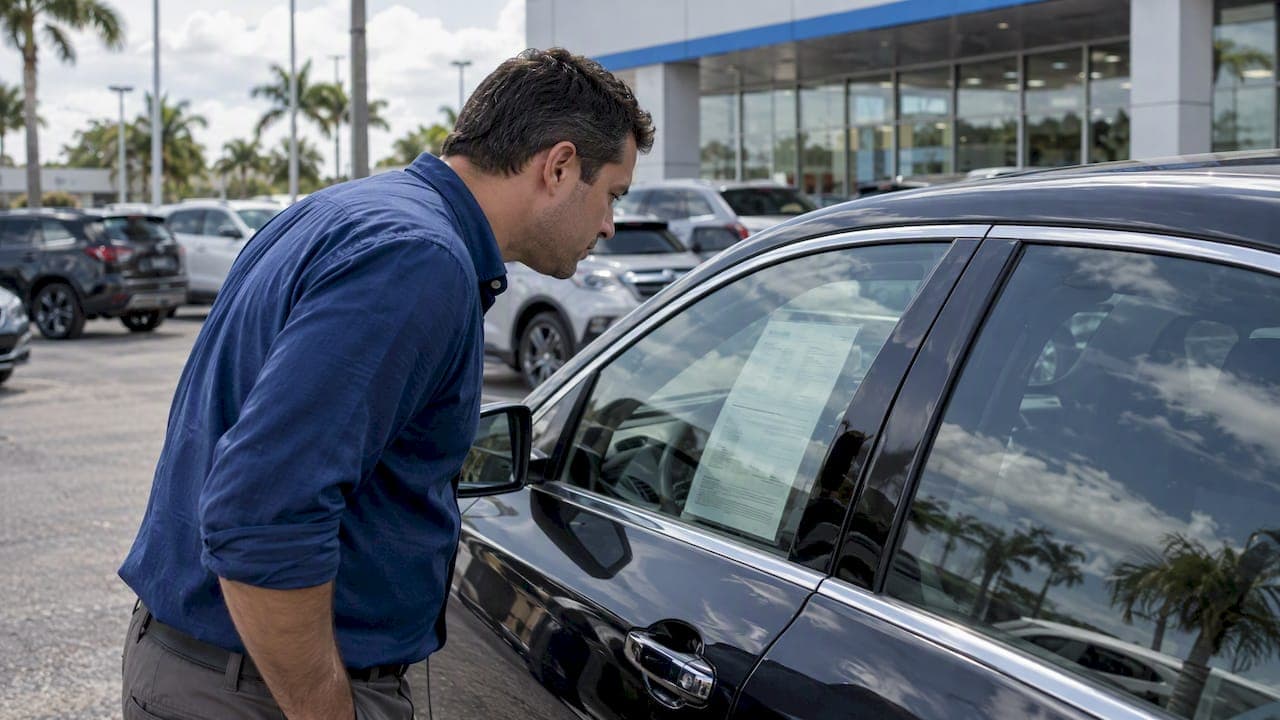
Florida does not have a lemon law for used cars. The state's Lemon Law, Chapter 681 of the Florida Statutes, applies only to new or demonstrator vehicles, with a narrow exception for a car that still sits inside its original 24-month rights period when you buy it. For nearly every used purchase, your protection comes from the paperwork you sign and the checks you make before signing. This guide explains where the line falls, what covers you instead, and what to do if a used car goes wrong.
TL;DR
- Florida's Lemon Law covers new and demonstrator vehicles. There is no general used car lemon law in the state.
- A late-model car may keep some rights if you buy it within 24 months of its original delivery date. Ask for the delivery date in writing.
- The FTC Buyers Guide on the window tells you whether the car is sold "as is" or with a warranty. Treat it as a legal document.
- Florida has no automatic cooling-off period. Once you sign and take delivery, the sale is final unless the contract says otherwise.
- The best protection is proactive: an independent pre-purchase inspection and every promise put in writing.
Table of Contents
- What the Florida Lemon Law covers, and what it leaves out
- The 24-month exception: when a used car still has lemon law rights
- The Buyers Guide: your most important used car document
- Implied warranties: the protection that disappears only in writing
- No cooling-off period: why signing is the point of no return
- Get every promise in writing
- Before you buy: the inspection that replaces a lemon law
- Our perspective: protection is built before the sale
- If a used car turns out to be a problem
- Paperwork that keeps you out of trouble
- Shopping used in Fort Lauderdale with Auto Vendors
- FAQ
- Sources
What the Florida Lemon Law covers, and what it leaves out
The law's formal name is the Motor Vehicle Warranty Enforcement Act. Chapter 681 gives consumers remedies when a new or demonstrator vehicle has a defect the manufacturer cannot fix. The Florida Bar describes the same scope: the statute provides remedies for people who purchase or lease new or demonstrator vehicles with nonconformities that have not been corrected within a reasonable number of attempts.
Two words in that description matter for you as a used car shopper.
- Manufacturer. The Lemon Law is a claim against the carmaker, not the dealer. It is built around the manufacturer's new vehicle warranty.
- Nonconformity. This means a defect or condition that substantially impairs the use, value or safety of the vehicle. A noise you dislike or a worn part from ordinary use generally does not qualify.
The state's motor vehicle agency says it plainly: there is no Lemon Law for used cars in Florida. The Florida Attorney General's consumer guide repeats it, adding that a car bought "as is" disclaims all warranties, so you should not expect legal protection if the car turns out to be a lemon.
The same agency notes that buying from a private seller offers even fewer protections than buying from a licensed dealer. If you want the strongest footing available, a licensed dealer with clear written terms is the better route.
The 24-month exception: when a used car still has lemon law rights
The one gap in the "no used car lemon law" rule involves timing. Chapter 681 runs its rights period for 24 months from the date the vehicle was originally delivered to its first consumer. According to the state, the law can reach cases where a vehicle is acquired from the first owner during that 24-month window.
In practice, that means a 14-month-old car with a remaining factory warranty may still carry Lemon Law rights, while a four-year-old car does not. If a vehicle fits the exception, the process is the same as for a new car:
- The defect must be reported to the manufacturer within the 24-month period.
- The manufacturer gets a reasonable number of repair attempts. Under the statute, after three attempts to repair the same nonconformity, the consumer must give the manufacturer written notice by registered or express mail.
- If the problem remains, the dispute can go to the state's New Motor Vehicle Arbitration Board, which resolves warranty disputes between consumers and manufacturers.
The statute also lets a consumer who sues and prevails recover pecuniary loss, litigation costs and reasonable attorney's fees. That fee-shifting is why lemon law attorneys take these cases, and it is also why you should verify eligibility before you count on it.
How to check whether a late-model car qualifies
Do not assume. Before you buy a car under about two and a half years old, ask for three things in writing: the original delivery date (sometimes called the in-service date), whether the car was previously sold to a consumer or used as a demonstrator, and what remains of the factory warranty. Then confirm the details with the manufacturer's customer service line using the VIN. If the answers are vague, plan as if the Lemon Law does not apply.
The Buyers Guide: your most important used car document
Because the Lemon Law will not help on most used cars, the federal Used Car Rule does a lot of the work. Enforced by the Federal Trade Commission, the rule requires dealers to display a Buyers Guide on the window of used cars. The sticker states whether the car is sold with a warranty or "as is," and it lists other key terms.
Here is how to read it:
| Buyers Guide box | What it means for you |
|---|---|
| As Is, No Dealer Warranty | You pay for repairs after the sale. The dealer has disclaimed all warranties. |
| Warranty (full or limited) | The dealer promises specific coverage. Check which systems, how long, and who pays labor and parts. |
| Implied warranties only | No written dealer warranty, but the unwritten legal promises (see below) may still apply. |
The FTC's guidance adds a point many buyers miss: the Buyers Guide is part of the sales contract, and if the dealer promises a warranty on it, those terms override contradictory language in the contract. Keep your copy. Photograph the sticker on the car before you sit down to negotiate, and compare it with the one handed to you at signing.
One caveat: the Florida Attorney General notes that dealers who sell fewer than six vehicles a year are exempt from posting a Buyers Guide. If you do not see one on a car at a lot, ask why.
Implied warranties: the protection that disappears only in writing
Even without a written warranty, the law can read in two unwritten promises: that the car is fit for ordinary use (merchantability) and fit for a particular purpose you told the seller about. According to the Attorney General's office, if a dealer does not affirmatively disclaim all warranties in writing, you may have a claim under those implied warranties.
The key word is "writing." A salesperson saying "you're buying it as is" does not count. A clear, explicit disclaimer in the contract and on the Buyers Guide does. That is why the checkbox on the window sticker matters so much, and why you should read the contract line by line for "as is" language before you initial anything.
A claim under implied warranty law is a contract dispute, not a lemon law case. It usually means a letter, a negotiation, small claims court or a lawyer, rather than a state arbitration board. It is slower and less predictable, which is another reason to prevent the problem.
No cooling-off period: why signing is the point of no return
Many buyers assume they have three days to change their mind. They do not. The FTC states that federal law gives used car buyers no three-day right to cancel, and that some states require one while others leave it to the dealer's own policy. The Florida Attorney General's guidance is consistent with this: once the contract is signed and the car delivered, the sale is final unless return terms are written into your agreement.
If a dealer advertises a "7-day return" or "exchange policy," get it on paper, with the mileage limit, any restocking charge and the condition the car must be in. A promise that lives only in a conversation or an ad is the hardest kind to enforce.
Get every promise in writing
Attorneys who handle these disputes repeat one lesson: oral assurances fail in court. If a salesperson says they will replace the brake pads, fix a rattle, add a second key or cover the first service, the promise needs to appear in the signed contract or on the Buyers Guide. Use a simple test: if it is not written down and signed by both sides, assume it does not exist.
A short checklist for the finance office:
- Every repair or reconditioning item promised, listed by name
- The warranty terms, including duration, deductible and exclusions
- Whether the Buyers Guide box matches the contract
- All fees itemized, including the dealer's documentation fee. Florida does not cap it, so ask for the total out-the-door price (our guide to Florida doc fees explains what to request)
- The odometer reading and VIN on every page, matching the car
Before you buy: the inspection that replaces a lemon law
The Attorney General's office advises that the most effective protection for used car buyers is an independent inspection by a trusted mechanic before you sign, because remedies afterward are limited. A good pre-purchase inspection costs a fraction of one major repair and gives you leverage: either the dealer fixes what is found, you renegotiate, or you walk away.
What a thorough inspection covers:
- Road test and cold start. Hesitation, noises, warning lights and how the transmission shifts.
- Computer diagnostics. Stored fault codes, especially on modern cars with many electronic modules.
- Lift inspection. Leaks, worn suspension parts, brake wear, frame or underbody damage.
- Fluids and filters. Color, level and condition of oil, coolant and transmission fluid.
- Flood and accident signs. Important in South Florida, where storm-damaged cars can surface for resale. Look for silt in seat tracks, musty carpet and mismatched paint.
If you are choosing a shop, look for one that does general pre-purchase inspections as a routine service, and consider whether it has experience with your car's brand. For European or high-performance cars, this piece on dealer diagnostics versus an independent shop helps you decide which kind of specialist fits.
For luxury vehicles, the stakes are higher because electronics, air suspension and driver-assistance systems are expensive to repair. Our own guides walk through how to inspect a pre-owned luxury vehicle, offer a pre-owned luxury inspection checklist, and explain why a pre-inspection matters. Pair the inspection with a review of the car's history: here are five steps to verify service records.
Buying from a distance? Do not skip any of this. Our three nonnegotiable steps for buying sight unseen apply directly.
Our perspective: protection is built before the sale
We talk with used car shoppers every week who arrive having read that Florida has a lemon law and hoping it will act as a safety net. It does not for most used cars, and we would rather say so up front than let anyone discover it after a repair bill. The honest version is that a used car purchase is protected by what you verify and what you document.
Our approach at Auto Vendors Inc in Fort Lauderdale is to curate vehicles with care, with a focus on quality and craftsmanship, and to help buyers find the right car through personalized assistance. But no dealer's promise replaces your own diligence, and we would say the same about ourselves. Ask for the Buyers Guide on any car, including ours. Ask for the service history. Take the car to an independent mechanic if you want a second opinion. A dealer worth your business will not resist any of it.
We also encourage buyers to think about coverage as a separate decision. A service contract or warranty can protect against the repairs that matter most on a luxury car, particularly electronics and driver-assistance systems, but only if you read what it excludes. Our write-up on used luxury warranties that cover electronics and ADAS explains what to look for.
— Allen
If a used car turns out to be a problem
Start by identifying which situation you are in, because the route differs.

The car was sold "as is," and the problem is ordinary wear or a failure after purchase. Under the Attorney General's guidance, the buyer is generally responsible for repairs. Your leverage is limited to what the dealer agrees to do as goodwill, or any misrepresentation you can document.
The dealer gave a written warranty, or did not disclaim warranties in writing. You may have a claim under the warranty or under implied warranty law. Gather the Buyers Guide, the contract, repair estimates and your communications. Put your complaint to the dealer in writing, describe the defect, and state what you want done.
The dealer misrepresented the car, for instance about accident history or mileage, or promised repairs it did not make. These facts matter in a complaint or lawsuit, which is why written records are so valuable.
The car is within 24 months of original delivery and has a manufacturer defect. Contact the manufacturer and follow the Lemon Law process described above, including the written notice.
For complaints about a dealer's conduct, the state's motor vehicle agency maintains a page of consumer complaint options. For a dispute over money, a consumer attorney can tell you whether your facts support a claim and whether the cost is worth it. The details of your contract decide the outcome, so bring all of it.
Paperwork that keeps you out of trouble
A clean transaction also means clean title and registration. Delays and errors in paperwork can complicate any later dispute, so review the details with care. Our guide to used car paperwork and common red flags covers what to confirm, and the breakdown of Florida car sales tax and forms helps you budget accurately. If you are weighing a lease instead, our lease versus buy checklist lays out the trade-offs, since new and long-term leased vehicles are the ones the Lemon Law is designed for.
Shopping used in Fort Lauderdale with Auto Vendors
If you would like a used or luxury vehicle from a dealer that will walk through the paperwork with you, you can browse our full used inventory, or narrow by body style with our SUV and sedan pages. Not seeing the right car? Our Car Finder service helps you locate a specific make, model or unique find. We also offer trade-in valuation and financing options. Bring your questions, your mechanic and your checklist.
FAQ
Does Florida have a lemon law for used cars?
No. Florida's Lemon Law covers new and demonstrator vehicles. A used car may keep Lemon Law rights only in the narrow case where it is acquired from the first owner within 24 months of its original delivery date. Otherwise your protection comes from warranties, the Buyers Guide and general contract law.
Can I return a used car in Florida if it has problems?
Not automatically. Florida has no cooling-off period for vehicle purchases, so the sale is final once you sign and take delivery, unless your written agreement includes return terms. If a dealer offers a return or exchange window, have the conditions written into the contract.
What can I do if a Florida dealer sold me a bad used car?
First check the Buyers Guide and contract. If the car was sold "as is," your options are limited. If there was a written warranty, or the dealer did not disclaim warranties in writing, you may have a claim. Send a written complaint to the dealer, keep your records, and consider talking to a consumer attorney.
Does a used car warranty work like a lemon law?
No, but it can serve a similar purpose. A dealer warranty or service contract is a contract, so you get exactly what its terms provide: covered parts, time limits and deductibles. Read the exclusions before you buy, and make sure the coverage you were promised appears in writing.
Sources
- Buying from a Licensed Dealer, Florida Department of Highway Safety and Motor Vehicles
- Buying from a Private Sale, Florida Department of Highway Safety and Motor Vehicles
- Consumer complaints, Florida Department of Highway Safety and Motor Vehicles
- How to Protect Yourself: Buying a Used Car, My Florida Legal
- Hearings Before the Florida New Motor Vehicle Arbitration Board, My Florida Legal
- Answering Dealers' Questions about the Revised Used Car Rule, Federal Trade Commission
- Buying a Used Car, Federal Trade Commission
- Florida's Motor Vehicle "Lemon Law," The Florida Bar
- Chapter 681, 2026 Florida Statutes, The Florida Senate
- Section 681.104, 2025 Florida Statutes, The Florida Senate
- Section 681.112, Online Sunshine, Florida Legislature