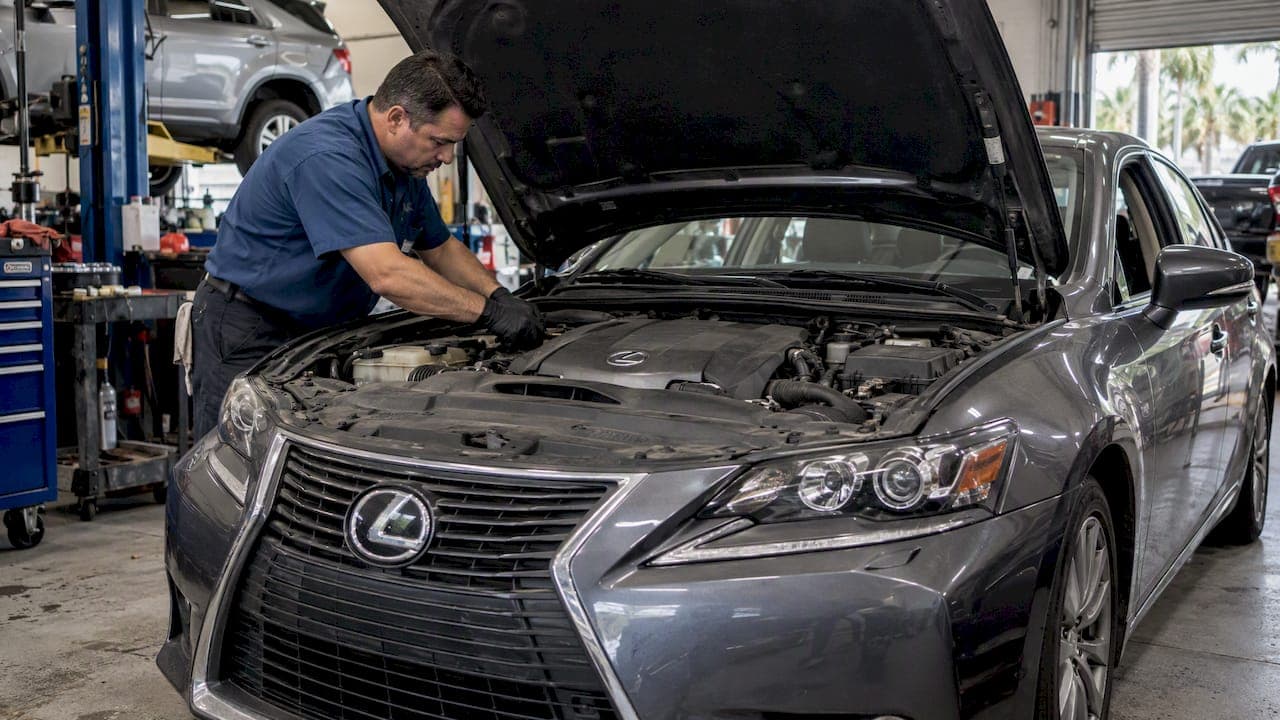
Lexus is not especially expensive to maintain. RepairPal puts the average annual repair and maintenance cost at $551, which is a useful starting budget for a Lexus. At Auto Vendors Inc, we offer personalized vehicle-finding assistance to buyers.
TL;DR:
- RepairPal rates Lexus reliability 4.0 out of 5, with 0.5 repair shop visits per year on average and an 8% chance of a severe repair.
- Routine service typically occurs at 5,000 miles or six months, with larger work at 30,000 miles; compare itemized dealer and independent shop quotes.
- As a Lexus ages, water pump repairs can cost $375 to $1,300, while hybrid battery and transmission bills vary widely; get diagnostics and two estimates.
- Repair costs rise with age, mileage, harsh driving, and local labor rates; used hybrid buyers should ask a qualified shop to assess the battery.
- Factory coverage runs four years or 50,000 miles for basic repairs and six years or 70,000 miles for the powertrain; check transfer status and records.
Table of Contents
- How much does a Lexus cost to maintain each year?
- How do costs change by model and ownership period?
- What do scheduled services cost at the dealer?
- What do major repairs cost?
- How can you lower Lexus maintenance and repair costs?
- What do the Lexus warranty and complimentary maintenance cover?
- Where do these numbers come from, and what are their limits?
- How does your location change Lexus service pricing?
- Which fluids and parts affect Lexus maintenance costs?
- Why should you ask for service records before you buy?
- How can we help you find a Lexus with a documented history?
- FAQ
- Sources
How much does a Lexus cost to maintain each year?
RepairPal's figure covers both routine maintenance and unscheduled repairs, so it is a blended number, not just oil changes. Here is what that means in practice:
- $551 per year is the average across the Lexus lineup, according to RepairPal's Lexus reliability data.
- Reliability rating of 4.0 out of 5, ranking seventh out of 32 car brands, suggests repairs tend to be less frequent than at many rivals.
- Severe repairs are uncommon. RepairPal's Lexus service guide lists an average of 0.5 repair-shop visits per year and an 8% probability that a repair is classified as severe.
According to RepairPal, the average Lexus costs $551 a year to maintain and repair. That is the national benchmark, and your own bill will move up or down with labor rates and how you drive.
For the longer view, Consumer Reports compared cumulative maintenance and repair costs by brand over five and ten years. Its analysis found that some brands cost thousands more over a decade, with several European luxury brands ranking much higher than domestic names like Buick and Lincoln. Multiplying one year's average by ten is only a rough guide, because costs tend to climb as a car ages. Dense city traffic, short trips and heavy loads also push bills higher.
How do costs change by model and ownership period?
Averages smooth out real differences. The ES sedan, the NX compact crossover and the RX midsize crossover share a brand but not a parts list, so treat the brand figure as a floor for planning, not a promise for each model.
- ES: A sedan whose maintenance costs depend on its condition, service history and parts.
- NX: A compact crossover whose maintenance costs depend on its condition, service history and parts.
- RX: A midsize crossover whose maintenance costs depend on its condition, service history and parts.
Ownership age matters more than model. In the first five years, most spending is scheduled service: oil changes, filters, inspections and tires. From years six through ten, parts like water pumps, suspension components and batteries start to wear out, and cumulative costs rise.
Hybrid and gas models also differ in the kinds of repairs you may face. Hybrid ownership may involve different repair costs than gas-model ownership. Ask a qualified shop to assess the battery's condition when considering a used hybrid. If you are looking at an older, high-mileage Lexus, our dealer's checklist for high-mileage luxury cars walks through what to inspect before you buy.
What do scheduled services cost at the dealer?
Lexus schedules service in steps, and what you pay depends on the visit:
- 5,000 miles or 6 months: Typically an oil and filter change plus a basic inspection.
- 10,000 miles or 12 months: Oil change, tire rotation and a more thorough multipoint check.
- 15,000 miles or 18 months: Oil change with added filter and brake inspections.
- 30,000 miles: A larger service that often includes filter replacements and fluid checks.
Dealer pricing for these visits varies by model, trim and location, and dealer service-pricing pages list wide ranges for 15,000-mile and 20,000-mile packages. Ask your dealer for a written line-item quote for your exact vehicle before you approve work.
Dealer bills run higher mainly because of higher shop labor rates and factory (OEM) parts. Independent Toyota and Lexus specialists can often do the same routine work for less, and for simple items like oil changes and filters the savings can be meaningful.
Pro Tip: Ask for the maintenance menu for your exact mileage, then compare line items, not just totals, between a dealer and an independent shop.
What do major repairs cost?
Major repairs are worth planning for, especially as a Lexus ages:
- Water pump: Roughly $375 to $1,300, depending on the engine and labor. Our partners at Integrity Auto break down what Lexus owners actually pay.
- Hybrid battery replacement: One of the largest single bills a hybrid owner might see, with prices varying widely by model and by whether the part is new or remanufactured.
- Transmission repair: The range is very wide, from a minor fix to a full replacement, so a precise diagnosis matters.
Lexus reliability is strong, but RepairPal still counts an 8% chance that any given repair is severe, according to its Lexus service guide.
Age and mileage raise the odds of these repairs, so a clean service history is worth real money. When a shop quotes a major repair, get a proper diagnostic and compare at least two estimates before you commit.
How can you lower Lexus maintenance and repair costs?
You control more of the bill than you might think.
- Compare shops: Use a dealer for warranty work and complex electronics, and a trusted independent Toyota or Lexus specialist for routine jobs.
- Choose parts wisely: OEM parts matter for sensors and critical components, while quality aftermarket parts are often fine for filters, wipers and brake pads.
- Stay ahead of wear: Follow the maintenance schedule and keep every receipt. Addressing maintenance needs promptly may help avoid additional problems.
- Use coverage: A warranty or extended plan can make sense on an older car if the price is fair, and service-package pricing is often negotiable.
Pro Tip: Keep a simple log of dates, mileage and work done. A documented history makes a Lexus easier to sell later and lets you spot problems early.
If you are still deciding how much car you can afford, our guide on what to budget for your first luxury car puts maintenance next to insurance, fuel and depreciation.
What do the Lexus warranty and complimentary maintenance cover?
According to CarGurus, Lexus backs its vehicles with a four-year, 50,000-mile basic warranty and a six-year, 70,000-mile powertrain warranty. The Lexus RZ EV, launched in 2023, carries an eight-year, 100,000-mile warranty on its battery and electric drivetrain components.
Check whether complimentary scheduled maintenance applies to the specific model year you are buying, since coverage differs.
Before you buy a used Lexus, check these points:
- Exclusions: Wear items like tires, brake pads and wipers are typically not covered.
- Transfer: Ask whether remaining factory coverage passes to a second owner.
- Records: Request service records and confirm that scheduled visits were completed.
- Extended plans: Ask whether any extended warranty exists and what it covers.
Documented history also helps at trade-in time, as we explain in our overview of how luxury vehicle trade-in appraisal works.
Where do these numbers come from, and what are their limits?
The estimates in this guide draw on a short list of references:
- RepairPal's average annual cost and reliability rating for Lexus.
- Consumer Reports' brand-cost comparison over five and ten years.
- Dealer service-pricing pages for interval ranges, which vary by model.
- CarGurus' summary of Lexus warranty terms.
National averages hide regional labor differences and model or trim variation, so read every figure as a starting point. I write this as Allen at Auto Vendors Inc. This shapes how we think about real-world upkeep.
How does your location change Lexus service pricing?
Labor rates drive most of the difference between one city and another. A shop's hourly rate reflects local rent, wages and competition, so the same 30,000-mile service can cost noticeably more in a high-cost metro than in a smaller market. Parts prices vary less, but shipping and availability can add a little.
In South Florida, including the Fort Lauderdale area, you will find a large number of dealers and independent shops. That competition gives you leverage: get quotes from two or three places for any job beyond a basic oil change. Dealer service departments typically charge more than independent specialists, so the gap between the two is often the biggest saving available.
Climate matters too. Heat and humidity are hard on batteries, rubber hoses, belts and air conditioning systems, and coastal salt air can speed up corrosion on underbody parts. A Lexus that has lived its whole life in Florida may need a battery or cooling-system component sooner than one from a cooler, drier region. Ask a seller whether those parts have been replaced, and have an independent shop inspect any used car before you finalize a purchase.
Finally, the figure you budget should reflect where you will actually service the car. A national average of $551 is a fair planning number, but if you live in a high-labor-cost area, add a cushion rather than assuming you will land at the average. We are happy to talk through realistic local costs with any buyer in our area.

Which fluids and parts affect Lexus maintenance costs?
Lexus recommends specific fluids and factory-approved parts, and the choices you make here show up on your invoice. Your owner's manual is the reference for the vehicle's specifications. Check the warranty terms to understand what may affect coverage.
Engine oil is the most frequent expense. Use the oil specified for your vehicle in the owner's manual. Using oil that does not meet the vehicle's specifications may affect engine performance.
Other fluids matter just as much, even though they are changed less often:
- Transmission fluid: Check the owner's manual for the fluid specified for your vehicle.
- Coolant: Check the owner's manual for the coolant specified for your vehicle.
- Brake fluid: Ask a qualified shop to check its condition as part of routine maintenance.
Parts follow the same logic. Compare the cost and specifications of OEM and aftermarket filters, brake pads and sensors. Quality aftermarket parts can work well for wear items, provided they meet the original specification.
When you collect quotes, ask which fluid and part grades each shop plans to use. Ask whether a quote includes the fluid specified for your vehicle.
Why should you ask for service records before you buy?
When we recommend a pre-owned Lexus, maintenance history is one of the first things we look at. A car with steady oil changes and completed scheduled visits is a safer bet than one with gaps, even at a slightly higher price. Ask every seller for records, and use our vehicle-finding service to help find a car.
— Allen
How can we help you find a Lexus with a documented history?
If you want a Lexus whose upkeep is already on paper, our Car Finder service can help you find a vehicle, and you can browse our used SUVs and sedans any time. Contact us to discuss your options.
FAQ
Is Lexus very expensive to maintain?
No. RepairPal reports an average of $551 per year for repairs and maintenance, which is a modest figure for a luxury brand. Costs rise with age and mileage, so budget more for older cars.
What luxury car is low maintenance?
Lexus ranks seventh out of 32 brands in RepairPal's reliability ratings, with a 4.0 out of 5 score, so it is among the strongest luxury choices. Consumer Reports also found that several European luxury brands cost far more to maintain over a decade.
Is Lexus cheaper to maintain than BMW?
Generally yes. Consumer Reports found that European luxury brands tend to rank among the costliest over five and ten years, while Lexus's RepairPal average stays low. Your exact savings depend on the model and its age.
What are the pros and cons of owning a Lexus?
On the plus side, Lexus offers strong reliability and a four-year, 50,000-mile basic warranty. Plan for dealer labor rates and OEM parts, and check service records on any used car.
Sources
- Repairpal
- Car Brands Ranked by Maintenance and Repair Costs Over Time - Consumer Reports
- The 10 Most Reliable Car Brands in 2025 - CarGurus