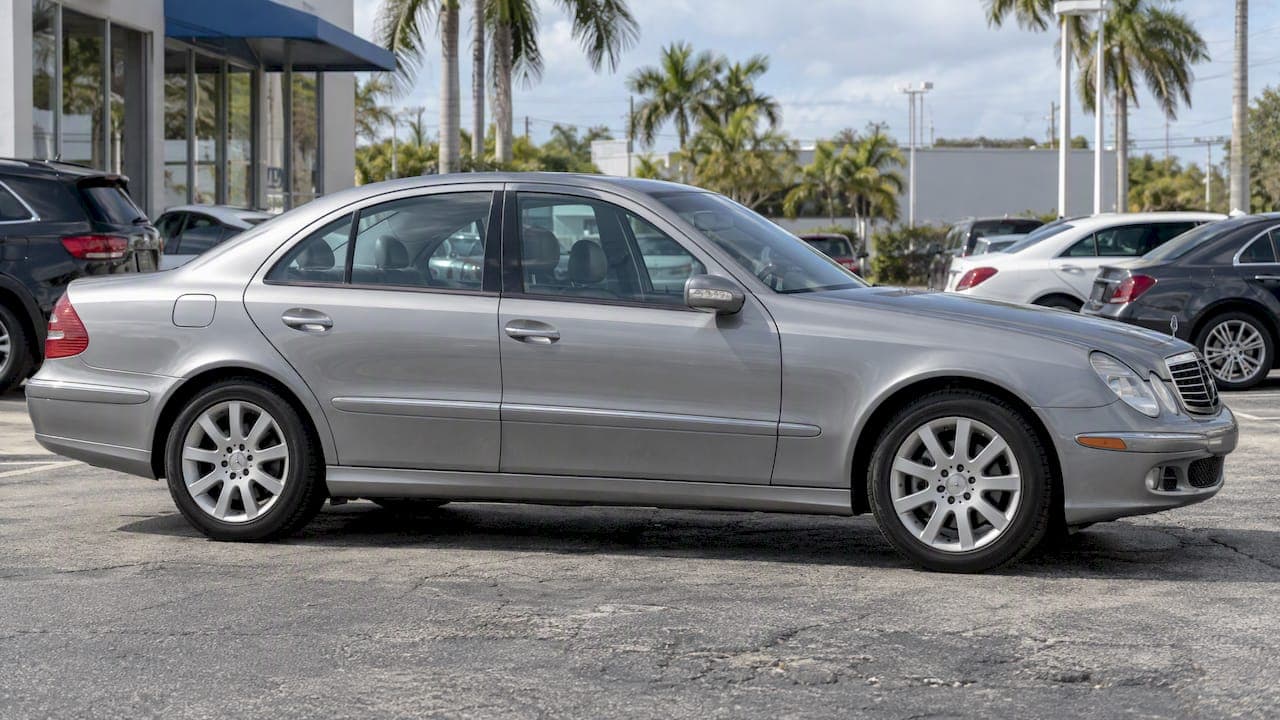
The Mercedes-Benz E-Class is generally a reasonable luxury sedan to own, but your experience hinges on model year, maintenance history, and options like air suspension. The 2003–2009 W211 generation carries the most risk, while later W212 years and recent W213 cars look safer. Before you fall for any car, run its VIN for open recalls and book a professional pre-purchase inspection.
TL;DR:
- Prioritize 2012 and 2015 W212s, plus 2020 and 2021 W213s; avoid early 2010 and 2011 W212s unless records document repairs.
- A complete invoice trail can outweigh the model year; look for transmission servicing, suspension work, cooling repairs, and repeated electrical faults.
- On a test drive, watch for harsh or delayed shifts, limp mode, a sagging corner, persistent warning lights, and a compressor that runs constantly.
- Have a technician scan stored codes, inspect control arm bushings and cooling components, and test transmission fluid condition and air suspension operation.
- Recent recalls have involved blank instrument panels after infotainment resets and misrouted transmission wiring; confirm completed remedies with dealer paperwork.
Table of Contents
- Which E-Class model years should you buy and which should you skip?
- How does reliability differ across E-Class generations?
- What are the common E-Class problems and what do repairs cost?
- What does it cost to keep an E-Class running?
- How do you check a used E-Class before you buy?
- Which recalls affect the E-Class and how do you confirm the fix?
- Our take on buying an E-Class
- How does our Car Finder reduce your risk when buying an E-Class?
- FAQ
- Sources
Which E-Class model years should you buy and which should you skip?
Repair-focused analyses that combine NHTSA complaint data, CarComplaints rankings, and owner-forum evidence name the W211 generation (2003–2009) as the weakest, mainly because of balance-shaft and early transmission problems. The same analyses point to 2012, 2015, 2020, and 2021 as widely regarded safer used buys when the paperwork backs them up. Here is how we would shortlist.
Years worth prioritizing:
- 2012: a later-run W212 year, after the first production batches exposed their early flaws.
- 2015: a mature W212 year, widely cited as a safer used pick.
- 2020 and 2021: W213 cars that draw fewer complaints in the owner-report analyses.
Years to approach with caution:
- 2003 to 2007 (W211): this is where the most serious faults concentrate, including balance-shaft trouble on certain V6 engines and early transmission problems.
- 2010 and 2011 (early W212): first-years of a new generation tend to carry transmission and airbag-related complications that were sorted out later.
Owner-complaint data tells the same story from another angle. ForCar's analysis puts the worst complaint peaks in the early 2000s, with 2003, 2004, and 2005 at the bottom, and notes that failures cluster around seven years of age. That timing matters for you: a car from a flagged year may now be well past its worst period if someone has already fixed the usual faults.
One caveat before you cross anything off your list. A flagged year with a complete, documented service history can still be a better purchase than a recommended year that has been neglected. Treat these rankings as a way to narrow your search, not as a replacement for inspecting the specific car in front of you.
How does reliability differ across E-Class generations?
Each generation has its own personality, and the ratings you read online do not always agree because they measure different things. Understanding both helps you avoid being misled by a single score.
W211 (2003–2009)
This is the generation that earned the E-Class its reputation for expensive surprises. Balance-shaft failures on the M272 and M273 engines, early transmission faults, and higher complaint rates all cluster here. The ForCar data lists fuel and propulsion, brakes, airbags, the electrical system, suspension, and the engine among the systems with high complaint counts in the early years. If you are tempted by a low price on a W211, assume you will be buying a project unless the records prove otherwise.

W212 (2010–2016)
Early W212 production brought transmission problems and airbag complications, including the wider Takata inflator issue that touched many brands. Later years improved after fixes reached the assembly line, which is why 2012 and 2015 keep appearing on recommended lists. Within this generation, the model year matters as much as the generation label itself.
W213 (2017–2023) and 2024 onward
Newer E-Classes lean on stronger mechanical reliability, but they add layers of electronics, sensors, and infotainment that give owners a different kind of headache. Consumer Reports' reliability page shows reliability history charts and recall listings, and its summary cites recent recalls for instrument-panel blanking tied to an infotainment control unit reset, plus transmission wiring-harness routing, in recent model years. Those are not engine or gearbox failures in the classic sense, but a blank display on the highway is still unsettling.
Why ratings and complaint data disagree
When you compare sources, remember what each one captures:
- J.D. Power publishes owner-survey quality and reliability ratings. The 2022 E-Class page reports 81 out of 100, and the 2020 model scored 83. Those ratings update each September, and a current-year rating may borrow from the previous model year when survey data is not yet available.
- Consumer Reports emphasizes predicted reliability and tracks recall history.
- Owner-complaint aggregates such as ForCar record problems over the whole life of a car, including failures that appear after the warranty ends.
A short-window owner survey rewards cars that rarely break early in ownership. A complaint aggregate captures what happens at year seven, when suspension parts wear out and electronics age. Both are true, and both are useful. J.D. Power also won't tell you much about the 2003 car sitting in a lot today, because that car's early-ownership window ended long ago.
Newer cars need a different kind of screening altogether. Early ownership data may surface software, infotainment, and sensor issues before anyone can measure long-term mechanical durability. That makes the VIN check for open campaigns especially important on anything recent.
The practical takeaway is to use ratings to shortlist model years, then let the inspection decide on the individual car. Expert reviewers agree on that point. The AA's E-Class review advises checking the full service history, transmission shift quality, warning lights, electronics, suspension, and brakes, and it notes that missed maintenance turns otherwise manageable issues into expensive ones.
What are the common E-Class problems and what do repairs cost?
Owner-survey aggregates tell a consistent story about where E-Classes tend to need attention. TrueDelta's owner-survey data lists suspension components, air-suspension faults on equipped cars, transmission hesitation when servicing is missed, electrical faults, and HVAC blower motor failures, along with brake wear, motor mounts, water pumps, thermostats, and sensors. Many of these show up in the non-engine category, so a catastrophic engine failure is not the typical complaint.
The systems that most often cause trouble:
- Suspension: worn control-arm bushings and joints produce clunks, vague steering, and uneven tire wear.
- Air suspension: compressor wear and leaking air springs show up as a sagging corner or a ride height that changes overnight.
- Transmission: on the 7G-Tronic automatic, conductor-plate and valve-body problems appear as harsh shifts, hesitation, or limp mode, particularly if fluid services were skipped.
- Electrical and infotainment: warning lights, sensor faults, and display glitches rank among the most frequent owner complaints.
- HVAC: blower motors wear out and cause weak airflow or noise.
- Engine, on affected years: the M272 and M273 balance-shaft issue sits at the expensive end of the list.
Symptoms to catch on the test drive
You do not need to be a mechanic to spot warning signs. Watch for limp mode, harsh or delayed shifts, a car that sits lower on one corner, dashboard warning lights that stay on, and unusual noises from the front end or engine bay. If an air-suspension car takes a long time to rise after startup, or you hear a compressor running constantly, ask hard questions. Our own guide to owner checks that catch Mercedes air suspension leaks walks through what to look for.
Suspension wear is easy to underestimate. A worn control-arm bushing often announces itself with a knock over bumps, and a simple jack check can confirm it. This guide to control arm bushing symptoms explains the five signs and how to check them with the car lifted.

Ballpark repair costs
Treat these as rough ranges and verify them with a quote from a shop you trust, because labor rates and parts vary:
- Minor electrical or HVAC repairs can vary widely in cost, so get a quote from a trusted shop.
- Replacing a suspension strut or air spring can be costly, so get a quote from a trusted shop.
- Balance-shaft engine repairs and major transmission failures can be expensive, depending on labor and parts.
Rebuilt components can soften the bill on some jobs. If a repair involves an alternator or starter, remanufactured alternators are rebuilt with new components and tested to OEM specifications, which can offer a cost-saving option over new parts.
Pro Tip: Ask whether the transmission fluid and filter service has been done on schedule, and have a technician test the air-suspension compressor during the inspection. Catching a tired compressor or neglected fluid early can head off a much larger bill later.
What does it cost to keep an E-Class running?
Mercedes keeps its maintenance schedule simple on paper. The brand's Service A and Service B visits alternate, generally every 10,000 to 15,000 miles or about once a year, depending on the model and how you drive. Skipping those visits is how small problems turn into big ones, which is the pattern the AA and TrueDelta both describe.
Luxury sedans cost more to maintain than mainstream sedans, and the E-Class is no exception. Parts carry premium pricing, specialist labor costs more per hour, and the electronics add diagnostic time. Some buyers consult RepairPal-style estimates of annual maintenance cost to set a baseline, but we would encourage you to look up the current figure for your exact year and engine rather than relying on a generic average.
When the big bills tend to arrive
Failures cluster around seven years of age in the owner-complaint data, and many reported problems show up as cars age. That affects how you buy. A 2012 or 2015 model sits squarely in or beyond that window, so you want proof that the age-related items have been dealt with: suspension parts, transmission service, cooling components, and any air-suspension work.
Choosing between a newer low-mileage car and an older documented one
This comes down to your tolerance for risk and how you plan to use the car.
- A later-model, low-mileage E-Class leaves you mostly exposed to electronics and software quirks, and recalls are the thing to verify. You also stay closer to any remaining warranty or certified pre-owned coverage.
- An older car with a thick folder of invoices can be a smart buy because the previous owner already paid for the expensive fixes. A neglected newer car can present several costly, age-related faults at once, which is why practitioners such as The Weekly Driver stress inspecting service history, gearbox shift quality, warning lights, electronics, suspension, brakes, and any air-suspension equipment.
Budget a repair cushion either way. Setting aside money for the first year of ownership turns a surprise repair into a planned expense.
How do you check a used E-Class before you buy?
Follow these steps in order. They screen out most problem cars before you spend money on an inspection.
- Run the VIN through NHTSA. Look for open recalls and confirm whether a dealer completed the remedy.
- Verify the service history. Ask for invoices, not just a stamped booklet. Our walkthrough on verifying service records explains how to separate real maintenance from a convenient story.
- Inspect and test drive the car. Start it cold, listen at idle, and cycle through the gears. Test acceleration and braking, check ride height, and run the HVAC and every infotainment function.
- Ask the right questions and collect documents. Request detailed invoices and, for M272 or M273 engines, the engine serial number so a specialist can verify whether the car falls in an affected range.
- Order a professional inspection. Have an independent technician examine the car, especially if anything on the earlier steps raised a flag.
What to look for in the records
- Gaps in service history, especially across several years.
- Missing transmission fluid and filter services.
- Air-suspension repairs or recent compressor replacement, which signal a car that has already had trouble.
- Repeated visits for the same warning light or electrical fault.
What to do on the test drive
- Listen for a compressor running too long or for noises that could point to balance-shaft or engine trouble.
- Feel for hesitation, harsh shifts, or the car dropping into limp mode.
- Press every button: seat controls, windows, navigation, the display, climate zones.
- Look for dashboard warning lights that stay lit after startup.
What a mechanic should cover
- A transmission scan and fluid condition check.
- Air-suspension leak and compressor test on equipped cars.
- Control-arm bushing, strut, and joint inspection.
- Full diagnostic scan for stored fault codes.
- Cooling system, water pump, and thermostat review.
For more on the process, our pre-owned luxury car inspection checklist and our piece on how to inspect a pre-owned luxury vehicle cover the on-car sequence in more detail.
Which recalls affect the E-Class and how do you confirm the fix?
Recalls are safety fixes that a dealer performs, usually at no cost to the owner. They are different from reliability complaints, which stay on your tab once the warranty ends. Both matter, but you handle them differently.
Recent recall categories include:
- Instrument panel blanking: an infotainment control unit reset that can leave the display blank.
- Transmission wiring harness routing: a harness that can be routed incorrectly in affected vehicles.
- Rear-axle structural welding: a manufacturing issue reported in some recalls, with remedies handled by the dealer.
Consumer Reports' recall listings for recent model years include the first two, along with remedy notes.
How to confirm the work was done:
- Enter the VIN at NHTSA.gov and read the open-recall result.
- Ask the seller for a recall completion letter or a dealer work order.
- Insist that open recalls be completed before you buy, or arrange for the dealer to perform them right after purchase.
- Keep the paperwork for future resale.
Our take on buying an E-Class
My advice is short: pay for documentation and a professional inspection before you pay for anything else. A well-documented older E-Class often beats a neglected newer one, because the records show you what the car has actually been through. If you want help finding a car, our Car Finder service exists for exactly that.
— Allen
How does our Car Finder reduce your risk when buying an E-Class?
Buying a used luxury sedan is easier when someone does the screening with you. Our Car Finder service is built around personalized vehicle searches for buyers who know the car they want but not where to find a good one.
Here is what we offer:
- A curated used-luxury inventory selected with an eye on elegance, craftsmanship, and quality.
- Personalized vehicle-finding help if the E-Class you want is not on our lot yet.
- Trade-in valuation and financing options, so the purchase process stays in one place.
- A dealership you can visit in person to see the car before you commit.
Ready to look? Browse our current cars for sale, narrow your search to sedans for sale, or contact us for a personalized search at Autovendorsfl. Tell us the model years you are considering, and we will help you find a car worth inspecting.
FAQ
What year is the most reliable E-Class?
No single year is perfect, but 2012, 2015, 2020, and 2021 are widely regarded as safer used buys when properly documented. A complete service history matters as much as the badge year.
Which E-Class years should I avoid buying?
Be most cautious with the W211 generation from 2003 to 2007 and the early W212 years of 2010 and 2011. Those years concentrate balance-shaft engine trouble, early transmission faults, and airbag complications, though a well-maintained example can still work.
Is the Mercedes E-Class reliable overall?
Reliability is conditional. J.D. Power's owner surveys show solid quality ratings, yet expensive age-related failures appear when maintenance has been neglected. Service history and inspection matter more than any generation ranking.
Is the E-Class more reliable than the Lexus ES?
The Lexus ES and E-Class offer different ownership experiences, and which one fits you depends on how much you value features versus simplicity. Either way, a documented, inspected car beats a neglected one.
What should I check first on a used E-Class?
Start with a VIN recall lookup on NHTSA.gov, then review the service invoices before you ever drive the car. If both look clean, book a professional pre-purchase inspection.
Sources
- 2022 Mercedes-Benz E-Class Reliability, Consumer Ratings & Pricing
- 2025 Mercedes-Benz E-Class Reliability - Consumer Reports
- Mercedes-Benz E-Class Reliability — Best and Worst Years by the Data | ForCar
- Mercedes-Benz E-Class years to avoid